Introduction
Catalog Management Software helps businesses organize, enrich, update, publish, and distribute product information across ecommerce stores, marketplaces, sales channels, retail systems, distributors, and internal teams. In simple words, it keeps product data clean, consistent, complete, and ready for selling.
A product catalog may include titles, descriptions, SKUs, categories, prices, images, videos, technical specifications, variants, inventory details, attributes, compliance documents, size charts, bundles, and channel-specific content. When this data is managed manually in spreadsheets, errors happen quickly. Product titles may be inconsistent, images may be outdated, specifications may be missing, and marketplace listings may fail.
Catalog management matters because customers expect accurate product information before buying. Sales teams need trusted product data. Ecommerce teams need clean listings. Marketplaces require correct attributes. Operations teams need SKU accuracy. A good catalog management tool helps centralize product information, improve data quality, reduce manual work, and publish product content faster.
Real-world use cases include:
- Managing large product catalogs across multiple channels
- Enriching product descriptions, images, and attributes
- Syncing product data to ecommerce stores and marketplaces
- Standardizing SKU, category, and variant information
- Supporting product launches and seasonal catalog updates
- Managing supplier product feeds and product onboarding
- Reducing listing errors and incomplete product pages
- Improving product discoverability and conversion
Buyers should evaluate:
- Product information management depth
- Catalog structure and attribute flexibility
- SKU, variant, and bundle handling
- Data import and export options
- Marketplace and ecommerce integrations
- Digital asset management support
- Workflow approvals and user permissions
- Data quality rules and validation
- Localization and multi-language support
- Bulk editing and automation features
- API and integration ecosystem
- Reporting, governance, and scalability
Best for: ecommerce brands, retailers, manufacturers, distributors, marketplaces, wholesalers, B2B sellers, DTC brands, product teams, merchandising teams, and companies managing many SKUs across multiple channels.
Not ideal for: very small stores with only a few simple products, businesses that sell only one product line, or teams that do not need multi-channel catalog control. In those cases, the built-in product catalog inside an ecommerce platform may be enough.
Key Trends in Catalog Management Software
- Product data quality is becoming a growth factor: Clean titles, accurate attributes, strong images, and complete specifications directly affect search visibility, customer trust, and conversion.
- PIM and catalog management are merging: Many businesses now want product information management, catalog workflows, digital assets, channel publishing, and data governance in one system.
- Marketplace requirements are getting stricter: Sellers must provide accurate categories, attributes, compliance fields, images, and variation structures to avoid listing errors.
- AI-assisted product content is growing: Teams are using AI to support product descriptions, attribute extraction, categorization, translation, and content improvement.
- Multi-channel publishing is essential: Product data must be adapted for ecommerce websites, marketplaces, social commerce, retail partners, distributors, and internal sales systems.
- Supplier data onboarding is a major need: Retailers and distributors need better ways to import, validate, clean, and approve product data from many suppliers.
- Digital asset management is more connected: Product images, videos, PDFs, manuals, and lifestyle photos are becoming part of catalog workflows.
- Localization is becoming more important: Global sellers need product content in multiple languages, currencies, units, and regional formats.
- Data governance is a priority: Businesses need approval workflows, role-based permissions, audit history, validation rules, and clear ownership of product data.
- Headless commerce increases catalog complexity: Businesses selling through multiple frontends need centralized product data that can be distributed through APIs.
How We Selected These Tools Methodology
The tools below were selected based on catalog management relevance, market recognition, product information management depth, integration capability, scalability, ease of use, and practical business fit.
- Catalog management depth: Product attributes, SKUs, variants, categories, bundles, and product families were considered.
- Product information management capability: Tools with strong PIM features, enrichment workflows, and product data governance were prioritized.
- Multi-channel publishing: Ecommerce, marketplace, retail, distributor, and API publishing workflows were evaluated.
- Data quality controls: Validation rules, required fields, completeness scoring, and error handling were considered.
- Digital asset support: Image, video, document, and product media workflows were reviewed.
- Workflow management: Approvals, roles, permissions, tasks, and audit trails were considered.
- Integration ecosystem: Ecommerce platforms, marketplaces, ERP, DAM, CRM, MDM, and data feeds were evaluated.
- Scalability: Tools for small businesses, mid-market companies, and enterprise catalog operations were included.
- Ease of use: User interface, onboarding, bulk editing, and non-technical team usability were reviewed.
- Practical buyer fit: The goal is not one universal winner, but a useful comparison based on product data complexity.
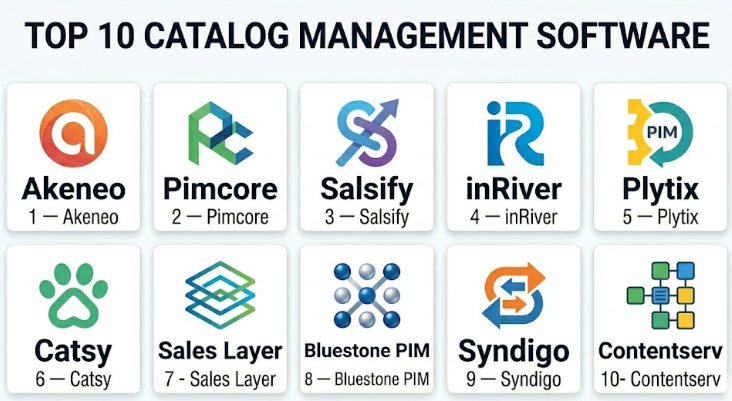
Top 10 Catalog Management Software
#1 — Akeneo
Short description :
Akeneo is a product information management and catalog management platform designed to help businesses centralize, enrich, and distribute product data across sales channels. It is widely used by retailers, manufacturers, distributors, and ecommerce businesses that need structured product data workflows. Akeneo helps teams manage product attributes, categories, variants, completeness rules, translations, and channel-specific product content. It is especially useful for businesses with large catalogs and multiple product contributors. Akeneo is a strong option for companies that want clean product data and scalable product experience management.
Key Features
- Product information management
- Catalog enrichment workflows
- Product attributes, families, and variants
- Data completeness tracking
- Multi-channel product publishing
- Localization and translation support
- Workflow and user role management
Pros
- Strong product data enrichment experience
- Good fit for multi-channel catalog teams
- Useful for retailers, manufacturers, and distributors
Cons
- Implementation requires product data planning
- May be more advanced than small stores need
- Integration setup can require technical support
Platforms / Deployment
Web
Cloud / Self-hosted options may vary by edition
Security & Compliance
Akeneo may handle product data, media assets, user permissions, workflow records, and channel publishing data. Specific certifications such as SOC 2, ISO 27001, GDPR, or other compliance details should be verified directly.
Not publicly stated.
Integrations & Ecosystem
Akeneo fits product data workflows across ecommerce, ERP, and marketplace systems.
- Ecommerce platforms
- ERP systems
- Marketplace connectors
- Digital asset systems
- Translation workflows
- API-based integrations
Support & Community
Akeneo has strong product information management community awareness and business support resources. It is best for teams that need structured catalog enrichment and multi-channel product data control.
#2 — Pimcore
Short description :
Pimcore is an open-source digital platform that includes product information management, master data management, digital asset management, and customer data capabilities. For catalog management, it helps businesses manage complex product data, product hierarchies, assets, variants, classifications, and channel distribution. Pimcore is especially useful for organizations that want flexible data modeling and strong customization. It is suitable for manufacturers, retailers, distributors, and enterprises with complex product information needs. Pimcore is a strong option when catalog management needs to connect with broader data and digital experience workflows.
Key Features
- Product information management
- Master data management capabilities
- Digital asset management
- Custom product data models
- Product hierarchy and classification support
- API and integration flexibility
- Workflow and user permissions
Pros
- Very flexible data modeling
- Useful for complex enterprise product data
- Combines PIM, DAM, and MDM-style capabilities
Cons
- Requires technical implementation expertise
- May be too complex for simple catalog needs
- Customization can increase project scope
Platforms / Deployment
Web
Cloud / Self-hosted / Hybrid depending on setup
Security & Compliance
Pimcore security depends on deployment, configuration, hosting, access controls, and implementation practices. Specific certifications and compliance details should be verified based on the selected deployment model.
Not publicly stated here for every setup.
Integrations & Ecosystem
Pimcore works well where catalog management connects with enterprise data and digital experience systems.
- Ecommerce platforms
- ERP and MDM systems
- DAM workflows
- APIs and custom applications
- Marketplace feeds
- Digital experience platforms
Support & Community
Pimcore has an open-source ecosystem and enterprise support options. It is best for organizations with technical teams or implementation partners.
#3 — Salsify
Short description :
Salsify is a product experience management platform that helps brands manage product content, digital shelf data, syndication, and retailer-specific product information. It is useful for consumer brands, manufacturers, ecommerce teams, and retailers that need to publish accurate product content across many commerce channels. Salsify helps teams manage product data, images, descriptions, attributes, channel requirements, and content readiness. It is especially strong for brands selling through retailers and marketplaces. Salsify is a strong option for businesses focused on digital shelf performance and product content syndication.
Key Features
- Product information management
- Product content syndication
- Digital shelf analytics support
- Retailer and marketplace content readiness
- Product data validation
- Digital asset management support
- Workflow and collaboration tools
Pros
- Strong for retail and marketplace product content
- Useful for brands managing digital shelf presence
- Good content syndication workflows
Cons
- May be more suitable for established brands
- Implementation requires clean product and channel data
- Pricing and scope should be reviewed carefully
Platforms / Deployment
Web
Cloud deployment
Security & Compliance
Salsify may process product data, retailer content requirements, digital assets, workflows, and performance signals. Specific certifications and compliance details should be verified directly.
Not publicly stated.
Integrations & Ecosystem
Salsify fits brands that need product content syndication and channel readiness.
- Retailer portals
- Marketplaces
- Ecommerce platforms
- Digital asset systems
- Product feed workflows
- Analytics and digital shelf systems
Support & Community
Salsify provides business-focused support and product experience resources. It is best for brands managing product content across many retail and marketplace destinations.
#4 — inRiver
Short description :
inRiver is a product information management platform designed to help businesses manage product data, enrich content, and distribute product information across customer-facing channels. It is useful for B2B and B2C companies that need structured catalog workflows, product enrichment, and channel publishing. inRiver supports product data modeling, media assets, workflows, product completeness, and sales channel delivery. It is especially useful for brands with complex product relationships and multiple selling channels. inRiver is a strong choice for organizations that want a user-friendly PIM focused on product content operations.
Key Features
- Product information management
- Product enrichment workflows
- Channel-specific content management
- Product completeness and quality controls
- Digital asset support
- Workflow and collaboration tools
- Data syndication and integrations
Pros
- Strong product content workflow support
- Good for B2B and B2C catalog teams
- Useful for complex product relationships
Cons
- Requires structured product data strategy
- May be too advanced for very small catalogs
- Integration planning is important
Platforms / Deployment
Web
Cloud deployment
Security & Compliance
inRiver may handle product data, digital assets, workflow data, user access, and channel publishing information. Specific certifications and compliance details should be verified directly.
Not publicly stated.
Integrations & Ecosystem
inRiver fits teams that need product data enrichment and distribution.
- Ecommerce platforms
- ERP systems
- DAM systems
- Marketplace feeds
- Sales channels
- API integrations
Support & Community
inRiver provides product information management support and business resources. It is best for teams needing structured product content workflows and channel publishing.
#5 — Plytix
Short description :
Plytix is a product information management and catalog management platform designed for small and mid-sized businesses that need a more approachable way to manage product data. It helps teams centralize product information, manage attributes, organize assets, create product sheets, and share catalog data with sales channels or partners. Plytix is especially useful for growing brands, distributors, and ecommerce teams moving away from spreadsheets. It focuses on making PIM easier for non-enterprise teams. Plytix is a strong option for businesses that need catalog control without heavy enterprise complexity.
Key Features
- Product information management
- Centralized catalog database
- Product attributes and variants
- Digital asset organization
- Product sheets and catalog sharing
- Team collaboration tools
- Import and export workflows
Pros
- Good for small and mid-sized businesses
- Easier learning curve than many enterprise PIM tools
- Useful for replacing spreadsheet-based catalog management
Cons
- May not fit very complex enterprise workflows
- Advanced syndication needs should be validated
- Some integrations may require setup work
Platforms / Deployment
Web
Cloud deployment
Security & Compliance
Plytix may process product data, images, documents, team access, and catalog exports. Specific certifications and compliance details should be verified directly.
Not publicly stated.
Integrations & Ecosystem
Plytix fits growing businesses that need practical catalog organization.
- Ecommerce platforms
- Product sheets
- Digital assets
- Distributor data sharing
- CSV import and export
- Sales team workflows
Support & Community
Plytix provides business-friendly support and onboarding resources. It is best for teams that want a simpler PIM experience.
#6 — Catsy
Short description :
Catsy is a product information management and digital asset management platform focused on helping manufacturers, distributors, and ecommerce teams manage product content and publish catalogs. It combines product data management, digital asset organization, and catalog publishing tools. Catsy is useful for companies that need to manage product specifications, images, documents, and channel-ready catalogs. It is especially relevant for B2B product businesses where product data must be shared with sales teams, dealers, distributors, and ecommerce channels. Catsy is a strong option for businesses that need catalog publishing and PIM together.
Key Features
- Product information management
- Digital asset management
- Catalog publishing tools
- Product specification management
- Data sharing workflows
- Channel content distribution
- Sales and distributor catalog support
Pros
- Combines PIM and DAM capabilities
- Good for manufacturers and distributors
- Useful for product catalog publishing workflows
Cons
- May be more B2B-focused than some ecommerce teams need
- Integration needs should be reviewed carefully
- Advanced automation may depend on setup
Platforms / Deployment
Web
Cloud deployment
Security & Compliance
Catsy may handle product data, product media, documents, catalogs, user access, and channel exports. Specific compliance and security details should be verified directly.
Not publicly stated.
Integrations & Ecosystem
Catsy fits businesses that need product content and assets distributed across teams and channels.
- Ecommerce platforms
- Sales portals
- Distributor workflows
- Digital asset libraries
- Catalog publishing
- Product data exports
Support & Community
Catsy provides product content and catalog-focused support resources. It is best for manufacturers and distributors managing rich product catalogs.
#7 — Sales Layer
Short description :
Sales Layer is a product information management platform that helps businesses centralize, clean, enrich, and distribute product information across ecommerce, marketplaces, sales channels, and internal systems. It is useful for brands, manufacturers, distributors, and retailers that want faster catalog updates and cleaner product data. Sales Layer supports product attributes, categories, digital assets, workflows, quality checks, and channel-ready exports. It is especially useful for teams that want to improve catalog speed and reduce product data errors. Sales Layer is a strong option for businesses looking for practical PIM with channel distribution.
Key Features
- Product information management
- Catalog data centralization
- Product data quality checks
- Digital asset support
- Multi-channel product publishing
- Team collaboration workflows
- API and connector options
Pros
- Good for improving catalog update speed
- Useful product data quality workflows
- Strong fit for brands and distributors
Cons
- Implementation requires data cleanup
- Channel-specific needs should be validated
- May be more than very small sellers need
Platforms / Deployment
Web
Cloud deployment
Security & Compliance
Sales Layer may process product data, media assets, workflows, user permissions, and channel data exports. Specific security and compliance details should be verified directly.
Not publicly stated.
Integrations & Ecosystem
Sales Layer fits teams that need product data distribution across commerce systems.
- Ecommerce platforms
- ERP systems
- Marketplace feeds
- APIs and connectors
- Product data exports
- Digital asset workflows
Support & Community
Sales Layer provides PIM-focused support and onboarding resources. It is best for businesses that want faster and cleaner product catalog operations.
#8 — Bluestone PIM
Short description :
Bluestone PIM is a product information management platform designed for businesses that need modern, API-first catalog management and product data distribution. It helps teams manage product content, attributes, relationships, assets, and channel-ready information. Bluestone PIM is especially useful for companies using headless commerce, composable commerce, or API-driven digital architecture. It supports product data centralization and flexible distribution to multiple channels. Bluestone PIM is a strong option for teams that want a modern PIM approach with integration flexibility.
Key Features
- Product information management
- API-first product data distribution
- Product attributes and relationships
- Catalog enrichment workflows
- Digital asset support
- Multi-channel content delivery
- Composable commerce alignment
Pros
- Strong fit for API-first commerce architecture
- Useful for headless and composable commerce teams
- Flexible product data distribution
Cons
- May require technical implementation resources
- Not always necessary for simple ecommerce stores
- Integration planning is important
Platforms / Deployment
Web / API
Cloud deployment
Security & Compliance
Bluestone PIM may process product data, media assets, API data, user permissions, and catalog workflows. Specific certifications and compliance details should be verified directly.
Not publicly stated.
Integrations & Ecosystem
Bluestone PIM fits modern commerce architectures and API-led catalog workflows.
- Headless commerce platforms
- Ecommerce systems
- APIs and middleware
- Digital asset systems
- ERP workflows
- Marketplace publishing
Support & Community
Bluestone PIM provides support for product data and composable commerce projects. It is best for teams with modern digital commerce architecture needs.
#9 — Syndigo
Short description :
Syndigo is a product content and data management platform focused on product information, content syndication, data governance, and digital shelf requirements. It is useful for brands, retailers, manufacturers, distributors, and CPG companies that need to manage and distribute accurate product content across many retail and commerce destinations. Syndigo supports product data, rich content, compliance information, and channel-specific requirements. It is especially relevant for businesses that must meet retailer content standards and improve product content consistency. Syndigo is a strong option for product content syndication and retail data management.
Key Features
- Product content management
- Data syndication to retail channels
- Product information governance
- Rich content and media support
- Data quality and validation workflows
- Compliance and attribute management
- Digital shelf content support
Pros
- Strong retail and CPG product content workflows
- Useful for syndicating product data to many channels
- Good for brands with retailer content requirements
Cons
- May be too enterprise-focused for small sellers
- Setup requires structured product data
- Pricing and syndication scope should be reviewed
Platforms / Deployment
Web
Cloud deployment
Security & Compliance
Syndigo may handle product content, compliance data, media assets, channel requirements, and retailer syndication workflows. Specific security and compliance details should be verified directly.
Not publicly stated.
Integrations & Ecosystem
Syndigo fits retail product content and syndication workflows.
- Retailer networks
- Ecommerce platforms
- Product content feeds
- Digital shelf systems
- CPG content workflows
- Data governance tools
Support & Community
Syndigo provides business and enterprise-focused support. It is best for brands and retailers with large product content syndication needs.
#10 — Contentserv
Short description :
Contentserv is a product experience and product information management platform designed to help businesses manage product data, marketing content, digital assets, and channel-ready product experiences. It is useful for retailers, manufacturers, brands, and distributors that need centralized product content and enrichment workflows. Contentserv helps teams manage attributes, classifications, localization, digital assets, workflows, and product experiences across channels. It is especially relevant for companies with complex product content and global commerce needs. Contentserv is a strong option for businesses that want product data management with marketing and experience workflows.
Key Features
- Product information management
- Product experience management
- Digital asset support
- Catalog enrichment workflows
- Localization and channel content support
- Workflow and approval management
- Data quality and governance features
Pros
- Strong for product experience management
- Useful for global catalog and content teams
- Good combination of product data and marketing content workflows
Cons
- May be too advanced for simple catalog needs
- Implementation requires planning and data governance
- Pricing and scope should be reviewed carefully
Platforms / Deployment
Web
Cloud deployment
Security & Compliance
Contentserv may process product data, digital assets, marketing content, workflows, user roles, and channel distribution data. Specific certifications and compliance details should be verified directly.
Not publicly stated.
Integrations & Ecosystem
Contentserv fits product experience and catalog management workflows.
- Ecommerce platforms
- ERP systems
- DAM systems
- Marketplace feeds
- Marketing content workflows
- Localization systems
Support & Community
Contentserv provides business-focused support for product experience and catalog management. It is best for organizations with complex product data and marketing content needs.
Comparison Table Top 10
| Tool Name | Best For | Platform(s) Supported | Deployment | Standout Feature | Public Rating |
|---|---|---|---|---|---|
| Akeneo | Multi-channel product catalog enrichment | Web | Cloud / Self-hosted options vary | Product enrichment and completeness workflows | N/A |
| Pimcore | Flexible PIM, DAM, and MDM-style catalog management | Web | Cloud / Self-hosted / Hybrid | Highly flexible product data modeling | N/A |
| Salsify | Retail product content syndication | Web | Cloud | Digital shelf and product content syndication | N/A |
| inRiver | B2B and B2C product content operations | Web | Cloud | Product enrichment and channel distribution | N/A |
| Plytix | Small and mid-sized catalog teams | Web | Cloud | Easy PIM for growing businesses | N/A |
| Catsy | Manufacturers and distributors | Web | Cloud | PIM plus DAM and catalog publishing | N/A |
| Sales Layer | Faster product data updates and channel exports | Web | Cloud | Product data quality and distribution | N/A |
| Bluestone PIM | API-first and headless commerce teams | Web, API | Cloud | Composable commerce-ready PIM | N/A |
| Syndigo | Retail and CPG product content syndication | Web | Cloud | Retail content governance and syndication | N/A |
| Contentserv | Global product experience management | Web | Cloud | Product data plus marketing content workflows | N/A |
Evaluation & Catalog Management Software
| Tool Name | Core 25% | Ease 15% | Integrations 15% | Security 10% | Performance 10% | Support 10% | Value 15% | Weighted Total 0–10 |
|---|---|---|---|---|---|---|---|---|
| Akeneo | 9.2 | 8.0 | 8.8 | 8.3 | 8.7 | 8.4 | 8.0 | 8.52 |
| Pimcore | 9.3 | 7.2 | 9.2 | 8.2 | 8.7 | 8.0 | 8.3 | 8.49 |
| Salsify | 9.0 | 7.8 | 8.8 | 8.4 | 8.7 | 8.4 | 7.8 | 8.42 |
| inRiver | 8.8 | 8.0 | 8.5 | 8.3 | 8.5 | 8.3 | 8.0 | 8.36 |
| Plytix | 8.2 | 8.8 | 7.8 | 8.0 | 8.2 | 8.2 | 8.5 | 8.25 |
| Catsy | 8.4 | 8.2 | 8.0 | 8.0 | 8.3 | 8.2 | 8.2 | 8.20 |
| Sales Layer | 8.5 | 8.4 | 8.2 | 8.0 | 8.4 | 8.2 | 8.3 | 8.30 |
| Bluestone PIM | 8.7 | 7.8 | 9.0 | 8.3 | 8.6 | 8.2 | 8.0 | 8.39 |
| Syndigo | 9.0 | 7.6 | 8.8 | 8.4 | 8.7 | 8.4 | 7.6 | 8.38 |
| Contentserv | 8.8 | 7.8 | 8.6 | 8.3 | 8.6 | 8.3 | 7.8 | 8.32 |
These scores are comparative and should be used as a starting point. A growing business moving away from spreadsheets may rate Plytix, Sales Layer, or Catsy higher because usability matters. A large retailer or manufacturer may prefer Akeneo, inRiver, Contentserv, or Pimcore. Brands focused on retail syndication may prefer Salsify or Syndigo. Teams using headless commerce may rate Bluestone PIM higher because API-first distribution matters.
Which Catalog Management Software Should You Choose?
Solo / Small Business
A solo seller or small business may not need a dedicated catalog management platform at first. If the product catalog is small and only sold on one store, the built-in ecommerce product manager may be enough.
When spreadsheets become messy or product updates become slow, tools like Plytix, Sales Layer, or Catsy can be useful starting points.
Small Ecommerce Brand
Small ecommerce brands should focus on product data accuracy, images, variants, descriptions, and channel exports. Plytix, Sales Layer, Akeneo, and Catsy are good tools to compare.
The priority should be reducing product errors, improving product page completeness, and making catalog updates faster.
Mid-Market Business
Mid-market companies often manage more SKUs, more product attributes, more teams, and more channels. Akeneo, inRiver, Sales Layer, Pimcore, and Contentserv can be strong options depending on data complexity.
At this stage, businesses should define product data ownership, approval workflows, category structures, and channel requirements before implementation.
Manufacturer or Distributor
Manufacturers and distributors need detailed specifications, technical documents, product relationships, dealer catalogs, and B2B data sharing. Catsy, Pimcore, Akeneo, inRiver, and Contentserv are strong options to evaluate.
For B2B catalog management, technical accuracy matters as much as marketing content.
Retailer or CPG Brand
Retail and CPG brands often need product content syndication to many channels and retailer portals. Salsify, Syndigo, Akeneo, and Contentserv are strong options.
These businesses should focus on retailer requirements, product content completeness, rich media, compliance fields, and digital shelf readiness.
Enterprise
Enterprise teams need strong governance, integrations, permissions, data quality rules, workflows, localization, and scalability. Pimcore, Akeneo, Salsify, Syndigo, inRiver, and Contentserv are strong platforms to compare.
Enterprise buyers should involve ecommerce, product, merchandising, IT, marketing, legal, operations, and data governance teams.
Budget vs Premium
Budget-focused teams should first clean product data and define catalog standards before buying software. A simpler PIM can be enough if catalog complexity is moderate.
Premium platforms are worth considering when businesses manage large catalogs, many markets, many channels, multiple teams, compliance data, and frequent product launches.
Feature Depth vs Ease of Use
Plytix is easier for smaller teams. Akeneo and inRiver provide strong product enrichment workflows. Pimcore is highly flexible but more technical. Salsify and Syndigo are strong for product content syndication. Bluestone PIM is better for API-first commerce. Contentserv is strong for product experience workflows.
The best choice depends on whether the main problem is product data cleanup, channel syndication, digital assets, headless commerce, supplier onboarding, or global product governance.
Integrations & Scalability
Catalog management software may need to connect with ERP systems, ecommerce platforms, marketplaces, DAM systems, supplier portals, translation tools, MDM systems, CRM systems, data warehouses, and product feed tools.
Scalability means handling more SKUs, more attributes, more languages, more channels, more contributors, more approvals, and more product updates without losing data quality.
Security & Compliance Needs
Catalog tools may store product data, pricing, supplier files, unpublished product launches, images, manuals, compliance documents, and channel credentials. Buyers should review user permissions, audit logs, encryption, data retention, access controls, and integration security.
Businesses in regulated industries should also manage compliance fields, documentation, product safety data, certifications, and approval workflows carefully.
Frequently Asked Questions FAQs
1. What is Catalog Management Software?
Catalog Management Software helps businesses organize, enrich, update, and distribute product information across ecommerce stores, marketplaces, sales channels, and internal teams.
2. How is catalog management different from PIM?
Catalog management focuses on organizing and publishing product catalogs. PIM, or product information management, is broader and usually includes product data governance, enrichment workflows, attributes, localization, and channel distribution.
3. Who needs catalog management software?
Retailers, manufacturers, distributors, ecommerce brands, marketplaces, wholesalers, and B2B sellers need catalog management software when product data becomes too complex for spreadsheets or native ecommerce tools.
4. What features should I look for first?
Start with product attributes, variants, categories, bulk editing, digital assets, data validation, workflow approvals, channel exports, integrations, and user permissions.
5. Which tool is best for small businesses?
Plytix, Sales Layer, and Catsy are useful options for small and mid-sized teams that need better catalog management without heavy enterprise complexity.
6. Which tool is best for enterprise catalog management?
Akeneo, Pimcore, Salsify, Syndigo, inRiver, and Contentserv are strong options for enterprise catalog management depending on data complexity, integrations, and syndication needs.
7. Which tool is best for retail product syndication?
Salsify and Syndigo are strong options for retail product content syndication. They are useful when brands need to publish accurate product content to many retailer and marketplace destinations.
8. Which tool is best for headless commerce?
Bluestone PIM and Pimcore are strong options for API-first and composable commerce environments. They are useful when product data must be delivered to multiple frontends and systems.
9. What are common catalog management mistakes?
Common mistakes include unclear product ownership, inconsistent SKU naming, missing attributes, poor image governance, no approval workflow, weak category structure, and relying on spreadsheets too long.
10. Can catalog management software improve ecommerce conversion?
Yes. Better product titles, complete descriptions, accurate specifications, high-quality images, and clean attributes can improve customer trust, search visibility, and buying confidence.
Conclusion
Catalog Management Software helps businesses create cleaner, more accurate, and more scalable product data workflows. The right platform can reduce spreadsheet chaos, improve product content quality, support multi-channel selling, and make product launches faster. Akeneo is strong for product enrichment and PIM workflows. Pimcore is powerful for flexible product data modeling and broader data management. Salsify and Syndigo are strong for retail product content syndication. inRiver and Contentserv are useful for product experience and channel distribution. Plytix, Catsy, and Sales Layer are practical for growing teams that need easier catalog control. Bluestone PIM is a strong option for API-first and headless commerce teams.
