Introduction
AI Safety & Evaluation Tools are platforms designed to test, monitor, and improve the behavior of AI systems—especially large language models (LLMs) and generative AI applications. In simple terms, they help teams ensure that AI outputs are accurate, safe, unbiased, and aligned with business goals before and after deployment.
As AI adoption accelerates, especially in enterprise workflows, customer-facing apps, and automation pipelines, the risks have also increased—hallucinations, harmful outputs, data leakage, and compliance issues. This is why AI safety is no longer optional; it’s becoming a core engineering and governance function.
Real-world use cases:
- Validating chatbot responses before production deployment
- Detecting hallucinations in AI-generated content
- Ensuring compliance with privacy and regulatory standards
- Monitoring model drift and performance over time
- Red-teaming AI systems for vulnerabilities
What buyers should evaluate:
- Coverage of evaluation types (toxicity, bias, accuracy, robustness)
- Automation vs manual testing capabilities
- Integration with ML pipelines and APIs
- Real-time monitoring vs batch evaluation
- Security and compliance support
- Customizability of evaluation metrics
- Scalability for large AI workloads
- Reporting and observability dashboards
Best for: AI engineers, ML teams, DevOps/SRE teams, product managers, compliance teams, and enterprises deploying AI at scale.
Not ideal for: Small teams not using AI in production, or companies using only basic automation tools without AI-driven workflows.
Key Trends in AI Safety & Evaluation Tools
- Shift from offline testing to continuous AI monitoring in production
- Rise of automated red-teaming frameworks for LLM security
- Increasing demand for compliance-ready AI governance tools
- Integration with MLOps and DevOps pipelines
- Focus on hallucination detection and mitigation
- Emergence of AI observability platforms
- Support for multi-model evaluation (OpenAI, open-source, custom models)
- Growing adoption of human-in-the-loop evaluation workflows
- Expansion of AI risk scoring and reporting dashboards
- Pricing evolving toward usage-based and API-based models
How We Selected These Tools (Methodology)
- Evaluated tools with strong market adoption and developer mindshare
- Assessed feature completeness across safety, evaluation, and monitoring
- Reviewed performance and reliability indicators
- Considered security and compliance capabilities
- Checked integration ecosystem (APIs, ML tools, CI/CD)
- Ensured coverage across enterprise, SMB, and developer-first tools
- Balanced between commercial and open-source platforms
- Focused on tools actively evolving with modern AI trends
- Prioritized tools with real-world deployment use cases
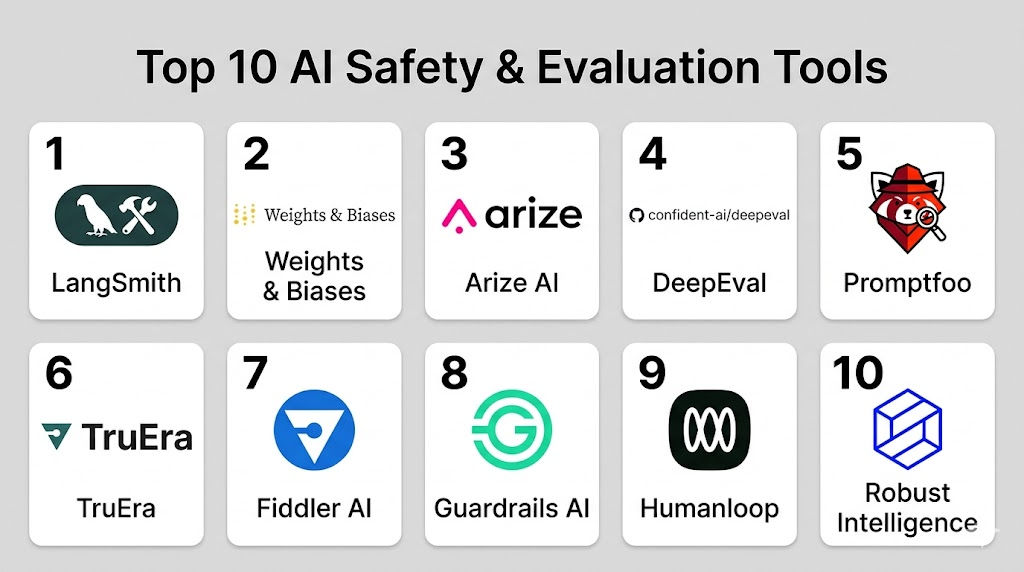
Top 10 AI Safety & Evaluation Tools
#1 — LangSmith
Short description: A developer-focused platform for debugging, testing, and evaluating LLM applications. Ideal for teams building production AI apps.
Key Features
- LLM tracing and debugging
- Dataset-based evaluation workflows
- Prompt versioning and testing
- Real-time observability
- Experiment tracking
- Performance metrics
Pros
- Strong developer tooling
- Seamless integration with LangChain ecosystem
Cons
- Limited governance features
- Requires technical setup
Platforms / Deployment
Cloud
Security & Compliance
Not publicly stated
Integrations & Ecosystem
Integrates deeply with LangChain and API-based AI tools.
- OpenAI-compatible APIs
- Custom LLM integrations
- SDK-based extensibility
Support & Community
Strong developer community and documentation.
#2 — Weights & Biases (W&B)
Short description: A popular ML experimentation and evaluation platform extended for LLM evaluation and monitoring.
Key Features
- Experiment tracking
- Model evaluation dashboards
- Dataset versioning
- Collaboration tools
- Visualization tools
Pros
- Mature platform
- Strong visualization capabilities
Cons
- Can be complex for beginners
- Pricing varies
Platforms / Deployment
Cloud / Self-hosted
Security & Compliance
Not publicly stated
Integrations & Ecosystem
Works across ML frameworks.
- PyTorch, TensorFlow
- APIs and SDKs
- CI/CD integrations
Support & Community
Strong community and enterprise support.
#3 — Arize AI
Short description: AI observability platform focused on monitoring, debugging, and evaluating ML and LLM systems.
Key Features
- Model monitoring
- Drift detection
- LLM evaluation tools
- Explainability features
- Alerting system
Pros
- Strong observability
- Enterprise-ready
Cons
- Requires setup effort
- Pricing varies
Platforms / Deployment
Cloud
Security & Compliance
Not publicly stated
Integrations & Ecosystem
Supports ML pipelines and APIs.
- Data platforms
- ML frameworks
- API integrations
Support & Community
Enterprise-level support.
#4 — DeepEval
Short description: Open-source evaluation framework for testing LLM applications with customizable metrics.
Key Features
- Automated evaluation pipelines
- Custom metrics support
- Test case generation
- LLM benchmarking
- Integration with CI pipelines
Pros
- Open-source flexibility
- Lightweight
Cons
- Limited enterprise features
- Requires coding knowledge
Platforms / Deployment
Self-hosted
Security & Compliance
Not publicly stated
Integrations & Ecosystem
Developer-focused integrations.
- Python-based workflows
- API extensibility
Support & Community
Growing open-source community.
#5 — Promptfoo
Short description: A testing and evaluation tool for prompt engineering and LLM outputs.
Key Features
- Prompt testing framework
- Regression testing
- Multi-model comparison
- CLI-based workflows
- YAML configurations
Pros
- Simple to use
- Great for prompt testing
Cons
- Limited monitoring features
- Developer-centric
Platforms / Deployment
CLI / Self-hosted
Security & Compliance
Not publicly stated
Integrations & Ecosystem
- OpenAI and LLM APIs
- CI/CD pipelines
Support & Community
Active GitHub community.
#6 — TruEra
Short description: Enterprise-grade AI quality and explainability platform.
Key Features
- Model explainability
- Bias detection
- Performance monitoring
- Governance tools
- LLM evaluation support
Pros
- Strong compliance focus
- Enterprise-ready
Cons
- Complex setup
- Premium pricing
Platforms / Deployment
Cloud / Hybrid
Security & Compliance
Not publicly stated
Integrations & Ecosystem
- ML pipelines
- Enterprise systems
- APIs
Support & Community
Enterprise support.
#7 — Fiddler AI
Short description: AI monitoring and explainability platform with strong governance capabilities.
Key Features
- Model monitoring
- Bias detection
- Explainability
- LLM observability
- Alerts and dashboards
Pros
- Strong governance tools
- Good UI
Cons
- Pricing may be high
- Requires integration effort
Platforms / Deployment
Cloud
Security & Compliance
Not publicly stated
Integrations & Ecosystem
- ML frameworks
- APIs
- Data pipelines
Support & Community
Enterprise support available.
#8 — Guardrails AI
Short description: Framework for enforcing constraints and validation rules on LLM outputs.
Key Features
- Output validation
- Schema enforcement
- Guardrail policies
- LLM safety checks
- Custom validators
Pros
- Strong safety enforcement
- Flexible
Cons
- Developer-focused
- Limited UI
Platforms / Deployment
Self-hosted / API
Security & Compliance
Not publicly stated
Integrations & Ecosystem
- Python SDK
- LLM APIs
Support & Community
Active developer community.
#9 — Humanloop
Short description: Platform for human-in-the-loop evaluation and feedback for AI systems.
Key Features
- Feedback loops
- Evaluation datasets
- Annotation tools
- Prompt iteration
- Experiment tracking
Pros
- Great for human evaluation
- Easy UI
Cons
- Limited automation
- Pricing varies
Platforms / Deployment
Cloud
Security & Compliance
Not publicly stated
Integrations & Ecosystem
- API integrations
- Data workflows
Support & Community
Growing adoption.
#10 — Robust Intelligence
Short description: AI risk and security platform focused on testing and protecting ML systems.
Key Features
- AI vulnerability testing
- Red teaming
- Security validation
- Risk scoring
- Compliance tools
Pros
- Strong security focus
- Enterprise-grade
Cons
- Premium pricing
- Complex deployment
Platforms / Deployment
Cloud / Hybrid
Security & Compliance
Not publicly stated
Integrations & Ecosystem
- Enterprise AI systems
- APIs
Support & Community
Enterprise support.
Comparison Table (Top 10)
| Tool Name | Best For | Platform(s) Supported | Deployment | Standout Feature | Public Rating |
|---|---|---|---|---|---|
| LangSmith | LLM debugging | Web | Cloud | LLM tracing | N/A |
| Weights & Biases | ML evaluation | Web | Cloud/Self-hosted | Experiment tracking | N/A |
| Arize AI | Observability | Web | Cloud | Drift detection | N/A |
| DeepEval | Open-source testing | Linux/macOS | Self-hosted | Custom metrics | N/A |
| Promptfoo | Prompt testing | CLI | Self-hosted | Regression testing | N/A |
| TruEra | Enterprise AI quality | Web | Cloud/Hybrid | Explainability | N/A |
| Fiddler AI | Governance | Web | Cloud | Bias detection | N/A |
| Guardrails AI | Output validation | API | Self-hosted | Schema enforcement | N/A |
| Humanloop | Human feedback | Web | Cloud | Human-in-loop | N/A |
| Robust Intelligence | AI security | Web | Cloud/Hybrid | Red teaming | N/A |
Evaluation & Scoring of AI Safety & Evaluation Tools
| Tool Name | Core (25%) | Ease (15%) | Integrations (15%) | Security (10%) | Performance (10%) | Support (10%) | Value (15%) | Weighted Total |
|---|---|---|---|---|---|---|---|---|
| LangSmith | 9 | 8 | 9 | 7 | 9 | 8 | 8 | 8.4 |
| W&B | 9 | 7 | 9 | 7 | 9 | 9 | 7 | 8.3 |
| Arize AI | 9 | 7 | 8 | 8 | 9 | 8 | 7 | 8.2 |
| DeepEval | 7 | 6 | 7 | 6 | 7 | 6 | 9 | 7.0 |
| Promptfoo | 7 | 8 | 7 | 6 | 7 | 7 | 9 | 7.5 |
| TruEra | 9 | 6 | 8 | 9 | 8 | 8 | 6 | 8.0 |
| Fiddler AI | 8 | 7 | 8 | 8 | 8 | 8 | 7 | 7.9 |
| Guardrails AI | 8 | 7 | 7 | 7 | 7 | 7 | 8 | 7.6 |
| Humanloop | 7 | 8 | 7 | 6 | 7 | 7 | 7 | 7.3 |
| Robust Intelligence | 9 | 6 | 7 | 9 | 8 | 8 | 6 | 7.9 |
How to interpret scores:
- Scores are relative comparisons, not absolute benchmarks
- Higher scores indicate stronger overall capability
- Enterprise tools often score higher in security but lower in ease
- Open-source tools may score lower in support but higher in value
- Choose based on your specific needs, not just total score
Which AI Safety & Evaluation Tools for You?
Solo / Freelancer
- Best: Promptfoo, Guardrails AI
- Focus on simplicity and low cost
SMB
- Best: LangSmith, Humanloop
- Balance between usability and features
Mid-Market
- Best: Arize AI, Fiddler AI
- Focus on monitoring and governance
Enterprise
- Best: TruEra, Robust Intelligence
- Strong compliance and security required
Budget vs Premium
- Budget: DeepEval, Promptfoo
- Premium: TruEra, Robust Intelligence
Feature Depth vs Ease of Use
- Deep features: Arize AI, TruEra
- Easy to use: Humanloop, Promptfoo
Integrations & Scalability
- Strong integrations: W&B, LangSmith
- Scalable: Arize AI, Fiddler AI
Security & Compliance Needs
- High security: Robust Intelligence, TruEra
- Moderate: LangSmith, Arize AI
Frequently Asked Questions (FAQs)
What are AI Safety tools used for?
They help test, monitor, and control AI outputs to ensure safety, accuracy, and compliance.
Are these tools only for large companies?
No, many tools support small teams and developers as well.
Do I need coding skills?
Some tools require coding, while others offer UI-based workflows.
How much do these tools cost?
Pricing varies widely from free open-source to enterprise-level subscriptions.
Can these tools detect hallucinations?
Yes, many tools include hallucination detection features.
Are they secure?
Security depends on the tool; always verify compliance requirements.
Can I integrate them with my pipeline?
Most tools support API and CI/CD integrations.
What is AI observability?
It refers to monitoring AI system performance and behavior in production.
How long does implementation take?
From a few hours (simple tools) to weeks (enterprise platforms).
Can I switch tools later?
Yes, but migration effort depends on integration complexity.
Conclusion
AI Safety & Evaluation Tools are becoming a critical part of modern AI development and deployment. As organizations increasingly rely on AI for decision-making, automation, and customer interactions, the need to ensure safe, reliable, and compliant outputs is growing rapidly. These tools help teams detect risks early, improve model performance, and maintain trust in AI systems. However, there is no single “best” tool for everyone. The right choice depends on your use case, team size, technical expertise, and compliance requirements. A startup may prefer lightweight tools like Promptfoo or Guardrails AI, while enterprises may require robust platforms like TruEra or Robust Intelligence.
