Introduction
AI Governance & Policy Tools are platforms designed to help organizations manage, monitor, and control how artificial intelligence systems are developed and used. These tools ensure that AI systems follow defined policies related to ethics, compliance, security, risk management, and accountability.
In the modern AI landscape, especially with the rapid adoption of generative AI and autonomous systems, governance is no longer optional. Organizations must ensure transparency, fairness, and compliance with evolving regulations. Without proper governance, AI can introduce risks such as bias, data leakage, regulatory violations, and reputational damage.
Real-world use cases include:
- Monitoring AI models for bias and fairness
- Enforcing data privacy and regulatory compliance
- Managing AI model lifecycle and approvals
- Auditing AI decisions and outputs
- Implementing enterprise AI risk management frameworks
What buyers should evaluate:
- Policy enforcement capabilities
- Model monitoring and explainability
- Risk management and audit trails
- Integration with AI/ML pipelines
- Data governance features
- Security and compliance standards
- Scalability across teams and systems
- Ease of implementation and usability
- Reporting and analytics
- Vendor support and ecosystem
Best for: Enterprises, regulated industries (finance, healthcare), AI teams, compliance officers, and organizations deploying AI at scale.
Not ideal for: Small teams or individuals experimenting with AI casually; basic governance processes may be handled manually or with lightweight tools.
Key Trends in AI Governance & Policy Tools
- Strong push toward Responsible AI frameworks and ethical AI standards
- Increasing adoption of automated compliance monitoring
- Integration with AI lifecycle management platforms (MLOps)
- Growth of explainability and model transparency tools
- Rise of real-time AI risk detection systems
- Focus on data privacy and regulatory alignment (GDPR, etc.)
- Expansion of policy-as-code and governance automation
- Support for multi-model and multi-cloud environments
- Demand for auditability and traceability of AI decisions
- Emergence of AI governance dashboards and analytics platforms
How We Selected These Tools (Methodology)
- Evaluated tools with strong enterprise adoption and visibility
- Assessed feature completeness across governance, risk, and compliance
- Considered reliability and scalability in production environments
- Reviewed security posture and compliance readiness indicators
- Examined integration capabilities with AI/ML ecosystems
- Included tools suitable for different organization sizes
- Balanced between established enterprise vendors and emerging platforms
- Focused on tools supporting modern AI use cases
- Considered usability and onboarding complexity
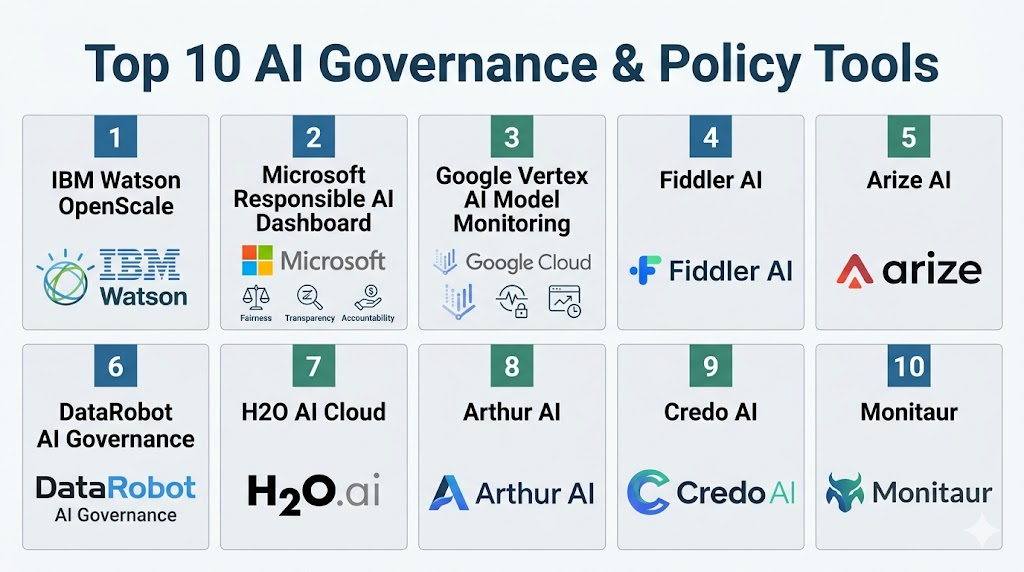
Top 10 AI Governance & Policy Tools
#1 — IBM Watson OpenScale
Short description: A comprehensive AI governance platform focused on monitoring, explainability, and bias detection for enterprise AI systems.
Key Features
- AI fairness and bias detection
- Model explainability tools
- Performance monitoring
- Risk and compliance tracking
- Lifecycle governance
- Audit logging
Pros
- Strong enterprise capabilities
- Deep analytics and monitoring
Cons
- Complex setup
- Enterprise-focused pricing
Platforms / Deployment
Web / Cloud / Hybrid
Security & Compliance
Supports enterprise-grade security controls (details not fully publicly stated)
Integrations & Ecosystem
Integrates with enterprise AI and data platforms
- IBM Cloud ecosystem
- Data science platforms
- APIs and analytics tools
Support & Community
Enterprise support with structured onboarding
#2 — Microsoft Responsible AI Dashboard
Short description: A governance and monitoring solution for AI models within Microsoft’s ecosystem, focused on fairness and transparency.
Key Features
- Model interpretability
- Fairness assessment
- Error analysis tools
- Responsible AI insights
- Integration with Azure ML
Pros
- Strong integration with Azure
- Built-in governance tools
Cons
- Limited outside Microsoft ecosystem
- Requires Azure familiarity
Platforms / Deployment
Web / Cloud
Security & Compliance
Varies / Not publicly stated
Integrations & Ecosystem
- Azure ML
- Microsoft ecosystem
- APIs
Support & Community
Strong documentation and enterprise support
#3 — Google Vertex AI Model Monitoring
Short description: A monitoring and governance solution for AI models deployed on Google Cloud.
Key Features
- Model drift detection
- Performance monitoring
- Data quality checks
- Alerts and reporting
- Integration with Vertex AI
Pros
- Scalable monitoring
- Strong cloud integration
Cons
- Limited governance depth
- Cloud dependency
Platforms / Deployment
Cloud
Security & Compliance
Varies / Not publicly stated
Integrations & Ecosystem
- Google Cloud services
- Data pipelines
- APIs
Support & Community
Enterprise support with strong documentation
#4 — Fiddler AI
Short description: A model performance and explainability platform designed to monitor AI systems in production.
Key Features
- Model explainability
- Bias detection
- Monitoring dashboards
- Alerting system
- Data drift detection
Pros
- Strong explainability
- User-friendly interface
Cons
- Limited policy management
- Pricing not transparent
Platforms / Deployment
Web / Cloud
Security & Compliance
Not publicly stated
Integrations & Ecosystem
- ML pipelines
- APIs
- Data platforms
Support & Community
Growing enterprise user base
#5 — Arize AI
Short description: A monitoring and observability platform for AI systems, focusing on performance and drift detection.
Key Features
- Drift detection
- Model monitoring
- Data quality insights
- Alerting and dashboards
- Performance tracking
Pros
- Strong observability
- Easy to deploy
Cons
- Limited governance features
- Focus on monitoring
Platforms / Deployment
Web / Cloud
Security & Compliance
Not publicly stated
Integrations & Ecosystem
- Data pipelines
- APIs
- ML tools
Support & Community
Active community and documentation
#6 — DataRobot AI Governance
Short description: A governance solution integrated into DataRobot’s AI platform for managing model lifecycle and compliance.
Key Features
- Model lifecycle governance
- Risk management
- Compliance tracking
- Documentation tools
- Monitoring
Pros
- End-to-end governance
- Enterprise-ready
Cons
- Platform lock-in
- Pricing complexity
Platforms / Deployment
Web / Cloud
Security & Compliance
Varies / Not publicly stated
Integrations & Ecosystem
- DataRobot ecosystem
- APIs
- Data platforms
Support & Community
Enterprise support and training
#7 — H2O AI Cloud (Responsible AI)
Short description: A platform offering governance, explainability, and compliance features for AI models.
Key Features
- Explainable AI
- Model monitoring
- Bias detection
- Compliance tools
- Dashboard analytics
Pros
- Strong explainability
- Flexible deployment
Cons
- Requires technical expertise
- Setup complexity
Platforms / Deployment
Cloud / Hybrid
Security & Compliance
Not publicly stated
Integrations & Ecosystem
- ML tools
- APIs
- Data systems
Support & Community
Enterprise and community support
#8 — Arthur AI
Short description: A monitoring and governance platform focused on AI performance and fairness.
Key Features
- Real-time monitoring
- Explainability
- Bias detection
- Alerts
- Performance tracking
Pros
- Strong monitoring
- Real-time insights
Cons
- Limited policy automation
- Smaller ecosystem
Platforms / Deployment
Web / Cloud
Security & Compliance
Not publicly stated
Integrations & Ecosystem
- APIs
- ML pipelines
Support & Community
Moderate enterprise support
#9 — Credo AI
Short description: A governance platform focused on policy management, compliance, and responsible AI frameworks.
Key Features
- Policy management
- Risk assessment
- Compliance workflows
- Audit trails
- Governance dashboards
Pros
- Strong policy focus
- Enterprise compliance
Cons
- Limited model monitoring
- Complex setup
Platforms / Deployment
Web / Cloud
Security & Compliance
Not publicly stated
Integrations & Ecosystem
- Compliance systems
- APIs
- Data platforms
Support & Community
Enterprise-focused support
#10 — Monitaur
Short description: A governance platform for managing AI risk, compliance, and auditability.
Key Features
- Risk management
- Audit logs
- Governance workflows
- Compliance tracking
- Model lifecycle support
Pros
- Strong compliance features
- Good audit capabilities
Cons
- Limited ecosystem
- UI complexity
Platforms / Deployment
Web / Cloud
Security & Compliance
Not publicly stated
Integrations & Ecosystem
- APIs
- Compliance tools
Support & Community
Moderate documentation and support
Comparison Table (Top 10)
| Tool Name | Best For | Platform(s) Supported | Deployment | Standout Feature | Public Rating |
|---|---|---|---|---|---|
| IBM Watson OpenScale | Enterprises | Web | Hybrid | Bias detection | N/A |
| Microsoft Responsible AI Dashboard | Azure users | Web | Cloud | Responsible AI tools | N/A |
| Google Vertex AI Monitoring | GCP users | Cloud | Cloud | Drift detection | N/A |
| Fiddler AI | Monitoring | Web | Cloud | Explainability | N/A |
| Arize AI | Observability | Web | Cloud | Drift tracking | N/A |
| DataRobot AI Governance | Enterprises | Web | Cloud | Lifecycle governance | N/A |
| H2O AI Cloud | Flexible users | Web | Hybrid | Explainable AI | N/A |
| Arthur AI | Monitoring | Web | Cloud | Real-time insights | N/A |
| Credo AI | Compliance | Web | Cloud | Policy management | N/A |
| Monitaur | Risk teams | Web | Cloud | Audit tracking | N/A |
Evaluation & Scoring of AI Governance & Policy Tools
| Tool Name | Core | Ease | Integrations | Security | Performance | Support | Value | Weighted Total |
|---|---|---|---|---|---|---|---|---|
| IBM Watson OpenScale | 9 | 6 | 8 | 8 | 8 | 8 | 7 | 8.0 |
| Microsoft Responsible AI Dashboard | 8 | 7 | 8 | 7 | 8 | 8 | 8 | 7.9 |
| Google Vertex AI Monitoring | 7 | 7 | 8 | 7 | 8 | 7 | 7 | 7.5 |
| Fiddler AI | 8 | 8 | 7 | 6 | 7 | 7 | 7 | 7.5 |
| Arize AI | 7 | 8 | 7 | 6 | 7 | 7 | 8 | 7.4 |
| DataRobot AI Governance | 9 | 7 | 8 | 8 | 8 | 8 | 7 | 8.1 |
| H2O AI Cloud | 8 | 6 | 7 | 7 | 7 | 7 | 7 | 7.4 |
| Arthur AI | 7 | 7 | 6 | 6 | 7 | 6 | 7 | 6.9 |
| Credo AI | 8 | 6 | 7 | 7 | 7 | 7 | 7 | 7.3 |
| Monitaur | 7 | 6 | 6 | 7 | 7 | 6 | 7 | 6.8 |
How to interpret scores:
- Scores are relative comparisons across tools.
- Higher scores indicate stronger enterprise readiness.
- Security and integration scores matter most for regulated industries.
- Ease of use is critical for cross-functional teams.
Which AI Governance & Policy Tools for You?
Solo / Freelancer
- Not typically required
- Use lightweight monitoring tools instead
SMB
- Best: Arize AI, Fiddler AI
- Focus on ease and quick deployment
Mid-Market
- Best: H2O AI Cloud, Credo AI
- Balance governance and usability
Enterprise
- Best: IBM Watson OpenScale, DataRobot
- Focus on compliance and scalability
Budget vs Premium
- Budget: Arize AI
- Premium: IBM Watson OpenScale
Feature Depth vs Ease of Use
- Deep: DataRobot, IBM
- Easy: Arize AI
Integrations & Scalability
- Strong: Microsoft, Google
- Moderate: Credo AI
Security & Compliance Needs
- High: IBM, DataRobot
- Moderate: Arize AI
Frequently Asked Questions (FAQs)
What are AI governance tools?
They help manage risks, compliance, and ethical use of AI systems.
Why are they important?
They reduce risks like bias, legal issues, and data misuse.
Are they required for all companies?
Mostly for companies using AI at scale.
Do they replace MLOps tools?
No, they complement MLOps platforms.
Are they expensive?
Enterprise tools can be costly; pricing varies.
How long to implement?
From days to months depending on complexity.
Can they monitor all models?
Most support major AI models.
Do they support compliance?
Yes, many include compliance features.
Are they secure?
Security varies by vendor.
Can I switch tools later?
Possible but depends on integration complexity.
Conclusion
AI Governance & Policy Tools are becoming essential as organizations scale their AI initiatives. They provide the structure needed to ensure AI systems are ethical, compliant, and reliable. While some tools focus on monitoring and explainability, others offer full lifecycle governance and policy enforcement. There is no single best tool for everyone. Enterprises should prioritize compliance and scalability, while smaller teams may focus on ease of use and cost. The right approach is to shortlist a few tools that align with your needs, test them in real-world scenarios, and validate their ability to integrate with your existing systems.
