Introduction
Endpoint Telemetry Platforms help organizations collect, analyze, monitor, and manage real-time data from endpoints such as laptops, desktops, servers, mobile devices, virtual machines, and cloud workloads. In simple terms, these platforms continuously gather operational, security, behavioral, and performance data from endpoints to improve visibility, threat detection, compliance, and operational intelligence.
In endpoint telemetry has become a critical component of cybersecurity, IT operations, digital employee experience (DEX), and observability strategies. Organizations now manage highly distributed workforces, hybrid cloud infrastructure, remote endpoints, and increasing cyber threats. Modern Endpoint Telemetry Platforms use AI-driven analytics, behavioral monitoring, real-time detection, and automation workflows to provide actionable insights across enterprise environments.
Common real-world use cases include:
- Endpoint threat detection and response
- IT operations monitoring
- Digital employee experience optimization
- Compliance and audit visibility
- Infrastructure performance analytics
When evaluating Endpoint Telemetry Platforms, buyers should consider:
- Real-time telemetry collection capabilities
- Endpoint visibility and monitoring depth
- AI-driven analytics and anomaly detection
- Threat detection and response functionality
- Cloud and hybrid infrastructure support
- Automation and orchestration capabilities
- Scalability across distributed environments
- Reporting and analytics quality
- Security and compliance support
- Integration ecosystem maturity
Best for: Enterprise IT teams, cybersecurity operations centers (SOC), managed security service providers (MSSPs), cloud operations teams, compliance-driven organizations, and businesses managing distributed endpoints.
Not ideal for: Very small organizations with minimal infrastructure or businesses that only require lightweight endpoint monitoring without advanced telemetry analytics.
Key Trends in Endpoint Telemetry Platforms
- AI-assisted anomaly detection is improving threat visibility and operational intelligence.
- Extended Detection and Response (XDR) integration is becoming increasingly common.
- Real-time behavioral analytics are replacing traditional signature-only monitoring.
- Cloud-native telemetry pipelines are rapidly expanding.
- Digital Employee Experience (DEX) monitoring is becoming a major use case.
- Zero Trust security initiatives are increasing demand for endpoint visibility.
- Automation workflows are reducing incident response times.
- Cross-platform endpoint monitoring is becoming essential.
- Privacy-aware telemetry collection is receiving greater attention.
- Integration with SIEM, SOAR, and observability platforms is accelerating.
How We Selected These Tools (Methodology)
The platforms in this list were selected based on operational visibility, telemetry depth, scalability, and enterprise adoption.
Our evaluation process included:
- Market adoption and vendor reputation
- Endpoint telemetry and analytics capabilities
- Threat detection and operational visibility
- AI and automation maturity
- Integration ecosystem strength
- Scalability across distributed environments
- Security and compliance functionality
- Cloud-native and hybrid infrastructure support
- Ease of deployment and administration
- Vendor reliability and customer support quality
The final list includes cybersecurity leaders, endpoint operations platforms, observability-focused vendors, and modern endpoint analytics solutions.
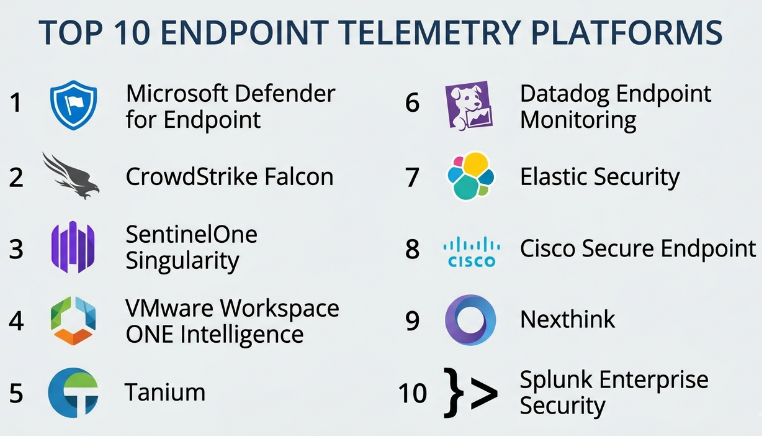
Endpoint Telemetry Platforms
#1 — Microsoft Defender for Endpoint
Short description :
Microsoft Defender for Endpoint is a leading endpoint security and telemetry platform designed to provide real-time visibility, threat detection, behavioral analytics, and operational monitoring across enterprise environments. It combines endpoint telemetry with AI-driven security analytics, automated investigation capabilities, and deep Microsoft ecosystem integration. Organizations use it to improve endpoint protection, compliance visibility, and operational intelligence across distributed workforces.
Key Features
- Real-time endpoint telemetry
- AI-powered threat detection
- Behavioral analytics
- Automated investigation and remediation
- Endpoint vulnerability management
- Threat intelligence integration
- Cross-platform endpoint monitoring
Pros
- Strong Microsoft ecosystem integration
- Excellent enterprise scalability
- Advanced security analytics capabilities
Cons
- Best experience often tied to Microsoft environments
- Complex policy configuration for advanced deployments
- Premium licensing costs for enterprise features
Platforms / Deployment
- Windows / macOS / Linux / iOS / Android
- Cloud
Security & Compliance
- SSO/SAML
- MFA
- RBAC
- Encryption
- Audit logs
- SOC 2
- ISO 27001
- GDPR
Integrations & Ecosystem
Microsoft Defender integrates deeply with Microsoft security, identity, and cloud ecosystems.
- Microsoft Sentinel
- Azure
- Intune
- Microsoft 365
- APIs
- SIEM platforms
Support & Community
Extensive enterprise ecosystem with global Microsoft support and large operational community adoption.
#2 — CrowdStrike Falcon
Short description :
CrowdStrike Falcon is a cloud-native endpoint telemetry and cybersecurity platform focused on endpoint detection and response (EDR), behavioral analytics, and threat intelligence. It is widely adopted by enterprises seeking scalable, AI-driven endpoint visibility and operational security monitoring.
Key Features
- Cloud-native endpoint telemetry
- Behavioral threat analytics
- AI-driven detection
- Real-time incident visibility
- Threat intelligence integration
- Endpoint response automation
- Managed threat hunting support
Pros
- Lightweight endpoint agent
- Strong threat intelligence capabilities
- Excellent cloud-native scalability
Cons
- Premium pricing structure
- Advanced workflows may require expertise
- Operational analytics depth varies by modules
Platforms / Deployment
- Windows / macOS / Linux / iOS / Android
- Cloud
Security & Compliance
- MFA
- SSO/SAML
- Encryption
- RBAC
- Audit logs
- SOC 2
- GDPR
Integrations & Ecosystem
CrowdStrike integrates broadly across enterprise cybersecurity and observability ecosystems.
- Splunk
- ServiceNow
- AWS
- Azure
- APIs
- SIEM platforms
Support & Community
Strong enterprise security ecosystem with extensive operational documentation and managed services support.
#3 — SentinelOne Singularity
Short description :
SentinelOne Singularity combines endpoint telemetry, AI-powered threat detection, behavioral monitoring, and autonomous response capabilities into a unified cybersecurity platform. It is designed for enterprises seeking automated endpoint visibility and operational intelligence across hybrid environments.
Key Features
- AI-powered telemetry analytics
- Autonomous threat response
- Behavioral monitoring
- Endpoint visibility dashboards
- Threat hunting capabilities
- Cloud workload monitoring
- Automated remediation
Pros
- Strong automation capabilities
- Excellent behavioral analytics
- Broad cross-platform support
Cons
- Advanced tuning may require expertise
- Premium enterprise pricing
- Reporting customization varies
Platforms / Deployment
- Windows / macOS / Linux / Kubernetes
- Cloud
Security & Compliance
- MFA
- SSO/SAML
- RBAC
- Encryption
- Audit logs
- SOC 2
- GDPR
Integrations & Ecosystem
SentinelOne integrates with operational security, cloud, and observability platforms.
- Splunk
- AWS
- ServiceNow
- Okta
- APIs
- SIEM platforms
Support & Community
Enterprise-focused support with active cybersecurity ecosystem adoption.
#4 — VMware Workspace ONE Intelligence
Short description :
VMware Workspace ONE Intelligence provides endpoint telemetry, digital employee experience monitoring, operational analytics, and automation capabilities for enterprise endpoint environments. It focuses heavily on unified endpoint management and operational visibility.
Key Features
- Endpoint telemetry analytics
- Digital employee experience monitoring
- Automation workflows
- Endpoint performance analytics
- Device compliance monitoring
- Real-time operational visibility
- Unified endpoint management integration
Pros
- Strong endpoint management integration
- Good DEX monitoring capabilities
- Broad enterprise device support
Cons
- Best suited for VMware-centric environments
- Advanced analytics may require additional modules
- Complex enterprise deployments
Platforms / Deployment
- Windows / macOS / Linux / iOS / Android
- Cloud
Security & Compliance
- SSO/SAML
- MFA
- Encryption
- RBAC
- Audit logs
- GDPR
Integrations & Ecosystem
Workspace ONE integrates with endpoint management and operational ecosystems.
- VMware Horizon
- Microsoft 365
- Okta
- APIs
- Identity providers
- Security platforms
Support & Community
Enterprise-focused support ecosystem with strong endpoint management expertise.
#5 — Tanium
Short description :
Tanium is an enterprise endpoint telemetry and operations platform focused on real-time endpoint visibility, operational management, cybersecurity analytics, and large-scale infrastructure monitoring. It is widely used in highly regulated and operationally complex environments.
Key Features
- Real-time endpoint telemetry
- Threat detection analytics
- Endpoint management
- Compliance monitoring
- Incident response support
- Operational analytics
- Large-scale endpoint visibility
Pros
- Excellent large-scale visibility
- Strong operational control capabilities
- Real-time endpoint querying
Cons
- Complex implementation requirements
- Premium enterprise pricing
- Requires specialized expertise
Platforms / Deployment
- Windows / macOS / Linux
- Cloud / Hybrid
Security & Compliance
- SSO/SAML
- MFA
- Encryption
- RBAC
- Audit logs
- SOC 2
- GDPR
Integrations & Ecosystem
Tanium integrates with enterprise security, operations, and infrastructure management ecosystems.
- ServiceNow
- Splunk
- Microsoft Defender
- APIs
- SIEM platforms
- Vulnerability management tools
Support & Community
Strong enterprise support with operational consulting and onboarding services.
#6 — Datadog Endpoint Monitoring
Short description :
Datadog Endpoint Monitoring combines endpoint telemetry with observability, cloud monitoring, security analytics, and infrastructure performance management. It is popular among DevOps and cloud-native organizations seeking unified operational visibility.
Key Features
- Endpoint telemetry collection
- Infrastructure observability
- Behavioral analytics
- Cloud workload monitoring
- Real-time dashboards
- Alerting and automation
- Threat detection support
Pros
- Excellent observability ecosystem
- Strong cloud-native integrations
- Unified operational visibility
Cons
- Pricing can scale quickly
- Advanced configurations may be complex
- Security workflows vary by deployment
Platforms / Deployment
- Windows / macOS / Linux
- Cloud
Security & Compliance
- SSO/SAML
- MFA
- RBAC
- Encryption
- Audit logs
- SOC 2
- GDPR
Integrations & Ecosystem
Datadog integrates broadly across cloud infrastructure and DevOps ecosystems.
- AWS
- Azure
- Kubernetes
- Slack
- APIs
- SIEM platforms
Support & Community
Large DevOps and cloud operations community with strong documentation resources.
#7 — Elastic Security
Short description :
Elastic Security combines endpoint telemetry, SIEM functionality, threat hunting, and operational analytics into a unified security analytics platform. It supports large-scale telemetry ingestion and flexible search-driven investigation workflows.
Key Features
- Endpoint telemetry ingestion
- Threat hunting workflows
- SIEM analytics
- Behavioral detection
- Real-time search capabilities
- Custom analytics dashboards
- Automation workflows
Pros
- Strong analytics flexibility
- Excellent search capabilities
- Scalable telemetry ingestion
Cons
- Requires technical expertise
- Operational complexity for large deployments
- Advanced tuning may require experienced teams
Platforms / Deployment
- Windows / macOS / Linux
- Cloud / Self-hosted
Security & Compliance
- SSO/SAML
- MFA
- RBAC
- Encryption
- Audit logs
- GDPR
Integrations & Ecosystem
Elastic integrates broadly across observability, cloud, and cybersecurity ecosystems.
- AWS
- Azure
- Kubernetes
- APIs
- SIEM systems
- Security tools
Support & Community
Large open-source and enterprise ecosystem with strong community adoption.
#8 — Cisco Secure Endpoint
Short description :
Cisco Secure Endpoint provides endpoint telemetry, behavioral monitoring, threat intelligence, and incident response capabilities across enterprise infrastructure environments. It integrates deeply with Cisco’s broader security and networking ecosystem.
Key Features
- Endpoint telemetry monitoring
- Threat intelligence integration
- Behavioral analytics
- Incident response support
- Device visibility dashboards
- Malware protection
- Operational analytics
Pros
- Strong Cisco ecosystem integration
- Good network-aware security visibility
- Broad enterprise deployment support
Cons
- Best suited for Cisco-centric environments
- Complex enterprise policy configuration
- Advanced analytics depth varies
Platforms / Deployment
- Windows / macOS / Linux / Android / iOS
- Cloud
Security & Compliance
- MFA
- SSO/SAML
- RBAC
- Encryption
- Audit logs
- SOC 2
- GDPR
Integrations & Ecosystem
Cisco Secure Endpoint integrates with Cisco security and networking ecosystems.
- Cisco XDR
- SecureX
- Splunk
- APIs
- SIEM platforms
- Identity systems
Support & Community
Large enterprise support organization with extensive operational documentation.
#9 — Nexthink
Short description :
Nexthink is a digital employee experience and endpoint telemetry platform focused on endpoint analytics, operational visibility, and user experience optimization. It helps organizations monitor endpoint health, performance, and employee productivity metrics.
Key Features
- Endpoint experience analytics
- Real-time telemetry monitoring
- Digital employee experience dashboards
- Endpoint performance visibility
- Automation workflows
- User sentiment analytics
- Operational reporting
Pros
- Excellent DEX visibility
- Strong endpoint analytics
- User experience optimization focus
Cons
- Less focused on advanced cybersecurity workflows
- Premium enterprise pricing
- Advanced customization varies
Platforms / Deployment
- Windows / macOS / Mobile
- Cloud / Hybrid
Security & Compliance
- SSO/SAML
- MFA
- RBAC
- Encryption
- Audit logs
- GDPR
Integrations & Ecosystem
Nexthink integrates with IT operations, service management, and endpoint ecosystems.
- ServiceNow
- Microsoft Intune
- APIs
- ITSM platforms
- Endpoint management tools
Support & Community
Strong enterprise onboarding and customer success support programs.
#10 — Splunk Enterprise Security
Short description :
Splunk Enterprise Security combines telemetry analytics, SIEM functionality, endpoint visibility, and operational intelligence into a scalable analytics platform. It is widely used by enterprise SOC teams for large-scale telemetry ingestion and security operations.
Key Features
- Large-scale telemetry analytics
- Endpoint visibility
- SIEM functionality
- Threat detection workflows
- Real-time dashboards
- Automation support
- Operational intelligence analytics
Pros
- Excellent analytics flexibility
- Strong scalability
- Broad integration ecosystem
Cons
- Complex administration requirements
- Premium licensing costs
- Requires experienced operational teams
Platforms / Deployment
- Windows / Linux
- Cloud / Hybrid / Self-hosted
Security & Compliance
- SSO/SAML
- MFA
- RBAC
- Encryption
- Audit logs
- SOC 2
- GDPR
Integrations & Ecosystem
Splunk integrates broadly across cybersecurity, observability, and cloud ecosystems.
- AWS
- Azure
- ServiceNow
- APIs
- SIEM tools
- Endpoint platforms
Support & Community
Large global security operations community with extensive documentation and training resources.
Comparison Table (Top 10)
| Tool Name | Best For | Platform(s) Supported | Deployment | Standout Feature | Public Rating |
|---|---|---|---|---|---|
| Microsoft Defender for Endpoint | Microsoft-centric enterprises | Windows, macOS, Linux, Mobile | Cloud | Deep Microsoft security integration | N/A |
| CrowdStrike Falcon | Cloud-native security operations | Cross-platform | Cloud | Lightweight cloud-native telemetry | N/A |
| SentinelOne Singularity | Automated endpoint security | Cross-platform | Cloud | Autonomous threat response | N/A |
| VMware Workspace ONE Intelligence | Digital employee experience monitoring | Cross-platform | Cloud | Endpoint analytics and DEX visibility | N/A |
| Tanium | Large-scale endpoint operations | Windows, macOS, Linux | Cloud, Hybrid | Real-time endpoint querying | N/A |
| Datadog Endpoint Monitoring | DevOps and observability teams | Windows, macOS, Linux | Cloud | Unified observability visibility | N/A |
| Elastic Security | Flexible telemetry analytics | Windows, macOS, Linux | Cloud, Self-hosted | Search-driven telemetry analysis | N/A |
| Cisco Secure Endpoint | Cisco-centric enterprises | Cross-platform | Cloud | Network-aware endpoint visibility | N/A |
| Nexthink | Digital employee experience optimization | Windows, macOS, Mobile | Cloud, Hybrid | User experience analytics | N/A |
| Splunk Enterprise Security | Large-scale SOC operations | Windows, Linux | Cloud, Hybrid, Self-hosted | Scalable telemetry analytics | N/A |
Evaluation & Endpoint Telemetry Platforms
| Tool Name | Core (25%) | Ease (15%) | Integrations (15%) | Security (10%) | Performance (10%) | Support (10%) | Value (15%) | Weighted Total (0–10) |
|---|---|---|---|---|---|---|---|---|
| Microsoft Defender for Endpoint | 9 | 8 | 10 | 10 | 9 | 9 | 8 | 8.95 |
| CrowdStrike Falcon | 9 | 8 | 9 | 10 | 9 | 8 | 7 | 8.55 |
| SentinelOne Singularity | 9 | 8 | 8 | 9 | 9 | 8 | 7 | 8.30 |
| VMware Workspace ONE Intelligence | 8 | 7 | 8 | 8 | 8 | 8 | 7 | 7.75 |
| Tanium | 9 | 6 | 8 | 10 | 9 | 8 | 6 | 8.00 |
| Datadog Endpoint Monitoring | 8 | 8 | 9 | 8 | 9 | 8 | 7 | 8.10 |
| Elastic Security | 8 | 6 | 9 | 8 | 8 | 7 | 8 | 7.80 |
| Cisco Secure Endpoint | 8 | 7 | 8 | 9 | 8 | 8 | 7 | 7.90 |
| Nexthink | 8 | 8 | 7 | 8 | 8 | 8 | 7 | 7.75 |
| Splunk Enterprise Security | 9 | 6 | 10 | 9 | 9 | 8 | 6 | 8.20 |
These scores are comparative evaluations intended to help organizations understand the relative strengths of each platform across operational categories. Security-focused platforms typically excel in analytics and threat detection, while observability-oriented solutions may prioritize operational visibility and integrations. Buyers should prioritize categories most aligned with infrastructure complexity, operational maturity, and security requirements.
Which Endpoint Telemetry Platforms
Solo / Freelancer
Solo operators and very small businesses generally only require lightweight endpoint security or monitoring solutions rather than enterprise telemetry analytics platforms.
SMB
Microsoft Defender for Endpoint, Datadog Endpoint Monitoring, and Cisco Secure Endpoint provide strong usability, operational visibility, and manageable deployment complexity for SMB environments.
Mid-Market
CrowdStrike Falcon, SentinelOne Singularity, and Nexthink work well for organizations balancing security analytics, automation, and operational visibility.
Enterprise
Tanium, Splunk Enterprise Security, and Microsoft Defender for Endpoint are ideal for enterprises requiring advanced telemetry analytics, governance, compliance, and large-scale operational monitoring.
Budget vs Premium
Budget-conscious organizations may prioritize Microsoft Defender due to ecosystem bundling advantages, while premium enterprise buyers often invest in CrowdStrike, Tanium, or Splunk for advanced telemetry capabilities.
Feature Depth vs Ease of Use
Splunk and Tanium provide deep operational functionality but require experienced administration teams. CrowdStrike and Microsoft Defender typically provide easier operational onboarding.
Integrations & Scalability
Organizations invested heavily in Microsoft, AWS, Azure, VMware, Cisco, or SIEM ecosystems should prioritize platforms with strong native integrations and API support.
Security & Compliance Needs
Highly regulated industries should prioritize platforms offering advanced audit logging, encryption, RBAC, compliance reporting, and real-time operational analytics.
Frequently Asked Questions (FAQs)
1. What is an Endpoint Telemetry Platform?
An Endpoint Telemetry Platform collects and analyzes operational, behavioral, security, and performance data from endpoints across enterprise environments.
2. Why is endpoint telemetry important in modern IT operations?
Organizations manage highly distributed infrastructure and remote workforces that require continuous operational visibility and threat monitoring.
3. What types of endpoints can these platforms monitor?
Most platforms support laptops, desktops, servers, mobile devices, virtual machines, cloud workloads, and containerized environments.
4. How does endpoint telemetry improve cybersecurity?
It helps detect suspicious behaviors, identify threats, monitor vulnerabilities, and improve incident response visibility.
5. What is the difference between EDR and endpoint telemetry?
Endpoint telemetry focuses on data collection and analytics, while EDR adds active threat detection and response capabilities.
6. Can these platforms support cloud-native environments?
Yes. Modern platforms increasingly support AWS, Azure, Kubernetes, hybrid cloud, and remote workforce environments.
7. Which industries rely heavily on endpoint telemetry?
Finance, healthcare, government, telecom, manufacturing, SaaS, and managed security providers are major adopters.
8. What deployment models are commonly available?
Most vendors provide cloud-native deployments, while some also support hybrid or self-hosted architectures.
9. What features matter most in endpoint telemetry platforms?
Important features include real-time analytics, AI detection, automation, integrations, scalability, operational visibility, and compliance reporting.
10. Are these tools difficult to implement?
Implementation complexity depends on organizational size, telemetry volume, and integration requirements. Enterprise deployments are generally more complex.
11. What are common implementation mistakes?
Common mistakes include excessive telemetry collection, poor alert tuning, weak integration planning, and insufficient operational training.
12. Can smaller organizations benefit from endpoint telemetry?
Yes. Even smaller businesses can improve visibility, operational monitoring, and cybersecurity readiness using modern telemetry platforms.
Conclusion
Endpoint Telemetry Platforms have become foundational technologies for organizations managing increasingly distributed, cloud-driven, and security-sensitive infrastructure environments. In beyond, businesses require real-time endpoint visibility, behavioral analytics, AI-assisted detection, and operational intelligence to maintain cybersecurity resilience and operational stability.The ideal solution depends heavily on operational maturity, infrastructure complexity, security requirements, and integration ecosystems.
