Introduction
Digital Experience Monitoring (DEM) tools help organizations monitor, analyze, and improve the performance and usability of digital services, applications, endpoints, and employee experiences across distributed environments. In simple terms, DEM platforms provide visibility into how users experience applications, networks, devices, collaboration tools, and cloud services in real time.
In DEM has become increasingly important because organizations rely heavily on remote work, SaaS applications, cloud infrastructure, hybrid environments, and digital collaboration platforms. Poor digital experiences can directly impact employee productivity, customer satisfaction, operational efficiency, and revenue. Modern DEM platforms use AI-driven analytics, endpoint telemetry, synthetic monitoring, real-user monitoring (RUM), and automation workflows to proactively identify performance bottlenecks and operational issues.
Common real-world use cases include:
- Employee experience monitoring
- SaaS application performance monitoring
- Endpoint performance analytics
- Hybrid workplace optimization
- Proactive issue detection and troubleshooting
When evaluating DEM tools, buyers should consider:
- Real-user monitoring capabilities
- Endpoint visibility and telemetry depth
- AI-driven analytics and anomaly detection
- Cloud and SaaS monitoring support
- Network and application visibility
- Automation and remediation workflows
- Scalability across distributed environments
- Reporting and dashboard quality
- Security and compliance features
- Integration ecosystem maturity
Best for: Enterprise IT teams, digital workplace operations, managed service providers, customer experience teams, cloud operations teams, and organizations supporting hybrid or remote workforces.
Not ideal for: Very small organizations with limited digital infrastructure or businesses only requiring basic infrastructure monitoring without user experience analytics.
Key Trends in Digital Experience Monitoring (DEM)
- AI-assisted root cause analysis is improving troubleshooting efficiency.
- Digital Employee Experience (DEX) monitoring is becoming a strategic priority.
- Real-user monitoring is expanding beyond web applications into endpoint environments.
- Cloud-native DEM platforms are rapidly gaining adoption.
- SaaS application performance visibility is becoming essential.
- Automation workflows are reducing manual troubleshooting effort.
- Endpoint telemetry integration is improving operational visibility.
- Predictive analytics are helping prevent user-impacting incidents.
- Hybrid workforce monitoring is driving DEM platform growth.
- Integration with observability and ITSM platforms is accelerating.
How We Selected These Tools (Methodology)
The platforms in this list were selected based on operational visibility, analytics capabilities, scalability, and market adoption.
Our evaluation process included:
- Market reputation and adoption
- Endpoint and user experience visibility
- Real-user and synthetic monitoring capabilities
- AI and automation maturity
- Integration ecosystem strength
- Scalability across enterprise environments
- Security and governance functionality
- Reporting and analytics quality
- Ease of deployment and usability
- Vendor reliability and support quality
The final list includes enterprise DEM leaders, observability vendors, endpoint analytics platforms, and digital workplace monitoring solutions.
Digital Experience Monitoring (DEM) Tools
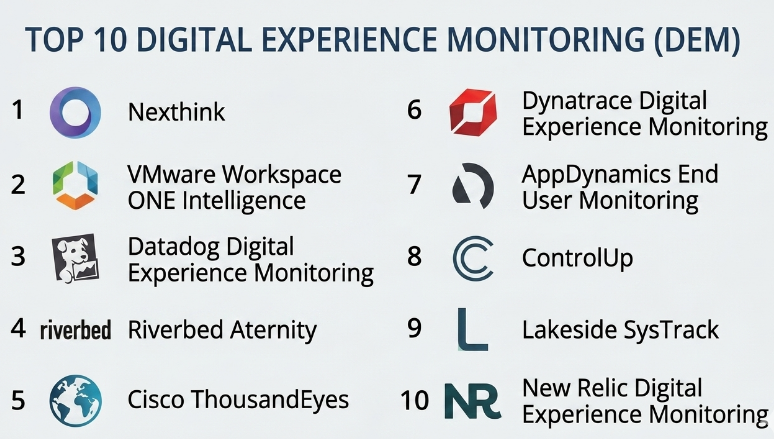
#1 — Nexthink
Short description :
Nexthink is one of the leading Digital Experience Monitoring platforms focused on endpoint analytics, employee experience monitoring, and operational intelligence. It provides real-time visibility into endpoint performance, application health, user sentiment, and digital workplace productivity across enterprise environments. Organizations use Nexthink to improve employee satisfaction, proactively resolve issues, and optimize digital operations.
Key Features
- Real-time endpoint telemetry
- Digital employee experience analytics
- Application performance monitoring
- User sentiment analysis
- AI-driven anomaly detection
- Automated remediation workflows
- Experience scoring dashboards
Pros
- Excellent DEX visibility
- Strong endpoint analytics capabilities
- Proactive troubleshooting support
Cons
- Premium enterprise pricing
- Advanced customization may require expertise
- Less focused on traditional infrastructure monitoring
Platforms / Deployment
- Windows / macOS / Mobile
- Cloud / Hybrid
Security & Compliance
- SSO/SAML
- MFA
- RBAC
- Encryption
- Audit logs
- GDPR
Integrations & Ecosystem
Nexthink integrates with IT operations, endpoint management, and service management platforms.
- ServiceNow
- Microsoft Intune
- APIs
- ITSM platforms
- Endpoint management tools
- Collaboration platforms
Support & Community
Strong enterprise onboarding programs with dedicated customer success resources and operational guidance.
#2 — VMware Workspace ONE Intelligence
Short description :
VMware Workspace ONE Intelligence combines endpoint telemetry, digital employee experience analytics, automation, and operational monitoring into a unified enterprise platform. It helps organizations improve endpoint visibility, application performance, and user productivity across hybrid work environments.
Key Features
- Endpoint analytics
- Digital experience scoring
- Automation workflows
- Device compliance monitoring
- Real-time operational visibility
- Application analytics
- Unified endpoint management integration
Pros
- Strong endpoint management integration
- Broad enterprise device support
- Good automation capabilities
Cons
- Best suited for VMware-centric environments
- Advanced analytics may require additional modules
- Complex enterprise deployments
Platforms / Deployment
- Windows / macOS / Linux / iOS / Android
- Cloud
Security & Compliance
- SSO/SAML
- MFA
- Encryption
- RBAC
- Audit logs
- GDPR
Integrations & Ecosystem
Workspace ONE integrates with enterprise endpoint management and operational ecosystems.
- VMware Horizon
- Microsoft 365
- Okta
- APIs
- Identity providers
- Security platforms
Support & Community
Enterprise-focused support ecosystem with strong endpoint management expertise.
#3 — Datadog Digital Experience Monitoring
Short description :
Datadog Digital Experience Monitoring provides real-user monitoring, synthetic monitoring, endpoint visibility, and application performance analytics within Datadog’s broader observability platform. It is popular among cloud-native and DevOps-focused organizations.
Key Features
- Real-user monitoring (RUM)
- Synthetic monitoring
- Endpoint telemetry analytics
- Application performance monitoring
- AI-driven alerting
- Cloud-native observability
- Interactive dashboards
Pros
- Strong observability ecosystem
- Excellent cloud-native visibility
- Broad integration support
Cons
- Pricing can increase rapidly at scale
- Advanced configurations may be complex
- Endpoint analytics depth varies
Platforms / Deployment
- Windows / macOS / Linux
- Cloud
Security & Compliance
- SSO/SAML
- MFA
- RBAC
- Encryption
- Audit logs
- SOC 2
- GDPR
Integrations & Ecosystem
Datadog integrates broadly across cloud infrastructure, DevOps, and collaboration ecosystems.
- AWS
- Azure
- Kubernetes
- Slack
- APIs
- SIEM platforms
Support & Community
Large DevOps and cloud operations community with extensive documentation resources.
#4 — Riverbed Aternity
Short description :
Riverbed Aternity focuses on digital experience management, endpoint analytics, application visibility, and user experience optimization. It helps enterprises proactively monitor and improve employee and customer-facing digital services.
Key Features
- Endpoint performance monitoring
- User experience analytics
- Application visibility
- Real-time telemetry collection
- AI-driven analytics
- Automation workflows
- Experience benchmarking
Pros
- Strong application visibility
- Good endpoint performance insights
- Useful user experience analytics
Cons
- Enterprise-focused pricing
- Advanced customization may require expertise
- Smaller ecosystem than larger observability vendors
Platforms / Deployment
- Windows / macOS / Mobile
- Cloud / Hybrid
Security & Compliance
- SSO/SAML
- MFA
- RBAC
- Encryption
- Audit logs
- GDPR
Integrations & Ecosystem
Aternity integrates with IT operations and endpoint management environments.
- ServiceNow
- APIs
- Endpoint tools
- Collaboration platforms
- Monitoring systems
Support & Community
Provides enterprise onboarding and operational support resources.
#5 — Cisco ThousandEyes
Short description :
Cisco ThousandEyes provides internet, network, cloud, and application visibility combined with digital experience monitoring capabilities. It helps organizations monitor SaaS applications, WAN performance, remote connectivity, and employee digital experiences.
Key Features
- Network path visibility
- SaaS application monitoring
- Internet performance analytics
- Endpoint experience monitoring
- Synthetic testing
- Cloud monitoring
- Real-time dashboards
Pros
- Excellent network visibility
- Strong SaaS monitoring capabilities
- Broad internet performance analytics
Cons
- Best suited for distributed enterprise environments
- Pricing may be high for smaller businesses
- Endpoint analytics depth varies
Platforms / Deployment
- Windows / macOS / Linux / Mobile
- Cloud
Security & Compliance
- MFA
- SSO/SAML
- RBAC
- Encryption
- Audit logs
- SOC 2
- GDPR
Integrations & Ecosystem
Cisco ThousandEyes integrates with networking, cloud, and operational ecosystems.
- Cisco ecosystem
- AWS
- Azure
- APIs
- ITSM platforms
- Observability tools
Support & Community
Strong enterprise networking support with extensive operational documentation.
#6 — Dynatrace Digital Experience Monitoring
Short description :
Dynatrace combines DEM, observability, application monitoring, and AI-powered analytics into a unified platform. It provides end-to-end visibility across applications, infrastructure, endpoints, and user experiences.
Key Features
- Real-user monitoring
- AI-powered root cause analysis
- Application performance analytics
- Synthetic monitoring
- Endpoint visibility
- Cloud observability
- Automated remediation support
Pros
- Excellent AI-driven analytics
- Strong full-stack observability
- Broad enterprise scalability
Cons
- Premium enterprise pricing
- Complex implementation for some environments
- Learning curve for advanced analytics
Platforms / Deployment
- Windows / macOS / Linux / Mobile
- Cloud / Hybrid
Security & Compliance
- SSO/SAML
- MFA
- RBAC
- Encryption
- Audit logs
- SOC 2
- ISO 27001
- GDPR
Integrations & Ecosystem
Dynatrace integrates broadly across cloud, DevOps, and operational ecosystems.
- AWS
- Azure
- Kubernetes
- ServiceNow
- APIs
- CI/CD platforms
Support & Community
Strong enterprise support with active observability and DevOps community adoption.
#7 — AppDynamics End User Monitoring
Short description :
AppDynamics End User Monitoring provides visibility into application performance, digital experience analytics, and user journey monitoring. It is widely used by enterprises monitoring customer-facing applications and distributed workforce environments.
Key Features
- End-user monitoring
- Application performance analytics
- Business transaction visibility
- Real-time dashboards
- Synthetic monitoring
- AI-assisted analytics
- User journey mapping
Pros
- Strong business transaction visibility
- Good application performance insights
- Useful enterprise analytics
Cons
- Advanced configuration may require expertise
- Premium pricing structure
- Endpoint-focused analytics vary
Platforms / Deployment
- Windows / macOS / Linux
- Cloud / Hybrid
Security & Compliance
- MFA
- SSO/SAML
- RBAC
- Encryption
- Audit logs
- GDPR
Integrations & Ecosystem
AppDynamics integrates with cloud, DevOps, and enterprise operational ecosystems.
- Cisco ecosystem
- AWS
- Azure
- APIs
- ITSM platforms
- Collaboration tools
Support & Community
Enterprise support ecosystem with extensive technical documentation.
#8 — ControlUp
Short description :
ControlUp focuses on real-time digital workplace monitoring, endpoint visibility, and virtual desktop infrastructure (VDI) performance analytics. It is commonly used by IT teams managing hybrid work environments and virtualized infrastructure.
Key Features
- Real-time endpoint monitoring
- VDI performance analytics
- User experience dashboards
- Automation workflows
- Remote troubleshooting tools
- Performance optimization insights
- Alerting and notifications
Pros
- Excellent VDI visibility
- Strong troubleshooting capabilities
- Good real-time operational monitoring
Cons
- Primarily focused on endpoint and VDI environments
- Advanced enterprise analytics vary
- Smaller ecosystem than broader observability vendors
Platforms / Deployment
- Windows / macOS
- Cloud / Hybrid
Security & Compliance
- SSO/SAML
- MFA
- Encryption
- RBAC
- Audit logs
- GDPR
Integrations & Ecosystem
ControlUp integrates with virtualization, endpoint, and operational ecosystems.
- Citrix
- VMware
- Microsoft Azure
- APIs
- ITSM tools
- Endpoint management platforms
Support & Community
Strong technical support for digital workplace and VDI environments.
#9 — Lakeside SysTrack
Short description :
Lakeside SysTrack is a digital experience monitoring and endpoint analytics platform designed to improve endpoint visibility, employee productivity, and operational intelligence across enterprise environments.
Key Features
- Endpoint telemetry analytics
- Experience scoring
- Application performance visibility
- AI-driven operational insights
- Automation support
- User productivity analytics
- Reporting dashboards
Pros
- Strong endpoint analytics
- Useful operational intelligence
- Good employee productivity visibility
Cons
- Enterprise-focused pricing
- Advanced customization may require expertise
- Smaller ecosystem compared to larger vendors
Platforms / Deployment
- Windows / macOS
- Cloud / Hybrid
Security & Compliance
- SSO/SAML
- MFA
- RBAC
- Encryption
- Audit logs
- GDPR
Integrations & Ecosystem
SysTrack integrates with endpoint management and IT operations environments.
- Microsoft Intune
- ServiceNow
- APIs
- Endpoint tools
- Collaboration platforms
Support & Community
Provides enterprise onboarding and customer success support resources.
#10 — New Relic Digital Experience Monitoring
Short description :
New Relic Digital Experience Monitoring combines real-user monitoring, synthetic monitoring, application observability, and operational analytics into a unified cloud observability platform. It is popular among SaaS and cloud-native organizations.
Key Features
- Real-user monitoring
- Synthetic testing
- Application observability
- AI-assisted alerting
- Cloud-native dashboards
- User journey analytics
- Performance monitoring
Pros
- Strong cloud observability ecosystem
- Good developer-focused visibility
- Broad monitoring capabilities
Cons
- Pricing can increase with telemetry scale
- Advanced operational workflows vary
- Endpoint analytics depth varies
Platforms / Deployment
- Windows / macOS / Linux
- Cloud
Security & Compliance
- MFA
- SSO/SAML
- RBAC
- Encryption
- Audit logs
- SOC 2
- GDPR
Integrations & Ecosystem
New Relic integrates broadly across cloud, DevOps, and application ecosystems.
- AWS
- Azure
- Kubernetes
- APIs
- CI/CD platforms
- Collaboration tools
Support & Community
Large observability and DevOps community with strong technical documentation.
Comparison Table (Top 10)
| Tool Name | Best For | Platform(s) Supported | Deployment | Standout Feature | Public Rating |
|---|---|---|---|---|---|
| Nexthink | Digital employee experience visibility | Windows, macOS, Mobile | Cloud, Hybrid | Endpoint experience analytics | N/A |
| VMware Workspace ONE Intelligence | Unified endpoint analytics | Cross-platform | Cloud | Endpoint management integration | N/A |
| Datadog Digital Experience Monitoring | Cloud-native observability | Windows, macOS, Linux | Cloud | Unified observability ecosystem | N/A |
| Riverbed Aternity | Application experience monitoring | Windows, macOS, Mobile | Cloud, Hybrid | Experience benchmarking | N/A |
| Cisco ThousandEyes | Internet and SaaS visibility | Cross-platform | Cloud | Network path analytics | N/A |
| Dynatrace Digital Experience Monitoring | AI-driven observability | Cross-platform | Cloud, Hybrid | AI root cause analysis | N/A |
| AppDynamics End User Monitoring | Application transaction visibility | Windows, macOS, Linux | Cloud, Hybrid | Business transaction analytics | N/A |
| ControlUp | VDI and endpoint monitoring | Windows, macOS | Cloud, Hybrid | Real-time VDI visibility | N/A |
| Lakeside SysTrack | Endpoint productivity analytics | Windows, macOS | Cloud, Hybrid | Experience scoring | N/A |
| New Relic Digital Experience Monitoring | Cloud application monitoring | Windows, macOS, Linux | Cloud | Developer-focused observability | N/A |
Evaluation & Digital Experience Monitoring (DEM)
| Tool Name | Core (25%) | Ease (15%) | Integrations (15%) | Security (10%) | Performance (10%) | Support (10%) | Value (15%) | Weighted Total (0–10) |
|---|---|---|---|---|---|---|---|---|
| Nexthink | 9 | 8 | 8 | 8 | 9 | 8 | 7 | 8.15 |
| VMware Workspace ONE Intelligence | 8 | 7 | 8 | 8 | 8 | 8 | 7 | 7.75 |
| Datadog Digital Experience Monitoring | 9 | 8 | 10 | 8 | 9 | 8 | 7 | 8.55 |
| Riverbed Aternity | 8 | 7 | 7 | 8 | 8 | 7 | 7 | 7.45 |
| Cisco ThousandEyes | 9 | 8 | 8 | 9 | 9 | 8 | 7 | 8.20 |
| Dynatrace Digital Experience Monitoring | 10 | 7 | 9 | 9 | 10 | 8 | 6 | 8.55 |
| AppDynamics End User Monitoring | 8 | 7 | 8 | 8 | 8 | 8 | 7 | 7.70 |
| ControlUp | 8 | 8 | 7 | 8 | 8 | 7 | 8 | 7.80 |
| Lakeside SysTrack | 8 | 7 | 7 | 8 | 8 | 7 | 7 | 7.45 |
| New Relic Digital Experience Monitoring | 8 | 8 | 9 | 8 | 8 | 8 | 7 | 8.00 |
These scores are comparative evaluations intended to help organizations understand relative strengths across operational categories. Observability-focused vendors often score highly in integrations and cloud analytics, while endpoint-focused DEM platforms may perform better in employee experience visibility and operational troubleshooting. Buyers should prioritize categories aligned with infrastructure complexity, operational maturity, and digital workplace requirements.
Which Digital Experience Monitoring (DEM) Tools
Solo / Freelancer
Solo operators and very small businesses generally only require lightweight monitoring or application analytics rather than enterprise-grade DEM platforms.
SMB
ControlUp, New Relic, and Datadog provide strong usability, operational visibility, and manageable deployment complexity for SMB and growing organizations.
Mid-Market
Cisco ThousandEyes, Nexthink, and AppDynamics work well for organizations balancing endpoint visibility, SaaS monitoring, and operational intelligence.
Enterprise
Dynatrace, Nexthink, and VMware Workspace ONE Intelligence are ideal for enterprises requiring advanced analytics, large-scale endpoint monitoring, automation, and governance capabilities.
Budget vs Premium
Budget-conscious buyers may prefer ControlUp or New Relic, while enterprises seeking advanced AI analytics and automation often justify investment in Dynatrace or Nexthink.
Feature Depth vs Ease of Use
Dynatrace and AppDynamics provide deep enterprise analytics but may require experienced operational teams. Datadog and New Relic generally provide easier onboarding and developer-friendly workflows.
Integrations & Scalability
Organizations heavily invested in AWS, Azure, Kubernetes, VMware, Cisco, or ServiceNow ecosystems should prioritize platforms with strong native integrations and API support.
Security & Compliance Needs
Highly regulated industries should prioritize DEM tools offering advanced audit logs, encryption, RBAC, compliance reporting, and operational governance functionality.
Frequently Asked Questions (FAQs)
1. What is Digital Experience Monitoring (DEM)?
Digital Experience Monitoring helps organizations monitor and improve the performance, usability, and reliability of digital services, applications, endpoints, and employee experiences.
2. Why is DEM important in modern enterprises?
Organizations now rely heavily on remote work, SaaS applications, and cloud infrastructure that require continuous visibility into user experiences and operational performance.
3. What is the difference between DEM and observability?
DEM focuses primarily on user and employee experience visibility, while observability platforms provide broader infrastructure, application, and telemetry analytics.
4. What environments can DEM tools monitor?
Most DEM platforms support endpoints, SaaS applications, cloud infrastructure, VDI environments, collaboration platforms, and web applications.
5. How does DEM improve employee productivity?
DEM platforms identify performance bottlenecks, application slowdowns, connectivity issues, and endpoint problems before they significantly impact users.
6. Are DEM platforms cloud-native?
Many modern DEM vendors provide cloud-native deployments optimized for hybrid and distributed enterprise environments.
7. Which industries rely heavily on DEM platforms?
Finance, healthcare, telecom, education, government, SaaS, and managed services organizations are major adopters.
8. What features matter most in DEM platforms?
Important features include real-user monitoring, endpoint telemetry, AI analytics, automation, integrations, reporting, and SaaS visibility.
9. Are DEM tools difficult to implement?
Implementation complexity depends on infrastructure scale, telemetry requirements, and integration complexity. Enterprise deployments are generally more involved.
10. What are common DEM implementation mistakes?
Common mistakes include poor telemetry prioritization, weak alert tuning, insufficient endpoint coverage, and inadequate integration planning.
11. Can smaller organizations benefit from DEM?
Yes. Even smaller organizations can improve employee productivity and operational visibility using modern DEM solutions.
12. How do DEM tools support hybrid work environments?
They provide visibility into endpoint performance, network connectivity, SaaS usage, and collaboration tool reliability across distributed workforces.
Conclusion
Digital Experience Monitoring platforms have become essential operational technologies for organizations managing increasingly distributed, cloud-driven, and experience-focused environments. In businesses require real-time visibility into employee productivity, endpoint performance, SaaS reliability, and digital operations to maintain efficiency, user satisfaction, and operational resilience.The ideal DEM platform depends heavily on operational maturity, infrastructure complexity, digital workplace priorities, and ecosystem integrations.
