Introduction
Open Data Portals are software platforms that help governments, public agencies, universities, research bodies, nonprofits, and enterprises publish datasets in a structured, searchable, and reusable format. In simple words, these platforms make data easier for the public, developers, journalists, researchers, businesses, and internal teams to find, understand, download, and use.
Instead of keeping public data hidden inside spreadsheets, PDFs, internal systems, or disconnected databases, an open data portal provides a central place where datasets can be cataloged, described, governed, updated, visualized, and shared. These portals often include metadata management, APIs, search, data previews, charts, maps, access controls, publishing workflows, and reporting tools.
Common use cases include government transparency, smart city dashboards, transportation data, environmental data, public finance, healthcare statistics, education data, research datasets, economic development, civic technology, and public performance reporting.
Buyers should evaluate:
- Dataset publishing and catalog management
- Metadata quality and search experience
- API and developer access
- Data visualization and mapping
- Workflow approvals and governance
- Security, privacy, and access control
- Integration with databases, BI tools, GIS, and cloud storage
- Scalability for large datasets
- Accessibility and multilingual support
- Total cost of ownership and technical effort
Best for: government agencies, municipalities, public-sector IT teams, data officers, research institutions, universities, civic technology teams, smart city teams, and organizations that need transparent public data sharing.
Not ideal for: teams that only need internal BI dashboards, small organizations publishing a few static files, or companies that do not need public-facing dataset discovery and governance.
Key Open Data Portal Trends
- Data transparency is becoming a public expectation. Citizens, researchers, journalists, and businesses increasingly expect governments and institutions to publish useful data in accessible formats.
- APIs are now essential. Open data is no longer only about downloadable CSV files. Developers expect APIs, machine-readable formats, and reliable data endpoints.
- Metadata quality is a major differentiator. Poor dataset titles, missing descriptions, and unclear update frequency reduce trust and usability.
- Geospatial data is becoming more important. Many open data programs need maps, location datasets, boundaries, infrastructure layers, and spatial search.
- Data governance is moving into the portal workflow. Publishing teams need approvals, version control, privacy review, ownership tracking, and lifecycle management.
- AI readiness depends on clean open data. Public datasets can support AI, analytics, forecasting, and research only when they are well-documented, structured, and reliable.
- Cloud-native deployment is common. Many organizations prefer hosted platforms to reduce infrastructure work, but some still need self-hosted or hybrid options.
- Accessibility and inclusiveness matter. Public data portals must be usable by non-technical users, not only developers and data scientists.
- Open-source platforms remain important. Some public-sector teams prefer open-source portals for transparency, flexibility, and cost control.
- Privacy protection is a growing concern. Publishing teams must avoid exposing personal, sensitive, or restricted data by mistake.
How We Selected These Tools
The platforms below were selected using the following evaluation logic:
- Market visibility and recognition in open data, data cataloging, government transparency, and public data publishing
- Breadth of dataset catalog, metadata, API, visualization, and publishing features
- Suitability for public-sector, research, enterprise, and civic technology use cases
- Ability to support both technical and non-technical data users
- Strength of data discovery, search, and metadata management
- Integration potential with cloud storage, databases, GIS, BI tools, and analytics systems
- Security, governance, and access control capabilities where confidently known
- Support for scalable data publishing workflows
- Balance between enterprise-grade platforms, open-source tools, and public-sector-focused solutions
- Practical fit across small, mid-sized, and large organizations
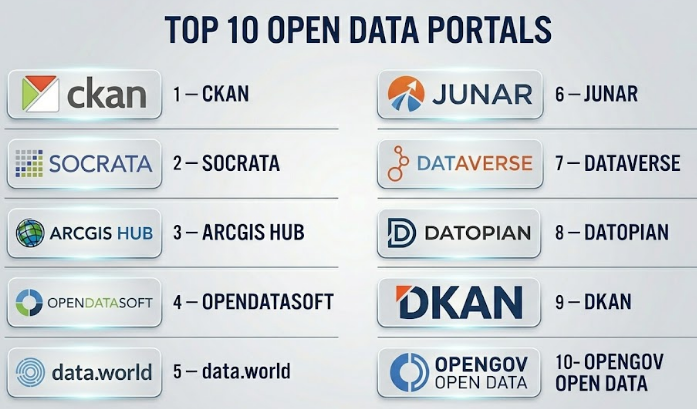
Top 10 Open Data Portals
#1 — CKAN
Short description :
CKAN is one of the most widely recognized open-source data portal platforms. It is used by governments, public institutions, research organizations, and civic technology teams to publish, catalog, and manage datasets. CKAN is especially strong for organizations that want flexibility, transparency, and control over their open data infrastructure. It supports dataset metadata, search, APIs, extensions, data previews, and publishing workflows. Because it is open-source, it can be customized deeply, but it also requires technical skills for hosting, maintenance, upgrades, and security management.
Key Features
- Open-source data catalog platform
- Dataset publishing and metadata management
- Search and filtering for public datasets
- API access for developers
- Extension ecosystem for additional functionality
- Data preview and resource management
- Support for public and private dataset workflows
Pros
- Strong open-source community and public-sector adoption
- Highly customizable for different open data programs
- Good fit for organizations that want technical control
Cons
- Requires technical expertise for setup and maintenance
- User experience may depend heavily on customization
- Support depends on internal team or implementation partner
Platforms / Deployment
Web-based platform
Self-hosted / Cloud through implementation partners / Hybrid possible
Security & Compliance
Varies / N/A. Security depends on hosting, configuration, maintenance, authentication setup, and implementation partner. Buyers should validate SSO, MFA, encryption, audit logs, RBAC, GDPR, data residency, and infrastructure security.
Integrations & Ecosystem
CKAN has a strong open-source ecosystem and can be extended for many open data workflows.
- APIs for dataset access
- Extensions and plugins
- Cloud storage integration through configuration
- GIS and spatial extensions
- Data previews and visualization extensions
- Custom authentication and workflow integrations
Support & Community
CKAN has a mature open-source community and ecosystem of vendors, developers, and implementation partners. Formal support depends on whether the organization self-hosts or works with a specialist provider.
#2 — Socrata
Short description :
Socrata is a public-sector-focused open data and data publishing platform commonly used by governments and agencies. It helps organizations publish datasets, create public dashboards, manage data catalogs, and provide access to civic data. Socrata is suitable for cities, counties, states, public agencies, and organizations that want a managed open data experience. It is especially useful when public teams need a portal that combines dataset discovery, visualization, API access, and performance reporting. Socrata is often considered by organizations that want a more managed approach than open-source self-hosting.
Key Features
- Public data portal and catalog management
- Dataset publishing and update workflows
- Built-in data visualization tools
- API access for developers
- Dashboards and performance reporting
- Searchable public data experience
- Government-focused publishing workflows
Pros
- Strong fit for government and public-sector use
- Managed platform reduces infrastructure burden
- Useful combination of data publishing and visualization
Cons
- May be costly for smaller organizations
- Customization may be more limited than self-hosted open-source platforms
- Pricing and modules should be reviewed carefully
Platforms / Deployment
Web-based platform
Cloud deployment
Security & Compliance
Not publicly stated. Buyers should validate SSO/SAML, MFA, encryption, audit logs, RBAC, SOC 2, ISO 27001, GDPR, FedRAMP, accessibility, and data residency requirements.
Integrations & Ecosystem
Socrata is useful when public data needs to be published, visualized, and accessed through APIs.
- Dataset APIs
- Public dashboards
- Data visualization tools
- Government data publishing workflows
- Performance management reporting
- Data exports and developer access
Support & Community
Support is generally vendor-led and may include onboarding, documentation, customer success, and implementation assistance. Buyers should confirm service levels, training options, and support response expectations.
#3 — ArcGIS Hub
Short description :
ArcGIS Hub is a data sharing, community engagement, and open data platform built around Esri’s GIS ecosystem. It is especially strong for organizations that publish geospatial data, maps, infrastructure layers, planning data, environmental datasets, and location-based public information. ArcGIS Hub is widely relevant for cities, planning departments, transportation agencies, emergency management teams, utilities, and public-sector GIS teams. It helps organizations create public-facing sites, share datasets, build maps, and connect data with community initiatives. It is best for teams already using Esri tools or needing strong geospatial capabilities.
Key Features
- Geospatial open data publishing
- Public sites and initiative pages
- Map-based data discovery
- Dataset downloads and APIs
- Integration with ArcGIS ecosystem
- Community engagement features
- Dashboards and location-based storytelling
Pros
- Excellent fit for geospatial and mapping-heavy data
- Strong ecosystem for GIS teams
- Useful for smart city, planning, infrastructure, and environmental data
Cons
- Best value is for organizations already using ArcGIS
- May be more GIS-focused than general data catalog users need
- Licensing and configuration can be complex
Platforms / Deployment
Web-based platform
Cloud deployment
Part of broader ArcGIS ecosystem
Security & Compliance
Not publicly stated. Buyers should validate SSO/SAML, MFA, encryption, RBAC, audit logs, data residency, accessibility, and compliance requirements relevant to their organization.
Integrations & Ecosystem
ArcGIS Hub has a strong ecosystem for geospatial data, maps, dashboards, and public information sharing.
- ArcGIS Online and ArcGIS Enterprise
- Web maps and feature layers
- Spatial data downloads
- Dashboards and story-based content
- GIS workflows and map services
- Public initiative sites
Support & Community
ArcGIS Hub benefits from the broader Esri documentation, training, partner ecosystem, and GIS community. Support depends on licensing, contract, and organizational setup.
#4 — OpenDataSoft
Short description :
OpenDataSoft is a data portal platform designed for publishing, sharing, visualizing, and reusing data. It is used by public-sector organizations, utilities, transport agencies, cities, and enterprises that want a managed data portal with strong data experience features. The platform supports data catalogs, APIs, dashboards, maps, and data storytelling. OpenDataSoft is useful for organizations that want to make data more accessible to both technical and non-technical users. It is a strong option for teams that need polished public data experiences without building everything from scratch.
Key Features
- Data catalog and open data publishing
- APIs for dataset reuse
- Data visualizations and dashboards
- Maps and geospatial display
- Data storytelling and public pages
- Dataset search and filtering
- Governance and publishing workflows
Pros
- Strong public-facing data experience
- Good mix of visualization, APIs, and catalog features
- Useful for both government and enterprise data sharing
Cons
- May require planning for larger data governance programs
- Pricing and advanced modules should be validated
- Custom technical flexibility may be less than fully open-source options
Platforms / Deployment
Web-based platform
Cloud deployment
Security & Compliance
Not publicly stated. Buyers should validate SSO/SAML, MFA, encryption, audit logs, RBAC, GDPR, ISO 27001, SOC 2, data residency, and accessibility needs.
Integrations & Ecosystem
OpenDataSoft supports data publishing and reuse across public-facing and internal use cases.
- Dataset APIs
- Dashboards and visualizations
- Map-based data display
- Data import and publishing workflows
- Public data pages
- Data exports and developer access
Support & Community
Support is generally vendor-led and may include onboarding, documentation, training, and customer success. Buyers should confirm implementation help, support tiers, and technical guidance.
#5 — data.world
Short description :
data.world is a cloud-based data catalog and data collaboration platform that can support open data, enterprise data discovery, and community data sharing. It is useful for organizations that want to publish datasets, manage metadata, improve discoverability, and support collaboration around data assets. While it is often used for enterprise data catalog and governance needs, it can also support public-facing data communities and open data initiatives. data.world is especially useful when teams care about knowledge graphs, metadata, data discovery, and collaboration. It is a strong option where open data overlaps with internal data governance.
Key Features
- Data catalog and metadata management
- Dataset publishing and discovery
- Collaboration around data assets
- Knowledge graph-based data context
- APIs and integrations
- Data governance support
- Public and private data sharing options
Pros
- Strong metadata and data discovery capabilities
- Useful for collaboration between technical and non-technical users
- Good fit when open data connects with enterprise data governance
Cons
- May be broader than needed for simple public data portals
- Public open data portal design may require planning
- Pricing and packaging should be reviewed carefully
Platforms / Deployment
Web-based platform
Cloud deployment
Security & Compliance
Not publicly stated. Buyers should validate SSO/SAML, MFA, encryption, RBAC, audit logs, SOC 2, ISO 27001, GDPR, and data governance requirements.
Integrations & Ecosystem
data.world fits organizations that need to connect open data with data catalog, governance, and analytics workflows.
- Data warehouse integrations
- BI and analytics tools
- APIs and metadata workflows
- Data collaboration spaces
- Governance and catalog systems
- Public and private dataset sharing
Support & Community
Support is generally vendor-led and may include documentation, onboarding, customer success, and enterprise support. Buyers should validate support tiers and implementation services.
#6 — Junar
Short description :
Junar is an open data and data publishing platform focused on helping governments and organizations publish datasets, visualizations, and public-facing data experiences. It is suitable for public agencies, cities, nonprofits, and organizations that want to make data easier to find and reuse. Junar can support data catalogs, APIs, dashboards, and data visualization workflows. It is especially useful for organizations that want a managed portal experience with a focus on public transparency. The platform is best evaluated by teams that need a practical open data publishing solution without managing infrastructure directly.
Key Features
- Open data publishing
- Dataset catalog and metadata management
- APIs for data reuse
- Visualizations and dashboards
- Public-facing data portal pages
- Search and filtering
- Data sharing workflows
Pros
- Focused on public data publishing
- Useful for governments and civic data programs
- Managed approach reduces hosting responsibility
Cons
- Public information about advanced features may be limited
- Buyers should validate integrations and scalability
- Security and compliance details should be confirmed directly
Platforms / Deployment
Web-based platform
Cloud deployment
Security & Compliance
Not publicly stated. Buyers should validate SSO/SAML, MFA, encryption, audit logs, RBAC, GDPR, data residency, accessibility, and public-sector compliance needs.
Integrations & Ecosystem
Junar is useful for publishing structured datasets and presenting them in reusable formats.
- Dataset APIs
- Data visualization tools
- Public data pages
- Data exports
- Catalog search and metadata
- Dashboard-style reporting
Support & Community
Support is vendor-led and should be evaluated based on onboarding, documentation, customer success, and technical assistance.
#7 — Dataverse
Short description :
Dataverse is an open-source research data repository platform commonly used by universities, libraries, research institutions, and academic communities. It helps researchers publish, preserve, cite, and share datasets with metadata and access controls. While it is more research-data-focused than a typical government open data portal, it is highly relevant for open data programs in academic and research environments. Dataverse is especially strong for dataset preservation, citation, metadata, and scholarly data sharing. It is a good fit for institutions that need research-grade data repository capabilities.
Key Features
- Open-source research data repository
- Dataset publishing and preservation
- Metadata management
- DOI and citation support through configured services
- Access controls and permissions
- File-level dataset organization
- Research data sharing workflows
Pros
- Strong fit for universities and research institutions
- Good for long-term dataset preservation and citation
- Open-source and customizable
Cons
- Less focused on public dashboards and civic open data visuals
- Requires technical setup and maintenance
- Best suited for research data rather than general municipal data
Platforms / Deployment
Web-based platform
Self-hosted / Cloud through implementation partners
Security & Compliance
Varies / N/A. Security depends on hosting, configuration, identity management, access controls, and institutional policies. Buyers should validate encryption, authentication, audit logs, RBAC, data retention, privacy, and research compliance needs.
Integrations & Ecosystem
Dataverse works well within academic, library, and research data ecosystems.
- Research repository workflows
- Metadata standards
- Citation and DOI services through configuration
- Institutional authentication systems
- Data preservation processes
- APIs and research data access
Support & Community
Dataverse has an academic and open-source community. Support depends on internal research IT teams, hosting partners, institutional services, or community resources.
#8 — Datopian
Short description :
Datopian provides data portal, data catalog, and open data solutions, often connected with CKAN and open-source data infrastructure. It is suitable for governments, public organizations, nonprofits, and enterprises that want customized open data portals and managed data services. Datopian is useful when a team wants the flexibility of open-source technology but also needs expert implementation, design, hosting, and support. It is especially relevant for organizations that want a tailored open data experience rather than a purely out-of-the-box platform. Datopian can be a strong choice for teams building serious data publishing programs around open standards.
Key Features
- Data portal implementation and hosting
- CKAN-based open data solutions
- Data catalog and metadata workflows
- APIs and data publishing
- Custom data portal design
- Data engineering and automation support
- Open-source focused delivery model
Pros
- Strong for customized open data portals
- Useful for organizations wanting open-source plus expert support
- Good fit for complex public data publishing needs
Cons
- May be more service-led than simple SaaS buying
- Scope and pricing depend on project requirements
- Internal teams still need data governance ownership
Platforms / Deployment
Web-based platform
Cloud / Self-hosted / Hybrid depending on project
Security & Compliance
Varies / N/A. Security depends on deployment architecture, hosting, configuration, and client requirements. Buyers should validate SSO, MFA, encryption, audit logs, RBAC, GDPR, data residency, and infrastructure security.
Integrations & Ecosystem
Datopian is suitable for organizations that need customized data portal integrations and open-source flexibility.
- CKAN ecosystem
- APIs and data pipelines
- Cloud storage and databases
- Custom data workflows
- Metadata management
- Data publishing automation
Support & Community
Support is typically project-based or service-based. Buyers should define support expectations, maintenance scope, hosting responsibility, upgrade process, and service-level commitments.
#9 — DKAN
Short description :
DKAN is an open-source open data platform originally built around Drupal-based data publishing. It helps organizations create open data portals, publish datasets, manage metadata, and provide APIs. DKAN is relevant for governments and organizations that want open-source flexibility and content management capabilities. It may appeal to teams familiar with Drupal or those needing a customizable open data publishing stack. Like other open-source tools, DKAN requires technical skills for deployment, customization, updates, and security management.
Key Features
- Open-source open data portal
- Dataset publishing and cataloging
- Metadata management
- API-based data access
- Content management flexibility
- Data previews and structured resources
- Customizable public portal experience
Pros
- Open-source and customizable
- Useful for teams with Drupal or web development expertise
- Good option for organizations wanting ownership of the portal stack
Cons
- Requires technical maintenance
- Community and implementation ecosystem may be smaller than CKAN
- User experience depends on design and configuration quality
Platforms / Deployment
Web-based platform
Self-hosted / Cloud through implementation partners
Security & Compliance
Varies / N/A. Security depends on hosting, Drupal configuration, updates, authentication, permissions, and maintenance. Buyers should validate encryption, RBAC, audit logs, SSO, MFA, GDPR, and infrastructure security.
Integrations & Ecosystem
DKAN can integrate with open-source web, content, and data publishing workflows.
- Drupal ecosystem
- Dataset APIs
- Custom website integrations
- Metadata workflows
- Data publishing pipelines
- Public data catalog pages
Support & Community
Support depends on internal developers, Drupal experts, open-source community resources, or implementation partners. Organizations should plan for maintenance and security patching.
#10 — OpenGov Open Data
Short description :
OpenGov Open Data is part of a broader public-sector software ecosystem focused on helping governments manage transparency, budgeting, reporting, and public data sharing. It is suitable for municipalities and government agencies that want open data capabilities connected to financial, performance, and operational transparency. The platform can help public-sector teams publish data, communicate performance, and improve public trust. OpenGov is most relevant for organizations already using or evaluating broader government management tools. It is a good option when open data is connected with budgeting, reporting, and public accountability.
Key Features
- Public-sector data transparency tools
- Dataset and information publishing
- Performance and financial reporting alignment
- Public-facing dashboards and reports
- Government-focused workflows
- Data communication and transparency support
- Broader civic operations ecosystem
Pros
- Good fit for local government transparency
- Useful when open data connects with budgeting and performance reporting
- Benefits from broader public-sector software ecosystem
Cons
- May be less flexible than open-source platforms for custom portal design
- Best value may depend on use of broader OpenGov ecosystem
- Pricing and module scope should be reviewed carefully
Platforms / Deployment
Web-based platform
Cloud deployment
Security & Compliance
Not publicly stated. Buyers should validate SSO/SAML, MFA, encryption, audit logs, RBAC, SOC 2, ISO 27001, GDPR, accessibility, and public-sector compliance needs.
Integrations & Ecosystem
OpenGov Open Data is useful when open data is part of broader government transparency and financial reporting.
- Budgeting and reporting workflows
- Public dashboards
- Government transparency tools
- Data exports
- Civic performance reporting
- Public-facing information portals
Support & Community
Support is vendor-led and may include onboarding, training, customer success, and implementation services. Buyers should confirm service levels and support scope.
Comparison Table
| Tool Name | Best For | Platform(s) Supported | Deployment | Standout Feature | Public Rating |
|---|---|---|---|---|---|
| CKAN | Open-source government and civic data portals | Web | Self-hosted / Cloud / Hybrid | Mature open-source data catalog ecosystem | N/A |
| Socrata | Managed public-sector open data publishing | Web | Cloud | Government-focused open data and visualization | N/A |
| ArcGIS Hub | Geospatial open data and smart city portals | Web | Cloud | Strong GIS and map-based data publishing | N/A |
| OpenDataSoft | Public-facing data portals and visualization | Web | Cloud | Data publishing, APIs, dashboards, and maps | N/A |
| data.world | Data catalog, collaboration, and open data sharing | Web | Cloud | Metadata and data discovery focus | N/A |
| Junar | Managed open data publishing | Web | Cloud | Simple public data portal and API publishing | N/A |
| Dataverse | Research data publishing and preservation | Web | Self-hosted / Partner-hosted | Research repository and citation workflows | N/A |
| Datopian | Custom open data portals and CKAN services | Web | Cloud / Self-hosted / Hybrid | Open-source implementation and managed services | N/A |
| DKAN | Drupal-based open data portals | Web | Self-hosted / Partner-hosted | Open-source data portal with CMS flexibility | N/A |
| OpenGov Open Data | Local government transparency and reporting | Web | Cloud | Open data connected with public-sector reporting | N/A |
Evaluation & Open Data Portals
| Tool Name | Core (25%) | Ease (15%) | Integrations (15%) | Security (10%) | Performance (10%) | Support (10%) | Value (15%) | Weighted Total (0–10) |
|---|---|---|---|---|---|---|---|---|
| CKAN | 9 | 6 | 9 | 6 | 8 | 8 | 9 | 8.00 |
| Socrata | 9 | 8 | 8 | 7 | 8 | 8 | 7 | 8.00 |
| ArcGIS Hub | 9 | 8 | 9 | 7 | 8 | 8 | 7 | 8.15 |
| OpenDataSoft | 9 | 8 | 8 | 7 | 8 | 8 | 8 | 8.15 |
| data.world | 8 | 8 | 9 | 7 | 8 | 8 | 7 | 7.95 |
| Junar | 7 | 8 | 7 | 6 | 7 | 7 | 8 | 7.25 |
| Dataverse | 8 | 6 | 8 | 6 | 8 | 7 | 9 | 7.55 |
| Datopian | 8 | 7 | 9 | 7 | 8 | 8 | 8 | 8.00 |
| DKAN | 7 | 6 | 7 | 6 | 7 | 6 | 8 | 6.85 |
| OpenGov Open Data | 8 | 8 | 7 | 7 | 8 | 8 | 7 | 7.70 |
These scores are comparative, not absolute. A higher score means the platform is strong across the selected criteria, but the right choice depends on your operating model. Open-source platforms may score high on flexibility and value, but they require more technical ownership. Managed SaaS platforms may score higher on ease of use and support, but can cost more over time. GIS-heavy organizations may naturally prefer ArcGIS Hub, while research institutions may prefer Dataverse.
Which Open Data Portal Should You Choose?
Solo / Freelancer
Solo consultants, civic technologists, and independent researchers usually do not need a large enterprise open data platform. If the goal is to publish a small number of datasets, a simple website, spreadsheet repository, or lightweight catalog may be enough.
However, freelancers who support governments, NGOs, or public data programs should learn CKAN, ArcGIS Hub, OpenDataSoft, or Socrata because these platforms often appear in professional open data projects.
Recommended direction: CKAN for open-source learning, Dataverse for research data, or lightweight tools for small publishing needs.
SMB
Small organizations, nonprofits, and local civic groups should focus on cost, simplicity, and maintenance effort. A powerful portal is useful only if the team can keep datasets updated and metadata clean.
For small teams with technical skills, CKAN or DKAN may work well. For teams that prefer managed hosting, Junar, OpenDataSoft, or data.world may be easier.
Recommended direction: Choose a managed platform if technical resources are limited. Choose open-source only if the team can maintain it properly.
Mid-Market
Mid-sized municipalities, public agencies, universities, utilities, and research organizations usually need stronger data governance, better search, APIs, dashboards, and publishing workflows.
At this level, the portal should support both technical users and ordinary citizens. Metadata quality, update processes, ownership, and reporting become more important.
Recommended direction: OpenDataSoft, Socrata, ArcGIS Hub, CKAN, Dataverse, data.world, or Datopian depending on data type and internal skills.
Enterprise
Large governments, national agencies, smart city programs, research networks, and enterprises need scalable infrastructure, governance, security, integrations, APIs, workflow controls, and long-term data management.
Enterprise buyers should evaluate not only portal features but also operating model. The key question is whether the organization wants a managed SaaS platform, an open-source stack, or a custom hybrid model.
Recommended direction: Socrata, ArcGIS Hub, OpenDataSoft, CKAN with expert support, Datopian, data.world, or OpenGov Open Data.
Budget vs Premium
Budget-focused teams may prefer open-source tools such as CKAN, DKAN, Dataverse, or CONSUL-style civic data alternatives. However, open-source does not mean free in practice. Hosting, maintenance, security updates, customization, and support still require budget.
Premium platforms are better when the organization needs polished user experience, vendor support, dashboards, APIs, onboarding, and lower internal technical burden.
Budget direction: CKAN, DKAN, Dataverse.
Premium direction: Socrata, ArcGIS Hub, OpenDataSoft, data.world, OpenGov Open Data.
Feature Depth vs Ease of Use
Feature-rich platforms give more control, but they can be harder to configure and maintain. Easy platforms reduce technical burden but may limit deep customization.
If your organization has strong technical capacity, open-source and custom platforms may be better. If your organization needs quick deployment and vendor support, managed platforms are safer.
Feature depth: CKAN, ArcGIS Hub, OpenDataSoft, data.world, Datopian.
Ease of use: Socrata, OpenDataSoft, ArcGIS Hub, Junar, OpenGov Open Data.
Integrations & Scalability
Open data portals should connect with databases, cloud storage, GIS systems, BI tools, APIs, data warehouses, and internal publishing workflows. Integration needs become more important as dataset volume grows.
Scalability also means the portal can support many publishers, dataset owners, departments, public users, APIs, and file formats.
Strong integration candidates: CKAN, ArcGIS Hub, OpenDataSoft, data.world, Datopian, Socrata.
Security & Compliance Needs
Open data platforms often publish public datasets, but the publishing process may involve sensitive internal data before review. That makes security important even when the final data is public.
Buyers should validate:
- SSO/SAML
- MFA
- Encryption in transit and at rest
- Role-based access control
- Audit logs
- Dataset approval workflows
- Data retention policies
- Privacy review process
- GDPR or local data protection requirements
- Accessibility standards
- Backup and disaster recovery
Organizations should also create a clear data review process to avoid publishing personal or restricted information.
Frequently Asked Questions
1. What is an Open Data Portal?
An Open Data Portal is a website or platform where organizations publish datasets for public discovery, access, download, and reuse. It usually includes metadata, search, APIs, data previews, and sometimes charts, maps, and dashboards.
2. How is an open data portal different from a normal website?
A normal website presents content pages, while an open data portal organizes structured datasets. It provides search, metadata, downloads, APIs, update tracking, and sometimes machine-readable access for developers and researchers.
3. Who uses Open Data Portals?
Governments, municipalities, universities, research institutions, nonprofits, utilities, civic technology groups, journalists, developers, and citizens use open data portals to publish, find, analyze, and reuse public datasets.
4. What pricing models are common?
Pricing varies widely. Open-source platforms may have no license fee but require hosting, technical support, customization, and maintenance. Managed platforms may charge based on modules, users, dataset volume, support level, or enterprise contract.
5. How long does implementation take?
A basic portal can be launched quickly if datasets and metadata are ready. Larger programs with governance, integrations, custom design, approvals, and multiple departments can take longer because data ownership and quality processes must be defined.
6. What are common mistakes in open data programs?
Common mistakes include publishing too many low-quality datasets, ignoring metadata, failing to update data, not assigning dataset owners, exposing sensitive data, and building a portal without understanding user needs.
7. Are Open Data Portals secure?
They can be secure, but security depends on platform choice, hosting model, authentication, permissions, configuration, and internal review processes. Buyers should validate encryption, access control, audit logs, SSO, MFA, and privacy workflows.
8. Can open data portals support APIs?
Yes, many open data portals support APIs so developers can access datasets programmatically. API quality varies, so buyers should review documentation, rate limits, authentication options, and reliability before choosing a platform.
9. Which platform is best for geospatial data?
ArcGIS Hub is a strong choice for organizations already using Esri tools and publishing map-based datasets. CKAN, OpenDataSoft, and other portals can also support geospatial data depending on configuration and extensions.
10. Are open-source portals better than commercial platforms?
Open-source portals provide flexibility, control, and transparency, but require technical ownership. Commercial platforms are often easier to deploy and support, but may cost more and offer less deep customization.
Conclusion
Open Data Portals help organizations turn scattered datasets into trusted, searchable, reusable public assets. The best platform depends on the type of data, technical capacity, governance needs, budget, and public audience. CKAN is a strong open-source choice for teams that want flexibility and control. Socrata and OpenDataSoft are strong managed options for public data publishing. ArcGIS Hub is excellent for geospatial and smart city data. data.world is useful where open data overlaps with enterprise data cataloging. Dataverse is a strong research data repository.
