Introduction
Patronage Platforms help creators, artists, writers, podcasters, educators, musicians, open-source developers, community builders, and independent professionals receive ongoing financial support from fans, followers, members, or patrons. In simple words, these platforms allow people who value a creator’s work to support them through recurring memberships, one-time contributions, exclusive content, community access, tips, donations, or paid benefits.
Patronage is different from normal selling. In a product sale, someone buys a specific item. In patronage, supporters often pay because they believe in the creator, want the work to continue, or want closer access to the creator’s process. This makes patronage platforms useful for creators who produce ongoing value through writing, videos, podcasts, art, music, newsletters, software, education, activism, or community work.
Real-world use cases include:
- Monthly fan memberships for creators
- Supporter-funded podcasts, videos, or newsletters
- One-time tips and donations from followers
- Exclusive behind-the-scenes content for patrons
- Private community access for supporters
- Funding open-source projects or independent research
- Offering early access, bonus content, or patron-only updates
Buyers should evaluate:
- Recurring membership support
- One-time contribution options
- Platform fees and payment processing fees
- Creator payout methods
- Exclusive content publishing tools
- Community and engagement features
- Audience ownership and email access
- Tier and reward management
- Branding and customization
- Digital product support
- Analytics and supporter reporting
- Integrations with social, email, community, and website tools
Best for: creators, writers, artists, musicians, podcasters, educators, YouTubers, open-source developers, newsletter creators, community leaders, independent journalists, coaches, and mission-driven creators who want direct support from their audience.
Not ideal for: creators who cannot provide ongoing value, businesses that only need one-time ecommerce sales, or creators with no clear audience yet. Patronage works best when supporters feel emotionally connected to the creator, mission, or ongoing work.
Key Trends in Patronage Platforms
- Direct creator support is growing: Creators are relying less on ads alone and more on direct support from fans, readers, viewers, and members.
- Recurring memberships are becoming normal: Monthly or annual patron support helps creators build more predictable income.
- Audience ownership matters more: Creators want direct access to supporters through email, member lists, communities, and private updates.
- Patron benefits are becoming more flexible: Creators now offer early access, private posts, behind-the-scenes updates, livestreams, downloads, community access, and personal recognition.
- Community is becoming part of patronage: Supporters often want more than content. They want belonging, interaction, discussion, and access to like-minded people.
- Micro-support is popular: One-time tips, small donations, and casual support options help creators earn from followers who may not want a full membership.
- Open-source patronage is increasing: Developers and maintainers use patronage platforms to support free tools, libraries, documentation, and community projects.
- Creators are combining revenue streams: Patronage often works alongside digital products, courses, sponsorships, affiliate income, merchandise, and consulting.
- Transparency builds trust: Supporters are more likely to contribute when creators clearly explain what support funds and what patrons receive.
- Retention is becoming important: Getting patrons is only the first step. Keeping them requires consistent communication, honest updates, and clear value.
How We Selected These Tools Methodology
The tools below were selected based on their relevance to patronage, creator support, membership funding, donation workflows, fan engagement, creator usability, and practical monetization value.
- Patronage capability: Tools were evaluated for recurring memberships, one-time support, fan funding, donations, and supporter benefits.
- Creator usability: Simple setup, easy payment collection, and clear dashboards were considered.
- Audience relationship: Platforms with member communication, email access, supporter updates, or community features were valued.
- Payment flexibility: One-time tips, monthly support, annual plans, and payout workflows were reviewed.
- Fee structure: Platform fees, payment processing, and revenue share were considered from a practical creator perspective.
- Content access: Tools that support exclusive posts, downloads, videos, newsletters, or private updates were included.
- Community support: Platforms with member interaction, comments, groups, or integration with community tools were rated higher.
- Creator type fit: The list balances tools for artists, writers, developers, video creators, podcasters, educators, and community builders.
- Scalability: Platforms suitable for beginners, growing creators, and professional creator businesses were included.
- Practical value: The goal is not one universal winner, but a useful comparison by creator model and supporter relationship.
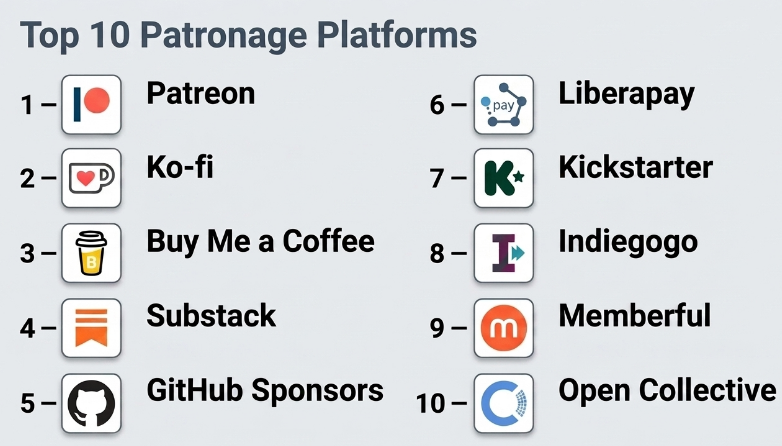
Top 10 Patronage Platforms
#1 — Patreon
Short description :
Patreon is one of the most recognized patronage platforms for creators who want recurring support from fans and members. It helps creators offer paid membership tiers, exclusive content, behind-the-scenes posts, early access, patron-only updates, and digital rewards. Patreon is widely used by podcasters, YouTubers, writers, artists, musicians, educators, and independent creators. It is especially useful for creators with a loyal audience that wants to support ongoing work. Patreon is a strong option when recurring patron support is the main monetization model.
Key Features
- Paid membership tiers
- Recurring patron support
- Exclusive posts and content access
- Digital rewards and benefits
- Patron communication tools
- Creator analytics
- Payment and payout management
Pros
- Strong audience recognition and creator adoption
- Good for recurring fan-funded income
- Flexible tier-based patron benefits
Cons
- Platform and payment fees reduce creator earnings
- Discovery is limited; creators must bring their own audience
- Creators need consistent updates to retain patrons
Platforms / Deployment
Web / mobile app availability
Cloud deployment
Security & Compliance
Patronage platforms handle payments, subscriber data, tax details, private content, and creator earnings. Specific certifications such as SOC 2, ISO 27001, GDPR, or other compliance details should be verified directly.
Not publicly stated.
Integrations & Ecosystem
Patreon works well as a membership layer connected with a creator’s broader content channels.
- Video and podcast communities
- Private community access
- Social media audience funnels
- Email and update workflows
- Digital reward delivery
- Member engagement tools
Support & Community
Patreon has a large creator ecosystem and strong public recognition. It is best for creators who already have an audience and can deliver ongoing patron value.
#2 — Ko-fi
Short description :
Ko-fi is a creator support platform that helps creators receive one-time tips, recurring memberships, commissions, donations, and shop sales. It is especially popular among artists, writers, streamers, indie creators, designers, and small creative businesses. Ko-fi is simple to set up and works well for creators who want lightweight patronage without building a full membership website. Creators can offer supporter-only content, sell digital products, accept commissions, and receive casual fan support. Ko-fi is a practical option for creators who want flexibility between tips, memberships, and small storefronts.
Key Features
- One-time supporter payments
- Monthly memberships
- Digital product shop
- Commission request support
- Supporter-only posts
- Creator profile page
- Payment and payout workflows
Pros
- Easy to start and creator-friendly
- Supports tips, memberships, shops, and commissions
- Good for artists and independent creators
Cons
- Not as advanced as full creator business platforms
- Larger communities may need deeper automation
- Audience growth depends on creator promotion
Platforms / Deployment
Web
Cloud deployment
Security & Compliance
Ko-fi handles payments, supporter data, private content, and digital transactions. Specific certifications and compliance details should be verified directly.
Not publicly stated.
Integrations & Ecosystem
Ko-fi works well as a lightweight patronage and creator support page.
- Social media profile links
- Digital downloads
- Fan support payments
- Membership access
- Commission workflows
- Creator storefronts
Support & Community
Ko-fi has strong awareness among artists and independent creators. It is best for creators who want simple monetization without heavy platform complexity.
#3 — Buy Me a Coffee
Short description :
Buy Me a Coffee is a simple patronage and creator support platform that helps creators receive one-time payments, recurring memberships, and supporter messages. It is useful for writers, developers, podcasters, designers, educators, bloggers, open-source contributors, and small creators who want a quick way to accept support. The platform works well as a simple support page linked from blogs, newsletters, social profiles, videos, or project pages. It is especially practical for creators who do not need complex membership management. Buy Me a Coffee is a strong option for low-friction fan support.
Key Features
- One-time supporter payments
- Monthly memberships
- Creator support page
- Supporter messages
- Simple content updates
- Payment and payout workflows
- Social-friendly support links
Pros
- Very easy to set up
- Good for tips and simple supporter payments
- Useful for small creators and independent professionals
Cons
- Limited compared with advanced membership platforms
- Not ideal for large digital product catalogs
- Creators still need to drive their own traffic
Platforms / Deployment
Web
Cloud deployment
Security & Compliance
The platform handles payments, supporter information, creator account data, and membership records. Specific certifications and compliance details should be verified directly.
Not publicly stated.
Integrations & Ecosystem
Buy Me a Coffee is best used as a simple patronage layer.
- Blog and newsletter support links
- Social media creator profiles
- Supporter payments
- Membership updates
- Simple creator pages
- Payment workflows
Support & Community
Buy Me a Coffee is popular with independent creators who want easy supporter payments. It is best for creators seeking fast setup and simple fan funding.
#4 — Substack
Short description :
Substack is a publishing and subscription platform used by writers, journalists, analysts, educators, podcasters, and experts who want direct support from readers. While it is often seen as a newsletter platform, it also works as a patronage model because readers can pay to support ongoing writing or access paid content. Substack helps creators publish free and paid newsletters, build email audiences, manage subscriptions, and communicate directly with readers. It is especially useful for creators whose value comes from ideas, analysis, storytelling, research, or commentary. Substack is a strong option for writing-led patronage.
Key Features
- Free and paid newsletters
- Reader subscription management
- Paid posts and member-only content
- Email publishing tools
- Podcast support
- Comments and discussion features
- Revenue and subscriber analytics
Pros
- Strong for writers and newsletter creators
- Helps build direct email audience
- Simple paid subscription workflow
Cons
- Best suited for content-led creators
- Design customization may be limited
- Platform fees apply to paid subscriptions
Platforms / Deployment
Web / mobile app availability
Cloud deployment
Security & Compliance
Substack handles subscriber data, payments, private content, and creator account records. Specific certifications and compliance details should be verified directly.
Not publicly stated.
Integrations & Ecosystem
Substack works best for patronage through writing and email publishing.
- Newsletter publishing
- Paid reader subscriptions
- Podcast publishing
- Subscriber email lists
- Reader discussions
- Audience analytics
Support & Community
Substack has a strong writer and creator ecosystem. It is best for creators who can publish consistently and build reader loyalty.
#5 — GitHub Sponsors
Short description :
GitHub Sponsors is a patronage platform designed for open-source developers, maintainers, and project contributors. It allows supporters, companies, and community members to financially support developers and projects they rely on. This is especially useful because many open-source tools are widely used but underfunded. GitHub Sponsors helps developers receive recurring sponsorships while staying connected to their software projects and developer identity. It is a strong option for developers who contribute to open-source libraries, tools, frameworks, documentation, or community infrastructure.
Key Features
- Developer sponsorship profiles
- Recurring sponsorship tiers
- Open-source project support
- Individual and organization sponsorship options
- Developer identity connection
- Sponsor recognition
- Payment and payout workflows
Pros
- Strong fit for open-source developers
- Works inside a developer-focused ecosystem
- Good for funding public software work
Cons
- Not designed for general creators
- Best results depend on project visibility and community value
- Sponsorship income can be unpredictable
Platforms / Deployment
Web
Cloud deployment
Security & Compliance
The platform handles financial support, developer account data, sponsor relationships, and payment records. Specific certifications and compliance details should be verified directly.
Not publicly stated here for every use case.
Integrations & Ecosystem
GitHub Sponsors is strongest inside the open-source and developer ecosystem.
- Open-source repositories
- Developer profiles
- Organization sponsorships
- Community project support
- Sponsor recognition
- Developer funding workflows
Support & Community
GitHub Sponsors benefits from the broader developer ecosystem. It is best for maintainers with visible open-source work and active users.
#6 — Liberapay
Short description :
Liberapay is a recurring donation platform designed for creators, open-source contributors, writers, artists, nonprofits, and communities that want ongoing support without a commercial fan club model. It focuses on regular donations rather than exclusive content or reward-heavy membership tiers. Liberapay is especially useful for people who want transparent, donation-based patronage. It works well for open-source contributors, independent writers, small projects, and community initiatives. Liberapay is a strong option when the goal is simple recurring support rather than complex creator benefits.
Key Features
- Recurring donations
- Creator and team profiles
- Open-source and community project support
- Transparent donation model
- Multi-person team support
- Supporter contribution tracking
- Payment and payout workflows
Pros
- Good for donation-based patronage
- Useful for open-source and community projects
- Simple recurring support model
Cons
- Limited exclusive content features
- Less suitable for fan reward tiers
- Discovery and growth depend on creator promotion
Platforms / Deployment
Web
Cloud deployment
Security & Compliance
Donation platforms handle payment information, supporter data, creator profiles, and payout workflows. Specific certifications and compliance details should be verified directly.
Not publicly stated.
Integrations & Ecosystem
Liberapay fits creators and projects that want recurring support without a heavy membership structure.
- Open-source projects
- Community initiatives
- Creator donation pages
- Team funding
- Recurring supporter workflows
- Public funding profiles
Support & Community
Liberapay is aligned with open-source and donation-based support culture. It is best for creators and teams that prefer simple recurring giving.
#7 — Kickstarter
Short description :
Kickstarter is a crowdfunding platform that helps creators raise money for specific creative projects before they are completed. While it is not a recurring patronage platform in the same way as Patreon, it is a strong project-based patronage model where backers support creative work in exchange for rewards, early access, or participation in bringing an idea to life. It is useful for artists, filmmakers, game creators, designers, writers, musicians, and product creators. Kickstarter is especially strong for launches, campaigns, and creative projects with a clear funding goal. It is a good fit when patronage is tied to a specific project rather than ongoing monthly support.
Key Features
- Project-based crowdfunding
- Funding goals and campaign pages
- Backer reward tiers
- Campaign storytelling tools
- Creator updates
- Community support and comments
- Payment collection for successful campaigns
Pros
- Strong for project launches
- Good public campaign format
- Useful for creative and product-based funding
Cons
- Not ideal for ongoing monthly support
- Campaign success requires strong promotion
- All-or-nothing style funding may not fit every creator
Platforms / Deployment
Web / mobile app availability
Cloud deployment
Security & Compliance
Crowdfunding platforms handle payments, backer data, creator project information, and campaign records. Specific certifications and compliance details should be verified directly.
Not publicly stated.
Integrations & Ecosystem
Kickstarter works best for creators with project-based patronage needs.
- Creative project campaigns
- Reward fulfillment workflows
- Backer communication
- Product launch funding
- Campaign updates
- Community support
Support & Community
Kickstarter has strong recognition among creative backers and project-based creators. It is best for creators with a clear campaign, strong story, and reward plan.
#8 — Indiegogo
Short description :
Indiegogo is a crowdfunding platform that helps creators, entrepreneurs, artists, makers, and product teams raise funds for projects, campaigns, and launches. Like Kickstarter, it is more project-based than recurring patronage, but it still supports patron-style backing where supporters fund creative or innovative work. It is useful for hardware projects, creative campaigns, community projects, films, technology products, and early-stage product launches. Indiegogo can be a good option when creators want flexible campaign structures and product-focused fundraising. It is strongest when a creator has a clear project, prototype, audience, and fulfillment plan.
Key Features
- Crowdfunding campaign pages
- Backer reward tiers
- Funding goal support
- Flexible campaign models depending on setup
- Product launch support
- Campaign updates
- Backer communication tools
Pros
- Good for product and innovation campaigns
- Useful for project-based patronage
- Flexible campaign options may fit some creators
Cons
- Not a recurring membership platform
- Campaign success depends on promotion and trust
- Fulfillment planning is critical
Platforms / Deployment
Web / mobile app availability
Cloud deployment
Security & Compliance
Indiegogo handles payments, campaign records, backer information, and creator data. Specific certifications and compliance details should be verified directly.
Not publicly stated.
Integrations & Ecosystem
Indiegogo fits creators and teams launching projects with supporter funding.
- Product crowdfunding
- Creative project campaigns
- Backer updates
- Reward management
- Campaign promotion
- Launch validation workflows
Support & Community
Indiegogo has a broad crowdfunding audience and creator resources. It is best for creators with project-based funding and clear delivery planning.
#9 — Memberful
Short description :
Memberful is a membership and subscription platform that helps creators, publishers, podcasters, educators, and independent businesses sell paid memberships from their own websites. It is useful for creators who want patronage-style recurring income but also want more control over branding and audience ownership. Memberful supports paid plans, gated content, subscriber management, coupons, and payment workflows. It works especially well for creators with an existing website, podcast, or publication. Memberful is a strong option when creators want patronage infrastructure without relying entirely on a closed creator platform.
Key Features
- Paid membership plans
- Recurring subscription billing
- Member management
- Gated content access
- Website integration support
- Coupons and promotions
- Subscriber analytics and revenue reporting
Pros
- Good for creators with existing websites
- Strong subscription management focus
- More brand control than many hosted patronage platforms
Cons
- Requires website setup and integration planning
- Not as simple as pure support pages
- Creators must manage their own content experience
Platforms / Deployment
Web
Cloud deployment
Security & Compliance
Memberful handles subscriber records, payment data, membership access, and creator revenue workflows. Specific certifications and compliance details should be verified directly.
Not publicly stated.
Integrations & Ecosystem
Memberful works well as a patronage and subscription layer for owned creator websites.
- Website memberships
- Paid podcast workflows
- Newsletter and email tools
- Community access
- Payment processing
- Subscriber management
Support & Community
Memberful provides creator and publisher-focused support resources. It is best for creators who want recurring supporter income with more control over their website.
#10 — Open Collective
Short description :
Open Collective is a funding and financial transparency platform used by open-source projects, communities, nonprofits, mutual aid groups, and mission-driven collectives. It allows supporters, sponsors, and organizations to contribute funds while giving the project public visibility into budgets, expenses, and financial activity. It is especially useful when patronage is for a community project rather than one individual creator. Open Collective helps groups receive support while building trust through transparent financial reporting. It is a strong choice for open-source, civic, nonprofit, and community-led projects.
Key Features
- Collective funding pages
- Recurring and one-time contributions
- Transparent budget and expense reporting
- Sponsor and supporter recognition
- Community funding workflows
- Project expense management
- Fiscal hosting options depending on setup
Pros
- Strong for transparent community funding
- Useful for open-source and nonprofit-style projects
- Good for teams, collectives, and public-benefit initiatives
Cons
- Not designed for typical fan content memberships
- May be too structured for casual creators
- Best value depends on community trust and transparency needs
Platforms / Deployment
Web
Cloud deployment
Security & Compliance
The platform handles donations, sponsorships, expenses, contributor data, and financial transparency records. Specific certifications and compliance details should be verified directly.
Not publicly stated.
Integrations & Ecosystem
Open Collective fits projects that need public funding and transparent financial management.
- Open-source project funding
- Community sponsorships
- Expense reporting
- Fiscal hosting workflows
- Donor recognition
- Public finance dashboards
Support & Community
Open Collective has strong relevance in open-source, nonprofit, and community funding spaces. It is best for groups that value transparency and shared ownership.
Comparison Table Top 10
| Tool Name | Best For | Platform(s) Supported | Deployment | Standout Feature | Public Rating |
|---|---|---|---|---|---|
| Patreon | Recurring fan memberships | Web, mobile app availability | Cloud | Tier-based patron support and exclusive content | N/A |
| Ko-fi | Tips, memberships, commissions, and small shops | Web | Cloud | Flexible creator support page | N/A |
| Buy Me a Coffee | Simple fan support and lightweight memberships | Web | Cloud | Fast one-time supporter payments | N/A |
| Substack | Writing-led patronage and paid newsletters | Web, mobile app availability | Cloud | Email-first reader support | N/A |
| GitHub Sponsors | Open-source developer funding | Web | Cloud | Developer and project sponsorships | N/A |
| Liberapay | Recurring donations for creators and projects | Web | Cloud | Simple donation-based patronage | N/A |
| Kickstarter | Project-based creative patronage | Web, mobile app availability | Cloud | Crowdfunding with reward tiers | N/A |
| Indiegogo | Product and project-based crowdfunding | Web, mobile app availability | Cloud | Flexible campaign-based funding | N/A |
| Memberful | Patronage through owned websites | Web | Cloud | Membership infrastructure for creator websites | N/A |
| Open Collective | Transparent community and open-source funding | Web | Cloud | Public budgets and collective funding | N/A |
Evaluation & Patronage Platforms
| Tool Name | Core 25% | Ease 15% | Integrations 15% | Security 10% | Performance 10% | Support 10% | Value 15% | Weighted Total (0–10) |
|---|---|---|---|---|---|---|---|---|
| Patreon | 9.0 | 8.5 | 8.0 | 8.0 | 8.5 | 8.0 | 8.2 | 8.43 |
| Ko-fi | 8.3 | 9.0 | 7.5 | 7.8 | 8.2 | 7.8 | 8.6 | 8.22 |
| Buy Me a Coffee | 7.8 | 9.2 | 7.2 | 7.8 | 8.0 | 7.6 | 8.5 | 8.01 |
| Substack | 8.6 | 9.0 | 7.6 | 8.0 | 8.5 | 8.0 | 8.4 | 8.35 |
| GitHub Sponsors | 8.2 | 8.4 | 8.2 | 8.2 | 8.4 | 7.8 | 8.5 | 8.27 |
| Liberapay | 7.8 | 8.5 | 7.2 | 7.8 | 8.0 | 7.5 | 8.4 | 7.91 |
| Kickstarter | 8.5 | 8.0 | 7.8 | 8.0 | 8.5 | 8.0 | 8.0 | 8.15 |
| Indiegogo | 8.3 | 8.0 | 7.8 | 8.0 | 8.3 | 8.0 | 8.0 | 8.08 |
| Memberful | 8.4 | 8.2 | 8.5 | 8.0 | 8.3 | 8.0 | 8.2 | 8.27 |
| Open Collective | 8.2 | 8.0 | 7.8 | 8.0 | 8.3 | 8.0 | 8.5 | 8.15 |
These scores are comparative and should be used as a starting point. A fan-funded creator may rate Patreon or Ko-fi higher. A writer may prefer Substack. An open-source developer may prefer GitHub Sponsors, Liberapay, or Open Collective. A creator launching a specific project may prefer Kickstarter or Indiegogo. A creator with an existing website may prefer Memberful.
Which Patronage Platform Should You Choose?
Solo / Beginner Creator
A beginner creator should start with a simple platform that does not require complex setup. Ko-fi, Buy Me a Coffee, or Patreon can be practical starting points for fan support. Writers may prefer Substack, while developers may prefer GitHub Sponsors or Liberapay.
At this stage, the goal is to test whether people are willing to support your work. Do not overbuild rewards before understanding what your audience values.
Small Creator Business
A small creator business may need recurring memberships, supporter updates, exclusive content, and basic analytics. Patreon, Ko-fi, Substack, and Memberful are strong options to compare.
The creator should focus on clear benefits, consistent communication, and simple pricing. Patronage succeeds when supporters understand why their contribution matters.
Open-source Developer or Community Project
Open-source developers and community projects should compare GitHub Sponsors, Liberapay, and Open Collective. These platforms are better suited for software, public goods, documentation, community infrastructure, and transparent funding.
For individual maintainers, GitHub Sponsors may be practical. For teams and community projects, Open Collective can provide stronger financial transparency.
Project-based Creator
Creators who want to fund a specific book, film, game, album, product, or creative project should consider Kickstarter or Indiegogo. These platforms are better for campaigns with a clear goal, timeline, story, and reward structure.
Project-based patronage requires strong planning. Creators must prepare rewards, budgets, production timelines, fulfillment plans, and communication updates.
Professional Creator With Existing Website
Creators who want more control over branding, subscriber relationships, and website experience may prefer Memberful. It works well for creators who already own a website and want membership infrastructure without moving everything to a hosted creator platform.
This approach gives more control, but it also requires more responsibility for content, marketing, and audience experience.
Budget vs Premium
Budget-focused creators can start with simple supporter platforms like Buy Me a Coffee, Ko-fi, Liberapay, or Substack. These are useful for early testing.
Premium or more structured platforms become useful when patronage revenue grows, when a creator needs better membership tiers, community features, analytics, integrations, or owned website workflows.
Feature Depth vs Ease of Use
Buy Me a Coffee and Ko-fi are easy for simple support. Patreon is deeper for recurring memberships. Substack is strong for writing-led patronage. GitHub Sponsors and Open Collective are stronger for open-source and community funding. Kickstarter and Indiegogo are stronger for project funding. Memberful is better for website-based memberships.
The best platform depends on whether your audience wants to support you monthly, fund a project, sponsor public work, or access exclusive content.
Integrations & Scalability
Patronage platforms may need to connect with email marketing, community tools, websites, social platforms, payment systems, digital product tools, analytics, and automation tools.
Scalability also means handling more patrons, more rewards, more updates, more customer support, more payment issues, and better retention workflows.
Security & Compliance Needs
Patronage platforms handle payments, supporter data, private content, tax information, messages, rewards, and membership access. Creators should review account security, payout settings, refund policies, data export options, and supporter privacy.
Creators should also write clear membership terms, reward expectations, cancellation rules, and delivery timelines to avoid confusion.
Frequently Asked Questions FAQs
1. What is a Patronage Platform?
A Patronage Platform helps creators, developers, artists, writers, and community projects receive financial support from fans, patrons, sponsors, or supporters. Support can be recurring, one-time, or project-based.
2. How is patronage different from selling products?
Selling products is usually a direct exchange for a specific item. Patronage is support for ongoing work, creative output, public projects, or a creator’s mission. Supporters may receive benefits, but they often contribute because they value the work.
3. Which platform is best for fan memberships?
Patreon is one of the strongest options for fan memberships. Ko-fi and Buy Me a Coffee are also useful for creators who want simpler supporter payments and lightweight memberships.
4. Which platform is best for writers?
Substack is a strong choice for writers because it combines newsletters, paid subscriptions, reader relationships, and email publishing. Writers can also use Patreon or Memberful depending on their audience model.
5. Which platform is best for open-source developers?
GitHub Sponsors, Liberapay, and Open Collective are strong options for open-source developers and public projects. GitHub Sponsors works well for individual maintainers, while Open Collective is strong for transparent community funding.
6. Which platform is best for project funding?
Kickstarter and Indiegogo are better for project-based patronage. They work well when a creator has a clear project, funding goal, campaign story, and reward plan.
7. Do patronage platforms take fees?
Yes, most patronage platforms charge platform fees, payment processing fees, revenue share, or payout-related fees. Creators should compare total cost before choosing a platform.
8. Can creators use more than one patronage platform?
Yes, but it is better to start with one main platform. Using too many platforms can confuse supporters and increase admin work. Add another platform only when it serves a clear audience or funding need.
9. What are common mistakes creators make with patronage?
Common mistakes include promising too many rewards, posting inconsistently, not explaining the purpose of support, ignoring patrons after signup, underpricing valuable access, and choosing a platform without checking fees.
10. How can creators keep patrons longer?
Creators can retain patrons by communicating regularly, delivering promised benefits, sharing progress, thanking supporters, offering meaningful updates, and making patrons feel part of the journey.
Conclusion
Patronage Platforms help creators, developers, artists, writers, and community projects earn support directly from the people who value their work. The best platform depends on the creator’s model. Patreon is strong for recurring fan memberships. Ko-fi and Buy Me a Coffee are simple options for tips, support, commissions, and lightweight memberships. Substack is strong for writing-led patronage. GitHub Sponsors, Liberapay, and Open Collective are better for open-source and community-funded work. Kickstarter and Indiegogo are useful for project-based patronage. Memberful is a strong option for creators who want memberships connected to their own website.
