Introduction
Trade Finance Platforms are digital systems that help banks, corporates, exporters, and importers manage international trade transactions like letters of credit, guarantees, invoices, and supply chain financing. In simple terms, they replace paper-heavy, slow processes with secure, automated workflows that improve speed, transparency, and risk management.
In today’s global economy, trade finance is evolving rapidly. Businesses demand faster cross-border transactions, regulatory compliance, and real-time visibility. With increasing fraud risks and complex documentation, modern platforms now integrate automation, AI, and blockchain technologies to streamline operations.
Common use cases include:
- Managing letters of credit and bank guarantees
- Supply chain finance and invoice financing
- Cross-border payment processing
- Trade compliance and document verification
- Risk assessment and fraud detection
What buyers should evaluate:
- Workflow automation capabilities
- Compliance and regulatory support
- Integration with banking/core systems
- Scalability for global operations
- Security and data protection
- Reporting and analytics features
- Ease of use and onboarding
- Cost structure and ROI
- Vendor reliability and support
Best for: Banks, financial institutions, large enterprises, exporters/importers, and supply chain finance providers that deal with complex international trade transactions.
Not ideal for: Small businesses with minimal cross-border operations or those managing simple invoicing, where basic accounting tools may be sufficient.
Key Trends in Trade Finance Platforms
- AI-driven document processing: OCR and AI now automate document verification and fraud detection.
- Blockchain adoption: Used for secure, tamper-proof trade documentation and smart contracts.
- API-first architecture: Platforms increasingly offer APIs for integration with ERP, banking, and logistics systems.
- Cloud-first deployment: SaaS-based models dominate for scalability and faster deployment.
- Regulatory automation: Built-in compliance checks for AML, KYC, and trade sanctions.
- Real-time visibility: Dashboards showing transaction status across global supply chains.
- Embedded finance: Trade finance features embedded into ERP and procurement systems.
- Interoperability focus: Platforms connecting multiple banks, suppliers, and buyers.
- Data-driven risk scoring: Predictive analytics for credit and trade risk evaluation.
How We Selected These Tools (Methodology)
- Evaluated market adoption and global presence across banks and enterprises
- Assessed feature completeness for trade finance workflows
- Reviewed performance and reliability indicators in enterprise deployments
- Considered security and compliance capabilities
- Analyzed integration capabilities with ERP, SWIFT, and banking systems
- Evaluated customer fit across SMB, mid-market, and enterprise segments
- Checked vendor ecosystem and partnerships
- Prioritized platforms with modern architecture and innovation (AI/blockchain)
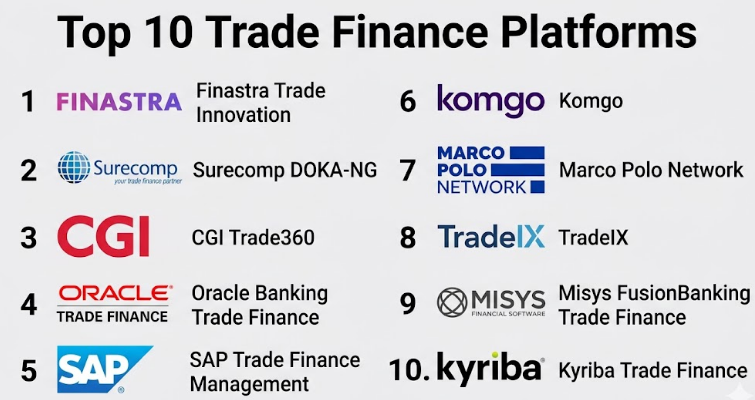
Top 10 Trade Finance Platforms
#1 — Finastra Trade Innovation
Short description :
Finastra Trade Innovation is a widely used platform designed for banks and financial institutions to manage trade finance operations. It supports end-to-end processing of trade transactions including letters of credit, guarantees, and collections. Known for its scalability, it caters to global banks handling large transaction volumes. The platform also integrates with core banking systems and SWIFT networks. It is best suited for enterprises seeking a robust and comprehensive trade finance solution.
Key Features
- End-to-end trade lifecycle management
- SWIFT integration
- Multi-entity and multi-currency support
- Workflow automation
- Risk management tools
- Reporting and analytics
Pros
- Highly scalable for enterprise use
- Strong banking integrations
Cons
- Complex implementation
- High cost for smaller organizations
Platforms / Deployment
Cloud / On-premise / Hybrid
Security & Compliance
RBAC, encryption, audit logs; other certifications Not publicly stated
Integrations & Ecosystem
Supports integration with banking systems, ERP, and SWIFT networks.
- Core banking systems
- ERP platforms
- Payment networks
- API integrations
Support & Community
Enterprise-grade support with onboarding services; community details Not publicly stated
#2 — Surecomp DOKA-NG
Short description:
Surecomp DOKA-NG is a modular trade finance solution focused on banks and financial institutions. It offers comprehensive trade services including guarantees, collections, and letters of credit. The platform emphasizes flexibility and digital transformation with strong automation capabilities.
Key Features
- Modular architecture
- Digital trade processing
- Compliance automation
- Workflow management
- Customer portal
- Trade analytics
Pros
- Flexible and configurable
- Strong compliance features
Cons
- Requires customization
- Implementation time can be long
Platforms / Deployment
Cloud / On-premise
Security & Compliance
MFA, audit logs; certifications Not publicly stated
Integrations & Ecosystem
Integrates with banking and financial systems using APIs.
- SWIFT
- Core banking systems
- ERP integrations
- API ecosystem
Support & Community
Professional support services; community presence limited
#3 — CGI Trade360
Short description:
CGI Trade360 is a cloud-based platform enabling digital trade finance operations. It connects banks, corporates, and partners through a single ecosystem. The platform is known for real-time collaboration and visibility across trade transactions.
Key Features
- Multi-bank connectivity
- Real-time dashboards
- Workflow automation
- Document management
- Risk assessment tools
Pros
- Strong collaboration features
- Cloud-first design
Cons
- Limited customization for niche use cases
- Pricing may vary significantly
Platforms / Deployment
Cloud
Security & Compliance
Encryption, RBAC; certifications Not publicly stated
Integrations & Ecosystem
Offers APIs and connectors for enterprise systems.
- ERP systems
- Banking platforms
- APIs
- Partner integrations
Support & Community
Enterprise support with onboarding assistance
#4 — Oracle Banking Trade Finance
Short description:
Oracle’s trade finance platform is part of its banking suite, offering integrated trade services for financial institutions. It provides automation, compliance, and analytics for global trade operations.
Key Features
- Integrated banking suite
- Trade lifecycle automation
- Compliance management
- Reporting tools
- Multi-currency support
Pros
- Strong enterprise ecosystem
- Reliable performance
Cons
- Requires Oracle ecosystem familiarity
- Cost-intensive
Platforms / Deployment
Cloud / On-premise
Security & Compliance
SSO, encryption; certifications Not publicly stated
Integrations & Ecosystem
Seamlessly integrates with Oracle products and third-party systems.
- Oracle ERP
- Banking systems
- APIs
- Data analytics tools
Support & Community
Strong enterprise support and documentation
#5 — SAP Trade Finance Management
Short description:
SAP Trade Finance Management is designed for enterprises already using SAP systems. It integrates trade finance operations directly into SAP ERP workflows, enabling better financial visibility and control.
Key Features
- ERP integration
- Trade compliance tools
- Workflow automation
- Financial tracking
- Risk management
Pros
- Seamless SAP integration
- Strong analytics
Cons
- Limited outside SAP ecosystem
- Requires SAP expertise
Platforms / Deployment
Cloud / On-premise
Security & Compliance
SSO, RBAC; certifications Not publicly stated
Integrations & Ecosystem
Deep integration within SAP ecosystem.
- SAP ERP
- Finance modules
- APIs
- Data analytics
Support & Community
Large enterprise community and support network
#6 — Komgo
Short description:
Komgo is a blockchain-based trade finance platform designed for secure document exchange and financing processes. It focuses on reducing fraud and increasing transparency in commodity trade finance.
Key Features
- Blockchain-based workflows
- Secure document exchange
- KYC management
- Trade finance digitization
- Fraud prevention tools
Pros
- High transparency
- Innovative blockchain approach
Cons
- Still evolving ecosystem
- Limited adoption compared to traditional tools
Platforms / Deployment
Cloud
Security & Compliance
Encryption; blockchain-based security
Integrations & Ecosystem
Supports integration with banking and commodity trading systems.
- APIs
- Trade partners
- Financial systems
Support & Community
Growing ecosystem with enterprise partnerships
#7 — Marco Polo Network
Short description:
Marco Polo Network is a distributed trade finance platform leveraging blockchain technology. It connects banks and corporates for real-time trade finance and working capital solutions.
Key Features
- Distributed ledger technology
- Real-time trade data
- Risk management
- Payment tracking
- Collaboration tools
Pros
- Strong innovation
- Real-time insights
Cons
- Adoption still growing
- Requires ecosystem participation
Platforms / Deployment
Cloud
Security & Compliance
Encryption; details Not publicly stated
Integrations & Ecosystem
Focuses on network-based integrations.
- Banking partners
- APIs
- ERP systems
Support & Community
Partner-driven support model
#8 — TradeIX
Short description:
TradeIX provides a digital trade finance platform focusing on supply chain finance and blockchain integration. It aims to modernize trade processes with better transparency and automation.
Key Features
- Supply chain finance tools
- Blockchain integration
- Workflow automation
- Risk analysis
- Data analytics
Pros
- Strong focus on supply chain finance
- Modern architecture
Cons
- Limited traditional banking features
- Requires integration effort
Platforms / Deployment
Cloud
Security & Compliance
Encryption; details Not publicly stated
Integrations & Ecosystem
API-driven integrations.
- ERP systems
- Banking systems
- APIs
Support & Community
Enterprise-focused support
#9 — Misys FusionBanking Trade Finance
Short description:
Misys (now part of Finastra) FusionBanking Trade Finance provides robust capabilities for trade finance processing and risk management. It supports banks handling complex international trade operations.
Key Features
- Trade lifecycle management
- Risk and compliance tools
- Multi-currency support
- Workflow automation
- Reporting tools
Pros
- Comprehensive features
- Strong banking focus
Cons
- Complex setup
- Requires skilled users
Platforms / Deployment
Cloud / On-premise
Security & Compliance
RBAC, encryption; certifications Not publicly stated
Integrations & Ecosystem
Integrates with banking systems and APIs.
- Core banking
- ERP
- APIs
Support & Community
Enterprise support available
#10 — Kyriba Trade Finance
Short description:
Kyriba offers treasury and trade finance capabilities within its financial platform. It is suitable for enterprises managing liquidity and trade finance operations in a unified system.
Key Features
- Treasury integration
- Trade finance workflows
- Risk management
- Payment automation
- Reporting tools
Pros
- Strong treasury integration
- User-friendly interface
Cons
- Limited specialized trade features
- Pricing may vary
Platforms / Deployment
Cloud
Security & Compliance
Encryption, MFA; certifications Not publicly stated
Integrations & Ecosystem
Integrates with financial and ERP systems.
- ERP systems
- Banking networks
- APIs
Support & Community
Good enterprise support and onboarding
Comparison Table (Top 10)
| Tool Name | Best For | Platform(s) Supported | Deployment | Standout Feature | Public Rating |
|---|---|---|---|---|---|
| Finastra Trade Innovation | Large banks | Web | Hybrid | End-to-end lifecycle | N/A |
| Surecomp DOKA-NG | Financial institutions | Web | Cloud/On-premise | Modular design | N/A |
| CGI Trade360 | Enterprises | Web | Cloud | Real-time collaboration | N/A |
| Oracle Banking Trade Finance | Enterprise banks | Web | Hybrid | Oracle ecosystem | N/A |
| SAP Trade Finance Management | SAP users | Web | Hybrid | ERP integration | N/A |
| Komgo | Commodity trade | Web | Cloud | Blockchain security | N/A |
| Marco Polo Network | Trade networks | Web | Cloud | Distributed ledger | N/A |
| TradeIX | Supply chain finance | Web | Cloud | API-first architecture | N/A |
| Misys FusionBanking Trade Finance | Banks | Web | Hybrid | Risk management | N/A |
| Kyriba Trade Finance | Enterprises | Web | Cloud | Treasury integration | N/A |
Evaluation & Trade Finance Platforms
| Tool Name | Core (25%) | Ease (15%) | Integrations (15%) | Security (10%) | Performance (10%) | Support (10%) | Value (15%) | Weighted Total |
|---|---|---|---|---|---|---|---|---|
| Finastra Trade Innovation | 9 | 7 | 9 | 8 | 9 | 8 | 7 | 8.3 |
| Surecomp DOKA-NG | 8 | 7 | 8 | 8 | 8 | 7 | 7 | 7.8 |
| CGI Trade360 | 8 | 8 | 8 | 7 | 8 | 8 | 7 | 7.9 |
| Oracle Banking Trade Finance | 9 | 7 | 9 | 8 | 9 | 8 | 6 | 8.1 |
| SAP Trade Finance Management | 8 | 7 | 8 | 8 | 8 | 8 | 7 | 7.8 |
| Komgo | 7 | 7 | 7 | 8 | 7 | 7 | 7 | 7.2 |
| Marco Polo Network | 7 | 7 | 7 | 7 | 7 | 7 | 7 | 7.0 |
| TradeIX | 7 | 8 | 8 | 7 | 7 | 7 | 7 | 7.3 |
| Misys FusionBanking Trade Finance | 9 | 6 | 8 | 8 | 9 | 8 | 6 | 8.0 |
| Kyriba Trade Finance | 8 | 8 | 8 | 8 | 8 | 8 | 7 | 7.9 |
How to interpret scores:
- Scores are comparative, not absolute performance indicators
- Higher “Core” reflects stronger feature completeness
- “Ease” indicates usability and onboarding experience
- “Integrations” measures ecosystem flexibility
- “Value” balances cost vs capability
- Choose tools based on priorities, not just total score
Which Trade Finance Platforms
Solo / Freelancer
Not typically required. Basic accounting or invoicing tools are better suited.
SMB
Look for lightweight, cloud-based platforms like Kyriba or TradeIX that offer essential features without heavy implementation.
Mid-Market
CGI Trade360 or Surecomp DOKA-NG provide a balance between features and flexibility.
Enterprise
Finastra, Oracle, and SAP platforms are best for large-scale, complex operations.
Budget vs Premium
- Budget: TradeIX, Kyriba
- Premium: Oracle, SAP, Finastra
Feature Depth vs Ease of Use
- Deep features: Finastra, Oracle
- Ease of use: Kyriba, CGI Trade360
Integrations & Scalability
- Strong integrations: SAP, Oracle, Finastra
- Moderate: TradeIX, Kyriba
Security & Compliance Needs
- High compliance: Finastra, Oracle
- Moderate: TradeIX, Komgo
Frequently Asked Questions (FAQs)
1. What is a Trade Finance Platform?
It is a software system that manages international trade transactions like letters of credit, guarantees, and financing.
2. How much do these platforms cost?
Pricing varies widely depending on scale and features. Most enterprise tools use custom pricing models.
3. How long does implementation take?
Implementation can take weeks to months depending on complexity and integrations.
4. Are these platforms secure?
Most platforms offer encryption, access control, and audit logs, but certifications may vary.
5. Can they integrate with ERP systems?
Yes, most modern platforms provide APIs and connectors for ERP integration.
6. Are they suitable for small businesses?
Generally no; smaller businesses may not need full trade finance solutions.
7. What industries use trade finance platforms?
Banking, manufacturing, logistics, commodities trading, and global enterprises.
8. What are common mistakes when choosing a platform?
Ignoring integration needs, underestimating implementation complexity, and focusing only on cost.
9. Can I switch platforms easily?
Switching is possible but can be complex due to data migration and integrations.
10. Are blockchain-based platforms better?
They offer transparency and security but may not yet match traditional systems in adoption.
Conclusion
Trade Finance Platforms are critical tools for organizations managing global trade operations. They help reduce manual work, improve compliance, and provide better visibility into transactions. However, the “best” platform depends heavily on your business size, complexity, and integration needs. Enterprise organizations may prioritize scalability and compliance, while mid-sized firms may focus on ease of use and cost efficiency. The right approach is to shortlist two or three platforms, evaluate their integration capabilities, and run a pilot project. This ensures the solution aligns with your operational workflows and delivers real business value before full-scale deployment.
