Introduction
RAG (Retrieval-Augmented Generation) tooling refers to platforms and frameworks that combine information retrieval systems (like vector databases) with AI generation models (like LLMs). In simple terms, instead of relying only on a model’s internal knowledge, RAG tools allow AI to fetch real-time or private data and use it to generate more accurate and contextual responses.
This approach has become critical in modern AI systems where accuracy, relevance, and trust are non-negotiable. As organizations deploy AI assistants, enterprise search systems, and knowledge bots, RAG ensures that responses are grounded in real data, not hallucinated guesses.
Real-world use cases:
- Enterprise knowledge chatbots for internal documentation
- Customer support automation using company data
- Legal and compliance document search assistants
- AI-powered research tools and summarization systems
- Personalized recommendation systems
What buyers should evaluate:
- Retrieval quality and ranking mechanisms
- Vector database compatibility
- Latency and response time
- Scalability for large datasets
- Integration with LLM providers
- Data ingestion pipelines and connectors
- Security and data isolation
- Observability and debugging tools
- Cost efficiency and pricing model
Best for: AI engineers, data teams, SaaS companies, enterprises building internal knowledge systems, and startups building AI-powered apps.
Not ideal for: Teams without structured data, simple chatbot use cases that don’t require external knowledge, or low-scale applications where basic prompt engineering is sufficient.
Key Trends in RAG (Retrieval-Augmented Generation) Tooling
- Rise of hybrid search (vector + keyword) for better retrieval accuracy
- Adoption of multi-vector and multi-modal retrieval systems
- Integration with real-time data sources and streaming pipelines
- Growing focus on evaluation and observability in RAG pipelines
- Emergence of end-to-end RAG platforms (no-code + low-code)
- Increased demand for data privacy and secure RAG architectures
- Support for multi-LLM orchestration within RAG pipelines
- Optimization for low-latency retrieval at scale
- Evolution of agent-based RAG systems
- Pricing shifting toward usage-based models (tokens + queries)
How We Selected These Tools (Methodology)
- Selected tools with strong developer adoption and ecosystem presence
- Evaluated end-to-end RAG capabilities (retrieval, generation, orchestration)
- Assessed performance and scalability benchmarks
- Considered security practices and enterprise readiness
- Reviewed integration flexibility with databases and APIs
- Ensured mix of open-source and enterprise-grade platforms
- Prioritized tools supporting modern LLM workflows
- Focused on platforms actively evolving in the AI ecosystem
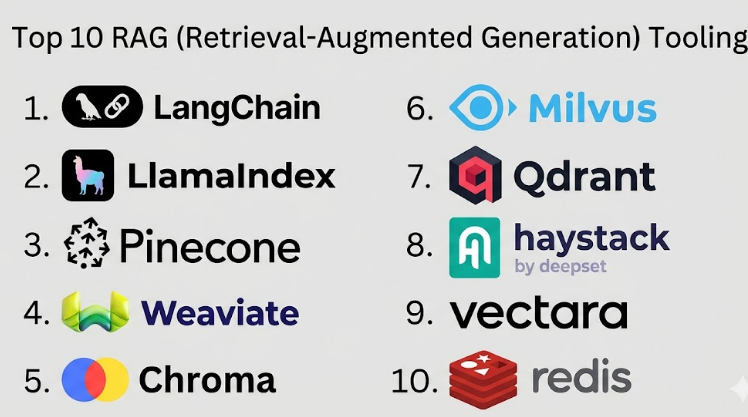
Top 10 RAG (Retrieval-Augmented Generation) Tooling
#1 — LangChain
Short description: A popular open-source framework for building RAG applications, widely used by developers to orchestrate LLM pipelines.
Key Features
- Modular RAG pipeline building
- Document loaders and retrievers
- Memory management
- Multi-LLM support
- Agent workflows
- Prompt chaining
Pros
- Highly flexible and extensible
- Strong community adoption
Cons
- Steep learning curve
- Debugging can be complex
Platforms / Deployment
Cloud / Self-hosted
Security & Compliance
Not publicly stated
Integrations & Ecosystem
Extensive ecosystem support for AI tools and databases.
- Vector databases (Pinecone, Weaviate)
- APIs for LLM providers
- Data connectors
Support & Community
Very strong open-source community and documentation.
#2 — LlamaIndex
Short description: A data framework designed specifically for connecting LLMs with structured and unstructured data sources.
Key Features
- Data connectors and ingestion pipelines
- Indexing and retrieval optimization
- Query engines
- Multi-modal support
- Evaluation tools
Pros
- Designed for RAG use cases
- Easy data integration
Cons
- Requires technical expertise
- Limited UI
Platforms / Deployment
Cloud / Self-hosted
Security & Compliance
Not publicly stated
Integrations & Ecosystem
Strong integration with data ecosystems.
- Databases and APIs
- File systems
- Cloud storage
Support & Community
Growing developer community.
#3 — Pinecone
Short description: A managed vector database optimized for similarity search and RAG applications.
Key Features
- High-performance vector search
- Managed infrastructure
- Scalability
- Metadata filtering
- Low-latency queries
Pros
- Fully managed
- High performance
Cons
- Cost can scale with usage
- Limited control over infrastructure
Platforms / Deployment
Cloud
Security & Compliance
Not publicly stated
Integrations & Ecosystem
Works with major AI frameworks.
- LangChain
- LlamaIndex
- APIs
Support & Community
Enterprise support available.
#4 — Weaviate
Short description: An open-source vector database with built-in AI modules for semantic search and RAG.
Key Features
- Hybrid search
- GraphQL API
- Modular AI integrations
- Schema-based data modeling
- Scalability
Pros
- Open-source flexibility
- Built-in AI features
Cons
- Requires infrastructure management
- Setup complexity
Platforms / Deployment
Cloud / Self-hosted
Security & Compliance
Not publicly stated
Integrations & Ecosystem
- APIs
- ML frameworks
- Cloud platforms
Support & Community
Active open-source community.
#5 — Chroma
Short description: Lightweight vector database designed for developers building local or small-scale RAG applications.
Key Features
- Simple vector storage
- Embedding support
- Fast local deployment
- Easy API usage
- Minimal setup
Pros
- Beginner-friendly
- Lightweight
Cons
- Not ideal for large-scale systems
- Limited enterprise features
Platforms / Deployment
Self-hosted
Security & Compliance
Not publicly stated
Integrations & Ecosystem
- Python-based integrations
- LLM APIs
Support & Community
Growing community.
#6 — Milvus
Short description: Open-source vector database designed for large-scale AI and RAG applications.
Key Features
- High-performance vector indexing
- Distributed architecture
- Multi-cloud support
- GPU acceleration
- Scalability
Pros
- Highly scalable
- Enterprise-ready
Cons
- Complex setup
- Requires infrastructure expertise
Platforms / Deployment
Cloud / Self-hosted
Security & Compliance
Not publicly stated
Integrations & Ecosystem
- Data pipelines
- APIs
- ML frameworks
Support & Community
Strong community and enterprise support.
#7 — Qdrant
Short description: Vector database with focus on performance, filtering, and real-time RAG use cases.
Key Features
- Payload filtering
- Real-time updates
- Distributed deployment
- High performance
- API-first design
Pros
- Fast and efficient
- Flexible filtering
Cons
- Smaller ecosystem
- Learning curve
Platforms / Deployment
Cloud / Self-hosted
Security & Compliance
Not publicly stated
Integrations & Ecosystem
- APIs
- LLM frameworks
Support & Community
Growing ecosystem.
#8 — Haystack
Short description: Open-source framework for building search systems and RAG pipelines.
Key Features
- Pipeline orchestration
- Document retrieval
- Multi-model support
- Evaluation tools
- API-based workflows
Pros
- Mature framework
- Flexible pipelines
Cons
- Requires configuration
- Less intuitive UI
Platforms / Deployment
Cloud / Self-hosted
Security & Compliance
Not publicly stated
Integrations & Ecosystem
- Search engines
- ML tools
- APIs
Support & Community
Strong open-source backing.
#9 — Vectara
Short description: End-to-end RAG platform offering retrieval and generation capabilities out-of-the-box.
Key Features
- Managed RAG platform
- Semantic search
- Built-in ranking
- APIs for integration
- Real-time indexing
Pros
- Easy to deploy
- End-to-end solution
Cons
- Less customization
- Pricing varies
Platforms / Deployment
Cloud
Security & Compliance
Not publicly stated
Integrations & Ecosystem
- APIs
- Data ingestion pipelines
Support & Community
Enterprise support available.
#10 — Redis (Vector Search)
Short description: Extension of Redis enabling vector search capabilities for RAG systems.
Key Features
- In-memory vector search
- Fast performance
- Hybrid queries
- Scalability
- Integration with existing Redis setups
Pros
- Very fast
- Widely adopted
Cons
- Limited advanced RAG features
- Requires tuning
Platforms / Deployment
Cloud / Self-hosted
Security & Compliance
Not publicly stated
Integrations & Ecosystem
- APIs
- Databases
- AI frameworks
Support & Community
Very strong global community.
Comparison Table (Top 10)
| Tool Name | Best For | Platform(s) Supported | Deployment | Standout Feature | Public Rating |
|---|---|---|---|---|---|
| LangChain | RAG orchestration | Web | Cloud/Self-hosted | Pipeline flexibility | N/A |
| LlamaIndex | Data integration | Web | Cloud/Self-hosted | Indexing system | N/A |
| Pinecone | Vector DB | Web | Cloud | Managed vector search | N/A |
| Weaviate | Open-source DB | Web | Cloud/Self-hosted | Hybrid search | N/A |
| Chroma | Lightweight apps | Local | Self-hosted | Simplicity | N/A |
| Milvus | Large-scale AI | Linux | Cloud/Self-hosted | Distributed search | N/A |
| Qdrant | Real-time apps | Web | Cloud/Self-hosted | Filtering | N/A |
| Haystack | Search pipelines | Web | Cloud/Self-hosted | Pipeline design | N/A |
| Vectara | Managed RAG | Web | Cloud | End-to-end platform | N/A |
| Redis | Fast retrieval | Web | Cloud/Self-hosted | In-memory speed | N/A |
Evaluation & Scoring of RAG (Retrieval-Augmented Generation) Tooling
| Tool Name | Core | Ease | Integrations | Security | Performance | Support | Value | Weighted Total |
|---|---|---|---|---|---|---|---|---|
| LangChain | 9 | 7 | 9 | 7 | 8 | 9 | 8 | 8.3 |
| LlamaIndex | 9 | 8 | 8 | 7 | 8 | 8 | 8 | 8.2 |
| Pinecone | 9 | 8 | 9 | 8 | 9 | 8 | 7 | 8.4 |
| Weaviate | 8 | 7 | 8 | 7 | 8 | 7 | 8 | 7.8 |
| Chroma | 7 | 9 | 7 | 6 | 7 | 7 | 9 | 7.8 |
| Milvus | 9 | 6 | 8 | 8 | 9 | 7 | 7 | 8.0 |
| Qdrant | 8 | 7 | 7 | 7 | 8 | 7 | 8 | 7.7 |
| Haystack | 8 | 7 | 8 | 7 | 8 | 8 | 8 | 7.9 |
| Vectara | 8 | 9 | 7 | 8 | 8 | 8 | 7 | 8.0 |
| Redis | 8 | 8 | 9 | 7 | 9 | 9 | 8 | 8.3 |
Interpretation:
- Scores reflect comparative strength across multiple dimensions
- Enterprise tools score higher in performance and security
- Open-source tools score higher in flexibility and value
- Ease of use may vary based on technical expertise
- Always evaluate based on your use case
Which RAG (Retrieval-Augmented Generation) Tooling
Solo / Freelancer
- Best: Chroma, LangChain
- Focus on simplicity and local development
SMB
- Best: LlamaIndex, Pinecone
- Balance of performance and usability
Mid-Market
- Best: Weaviate, Qdrant
- Scalable and flexible
Enterprise
- Best: Milvus, Vectara, Pinecone
- High performance and reliability
Budget vs Premium
- Budget: Chroma, Qdrant
- Premium: Pinecone, Vectara
Feature Depth vs Ease of Use
- Deep features: LangChain, Haystack
- Easy to use: Vectara, Chroma
Integrations & Scalability
- Strong integrations: LangChain, Redis
- Scalable: Milvus, Pinecone
Security & Compliance Needs
- High security: Pinecone, Milvus
- Moderate: Weaviate, Qdrant
Frequently Asked Questions (FAQs)
What is RAG in AI?
RAG combines retrieval systems with AI models to improve response accuracy using external data.
Why is RAG important?
It reduces hallucinations and improves trust in AI outputs.
Do I need a vector database?
Yes, most RAG systems rely on vector databases for similarity search.
Is RAG expensive?
Costs vary depending on data size, queries, and infrastructure.
Can RAG work in real-time?
Yes, many tools support low-latency retrieval.
Is RAG secure?
Security depends on deployment and tool choice.
How long does it take to build a RAG system?
From a few days to several weeks depending on complexity.
Can I use multiple models?
Yes, many tools support multi-LLM setups.
What are common mistakes?
Poor data quality, lack of evaluation, and ignoring latency.
Can I switch tools later?
Yes, but migration depends on architecture.
Conclusion
RAG (Retrieval-Augmented Generation) tooling has quickly become one of the most important building blocks in modern AI systems. Instead of relying solely on pre-trained models, organizations are now building AI applications that are deeply connected to their own data, ensuring better accuracy, relevance, and trust. However, choosing the right RAG tooling depends entirely on your use case. Developer-first frameworks like LangChain and LlamaIndex offer flexibility, while managed solutions like Pinecone and Vectara simplify deployment. Open-source databases like Milvus and Weaviate provide scalability, while lightweight tools like Chroma are perfect for rapid prototyping.
