Introduction
Prompt Engineering Tools are platforms and frameworks that help users design, test, optimize, and manage prompts used to interact with AI models like large language models (LLMs). Instead of manually experimenting with prompts, these tools provide structured workflows, versioning, testing environments, and collaboration features to improve output quality and consistency.
In today’s AI-driven environment, prompt engineering has become a core skill for developers, marketers, product teams, and AI engineers. As organizations increasingly rely on generative AI for automation, content generation, coding, analytics, and customer support, managing prompts effectively is no longer optional—it is critical for performance, cost control, and reliability.
Real-world use cases include:
- Building AI-powered chatbots and assistants
- Automating content creation workflows
- Enhancing developer productivity with AI copilots
- Running A/B testing for prompt optimization
- Managing enterprise AI workflows and governance
What buyers should evaluate:
- Prompt testing and evaluation capabilities
- Version control and collaboration features
- Integration with LLM APIs and workflows
- Security and compliance controls
- Scalability and performance
- Ease of use for non-technical users
- Cost and pricing flexibility
- Observability and analytics
- Deployment options (cloud vs self-hosted)
Best for: Developers, AI engineers, product managers, marketers, and enterprises building AI-driven workflows, especially those scaling LLM usage across teams.
Not ideal for: Individuals using AI casually or small teams with minimal prompt experimentation needs; basic AI interfaces may be sufficient in such cases.
Key Trends in Prompt Engineering Tools
- Rise of LLM observability platforms with real-time monitoring and debugging
- Increased focus on prompt versioning and lifecycle management
- Integration with AI agents and autonomous workflows
- Growing demand for security, governance, and auditability
- Expansion of no-code and low-code prompt builders
- Support for multi-model orchestration (OpenAI, Anthropic, etc.)
- Emergence of evaluation frameworks and benchmarking tools
- Integration with CI/CD pipelines for AI applications
- Adoption of fine-tuning + prompt hybrid strategies
- Shift toward enterprise-grade prompt management platforms
How We Selected These Tools (Methodology)
- Strong market adoption and developer mindshare
- Feature completeness across prompt lifecycle
- Performance and reliability indicators
- Security posture and enterprise readiness
- Integration capabilities with modern stacks
- Flexibility across use cases (dev, business, AI teams)
- Support for multiple LLM providers
- Community activity and ecosystem growth
- Fit across SMB, mid-market, and enterprise users
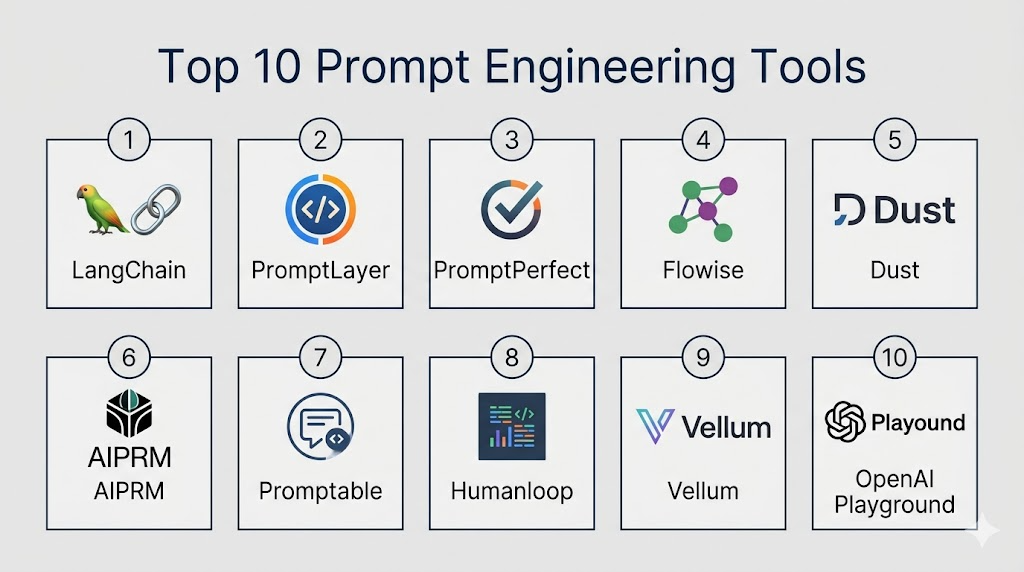
Top 10 Prompt Engineering Tools
#1 — LangChain
Short description: A popular developer framework for building applications using LLMs. Widely used for chaining prompts, tools, and workflows.
Key Features
- Prompt templates and chaining logic
- Memory and context management
- Multi-model support
- Tool and agent integrations
- Extensive ecosystem and plugins
- Debugging and tracing tools
Pros
- Highly flexible for developers
- Strong ecosystem and community
Cons
- Steep learning curve
- Requires coding expertise
Platforms / Deployment
Python / JavaScript / Cloud / Self-hosted
Security & Compliance
Varies / Not publicly stated
Integrations & Ecosystem
Strong integration with LLM APIs and developer tools
- OpenAI, Anthropic
- Vector databases
- APIs and plugins
- Cloud platforms
Support & Community
Large open-source community with extensive documentation
#2 — PromptLayer
Short description: A prompt management and observability platform designed for tracking and optimizing LLM prompts.
Key Features
- Prompt logging and tracking
- Version control
- Performance analytics
- A/B testing
- API integration
Pros
- Strong observability features
- Easy integration
Cons
- Limited UI flexibility
- Focused mainly on monitoring
Platforms / Deployment
Web / Cloud
Security & Compliance
Not publicly stated
Integrations & Ecosystem
Supports API-based integrations
- LLM providers
- Developer tools
- Analytics platforms
Support & Community
Growing community with good documentation
#3 — PromptPerfect
Short description: A tool focused on optimizing prompts automatically for better AI responses.
Key Features
- Automated prompt refinement
- Multi-model compatibility
- Performance benchmarking
- Prompt tuning suggestions
- Optimization engine
Pros
- Improves prompt quality quickly
- Easy to use
Cons
- Limited customization depth
- Less control for advanced users
Platforms / Deployment
Web / Cloud
Security & Compliance
Not publicly stated
Integrations & Ecosystem
Works with multiple AI models
- OpenAI
- Other LLM APIs
Support & Community
Moderate documentation and support
#4 — Flowise
Short description: A visual drag-and-drop tool for building LLM workflows and prompt pipelines.
Key Features
- Visual workflow builder
- Node-based prompt design
- Integration with LangChain
- API deployment
- Custom components
Pros
- No-code friendly
- Fast prototyping
Cons
- Limited enterprise features
- Performance varies
Platforms / Deployment
Web / Self-hosted / Cloud
Security & Compliance
Varies / Not publicly stated
Integrations & Ecosystem
- LangChain
- APIs
- Databases
Support & Community
Open-source community support
#5 — Dust
Short description: A collaborative AI tool for building internal assistants and managing prompts.
Key Features
- Team collaboration
- Prompt templates
- Workflow automation
- Knowledge base integration
- Custom assistants
Pros
- Strong collaboration features
- Enterprise-friendly
Cons
- Limited customization
- Pricing transparency unclear
Platforms / Deployment
Web / Cloud
Security & Compliance
Not publicly stated
Integrations & Ecosystem
- Internal data sources
- APIs
- Knowledge systems
Support & Community
Enterprise-focused support
#6 — AIPRM
Short description: A prompt management extension widely used for predefined templates and marketing use cases.
Key Features
- Prompt templates library
- Community sharing
- SEO and marketing prompts
- Easy installation
- Categorized prompts
Pros
- Easy for beginners
- Large template library
Cons
- Limited customization
- Browser dependency
Platforms / Deployment
Browser extension
Security & Compliance
Not publicly stated
Integrations & Ecosystem
- ChatGPT integration
- Template sharing
Support & Community
Active user community
#7 — Promptable
Short description: A testing and evaluation platform for prompts focused on improving output quality.
Key Features
- Prompt testing
- Evaluation metrics
- Regression testing
- Debugging tools
- Collaboration
Pros
- Strong testing features
- Useful for developers
Cons
- Smaller ecosystem
- Limited integrations
Platforms / Deployment
Web / Cloud
Security & Compliance
Not publicly stated
Integrations & Ecosystem
- APIs
- LLM providers
Support & Community
Emerging community
#8 — Humanloop
Short description: A platform for building, evaluating, and deploying AI applications with prompt management.
Key Features
- Prompt versioning
- Evaluation workflows
- Data annotation
- Experiment tracking
- Analytics
Pros
- Strong enterprise features
- Good evaluation tools
Cons
- Learning curve
- Pricing not transparent
Platforms / Deployment
Web / Cloud
Security & Compliance
Not publicly stated
Integrations & Ecosystem
- LLM APIs
- Data pipelines
- Analytics tools
Support & Community
Enterprise-grade support
#9 — Vellum
Short description: A platform for prompt engineering, testing, and deployment with a focus on production use.
Key Features
- Prompt testing
- Version control
- Workflow automation
- Monitoring
- Deployment tools
Pros
- Production-ready features
- Strong testing
Cons
- Complex setup
- Limited free usage
Platforms / Deployment
Web / Cloud
Security & Compliance
Not publicly stated
Integrations & Ecosystem
- APIs
- LLM platforms
- Dev tools
Support & Community
Professional support available
#10 — OpenAI Playground
Short description: A widely used interface for experimenting with prompts and testing LLM outputs.
Key Features
- Interactive prompt testing
- Parameter tuning
- Model selection
- Real-time outputs
- Simple interface
Pros
- Easy to use
- Great for experimentation
Cons
- Not a full management tool
- Limited collaboration
Platforms / Deployment
Web / Cloud
Security & Compliance
Varies / Not publicly stated
Integrations & Ecosystem
- OpenAI ecosystem
- API access
Support & Community
Extensive documentation
Comparison Table (Top 10)
| Tool Name | Best For | Platform(s) Supported | Deployment | Standout Feature | Public Rating |
|---|---|---|---|---|---|
| LangChain | Developers | Python/JS | Hybrid | Workflow chaining | N/A |
| PromptLayer | Monitoring | Web | Cloud | Observability | N/A |
| PromptPerfect | Optimization | Web | Cloud | Auto prompt tuning | N/A |
| Flowise | No-code users | Web | Hybrid | Visual builder | N/A |
| Dust | Teams | Web | Cloud | Collaboration | N/A |
| AIPRM | Marketers | Browser | Cloud | Prompt templates | N/A |
| Promptable | Testing | Web | Cloud | Evaluation tools | N/A |
| Humanloop | Enterprises | Web | Cloud | Experiment tracking | N/A |
| Vellum | Production teams | Web | Cloud | Deployment tools | N/A |
| OpenAI Playground | Beginners | Web | Cloud | Easy experimentation | N/A |
Evaluation & Scoring of Prompt Engineering Tools
| Tool Name | Core | Ease | Integrations | Security | Performance | Support | Value | Weighted Total |
|---|---|---|---|---|---|---|---|---|
| LangChain | 9 | 6 | 9 | 6 | 8 | 8 | 8 | 8.0 |
| PromptLayer | 8 | 8 | 7 | 6 | 7 | 7 | 7 | 7.4 |
| PromptPerfect | 7 | 9 | 6 | 5 | 7 | 6 | 8 | 7.1 |
| Flowise | 7 | 8 | 7 | 5 | 6 | 6 | 8 | 7.0 |
| Dust | 8 | 7 | 7 | 6 | 7 | 7 | 7 | 7.3 |
| AIPRM | 6 | 9 | 5 | 5 | 6 | 6 | 8 | 6.8 |
| Promptable | 7 | 7 | 6 | 5 | 7 | 6 | 7 | 6.9 |
| Humanloop | 9 | 7 | 8 | 7 | 8 | 8 | 7 | 8.1 |
| Vellum | 8 | 7 | 8 | 7 | 8 | 7 | 7 | 7.8 |
| OpenAI Playground | 7 | 10 | 6 | 6 | 8 | 8 | 9 | 7.8 |
How to interpret scores:
- Scores are comparative, not absolute.
- Higher scores indicate stronger overall capability for enterprise use.
- Ease of use matters more for non-technical teams.
- Integration and security scores are critical for production deployments.
Which Prompt Engineering Tools for You?
Solo / Freelancer
- Best: OpenAI Playground, AIPRM, PromptPerfect
- Focus on ease and speed
SMB
- Best: Flowise, PromptLayer, Dust
- Balance between usability and features
Mid-Market
- Best: Vellum, Humanloop
- Need scalability and testing
Enterprise
- Best: LangChain, Humanloop
- Focus on integrations, governance, performance
Budget vs Premium
- Budget: OpenAI Playground, Flowise
- Premium: Humanloop, Vellum
Feature Depth vs Ease of Use
- Deep features: LangChain
- Easy use: AIPRM, PromptPerfect
Integrations & Scalability
- Strong: LangChain, Humanloop
- Moderate: PromptLayer
Security & Compliance Needs
- Enterprise focus: Humanloop, Vellum
- Basic: AIPRM
Frequently Asked Questions (FAQs)
What are prompt engineering tools?
They help design, test, and manage prompts for AI systems to improve output quality and consistency.
Are these tools expensive?
Pricing varies widely; many offer free tiers, while enterprise tools can be costly.
Do I need coding skills?
Some tools require coding (LangChain), while others are no-code.
Can I use multiple tools together?
Yes, many tools integrate with APIs and can be combined.
Are these tools secure?
Security varies; enterprise tools offer better controls.
Do they support all AI models?
Most support major LLM providers.
How long does implementation take?
From minutes (simple tools) to weeks (enterprise deployment).
Can I switch tools easily?
Depends on architecture and integrations.
What is the biggest mistake users make?
Not testing prompts properly before deployment.
Are prompt tools replacing developers?
No, they enhance productivity but still require expertise.
Conclusion
Prompt engineering tools have become essential for anyone building or scaling AI-powered applications. From simple experimentation platforms to enterprise-grade systems with governance, testing, and observability, the ecosystem is evolving rapidly. The right choice depends on your use case, technical expertise, and scale. Beginners may benefit from simple tools like Playground or AIPRM, while enterprises should prioritize platforms like Humanloop or LangChain for advanced workflows.
