Introduction
Stream Processing Frameworks are software systems designed to process continuous flows of data in real time. Instead of waiting for data to be stored and processed in batches, these frameworks analyze and act on data the moment it arrives. This makes them essential for modern applications where speed, responsiveness, and real-time insights are critical.
In today’s data-driven world, businesses rely heavily on instant decision-making. Whether it’s fraud detection in banking, live recommendations in e-commerce, or monitoring infrastructure in DevOps, stream processing frameworks play a key role. With the rise of AI, IoT, and real-time analytics, these tools are becoming even more important.
Common use cases include:
- Real-time fraud detection and anomaly detection
- Live dashboards and analytics platforms
- Event-driven microservices architectures
- Log and metrics monitoring
- IoT data processing and automation
What buyers should evaluate:
- Latency and throughput performance
- Scalability and fault tolerance
- Ease of development and APIs
- Integration ecosystem
- Deployment flexibility (cloud/on-prem)
- Security and compliance support
- Cost and operational overhead
- Community and enterprise support
Best for: Data engineers, DevOps teams, platform engineers, and organizations handling real-time data at scale—especially in fintech, e-commerce, telecom, and SaaS.
Not ideal for: Small projects with low data volume, static reporting needs, or teams without real-time requirements. In such cases, batch processing or traditional databases may be sufficient.
Key Trends in Stream Processing Frameworks
- AI-driven stream analytics: Integration with machine learning models for real-time predictions
- Serverless streaming: Reduced operational overhead with managed services
- Unified batch + stream processing: Single frameworks handling both workloads
- Event-driven architectures: Growing adoption in microservices and cloud-native systems
- Low-latency processing improvements: Millisecond-level data processing becoming standard
- Security-first design: Encryption, RBAC, and compliance features becoming mandatory
- Multi-cloud compatibility: Tools designed to work across cloud providers
- Streaming SQL adoption: Easier querying for non-developers
- Cost optimization models: Pay-as-you-go and resource-based pricing
- Integration with data lakes and warehouses: Seamless pipelines across systems
How We Selected These Tools (Methodology)
- Evaluated market adoption and popularity
- Assessed feature completeness and flexibility
- Considered performance benchmarks and reliability signals
- Reviewed security capabilities and compliance readiness
- Checked integration ecosystem and extensibility
- Looked at community strength and enterprise support
- Balanced tools across enterprise, SMB, and open-source ecosystems
- Considered developer experience and ease of use
- Evaluated deployment flexibility (cloud vs self-hosted)
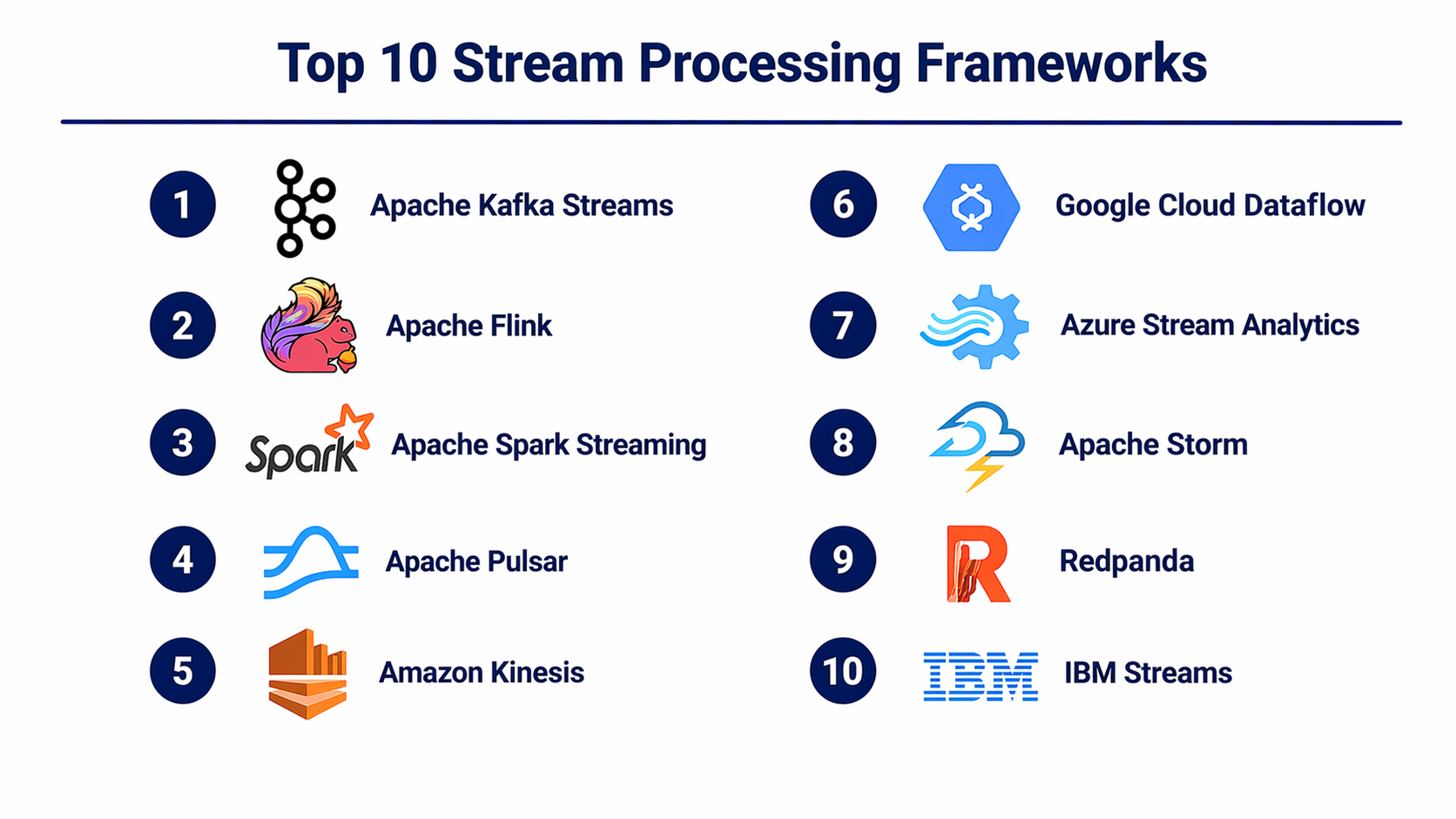
Top 10 Stream Processing Frameworks
#1 — Apache Kafka Streams
Short description: A lightweight stream processing library built on Kafka, ideal for developers building real-time applications directly within Kafka ecosystems.
Key Features
- Native Kafka integration
- Stateless and stateful processing
- Fault tolerance via Kafka
- Exactly-once processing semantics
- Scalable stream pipelines
- Local state storage
Pros
- Seamless Kafka integration
- High reliability and scalability
Cons
- Requires Kafka knowledge
- Limited outside Kafka ecosystem
Platforms / Deployment
Cloud / Self-hosted
Security & Compliance
Supports encryption, authentication, RBAC (depends on Kafka setup)
Integrations & Ecosystem
Works tightly with Kafka ecosystem, connectors, and event-driven systems
- Kafka Connect
- Kafka brokers
- Monitoring tools
Support & Community
Strong open-source community and extensive documentation
#2 — Apache Flink
Short description: A powerful distributed stream processing engine known for high performance and low latency.
Key Features
- True streaming architecture
- Event-time processing
- Stateful computations
- Fault tolerance
- SQL support
- Scalable processing
Pros
- Very low latency
- Strong fault tolerance
Cons
- Complex setup
- Steeper learning curve
Platforms / Deployment
Cloud / Self-hosted
Security & Compliance
Encryption, RBAC supported; compliance not publicly stated
Integrations & Ecosystem
Wide integrations with big data tools
- Kafka
- Hadoop
- Kubernetes
Support & Community
Active community and growing enterprise support
#3 — Apache Spark Streaming
Short description: Extension of Apache Spark for processing real-time data streams using micro-batch processing.
Key Features
- Micro-batch processing
- Integration with Spark ecosystem
- Fault tolerance
- Scalable architecture
- SQL support
Pros
- Easy for Spark users
- Strong ecosystem
Cons
- Higher latency than true streaming
- Resource-heavy
Platforms / Deployment
Cloud / Self-hosted
Security & Compliance
Encryption and access control supported
Integrations & Ecosystem
- Hadoop
- Kafka
- Databases
Support & Community
Large community and enterprise backing
#4 — Apache Pulsar
Short description: Distributed messaging and streaming platform designed for high throughput and low latency.
Key Features
- Multi-tenancy
- Geo-replication
- Low-latency messaging
- Stream processing
- Tiered storage
Pros
- High scalability
- Flexible architecture
Cons
- Less mature ecosystem than Kafka
- Setup complexity
Platforms / Deployment
Cloud / Self-hosted
Security & Compliance
Supports encryption, authentication
Integrations & Ecosystem
- Kafka connectors
- Cloud storage
- APIs
Support & Community
Growing community
#5 — Amazon Kinesis
Short description: Fully managed streaming service for real-time data processing in AWS.
Key Features
- Managed streaming
- Real-time analytics
- Auto scaling
- Integration with AWS services
Pros
- Easy setup
- No infrastructure management
Cons
- AWS dependency
- Cost can scale quickly
Platforms / Deployment
Cloud
Security & Compliance
Supports IAM, encryption, compliance frameworks
Integrations & Ecosystem
- AWS Lambda
- S3
- Redshift
Support & Community
Strong enterprise support
#6 — Google Cloud Dataflow
Short description: Fully managed stream and batch processing service based on Apache Beam.
Key Features
- Unified batch and stream
- Auto scaling
- Serverless execution
- Built-in monitoring
Pros
- Fully managed
- Flexible pipelines
Cons
- Google Cloud dependency
- Learning curve
Platforms / Deployment
Cloud
Security & Compliance
Supports encryption and IAM
Integrations & Ecosystem
- BigQuery
- Pub/Sub
- Cloud Storage
Support & Community
Strong enterprise support
#7 — Azure Stream Analytics
Short description: Real-time analytics service for processing streaming data on Azure.
Key Features
- SQL-like queries
- Real-time insights
- Integration with Azure
- Low-latency processing
Pros
- Easy to use
- Strong Azure integration
Cons
- Limited customization
- Azure dependency
Platforms / Deployment
Cloud
Security & Compliance
Supports Azure security features
Integrations & Ecosystem
- Azure Event Hubs
- Power BI
- Blob storage
Support & Community
Enterprise-grade support
#8 — Apache Storm
Short description: Real-time computation system for processing unbounded streams of data.
Key Features
- Real-time processing
- Fault tolerance
- Scalable architecture
- Low latency
Pros
- Mature system
- Reliable processing
Cons
- Older technology
- Limited modern features
Platforms / Deployment
Self-hosted
Security & Compliance
Not publicly stated
Integrations & Ecosystem
- Kafka
- Databases
Support & Community
Declining but still active
#9 — Redpanda
Short description: Kafka-compatible streaming platform designed for simplicity and performance.
Key Features
- Kafka API compatibility
- High throughput
- Low latency
- Simplified operations
Pros
- Easy deployment
- High performance
Cons
- Smaller ecosystem
- Newer platform
Platforms / Deployment
Cloud / Self-hosted
Security & Compliance
Supports encryption and authentication
Integrations & Ecosystem
- Kafka tools
- Cloud platforms
Support & Community
Growing community
#10 — IBM Streams
Short description: Enterprise-grade streaming analytics platform for real-time data processing.
Key Features
- Advanced analytics
- AI integration
- Scalable processing
- Enterprise-grade security
Pros
- Strong enterprise features
- AI capabilities
Cons
- Complex setup
- Higher cost
Platforms / Deployment
Cloud / Hybrid
Security & Compliance
Enterprise-grade security features
Integrations & Ecosystem
- IBM Cloud
- AI tools
- Data platforms
Support & Community
Enterprise support
Comparison Table (Top 10)
| Tool Name | Best For | Platform(s) Supported | Deployment | Standout Feature | Public Rating |
|---|---|---|---|---|---|
| Apache Kafka Streams | Kafka users | Linux, Cloud | Hybrid | Native Kafka integration | N/A |
| Apache Flink | Real-time analytics | Linux, Cloud | Hybrid | True streaming engine | N/A |
| Apache Spark Streaming | Spark users | Multi-platform | Hybrid | Micro-batch processing | N/A |
| Apache Pulsar | Messaging + streaming | Multi-platform | Hybrid | Multi-tenancy | N/A |
| Amazon Kinesis | AWS users | Cloud | Cloud | Managed streaming | N/A |
| Google Dataflow | Serverless pipelines | Cloud | Cloud | Unified processing | N/A |
| Azure Stream Analytics | Azure users | Cloud | Cloud | SQL-based streaming | N/A |
| Apache Storm | Legacy systems | Linux | Self-hosted | Low latency | N/A |
| Redpanda | Kafka alternative | Multi-platform | Hybrid | High performance | N/A |
| IBM Streams | Enterprise analytics | Cloud | Hybrid | AI integration | N/A |
Evaluation & Scoring of Stream Processing Frameworks
| Tool Name | Core (25%) | Ease (15%) | Integrations (15%) | Security (10%) | Performance (10%) | Support (10%) | Value (15%) | Weighted Total |
|---|---|---|---|---|---|---|---|---|
| Kafka Streams | 9 | 7 | 9 | 8 | 9 | 8 | 8 | 8.5 |
| Flink | 9 | 6 | 9 | 8 | 9 | 8 | 8 | 8.4 |
| Spark Streaming | 8 | 7 | 9 | 8 | 7 | 9 | 8 | 8.0 |
| Pulsar | 8 | 7 | 8 | 8 | 8 | 7 | 8 | 7.9 |
| Kinesis | 8 | 9 | 9 | 9 | 8 | 9 | 7 | 8.5 |
| Dataflow | 8 | 8 | 9 | 9 | 8 | 9 | 7 | 8.4 |
| Azure Stream | 7 | 9 | 8 | 9 | 7 | 9 | 7 | 8.0 |
| Storm | 7 | 6 | 7 | 6 | 8 | 7 | 7 | 7.0 |
| Redpanda | 8 | 8 | 8 | 8 | 9 | 7 | 8 | 8.2 |
| IBM Streams | 9 | 6 | 8 | 9 | 8 | 9 | 7 | 8.2 |
How to interpret scores:
- Scores are relative comparisons, not absolute truths
- Higher scores indicate stronger overall capability
- Choose based on your use case, not just score
- Enterprise tools may score high but cost more
- Simpler tools may score lower but be easier to adopt
Which Stream Processing Frameworks Right for You?
Solo / Freelancer
- Choose managed services like Kinesis or Azure Stream Analytics
- Avoid complex distributed systems
SMB
- Consider Redpanda or Kafka Streams
- Balance performance with simplicity
Mid-Market
- Use Flink or Spark Streaming
- Ensure scalability and integrations
Enterprise
- Prefer Flink, Dataflow, IBM Streams
- Focus on performance, security, and compliance
Budget vs Premium
- Open-source tools = lower cost, higher management effort
- Managed services = higher cost, lower operational burden
Feature Depth vs Ease of Use
- Flink = deep features
- Azure Stream = easy setup
Integrations & Scalability
- Kafka ecosystem offers best integrations
- Cloud tools offer better scaling
Security & Compliance Needs
- Enterprises should prioritize cloud-native tools with compliance features
Frequently Asked Questions (FAQs)
What is a stream processing framework?
It processes data in real time as it arrives instead of batching it.
How is it different from batch processing?
Batch processing handles stored data, while streaming handles live data.
Are these tools expensive?
Costs vary; open-source is cheaper but requires management.
Which is easiest to start with?
Managed services like Azure Stream Analytics or Kinesis.
Can these tools handle AI workloads?
Yes, many integrate with ML models for real-time predictions.
Are they secure?
Most support encryption and access control.
Can I switch tools later?
Yes, but migration can be complex.
Do I need DevOps knowledge?
Yes, especially for self-hosted solutions.
What is the best tool overall?
Depends on your use case and infrastructure.
Are open-source tools reliable?
Yes, many are production-grade and widely used.
Conclusion
Stream processing frameworks are no longer optional for modern data-driven systems. They power everything from real-time analytics to AI-driven decision-making. However, choosing the right framework depends heavily on your specific needs, technical expertise, and infrastructure. If you want flexibility and control, open-source tools like Flink or Kafka Streams are strong choices. If you prefer simplicity and scalability, managed cloud services like Kinesis or Dataflow can reduce operational overhead. Enterprises may benefit from advanced platforms like IBM Streams, while smaller teams might prefer lightweight solutions like Redpanda.
