Introduction
Event Streaming Platforms are systems that continuously capture, process, and deliver streams of data in real time. Instead of waiting for batch updates, these platforms allow organizations to react instantly to events such as user actions, system logs, financial transactions, or IoT signals.
In the modern data-driven landscape, real-time decision-making is no longer optional. Businesses now rely on event streaming to power applications like fraud detection, recommendation engines, supply chain tracking, and real-time analytics dashboards. With increasing adoption of microservices and cloud-native architectures, event streaming platforms have become a foundational layer in modern software systems.
Common use cases include:
- Real-time fraud detection in banking and fintech
- Monitoring and alerting for infrastructure and applications
- Personalized recommendations in e-commerce and media
- IoT data ingestion and analytics
- Event-driven microservices communication
When evaluating these platforms, buyers should consider:
- Scalability and throughput
- Latency performance
- Ease of deployment and management
- Integration ecosystem
- Security and compliance
- Cost and pricing model
- Observability and monitoring features
- Multi-region and disaster recovery support
Best for: Developers, data engineers, platform teams, and enterprises building real-time applications or event-driven architectures across industries like finance, retail, telecom, and healthcare.
Not ideal for: Small teams with simple batch processing needs or businesses that do not require real-time data processing; traditional ETL or database systems may be sufficient.
Key Trends in Event Streaming Platforms
- AI-driven stream processing: Platforms are increasingly embedding AI/ML capabilities for anomaly detection and predictive insights.
- Serverless streaming models: Reduced operational overhead with auto-scaling and pay-per-use pricing.
- Unified data platforms: Convergence of streaming, batch, and analytics into a single platform.
- Cloud-native dominance: Managed services are replacing self-hosted clusters in many organizations.
- Data governance and compliance: Stronger focus on data lineage, encryption, and regulatory requirements.
- Real-time analytics integration: Tight coupling with BI and analytics tools for instant insights.
- Multi-cloud and hybrid deployments: Flexibility to run workloads across different environments.
- Low-latency processing improvements: Enhanced support for ultra-low latency use cases.
- Developer experience enhancements: Simplified APIs, SDKs, and tooling for faster adoption.
How We Selected These Tools (Methodology)
- Evaluated market adoption and industry usage across enterprises and startups
- Assessed feature completeness, including streaming, processing, and storage capabilities
- Reviewed performance and reliability indicators such as scalability and fault tolerance
- Considered security posture, including encryption, RBAC, and compliance readiness
- Analyzed integration ecosystems with cloud providers, databases, and analytics tools
- Examined developer experience, including APIs, documentation, and onboarding
- Ensured coverage across segments (open-source, enterprise, cloud-managed solutions)
- Looked at deployment flexibility (cloud, hybrid, self-hosted)
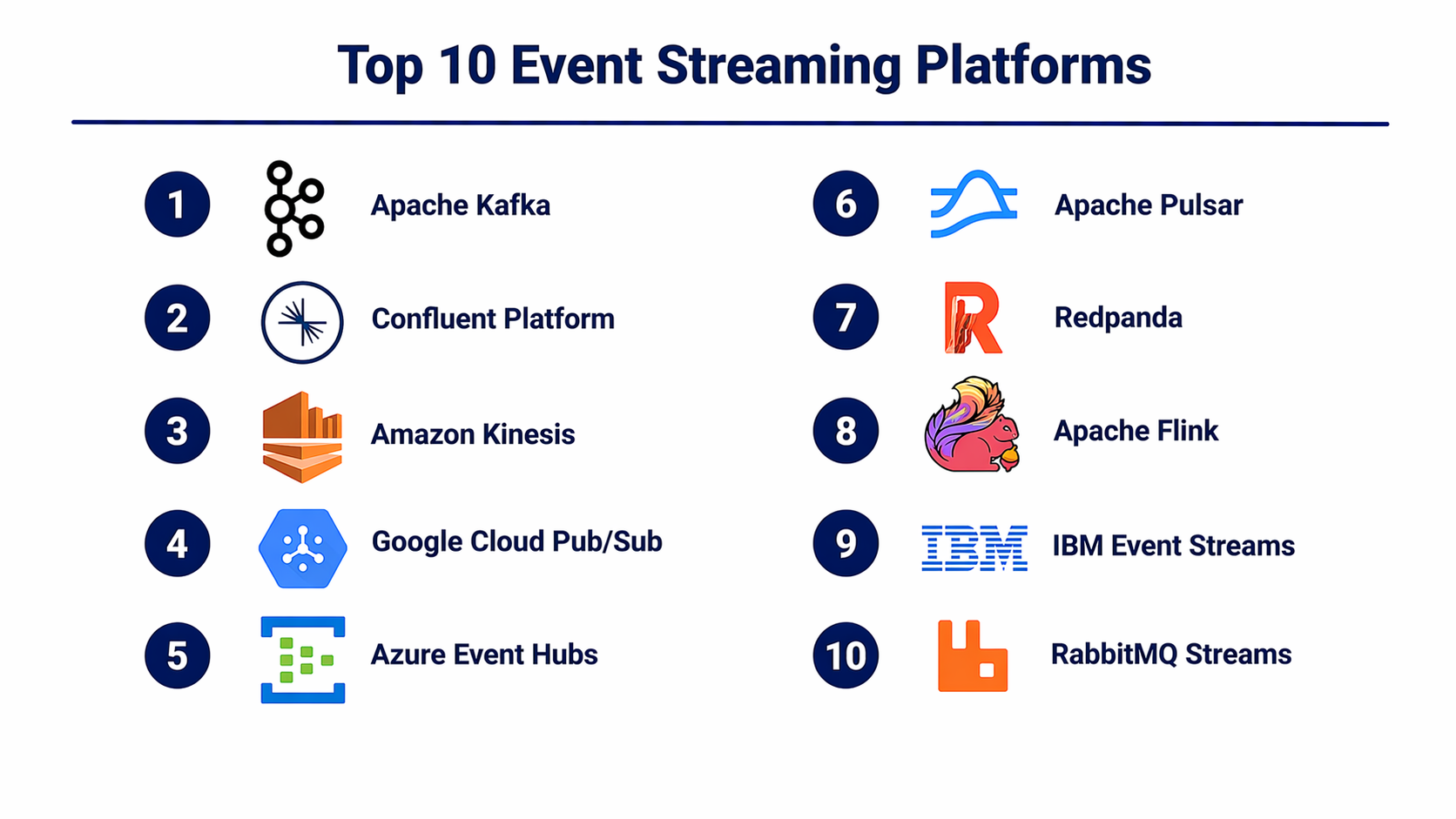
Top 10 Event Streaming Platforms
#1 — Apache Kafka
Short description: A widely adopted open-source event streaming platform designed for high-throughput, fault-tolerant data pipelines and real-time applications.
Key Features
- Distributed architecture with horizontal scalability
- High-throughput messaging system
- Stream processing with Kafka Streams
- Fault tolerance with replication
- Durable message storage
- Strong ecosystem and community
Pros
- Highly scalable and reliable
- Large ecosystem and community support
Cons
- Complex setup and management
- Requires operational expertise
Platforms / Deployment
Cloud / Self-hosted / Hybrid
Security & Compliance
Encryption, RBAC, audit logs; compliance: Varies / Not publicly stated
Integrations & Ecosystem
Integrates with databases, cloud platforms, analytics tools, and connectors.
- Hadoop ecosystem
- Spark
- Flink
- Elasticsearch
Support & Community
Strong open-source community, extensive documentation, enterprise support via vendors.
#2 — Confluent Platform
Short description: A commercial distribution of Kafka with enterprise-grade features and managed services.
Key Features
- Fully managed Kafka service
- Schema registry
- Stream governance tools
- Advanced monitoring and control center
- Connectors ecosystem
Pros
- Easier management than raw Kafka
- Enterprise-grade tooling
Cons
- Higher cost
- Vendor lock-in concerns
Platforms / Deployment
Cloud / Hybrid
Security & Compliance
SSO, RBAC, encryption; compliance: Varies / Not publicly stated
Integrations & Ecosystem
Extensive connectors for cloud services, databases, and SaaS tools.
- AWS
- Azure
- Snowflake
- Databricks
Support & Community
Enterprise support with SLAs; strong documentation.
#3 — Amazon Kinesis
Short description: A fully managed AWS service for real-time data streaming and analytics.
Key Features
- Real-time data ingestion
- Auto-scaling streams
- Integration with AWS ecosystem
- Serverless processing
- Data retention management
Pros
- Fully managed and scalable
- Deep AWS integration
Cons
- AWS vendor lock-in
- Limited flexibility outside AWS
Platforms / Deployment
Cloud
Security & Compliance
IAM, encryption, audit logs; compliance: Varies / Not publicly stated
Integrations & Ecosystem
Native integration with AWS services.
- Lambda
- S3
- Redshift
- CloudWatch
Support & Community
Strong AWS support ecosystem; extensive documentation.
#4 — Google Cloud Pub/Sub
Short description: A global messaging service for building event-driven systems on Google Cloud.
Key Features
- Global message delivery
- Auto-scaling infrastructure
- Low-latency messaging
- Serverless model
- Strong reliability guarantees
Pros
- Highly scalable
- Minimal operational overhead
Cons
- Limited customization
- Google Cloud dependency
Platforms / Deployment
Cloud
Security & Compliance
Encryption, IAM; compliance: Varies / Not publicly stated
Integrations & Ecosystem
Integrates with Google Cloud services.
- BigQuery
- Dataflow
- Cloud Functions
Support & Community
Strong cloud support; good documentation.
#5 — Azure Event Hubs
Short description: Microsoft’s event ingestion service designed for big data streaming scenarios.
Key Features
- High-throughput ingestion
- Kafka-compatible endpoints
- Real-time analytics integration
- Event retention policies
- Auto-scaling
Pros
- Seamless Azure integration
- Kafka compatibility
Cons
- Azure-centric
- Limited outside ecosystem
Platforms / Deployment
Cloud
Security & Compliance
RBAC, encryption; compliance: Varies / Not publicly stated
Integrations & Ecosystem
Works with Azure ecosystem.
- Azure Stream Analytics
- Power BI
- Data Lake
Support & Community
Enterprise support with Azure ecosystem backing.
#6 — Apache Pulsar
Short description: A distributed messaging and streaming platform with built-in multi-tenancy and geo-replication.
Key Features
- Multi-tenant architecture
- Geo-replication
- Separate compute and storage
- Stream processing support
- High scalability
Pros
- Flexible architecture
- Strong multi-region support
Cons
- Smaller ecosystem than Kafka
- Learning curve
Platforms / Deployment
Cloud / Self-hosted
Security & Compliance
Encryption, authentication; compliance: Not publicly stated
Integrations & Ecosystem
Supports connectors and APIs.
- Flink
- Spark
- Kubernetes
Support & Community
Growing community; improving documentation.
#7 — Redpanda
Short description: A Kafka-compatible streaming platform focused on performance and simplicity.
Key Features
- Kafka API compatibility
- No JVM dependency
- High performance
- Simplified deployment
- Built-in storage
Pros
- Fast and efficient
- Easier operations than Kafka
Cons
- Smaller ecosystem
- Limited enterprise features
Platforms / Deployment
Cloud / Self-hosted
Security & Compliance
Encryption, RBAC; compliance: Not publicly stated
Integrations & Ecosystem
Works with Kafka ecosystem tools.
- Kafka clients
- Connectors
Support & Community
Emerging community; commercial support available.
#8 — Apache Flink
Short description: A powerful stream processing framework for stateful computations over data streams.
Key Features
- Stateful stream processing
- Low-latency processing
- Event time processing
- Exactly-once guarantees
- Scalable architecture
Pros
- Advanced processing capabilities
- High performance
Cons
- Complex to operate
- Requires expertise
Platforms / Deployment
Cloud / Self-hosted
Security & Compliance
Varies / Not publicly stated
Integrations & Ecosystem
Integrates with streaming platforms and data systems.
- Kafka
- Hadoop
- Databases
Support & Community
Strong open-source community.
#9 — IBM Event Streams
Short description: Enterprise-grade event streaming platform built on Kafka with IBM integrations.
Key Features
- Managed Kafka service
- Enterprise security
- Integration with IBM Cloud
- Monitoring tools
- Data governance support
Pros
- Enterprise-ready
- Strong security features
Cons
- Limited outside IBM ecosystem
- Pricing not transparent
Platforms / Deployment
Cloud / Hybrid
Security & Compliance
RBAC, encryption; compliance: Not publicly stated
Integrations & Ecosystem
IBM ecosystem integrations.
- Watson
- Cloud services
Support & Community
Enterprise support; moderate community.
#10 — RabbitMQ Streams
Short description: Extension of RabbitMQ enabling log-based streaming alongside traditional messaging.
Key Features
- Stream support
- Lightweight messaging
- Flexible routing
- Plugin-based architecture
- High availability
Pros
- Easy to use
- Lightweight
Cons
- Not as scalable as Kafka
- Limited streaming features
Platforms / Deployment
Cloud / Self-hosted
Security & Compliance
Encryption, authentication; compliance: Not publicly stated
Integrations & Ecosystem
Supports messaging integrations.
- AMQP
- Plugins
Support & Community
Strong RabbitMQ community.
Comparison Table (Top 10)
| Tool Name | Best For | Platform(s) Supported | Deployment | Standout Feature | Public Rating |
|---|---|---|---|---|---|
| Apache Kafka | Large-scale streaming | Linux, Cloud | Hybrid | High throughput | N/A |
| Confluent Platform | Enterprise Kafka | Web, Cloud | Cloud/Hybrid | Managed Kafka | N/A |
| Amazon Kinesis | AWS users | Web | Cloud | Serverless streaming | N/A |
| Google Pub/Sub | GCP users | Web | Cloud | Global messaging | N/A |
| Azure Event Hubs | Azure ecosystem | Web | Cloud | Kafka compatibility | N/A |
| Apache Pulsar | Multi-region systems | Linux, Cloud | Hybrid | Geo-replication | N/A |
| Redpanda | High-performance streaming | Linux, Cloud | Hybrid | No JVM | N/A |
| Apache Flink | Stream processing | Linux, Cloud | Hybrid | Stateful processing | N/A |
| IBM Event Streams | Enterprise users | Web | Hybrid | IBM integration | N/A |
| RabbitMQ Streams | Lightweight streaming | Linux, Cloud | Hybrid | Simple messaging | N/A |
Evaluation & Scoring of Event Streaming Platforms
| Tool Name | Core (25%) | Ease (15%) | Integrations (15%) | Security (10%) | Performance (10%) | Support (10%) | Value (15%) | Weighted Total |
|---|---|---|---|---|---|---|---|---|
| Apache Kafka | 9 | 6 | 9 | 7 | 9 | 8 | 8 | 8.2 |
| Confluent Platform | 9 | 8 | 9 | 8 | 9 | 9 | 7 | 8.6 |
| Amazon Kinesis | 8 | 8 | 8 | 8 | 8 | 8 | 7 | 8.0 |
| Google Pub/Sub | 8 | 9 | 8 | 8 | 8 | 8 | 7 | 8.1 |
| Azure Event Hubs | 8 | 8 | 8 | 8 | 8 | 8 | 7 | 8.0 |
| Apache Pulsar | 8 | 6 | 7 | 7 | 8 | 7 | 8 | 7.6 |
| Redpanda | 8 | 7 | 7 | 7 | 9 | 7 | 8 | 7.8 |
| Apache Flink | 9 | 5 | 8 | 7 | 9 | 8 | 7 | 8.0 |
| IBM Event Streams | 8 | 7 | 7 | 8 | 8 | 8 | 7 | 7.8 |
| RabbitMQ Streams | 7 | 8 | 7 | 7 | 7 | 8 | 8 | 7.6 |
Scores are comparative and reflect relative strengths across tools. A higher score does not mean universally better—it depends on use case, team expertise, and ecosystem fit.
Which Event Streaming Platforms Right for You?
Solo / Freelancer
- Use managed services like Google Pub/Sub or AWS Kinesis
- Avoid complex self-hosted systems
SMB
- Prefer managed platforms with low operational overhead
- Confluent Cloud or Azure Event Hubs are practical choices
Mid-Market
- Hybrid approaches work well
- Kafka or Pulsar with managed services
Enterprise
- Full-scale Kafka or Confluent deployments
- Multi-region, high availability setups
Budget vs Premium
- Open-source tools (Kafka, Pulsar) for cost control
- Managed platforms for convenience
Feature Depth vs Ease of Use
- Kafka/Flink = deep features
- Pub/Sub/Kinesis = easier usage
Integrations & Scalability
- Choose based on cloud ecosystem alignment
Security & Compliance Needs
- Enterprises should prioritize RBAC, encryption, audit logs
Frequently Asked Questions (FAQs)
What is an event streaming platform?
A system that processes and delivers real-time data streams continuously.
How is it different from message queues?
Event streaming stores and replays data, while queues typically delete messages after processing.
Are these platforms expensive?
Costs vary widely depending on scale and deployment model.
Do I need coding skills?
Yes, most platforms require developer involvement.
Can small teams use event streaming?
Yes, but managed services are recommended.
What are common mistakes?
Over-engineering, ignoring monitoring, and poor schema management.
How secure are these platforms?
Most support encryption and access controls; compliance varies.
Can I migrate between platforms?
Yes, but it requires planning and data migration strategies.
What industries use event streaming?
Finance, retail, telecom, healthcare, and more.
What is the future of event streaming?
More AI integration, serverless models, and unified data platforms.
Conclusion
Event streaming platforms are now a core building block for modern applications. They enable real-time processing, faster decision-making, and scalable architectures that align with today’s cloud-native and data-driven environments. However, choosing the right platform depends heavily on your specific use case, team expertise, and infrastructure strategy.
