Introduction
Real-time analytics platforms are systems designed to process, analyze, and deliver insights from data as it is generated—within seconds or milliseconds. Unlike traditional batch analytics, which processes data periodically, real-time platforms enable immediate decision-making based on live data streams.
In the modern digital landscape, where applications, IoT devices, financial systems, and user interactions generate massive continuous data, real-time analytics has become critical. Organizations are no longer satisfied with yesterday’s reports—they need insights now to act quickly, optimize performance, and reduce risk.
Common real-world use cases include:
- Fraud detection in banking and fintech
- Real-time recommendation engines (e-commerce, media)
- Monitoring application performance and user behavior
- IoT and sensor data analytics
- Dynamic pricing and supply chain optimization
What buyers should evaluate:
- Data ingestion speed and throughput
- Latency (processing and query response time)
- Scalability under high data volumes
- Integration with streaming tools (Kafka, etc.)
- Query flexibility (SQL, APIs, real-time queries)
- AI/ML capabilities for anomaly detection
- Data storage and retention policies
- Security and governance controls
- Cost model (usage-based vs infrastructure-heavy)
- Deployment flexibility (cloud vs on-premise)
Best for: Data engineers, DevOps teams, product teams, fintech companies, SaaS platforms, and enterprises handling streaming data or requiring instant insights.
Not ideal for: Small teams with static datasets, reporting-only use cases, or scenarios where batch analytics is sufficient and cost efficiency is more important than speed.
Key Trends in Real-time Analytics Platforms
- Streaming-first architectures: Platforms are designed around event streams instead of batch pipelines.
- AI-powered anomaly detection: Automated detection of unusual patterns in real-time data.
- Serverless analytics: Reduced infrastructure management with auto-scaling compute.
- Unified batch + streaming processing: Hybrid models combining historical and real-time analytics.
- Low-latency query engines: Sub-second query performance for dashboards and APIs.
- Edge analytics adoption: Processing data closer to the source (IoT and edge devices).
- Data lakehouse convergence: Real-time analytics integrated with lakehouse platforms.
- Event-driven microservices integration: Strong compatibility with modern architectures.
- Usage-based pricing models: Cost tied to data processed or queries executed.
- Enhanced governance: Real-time monitoring with compliance and auditing built-in.
How We Selected These Tools (Methodology)
- High adoption in real-time data and streaming ecosystems
- Proven ability to handle high-throughput, low-latency workloads
- Feature completeness across ingestion, processing, and visualization
- Strong integration with modern data stacks (Kafka, cloud warehouses)
- Reliable performance and scalability benchmarks
- Security features like RBAC, encryption, and access controls
- Suitability across different company sizes and industries
- Developer and analyst usability balance
- Active ecosystem, community, and vendor innovation
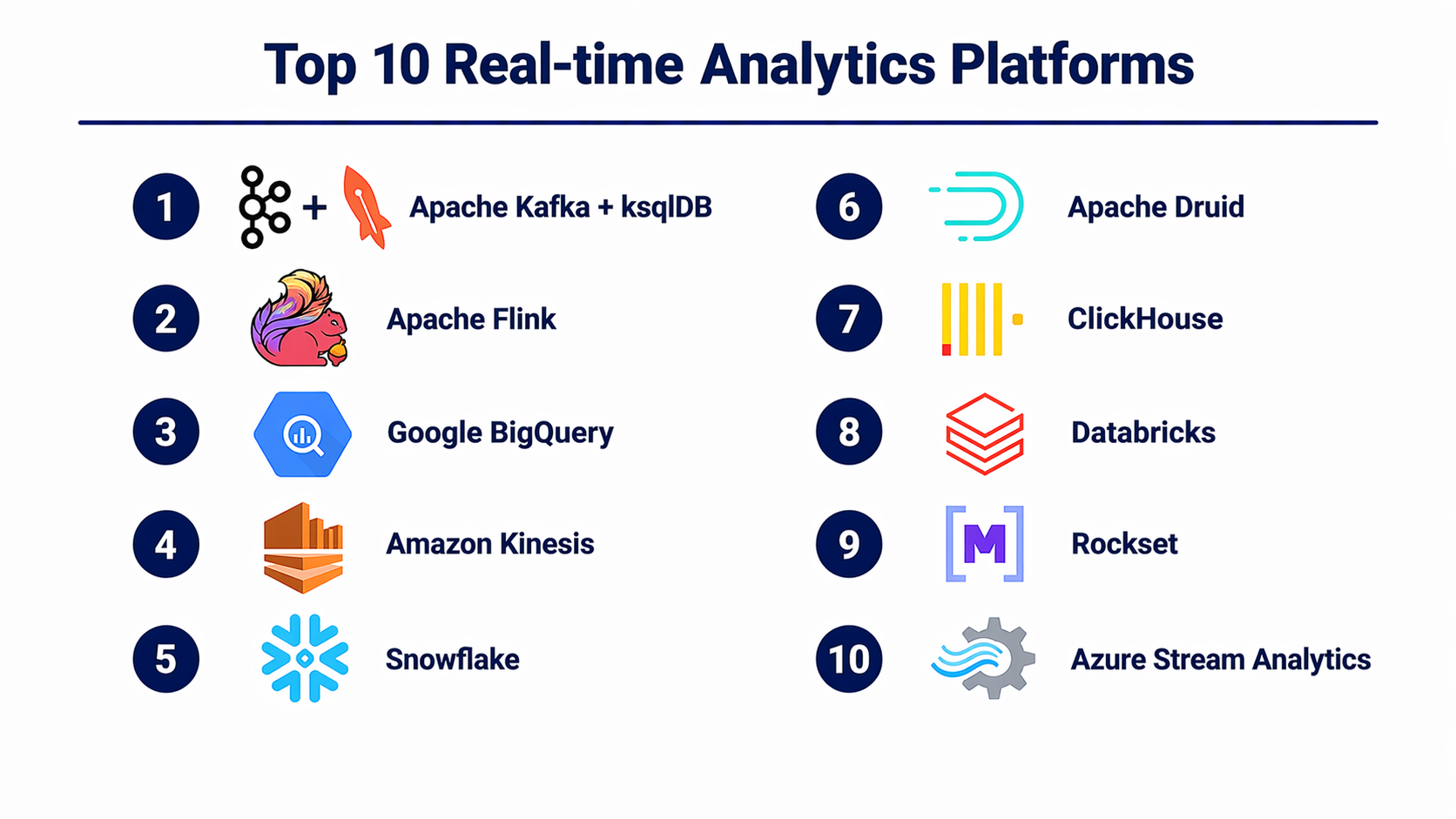
Top 10 Real-time Analytics Platforms
#1 — Apache Kafka + ksqlDB
Short description: A leading distributed event streaming platform used for building real-time data pipelines and streaming applications.
Key Features
- High-throughput event streaming
- Distributed architecture
- Real-time stream processing with ksqlDB
- Fault-tolerant data pipelines
- Event-driven architecture support
- Scalable message queues
Pros
- Extremely scalable and reliable
- Strong ecosystem and adoption
Cons
- Complex setup and management
- Requires engineering expertise
Platforms / Deployment
Linux / Web
Self-hosted / Cloud
Security & Compliance
Encryption, RBAC
Varies / N/A
Integrations & Ecosystem
Kafka integrates with most modern data platforms and tools.
- Spark
- Flink
- Databases
- APIs
Support & Community
Very large open-source community with extensive documentation.
#2 — Apache Flink
Short description: A powerful stream processing framework designed for high-performance, real-time analytics.
Key Features
- Stateful stream processing
- Low-latency processing
- Event-time processing
- Fault tolerance
- Batch + streaming support
Pros
- High performance
- Flexible processing capabilities
Cons
- Steep learning curve
- Requires infrastructure management
Platforms / Deployment
Linux
Self-hosted / Cloud
Security & Compliance
Not publicly stated
Integrations & Ecosystem
- Kafka
- Hadoop
- Cloud storage
Support & Community
Strong open-source community.
#3 — Google BigQuery (Streaming)
Short description: A serverless data warehouse supporting real-time analytics through streaming data ingestion.
Key Features
- Serverless architecture
- Real-time data ingestion
- SQL-based querying
- Built-in ML capabilities
- Auto-scaling
Pros
- Easy to use
- No infrastructure management
Cons
- Cost can increase with heavy usage
- Limited customization
Platforms / Deployment
Web
Cloud
Security & Compliance
SSO, encryption
Varies / N/A
Integrations & Ecosystem
- Google Cloud
- APIs
- Data connectors
Support & Community
Strong enterprise support.
#4 — Amazon Kinesis
Short description: A managed service for real-time data streaming and analytics on AWS.
Key Features
- Real-time data ingestion
- Stream processing
- Integration with AWS ecosystem
- Scalability
- Data analytics tools
Pros
- Fully managed
- Strong AWS integration
Cons
- Vendor lock-in
- Pricing complexity
Platforms / Deployment
Web
Cloud
Security & Compliance
IAM, encryption
Varies / N/A
Integrations & Ecosystem
- AWS services
- Lambda
- S3
Support & Community
Enterprise-grade AWS support.
#5 — Snowflake (Real-time Capabilities)
Short description: A cloud data platform with support for near real-time analytics through streaming ingestion.
Key Features
- Data sharing
- Real-time ingestion
- Scalable compute
- SQL-based analytics
- Separation of storage and compute
Pros
- High scalability
- Easy data sharing
Cons
- Not fully real-time (near real-time)
- Cost management needed
Platforms / Deployment
Web
Cloud
Security & Compliance
Encryption, RBAC
Varies / N/A
Integrations & Ecosystem
- Cloud platforms
- BI tools
- APIs
Support & Community
Strong enterprise support.
#6 — Apache Druid
Short description: A real-time analytics database optimized for fast queries and high-ingestion rates.
Key Features
- Real-time ingestion
- Sub-second query performance
- Columnar storage
- Distributed architecture
- Time-series optimization
Pros
- Fast query performance
- Designed for real-time analytics
Cons
- Complex setup
- Requires tuning
Platforms / Deployment
Linux / Web
Self-hosted / Cloud
Security & Compliance
RBAC
Not publicly stated
Integrations & Ecosystem
- Kafka
- Databases
- APIs
Support & Community
Active open-source community.
#7 — ClickHouse
Short description: A high-performance columnar database used for real-time analytics and OLAP workloads.
Key Features
- Columnar storage
- High-speed queries
- Real-time ingestion
- Distributed architecture
- Compression
Pros
- Extremely fast
- Cost-efficient
Cons
- Requires expertise
- Limited built-in visualization
Platforms / Deployment
Linux
Self-hosted / Cloud
Security & Compliance
Not publicly stated
Integrations & Ecosystem
- Kafka
- BI tools
- APIs
Support & Community
Growing open-source community.
#8 — Databricks (Streaming)
Short description: A unified analytics platform supporting real-time data processing with structured streaming.
Key Features
- Unified analytics
- Real-time streaming
- ML integration
- Data lakehouse support
- Collaborative notebooks
Pros
- Strong AI/ML capabilities
- Scalable
Cons
- Costly
- Requires expertise
Platforms / Deployment
Web
Cloud
Security & Compliance
RBAC, encryption
Varies / N/A
Integrations & Ecosystem
- Spark
- Cloud storage
- APIs
Support & Community
Strong enterprise support.
#9 — Rockset
Short description: A real-time analytics platform focused on fast SQL queries over streaming data.
Key Features
- Real-time indexing
- SQL queries
- Low latency
- Auto-scaling
- Serverless
Pros
- Fast query performance
- Easy to use
Cons
- Limited ecosystem
- Pricing not transparent
Platforms / Deployment
Web
Cloud
Security & Compliance
Not publicly stated
Integrations & Ecosystem
- APIs
- Databases
- Streaming sources
Support & Community
Moderate support availability.
#10 — Azure Stream Analytics
Short description: A real-time analytics service for processing streaming data on Azure.
Key Features
- Real-time processing
- SQL-like queries
- Integration with Azure
- Event processing
- Auto-scaling
Pros
- Easy integration with Azure
- Fully managed
Cons
- Limited flexibility
- Vendor lock-in
Platforms / Deployment
Web
Cloud
Security & Compliance
Azure security features
Varies / N/A
Integrations & Ecosystem
- Azure services
- Event hubs
- APIs
Support & Community
Strong enterprise support.
Comparison Table (Top 10)
| Tool Name | Best For | Platform(s) Supported | Deployment | Standout Feature | Public Rating |
|---|---|---|---|---|---|
| Kafka + ksqlDB | Streaming pipelines | Linux/Web | Cloud/Self-hosted | Event streaming | N/A |
| Flink | Stream processing | Linux | Self-hosted/Cloud | Stateful processing | N/A |
| BigQuery | Serverless analytics | Web | Cloud | SQL streaming | N/A |
| Kinesis | AWS users | Web | Cloud | Managed streaming | N/A |
| Snowflake | Data warehousing | Web | Cloud | Data sharing | N/A |
| Druid | Real-time OLAP | Linux/Web | Self-hosted | Fast queries | N/A |
| ClickHouse | High-performance DB | Linux | Self-hosted | Speed | N/A |
| Databricks | Unified analytics | Web | Cloud | ML integration | N/A |
| Rockset | Real-time SQL | Web | Cloud | Fast indexing | N/A |
| Azure Stream Analytics | Azure users | Web | Cloud | Event processing | N/A |
Evaluation & Scoring of Real-time Analytics Platforms
| Tool | Core | Ease | Integrations | Security | Performance | Support | Value | Weighted Total |
|---|---|---|---|---|---|---|---|---|
| Kafka | 10 | 6 | 9 | 8 | 10 | 9 | 8 | 8.8 |
| Flink | 9 | 6 | 8 | 7 | 10 | 8 | 8 | 8.3 |
| BigQuery | 8 | 9 | 9 | 8 | 8 | 9 | 7 | 8.4 |
| Kinesis | 8 | 8 | 9 | 8 | 8 | 9 | 7 | 8.2 |
| Snowflake | 8 | 9 | 8 | 8 | 8 | 9 | 7 | 8.2 |
| Druid | 8 | 6 | 7 | 7 | 9 | 7 | 8 | 7.8 |
| ClickHouse | 9 | 6 | 8 | 7 | 10 | 7 | 9 | 8.4 |
| Databricks | 9 | 7 | 9 | 8 | 9 | 9 | 6 | 8.5 |
| Rockset | 8 | 8 | 7 | 7 | 9 | 7 | 6 | 7.8 |
| Azure Stream | 8 | 8 | 9 | 8 | 8 | 9 | 7 | 8.2 |
How to interpret scores:
- Scores are relative comparisons within this category
- “Core” reflects real-time capability strength
- “Ease” reflects accessibility for teams
- “Performance” highlights latency and throughput
- “Value” considers cost vs capability
- Open-source tools may score high on performance but lower on ease
Which Real-time Analytics Platforms Right for You?
Solo / Freelancer
- Best: BigQuery, Rockset
- Focus on ease and low operational overhead
SMB
- Best: Azure Stream Analytics, BigQuery
- Balanced cost and usability
Mid-Market
- Best: Snowflake, Kinesis
- Scalability with managed services
Enterprise
- Best: Kafka, Databricks, Flink
- Full control, scalability, and flexibility
Budget vs Premium
- Budget: ClickHouse, Druid
- Premium: Databricks, Snowflake
Feature Depth vs Ease of Use
- Easy: BigQuery, Azure Stream
- Deep: Kafka, Flink
Integrations & Scalability
- Best integrations: Kafka, Databricks
- Cloud ecosystems: AWS, Azure tools
Security & Compliance Needs
- Enterprise-grade: Cloud platforms
- Basic: Open-source tools
Frequently Asked Questions (FAQs)
What is real-time analytics?
It processes and analyzes data instantly as it is generated.
Is real-time analytics expensive?
It can be, depending on data volume and infrastructure.
Do I need engineers to use these tools?
Most advanced tools require engineering expertise.
What is latency in analytics?
It is the delay between data generation and insight.
Can these tools handle big data?
Yes, most are designed for high-scale data.
Are they secure?
Most offer enterprise-grade security, but varies by tool.
What integrations are needed?
Typically streaming tools, databases, and APIs.
Can I combine batch and real-time analytics?
Yes, many platforms support hybrid models.
What are common mistakes?
Underestimating cost and complexity.
How do I choose the right tool?
Evaluate based on use case, scale, and expertise.
Conclusion
Real-time analytics platforms are becoming the backbone of modern data-driven organizations. Whether it’s detecting fraud in milliseconds, delivering personalized user experiences, or monitoring system performance, the ability to act on data instantly is no longer optional—it’s a competitive advantage. However, selecting the right platform is not about choosing the most powerful tool, but the one that aligns best with your use case, team expertise, and budget. Some platforms offer deep control and scalability, while others prioritize simplicity and managed services.
