Introduction
Model Explainability Tools are software platforms and frameworks designed to help organizations understand, interpret, visualize, and audit machine learning and AI model behavior. These tools provide insights into how models make predictions, which features influence outcomes, and where risks such as bias, drift, or unreliable predictions may exist.
In model explainability has become a critical requirement for enterprise AI governance, regulatory compliance, generative AI oversight, and operational trust. As organizations increasingly deploy large language models (LLMs), autonomous systems, recommendation engines, and predictive analytics platforms, explainability helps stakeholders validate AI decisions, debug model failures, improve fairness, and maintain transparency across AI workflows.
Common real-world use cases include:
- AI decision transparency
- Bias and fairness analysis
- Regulatory compliance reporting
- Model debugging and validation
- LLM observability and monitoring
When evaluating Model Explainability Tools, buyers should consider:
- Explainability method coverage
- Visualization capabilities
- Bias and fairness analysis
- LLM and generative AI support
- Integration ecosystem
- Governance and audit tooling
- Scalability for enterprise AI
- Monitoring and observability
- Collaboration workflows
- Security and compliance controls
Best for: Enterprise AI teams, MLOps teams, regulated industries, financial services, healthcare organizations, government agencies, and companies deploying production AI systems.
Not ideal for: Small experimental AI projects with limited governance requirements or organizations using only basic predictive models without operational oversight needs.
Key Trends in Model Explainability Tools
- LLM explainability and prompt tracing are rapidly expanding.
- Regulatory pressure is increasing demand for transparent AI systems.
- Explainability is becoming integrated into broader AI governance platforms.
- Real-time AI observability is converging with explainability tooling.
- Counterfactual explanations are becoming more common in enterprise AI.
- Privacy-preserving explainability methods are gaining traction.
- Human-in-the-loop review workflows remain important.
- Explainability for multimodal AI systems is improving.
- Open-source explainability frameworks continue growing rapidly.
- AI monitoring and explainability platforms are increasingly unified.
How We Selected These Tools (Methodology)
The tools in this list were selected based on explainability capabilities, enterprise adoption, AI governance relevance, scalability, and ecosystem maturity.
Selection criteria included:
- Explainability method support
- Enterprise governance capabilities
- Visualization and interpretability quality
- Monitoring and observability integration
- LLM and generative AI relevance
- Security and compliance support
- Workflow automation capabilities
- Documentation and community adoption
- Integration ecosystem maturity
- Innovation in explainable AI workflows
The final list includes enterprise explainability platforms, open-source frameworks, observability systems, and Responsible AI tooling.
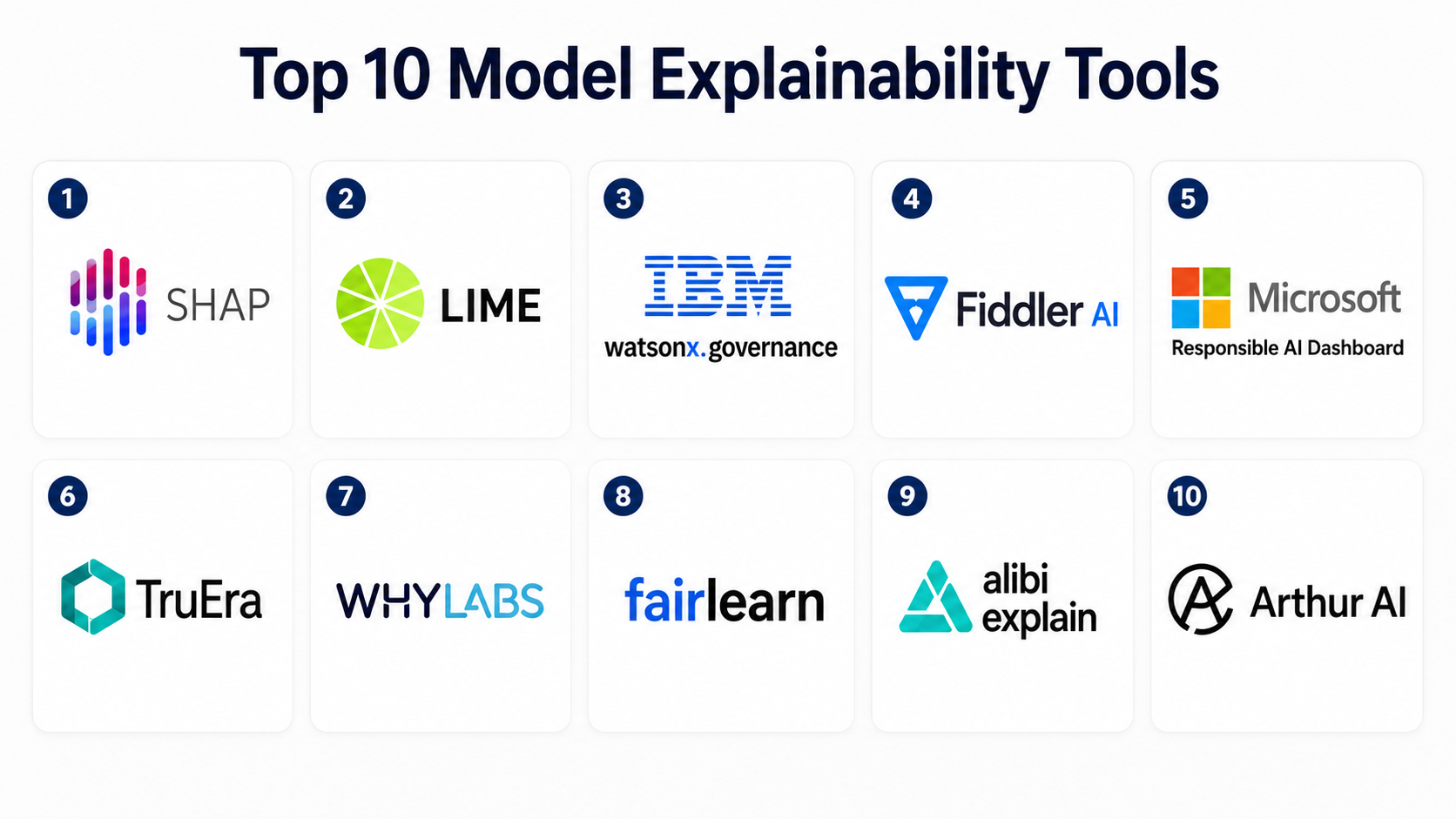
Model Explainability Tools
#1 — SHAP
Short description :
SHAP (SHapley Additive exPlanations) is one of the most widely used open-source explainability frameworks for interpreting machine learning model predictions. It uses game theory concepts to calculate feature importance and explain how individual inputs influence model outputs.
Key Features
- Feature importance analysis
- Local and global explanations
- Visualization dashboards
- Model-agnostic explanations
- Tree model optimization
- Python-native workflows
- Explainability metrics
Pros
- Strong industry adoption
- Excellent visualization capabilities
- Broad model compatibility
Cons
- Advanced usage requires ML expertise
- Large datasets may impact performance
- Limited enterprise governance tooling
Platforms / Deployment
- Windows / Linux / macOS
- Self-hosted
Security & Compliance
- Varies / N/A
Integrations & Ecosystem
SHAP integrates with major ML frameworks and data science ecosystems.
- Scikit-learn
- XGBoost
- TensorFlow
- PyTorch
- Jupyter
Support & Community
SHAP has one of the strongest open-source explainability communities in machine learning.
#2 — LIME
Short description :
LIME (Local Interpretable Model-agnostic Explanations) is an open-source explainability framework that helps users understand individual model predictions through simplified interpretable approximations.
Key Features
- Local prediction explanations
- Model-agnostic support
- Feature contribution analysis
- Interpretable approximations
- NLP explainability
- Image model support
- Lightweight deployment
Pros
- Easy to experiment with
- Broad model compatibility
- Strong academic adoption
Cons
- Limited enterprise operational tooling
- Less scalable for large production environments
- Explanation stability may vary
Platforms / Deployment
- Windows / Linux / macOS
- Self-hosted
Security & Compliance
- Varies / N/A
Integrations & Ecosystem
LIME integrates with popular machine learning ecosystems.
- Scikit-learn
- TensorFlow
- PyTorch
- Jupyter
- Python
Support & Community
LIME has strong academic and research community adoption.
#3 — IBM watsonx.governance
Short description :
IBM watsonx.governance is an enterprise AI governance platform offering explainability, fairness analysis, model lifecycle governance, and compliance management across AI systems and generative AI deployments.
Key Features
- Explainability workflows
- AI governance
- Bias analysis
- Compliance reporting
- Model lifecycle management
- Risk monitoring
- Generative AI governance
Pros
- Strong enterprise governance support
- Good compliance tooling
- Broad Responsible AI coverage
Cons
- Enterprise complexity can be significant
- Premium enterprise positioning
- Advanced workflows require onboarding
Platforms / Deployment
- Web
- Cloud / Hybrid
Security & Compliance
- SSO/SAML
- RBAC
- Encryption
- Audit logs
- GDPR support
Integrations & Ecosystem
IBM watsonx.governance integrates with enterprise AI and analytics infrastructure.
- IBM Cloud
- OpenShift
- APIs
- ML pipelines
- Enterprise data systems
Support & Community
IBM provides enterprise onboarding and governance consulting support.
#4 — Fiddler AI
Short description :
Fiddler AI is an AI observability and explainability platform focused on model monitoring, interpretability, fairness analysis, and LLM observability for enterprise AI systems.
Key Features
- Model explainability
- AI observability
- Feature attribution analysis
- LLM monitoring
- Drift detection
- Governance dashboards
- Real-time monitoring
Pros
- Strong enterprise observability support
- Good explainability visualizations
- Broad AI monitoring capabilities
Cons
- Premium enterprise pricing
- Operational complexity for large deployments
- Advanced workflows require expertise
Platforms / Deployment
- Web
- Cloud / Hybrid
Security & Compliance
- SSO/SAML
- RBAC
- Encryption
- Audit logs
Integrations & Ecosystem
Fiddler AI integrates with enterprise MLOps and AI infrastructure.
- Databricks
- AWS
- Azure
- MLflow
- APIs
Support & Community
Fiddler provides enterprise onboarding and technical support programs.
#5 — Microsoft Responsible AI Dashboard
Short description :
Microsoft Responsible AI Dashboard provides fairness analysis, interpretability tooling, error analysis, and explainability workflows for Azure AI and enterprise machine learning systems.
Key Features
- Explainability visualizations
- Fairness analysis
- Error diagnostics
- Model debugging
- Data exploration
- Responsible AI reporting
- AI transparency tooling
Pros
- Strong Azure ecosystem integration
- Good visualization experience
- Developer-friendly workflows
Cons
- Best suited for Microsoft ecosystems
- Advanced governance may require additional tooling
- Enterprise customization complexity
Platforms / Deployment
- Web
- Cloud / Hybrid
Security & Compliance
- RBAC
- Encryption
- Audit logs
- Azure security controls
Integrations & Ecosystem
The platform integrates deeply with Microsoft AI and analytics systems.
- Azure Machine Learning
- Power BI
- GitHub
- APIs
- Microsoft Fabric
Support & Community
Microsoft provides extensive enterprise documentation and ecosystem support.
#6 — TruEra
Short description :
TruEra is an AI quality management and explainability platform focused on model interpretability, fairness analysis, performance monitoring, and governance workflows.
Key Features
- Explainability analytics
- Bias analysis
- Performance monitoring
- Drift detection
- Evaluation tooling
- Governance reporting
- AI quality management
Pros
- Strong explainability support
- Good governance workflows
- Enterprise-friendly analytics
Cons
- Enterprise deployment complexity
- Premium operational positioning
- Advanced workflows require expertise
Platforms / Deployment
- Web
- Cloud / Hybrid
Security & Compliance
- SSO/SAML
- RBAC
- Encryption
- Audit logs
Integrations & Ecosystem
TruEra integrates with enterprise ML and analytics ecosystems.
- Databricks
- AWS
- APIs
- ML pipelines
- AI orchestration systems
Support & Community
TruEra provides enterprise onboarding and workflow consultation services.
#7 — WhyLabs
Short description :
WhyLabs is an AI observability platform supporting explainability, monitoring, anomaly detection, and LLM safety analysis for production AI systems.
Key Features
- Explainability monitoring
- Drift detection
- LLM observability
- Data quality monitoring
- Anomaly alerts
- Real-time analytics
- AI performance tracking
Pros
- Strong monitoring capabilities
- Good developer usability
- Growing LLM monitoring support
Cons
- Governance tooling less comprehensive than some competitors
- Smaller ecosystem footprint
- Advanced controls may require customization
Platforms / Deployment
- Web
- Cloud
Security & Compliance
- RBAC
- Encryption
- Audit logs
Integrations & Ecosystem
WhyLabs integrates with AI and MLOps infrastructure.
- MLflow
- Databricks
- Python
- Kubernetes
- APIs
Support & Community
WhyLabs has active AI engineering communities and enterprise support programs.
#8 — Fairlearn
Short description :
Fairlearn is an open-source Responsible AI toolkit focused on fairness assessment, explainability workflows, and bias mitigation for machine learning systems.
Key Features
- Fairness analysis
- Bias mitigation
- Explainability support
- Open-source toolkit
- Fairness metrics
- ML evaluation workflows
- Python-native tooling
Pros
- Strong fairness-focused tooling
- Open-source flexibility
- Good research workflow support
Cons
- Limited enterprise governance tooling
- Requires technical expertise
- Minimal operational observability support
Platforms / Deployment
- Windows / Linux / macOS
- Self-hosted
Security & Compliance
- Varies / N/A
Integrations & Ecosystem
Fairlearn integrates with Python ML ecosystems and research workflows.
- Scikit-learn
- Python
- Jupyter
- ML pipelines
- AI experimentation systems
Support & Community
Fairlearn has active open-source and academic communities.
#9 — Alibi Explain
Short description :
Alibi Explain is an open-source explainability library supporting counterfactual explanations, feature attribution, anchor explanations, and adversarial robustness workflows.
Key Features
- Counterfactual explanations
- Feature attribution
- Anchor explanations
- Adversarial analysis
- Open-source framework
- Explainability metrics
- Model-agnostic support
Pros
- Advanced explainability methods
- Strong research capabilities
- Good open-source flexibility
Cons
- Requires engineering expertise
- Limited enterprise operational tooling
- Smaller ecosystem than SHAP
Platforms / Deployment
- Windows / Linux / macOS
- Self-hosted
Security & Compliance
- Varies / N/A
Integrations & Ecosystem
Alibi Explain integrates with machine learning and research ecosystems.
- TensorFlow
- PyTorch
- Python
- Jupyter
- AI experimentation workflows
Support & Community
Alibi Explain has active research-oriented developer communities.
#10 — Arthur AI
Short description :
Arthur AI is an enterprise AI monitoring and explainability platform focused on observability, governance, fairness analysis, and operational transparency across ML and LLM systems.
Key Features
- Explainability workflows
- AI monitoring
- Bias analysis
- LLM observability
- Drift detection
- Governance dashboards
- Real-time analytics
Pros
- Strong operational monitoring
- Good enterprise explainability tooling
- Broad ML and LLM support
Cons
- Premium enterprise pricing
- Advanced onboarding requirements
- Smaller ecosystem than hyperscaler platforms
Platforms / Deployment
- Web
- Cloud / Hybrid
Security & Compliance
- RBAC
- Encryption
- Audit logs
- SSO/SAML
Integrations & Ecosystem
Arthur AI integrates with enterprise AI and analytics environments.
- Kubernetes
- Databricks
- APIs
- Cloud infrastructure
- ML workflows
Support & Community
Arthur AI provides enterprise onboarding and technical support services.
Comparison Table (Top 10)
| Tool Name | Best For | Platform(s) Supported | Deployment | Standout Feature | Public Rating |
|---|---|---|---|---|---|
| SHAP | Feature attribution analysis | Windows, Linux, macOS | Self-hosted | Shapley value explainability | N/A |
| LIME | Local prediction explanations | Windows, Linux, macOS | Self-hosted | Model-agnostic explanations | N/A |
| IBM watsonx.governance | Enterprise AI governance | Web | Hybrid | Governance and explainability | N/A |
| Fiddler AI | AI observability | Web | Hybrid | Enterprise explainability monitoring | N/A |
| Microsoft Responsible AI Dashboard | Azure AI explainability | Web | Hybrid | Visualization and fairness analysis | N/A |
| TruEra | AI quality management | Web | Hybrid | Explainability analytics | N/A |
| WhyLabs | AI monitoring | Web | Cloud | Real-time AI observability | N/A |
| Fairlearn | Fairness analysis | Windows, Linux, macOS | Self-hosted | Bias mitigation tooling | N/A |
| Alibi Explain | Advanced explainability research | Windows, Linux, macOS | Self-hosted | Counterfactual explanations | N/A |
| Arthur AI | Enterprise AI observability | Web | Hybrid | LLM explainability workflows | N/A |
Evaluation & Model Explainability Tools
| Tool Name | Core (25%) | Ease (15%) | Integrations (15%) | Security (10%) | Performance (10%) | Support (10%) | Value (15%) | Weighted Total |
|---|---|---|---|---|---|---|---|---|
| SHAP | 9 | 7 | 9 | 5 | 8 | 8 | 10 | 8.0 |
| LIME | 8 | 8 | 8 | 5 | 7 | 7 | 10 | 7.7 |
| IBM watsonx.governance | 9 | 7 | 8 | 9 | 8 | 8 | 7 | 8.0 |
| Fiddler AI | 9 | 7 | 8 | 8 | 9 | 8 | 7 | 8.0 |
| Microsoft Responsible AI Dashboard | 8 | 8 | 9 | 8 | 8 | 8 | 8 | 8.1 |
| TruEra | 8 | 7 | 8 | 8 | 8 | 8 | 7 | 7.8 |
| WhyLabs | 8 | 8 | 7 | 7 | 8 | 7 | 8 | 7.7 |
| Fairlearn | 7 | 6 | 6 | 4 | 7 | 6 | 9 | 6.6 |
| Alibi Explain | 8 | 6 | 7 | 4 | 7 | 6 | 9 | 7.0 |
| Arthur AI | 8 | 7 | 8 | 8 | 8 | 8 | 7 | 7.8 |
These scores are comparative rather than absolute. Some tools focus heavily on research explainability workflows, while others prioritize enterprise governance, monitoring, or operational transparency. Buyers should evaluate explainability tooling based on AI deployment scale, regulatory requirements, operational maturity, and model complexity.
Which Model Explainability Tools
Solo / Freelancer
Independent developers and researchers may prefer:
- SHAP
- LIME
- Alibi Explain
These tools provide flexible experimentation and strong open-source explainability capabilities.
SMB
Small and medium-sized businesses should prioritize usability and operational simplicity.
Recommended options:
- WhyLabs
- Microsoft Responsible AI Dashboard
- SHAP
Mid-Market
Mid-sized organizations often require scalable explainability and governance workflows.
Recommended options:
- TruEra
- Fiddler AI
- Arthur AI
- WhyLabs
Enterprise
Large enterprises with governance and compliance priorities should focus on operational transparency and auditability.
Recommended options:
- IBM watsonx.governance
- Fiddler AI
- Arthur AI
- Microsoft Responsible AI Dashboard
Budget vs Premium
- Budget-friendly: SHAP, LIME, Fairlearn
- Premium enterprise: IBM watsonx.governance, Fiddler AI
- Balanced value: WhyLabs, TruEra
Feature Depth vs Ease of Use
- Deepest enterprise workflows: IBM watsonx.governance, Fiddler AI
- Best usability: Microsoft Responsible AI Dashboard
- Best open-source flexibility: SHAP
Integrations & Scalability
- Best Azure ecosystem integration: Microsoft Responsible AI Dashboard
- Best enterprise AI observability: Fiddler AI
- Best research explainability tooling: Alibi Explain
Security & Compliance Needs
Organizations with strict governance requirements should prioritize:
- IBM watsonx.governance
- Arthur AI
- TruEra
- Fiddler AI
Frequently Asked Questions (FAQs)
1. What are Model Explainability Tools?
These are platforms and frameworks that help users understand how AI and machine learning models generate predictions or decisions.
2. Why is model explainability important?
Explainability improves trust, transparency, debugging, governance, compliance, and fairness in AI systems.
3. What is feature attribution?
Feature attribution identifies which input variables most influence model predictions.
4. What is the difference between SHAP and LIME?
SHAP uses Shapley values from game theory, while LIME creates simplified local approximations for individual predictions.
5. Which industries rely most on explainability tools?
Finance, healthcare, insurance, government, cybersecurity, and regulated enterprise industries are major adopters.
6. Can explainability tools support LLMs?
Yes. Modern explainability platforms increasingly support LLM monitoring, prompt tracing, and generative AI observability.
7. What are counterfactual explanations?
Counterfactual explanations show how small input changes could alter a model’s prediction outcome.
8. Are open-source explainability frameworks enterprise-ready?
Some open-source tools can support enterprise AI environments when paired with operational governance and monitoring systems.
9. What should buyers prioritize when selecting explainability tools?
Buyers should evaluate explainability coverage, scalability, integrations, governance support, and monitoring capabilities.
10. Do explainability tools improve AI fairness?
Yes. Explainability helps identify bias, detect unfair predictions, and improve transparency across AI decision-making systems.
Conclusion
Model Explainability Tools are becoming essential infrastructure for trustworthy AI systems, enterprise governance, regulatory compliance, and operational AI transparency. As organizations deploy increasingly complex machine learning systems and generative AI applications, explainability workflows help improve trust, reduce bias, support debugging, and maintain accountability across AI operations. SHAP and LIME remain foundational open-source explainability frameworks, while enterprise platforms like IBM watsonx.governance, Fiddler AI, Arthur AI, and TruEra provide broader governance, monitoring, and operational transparency capabilities.
