Introduction
Bias & Fairness Testing Tools are software platforms and frameworks designed to identify, measure, monitor, and mitigate bias in artificial intelligence and machine learning systems. These tools help organizations evaluate whether AI models generate fair, transparent, and non-discriminatory outcomes across various demographic groups, datasets, and operational environments.
In 2026 and beyond, fairness testing has become a critical component of Responsible AI governance due to the rapid growth of generative AI, automated decision-making systems, and global AI regulations. Enterprises deploying AI in sensitive industries such as finance, healthcare, insurance, HR technology, cybersecurity, and public services now require operational safeguards to ensure models remain ethical, explainable, and compliant.
Common real-world use cases include:
- AI hiring fairness validation
- Credit scoring bias detection
- Healthcare AI transparency analysis
- Generative AI safety monitoring
- Compliance and audit reporting
When evaluating Bias & Fairness Testing Tools, buyers should consider:
- Fairness metric coverage
- Bias mitigation capabilities
- Explainability and interpretability
- Governance and audit workflows
- LLM and generative AI support
- Integration ecosystem
- Scalability and monitoring
- Automation capabilities
- Security and compliance controls
- Ease of deployment and usability
Best for: Enterprise AI teams, compliance departments, MLOps teams, regulated industries, financial institutions, healthcare organizations, government agencies, and companies deploying high-impact AI systems.
Not ideal for: Small experimental AI projects with limited governance requirements or organizations relying entirely on third-party AI APIs without internal oversight responsibilities.
Key Trends in Bias & Fairness Testing Tools
- AI fairness governance is becoming mandatory in regulated industries.
- LLM bias testing and prompt safety analysis are rapidly expanding.
- Automated bias detection workflows are improving operational efficiency.
- Explainability and fairness platforms are increasingly unified.
- Real-time fairness monitoring is gaining enterprise adoption.
- Counterfactual fairness analysis is becoming more common.
- AI compliance reporting is evolving alongside global regulations.
- Privacy-preserving fairness evaluation techniques are growing.
- Open-source fairness frameworks remain highly influential.
- Human oversight continues to play a critical role in Responsible AI operations.
How We Selected These Tools (Methodology)
The platforms in this list were selected based on fairness analysis capabilities, enterprise adoption, governance relevance, scalability, ecosystem maturity, and Responsible AI innovation.
Selection criteria included:
- Bias detection functionality
- Fairness metric coverage
- Explainability capabilities
- Enterprise governance support
- LLM and generative AI relevance
- Integration ecosystem maturity
- Monitoring and observability features
- Documentation and community adoption
- Operational scalability
- Innovation in Responsible AI workflows
The final list includes enterprise AI governance platforms, open-source fairness frameworks, explainability systems, and observability platforms.
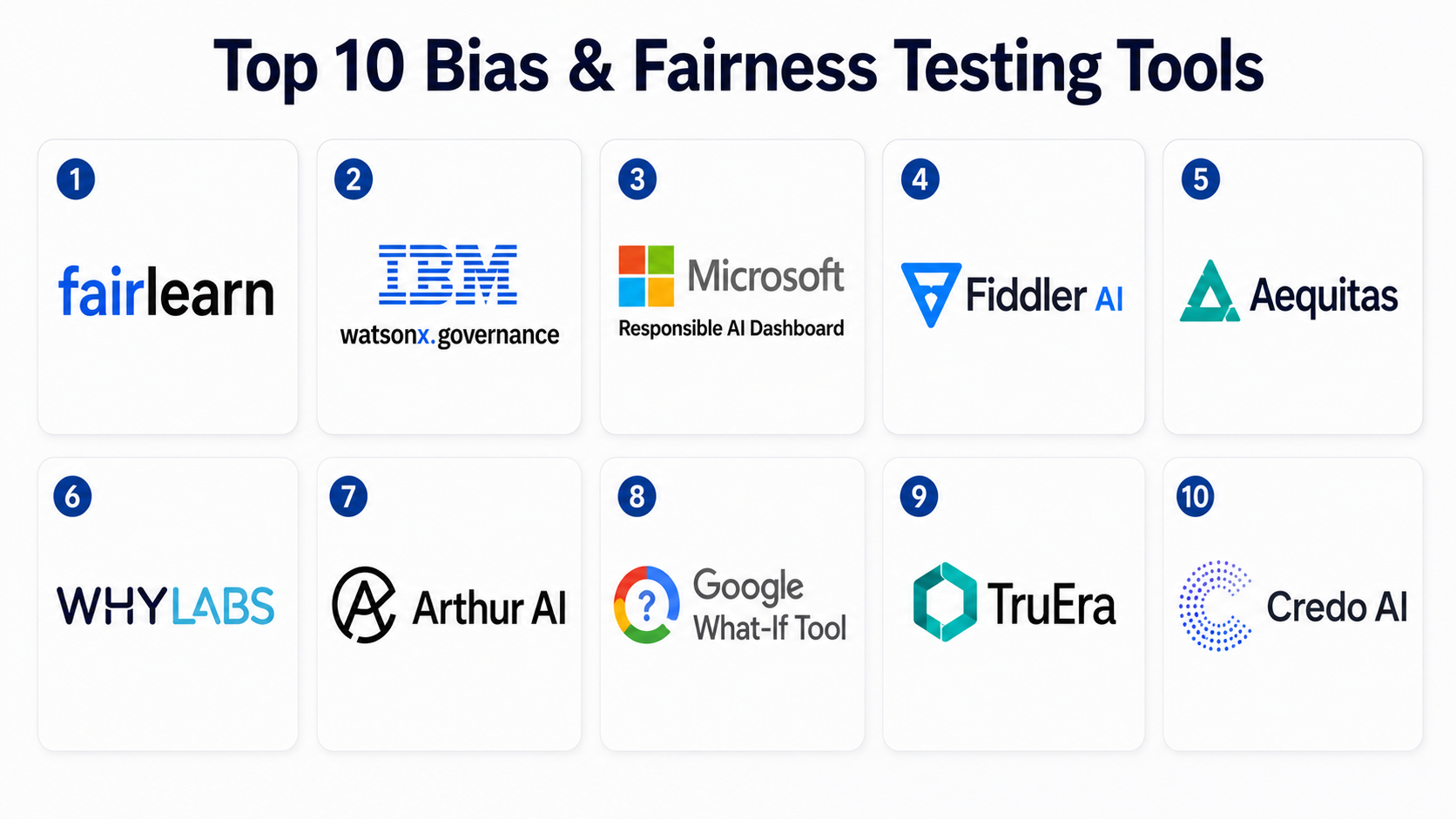
Bias & Fairness Testing Tools
#1 — Fairlearn
Short description :
Fairlearn is a widely adopted open-source Responsible AI framework focused on fairness assessment, bias mitigation, and transparent machine learning evaluation. It helps organizations measure disparities across demographic groups and optimize models for fairer outcomes.
Key Features
- Bias detection workflows
- Fairness metrics
- Bias mitigation algorithms
- Explainability support
- Open-source architecture
- Model evaluation tooling
- Python-native integration
Pros
- Strong fairness-focused tooling
- Excellent research and experimentation support
- Flexible open-source ecosystem
Cons
- Requires technical expertise
- Limited enterprise governance tooling
- Minimal operational monitoring support
Platforms / Deployment
- Windows / Linux / macOS
- Self-hosted
Security & Compliance
- Varies / N/A
Integrations & Ecosystem
Fairlearn integrates with machine learning and research ecosystems.
- Scikit-learn
- Python
- Jupyter
- AI experimentation workflows
- ML pipelines
Support & Community
Fairlearn has strong academic adoption and active Responsible AI communities.
#2 — IBM watsonx.governance
Short description :
IBM watsonx.governance is an enterprise AI governance platform supporting fairness analysis, explainability, compliance management, and Responsible AI lifecycle operations across traditional ML and generative AI systems.
Key Features
- Bias monitoring
- Governance workflows
- Explainability tooling
- Compliance reporting
- AI lifecycle management
- Risk assessment
- Generative AI governance
Pros
- Strong enterprise governance support
- Broad compliance management capabilities
- Good operational scalability
Cons
- Enterprise deployment complexity
- Premium pricing positioning
- Advanced workflows require onboarding
Platforms / Deployment
- Web
- Cloud / Hybrid
Security & Compliance
- SSO/SAML
- RBAC
- Encryption
- Audit logs
- GDPR support
Integrations & Ecosystem
IBM watsonx.governance integrates with enterprise AI infrastructure and governance systems.
- IBM Cloud
- OpenShift
- APIs
- ML workflows
- Enterprise data platforms
Support & Community
IBM provides enterprise onboarding, governance consulting, and professional support services.
#3 — Microsoft Responsible AI Dashboard
Short description :
Microsoft Responsible AI Dashboard provides fairness analysis, interpretability workflows, error diagnostics, and bias testing tools for Azure AI and enterprise machine learning environments.
Key Features
- Fairness visualization
- Bias assessment
- Explainability workflows
- Error analysis
- Model debugging
- Transparency reporting
- AI diagnostics
Pros
- Strong Azure ecosystem integration
- User-friendly visualization tools
- Good developer experience
Cons
- Best suited for Microsoft ecosystems
- Enterprise governance may require additional tooling
- Advanced customization complexity
Platforms / Deployment
- Web
- Cloud / Hybrid
Security & Compliance
- RBAC
- Encryption
- Audit logs
- Azure security controls
Integrations & Ecosystem
The platform integrates with Microsoft AI and analytics ecosystems.
- Azure Machine Learning
- Power BI
- GitHub
- APIs
- Microsoft Fabric
Support & Community
Microsoft provides extensive documentation and enterprise support resources.
#4 — Fiddler AI
Short description :
Fiddler AI is an AI observability and fairness monitoring platform focused on explainability, bias detection, LLM monitoring, and operational AI transparency.
Key Features
- Fairness analysis
- Bias monitoring
- LLM observability
- Explainability workflows
- Drift detection
- Real-time monitoring
- Governance dashboards
Pros
- Strong enterprise observability support
- Good monitoring visualizations
- Broad AI system coverage
Cons
- Premium enterprise pricing
- Operational complexity for large deployments
- Advanced workflows require expertise
Platforms / Deployment
- Web
- Cloud / Hybrid
Security & Compliance
- SSO/SAML
- RBAC
- Encryption
- Audit logs
Integrations & Ecosystem
Fiddler AI integrates with modern AI infrastructure and MLOps environments.
- Databricks
- AWS
- Azure
- MLflow
- APIs
Support & Community
Fiddler provides enterprise onboarding and dedicated technical support.
#5 — Aequitas
Short description :
Aequitas is an open-source bias audit toolkit designed to evaluate fairness in machine learning systems, particularly for public sector and high-risk decision-making applications.
Key Features
- Bias auditing
- Fairness scoring
- Group disparity analysis
- Transparency reporting
- Open-source workflows
- Fairness visualization
- Statistical evaluation
Pros
- Strong fairness auditing capabilities
- Good public sector adoption
- Open-source flexibility
Cons
- Requires technical expertise
- Limited enterprise operational tooling
- Smaller ecosystem footprint
Platforms / Deployment
- Windows / Linux / macOS
- Self-hosted
Security & Compliance
- Varies / N/A
Integrations & Ecosystem
Aequitas integrates with ML evaluation and analytics workflows.
- Python
- Jupyter
- Data science pipelines
- Statistical analysis tools
- ML workflows
Support & Community
Aequitas has strong academic and policy-focused adoption.
#6 — WhyLabs
Short description :
WhyLabs is an AI observability platform supporting fairness monitoring, anomaly detection, drift analysis, and Responsible AI workflows across production machine learning systems.
Key Features
- Fairness monitoring
- Drift detection
- AI observability
- LLM monitoring
- Real-time alerts
- Data quality analysis
- Anomaly detection
Pros
- Strong monitoring capabilities
- Good operational visibility
- Developer-friendly workflows
Cons
- Governance tooling less extensive than some competitors
- Smaller enterprise ecosystem
- Advanced enterprise workflows may require customization
Platforms / Deployment
- Web
- Cloud
Security & Compliance
- RBAC
- Encryption
- Audit logs
Integrations & Ecosystem
WhyLabs integrates with modern AI and MLOps systems.
- MLflow
- Kubernetes
- Databricks
- Python
- APIs
Support & Community
WhyLabs has growing AI engineering communities and enterprise support programs.
#7 — Arthur AI
Short description :
Arthur AI focuses on enterprise AI monitoring, fairness analysis, explainability, and operational governance across machine learning and generative AI systems.
Key Features
- Bias detection
- Explainability tooling
- AI observability
- LLM monitoring
- Governance dashboards
- Performance analytics
- Drift analysis
Pros
- Strong enterprise monitoring support
- Good explainability capabilities
- Broad ML and LLM coverage
Cons
- Premium enterprise positioning
- Complex onboarding requirements
- Smaller ecosystem than hyperscaler vendors
Platforms / Deployment
- Web
- Cloud / Hybrid
Security & Compliance
- RBAC
- Encryption
- Audit logs
- SSO/SAML
Integrations & Ecosystem
Arthur AI integrates with enterprise AI infrastructure and MLOps systems.
- Kubernetes
- Databricks
- APIs
- Cloud infrastructure
- AI workflows
Support & Community
Arthur AI provides enterprise onboarding and technical support services.
#8 — Google What-If Tool
Short description :
Google What-If Tool is an open-source visual interface for analyzing machine learning models, testing fairness scenarios, and exploring model predictions interactively.
Key Features
- Fairness visualization
- Interactive model analysis
- Counterfactual testing
- Explainability support
- Bias exploration
- Prediction debugging
- TensorFlow integration
Pros
- Strong visualization experience
- Good educational and research support
- Interactive experimentation capabilities
Cons
- Limited enterprise governance tooling
- Primarily developer-focused
- Less operational monitoring support
Platforms / Deployment
- Windows / Linux / macOS
- Self-hosted
Security & Compliance
- Varies / N/A
Integrations & Ecosystem
Google What-If Tool integrates with machine learning experimentation environments.
- TensorFlow
- Jupyter
- Python
- AI research workflows
- ML experimentation systems
Support & Community
Google What-If Tool has active open-source and educational communities.
#9 — TruEra
Short description :
TruEra is an enterprise AI quality management platform focused on fairness analysis, explainability, governance, and AI performance monitoring.
Key Features
- Fairness evaluation
- Explainability analytics
- Governance workflows
- Model performance monitoring
- Bias analysis
- Drift detection
- Enterprise reporting
Pros
- Strong governance support
- Good explainability workflows
- Enterprise-friendly analytics
Cons
- Enterprise deployment complexity
- Premium operational positioning
- Advanced workflows require expertise
Platforms / Deployment
- Web
- Cloud / Hybrid
Security & Compliance
- SSO/SAML
- RBAC
- Encryption
- Audit logs
Integrations & Ecosystem
TruEra integrates with enterprise ML and analytics ecosystems.
- Databricks
- AWS
- APIs
- AI orchestration systems
- ML workflows
Support & Community
TruEra provides enterprise onboarding and workflow consultation services.
#10 — Credo AI
Short description :
Credo AI is an enterprise Responsible AI governance platform focused on AI risk management, fairness governance, compliance workflows, and policy enforcement.
Key Features
- Fairness governance
- Compliance management
- Risk assessment
- AI inventory management
- Governance dashboards
- Audit workflows
- Policy automation
Pros
- Strong governance capabilities
- Good compliance support
- Broad Responsible AI coverage
Cons
- Enterprise onboarding complexity
- Premium governance positioning
- Smaller developer ecosystem
Platforms / Deployment
- Web
- Cloud / Hybrid
Security & Compliance
- SSO/SAML
- RBAC
- Encryption
- Audit logs
Integrations & Ecosystem
Credo AI integrates with enterprise governance and AI operations systems.
- APIs
- AI governance workflows
- Enterprise compliance systems
- Cloud infrastructure
- ML operations platforms
Support & Community
Credo AI provides enterprise consulting and governance onboarding support.
Comparison Table (Top 10)
| Tool Name | Best For | Platform(s) Supported | Deployment | Standout Feature | Public Rating |
|---|---|---|---|---|---|
| Fairlearn | Open-source fairness analysis | Windows, Linux, macOS | Self-hosted | Bias mitigation algorithms | N/A |
| IBM watsonx.governance | Enterprise AI governance | Web | Hybrid | AI governance workflows | N/A |
| Microsoft Responsible AI Dashboard | Azure AI fairness analysis | Web | Hybrid | Fairness visualizations | N/A |
| Fiddler AI | AI observability and fairness | Web | Hybrid | LLM fairness monitoring | N/A |
| Aequitas | Bias auditing | Windows, Linux, macOS | Self-hosted | Group disparity analysis | N/A |
| WhyLabs | AI observability | Web | Cloud | Real-time fairness monitoring | N/A |
| Arthur AI | Enterprise AI monitoring | Web | Hybrid | Operational fairness analytics | N/A |
| Google What-If Tool | Interactive fairness analysis | Windows, Linux, macOS | Self-hosted | Counterfactual testing | N/A |
| TruEra | AI quality management | Web | Hybrid | Governance and fairness analytics | N/A |
| Credo AI | Responsible AI governance | Web | Hybrid | AI risk management | N/A |
Evaluation & Bias & Fairness Testing Tools
| Tool Name | Core (25%) | Ease (15%) | Integrations (15%) | Security (10%) | Performance (10%) | Support (10%) | Value (15%) | Weighted Total |
|---|---|---|---|---|---|---|---|---|
| Fairlearn | 8 | 6 | 7 | 4 | 7 | 7 | 10 | 7.1 |
| IBM watsonx.governance | 9 | 7 | 8 | 9 | 8 | 8 | 7 | 8.0 |
| Microsoft Responsible AI Dashboard | 8 | 8 | 9 | 8 | 8 | 8 | 8 | 8.1 |
| Fiddler AI | 9 | 7 | 8 | 8 | 9 | 8 | 7 | 8.0 |
| Aequitas | 7 | 6 | 6 | 4 | 7 | 6 | 9 | 6.7 |
| WhyLabs | 8 | 8 | 7 | 7 | 8 | 7 | 8 | 7.7 |
| Arthur AI | 8 | 7 | 8 | 8 | 8 | 8 | 7 | 7.8 |
| Google What-If Tool | 7 | 8 | 6 | 4 | 7 | 7 | 9 | 7.0 |
| TruEra | 8 | 7 | 8 | 8 | 8 | 8 | 7 | 7.8 |
| Credo AI | 8 | 7 | 7 | 9 | 8 | 8 | 7 | 7.8 |
These scores are comparative rather than absolute. Some tools prioritize governance and enterprise monitoring, while others focus on open-source fairness analysis or interactive explainability. Buyers should evaluate fairness testing platforms based on operational maturity, regulatory exposure, AI deployment scale, and Responsible AI requirements.
Which Bias & Fairness Testing Tools
Solo / Freelancer
Independent developers and researchers may prefer:
- Fairlearn
- Google What-If Tool
- Aequitas
These tools provide strong experimentation flexibility and open-source accessibility.
SMB
Small and medium-sized businesses should prioritize usability and manageable deployment complexity.
Recommended options:
- WhyLabs
- Microsoft Responsible AI Dashboard
- Fairlearn
Mid-Market
Mid-sized organizations often require scalable governance and fairness monitoring.
Recommended options:
- Fiddler AI
- Arthur AI
- TruEra
- WhyLabs
Enterprise
Large enterprises with strict governance and compliance requirements should prioritize operational transparency and auditability.
Recommended options:
- IBM watsonx.governance
- Credo AI
- Fiddler AI
- Arthur AI
Budget vs Premium
- Budget-friendly: Fairlearn, Aequitas
- Premium enterprise: IBM watsonx.governance, Fiddler AI
- Balanced value: WhyLabs, TruEra
Feature Depth vs Ease of Use
- Deepest governance workflows: IBM watsonx.governance, Credo AI
- Best usability: Microsoft Responsible AI Dashboard
- Best open-source flexibility: Fairlearn
Integrations & Scalability
- Best Azure integration: Microsoft Responsible AI Dashboard
- Best enterprise AI observability: Fiddler AI
- Best governance ecosystem: IBM watsonx.governance
Security & Compliance Needs
Organizations with strict Responsible AI governance requirements should prioritize:
- IBM watsonx.governance
- Credo AI
- TruEra
- Arthur AI
Frequently Asked Questions (FAQs)
1. What are Bias & Fairness Testing Tools?
These tools help organizations identify, measure, monitor, and reduce bias in AI and machine learning systems.
2. Why are fairness testing tools important?
They improve AI transparency, reduce discriminatory outcomes, support compliance, and strengthen trust in AI systems.
3. What types of bias can these tools detect?
They can detect demographic bias, sampling bias, prediction disparity, fairness violations, and model performance inconsistencies.
4. Which industries rely most on fairness testing?
Finance, healthcare, insurance, government, HR technology, and cybersecurity are major adopters.
5. Can these tools support generative AI systems?
Yes. Many modern platforms now support LLM fairness analysis, prompt safety testing, and generative AI governance workflows.
6. What is counterfactual fairness testing?
Counterfactual testing evaluates how small changes to sensitive attributes affect AI predictions and fairness outcomes.
7. Are open-source fairness tools enterprise-ready?
Some open-source frameworks can support enterprise AI environments when combined with operational governance infrastructure.
8. What should buyers prioritize when selecting fairness tools?
Buyers should evaluate fairness metrics, governance workflows, integrations, monitoring capabilities, scalability, and compliance support.
9. Can fairness tools improve regulatory compliance?
Yes. Many platforms support audit reporting, governance tracking, transparency workflows, and Responsible AI documentation.
10. Do fairness testing tools improve AI trustworthiness?
Yes. Fairness analysis improves transparency, accountability, and operational confidence in AI systems.
Conclusion
Bias & Fairness Testing Tools are becoming essential infrastructure for Responsible AI governance, regulatory compliance, and trustworthy machine learning operations. As enterprises increasingly deploy generative AI systems, predictive analytics platforms, and automated decision-making workflows, fairness evaluation and bias mitigation are now critical operational requirements rather than optional features. Fairlearn and Aequitas remain important open-source fairness frameworks, while enterprise platforms such as IBM watsonx.governance, Fiddler AI, Arthur AI, and TruEra provide broader governance, monitoring, and operational transparency capabilities.
