Introduction
ELT (Extract, Load, Transform) orchestration tools are platforms that manage and automate the flow of raw data from source systems into data warehouses or data lakes, and then coordinate transformation processes inside the target system. In simple terms, they ensure that data is first loaded quickly and reliably, and then transformed efficiently for analytics, reporting, and machine learning.
In ELT orchestration has become the dominant approach in modern data stacks because cloud data warehouses are powerful enough to handle transformations at scale. This shift reduces the need for heavy ETL preprocessing and enables faster, more flexible analytics pipelines.
Common use cases include:
- Loading raw data into cloud data warehouses
- Transforming data inside Snowflake, BigQuery, or Redshift
- Building analytics-ready datasets
- Automating business intelligence pipelines
- Supporting AI/ML feature engineering workflows
- Syncing SaaS application data into centralized storage
When evaluating ELT orchestration tools, buyers should focus on:
- Connector coverage for SaaS and databases
- Scheduling and incremental sync capabilities
- Transformation workflow flexibility (SQL, Python, dbt)
- Data warehouse compatibility
- Monitoring, logging, and alerting features
- Data freshness and latency handling
- Scalability across large datasets
- Security (RBAC, encryption, compliance readiness)
- Ease of setup and maintenance
- Cost efficiency at scale
Best for:
Data engineering teams, analytics engineers, BI teams, and enterprises building modern cloud data stacks.
Not ideal for:
Small apps with minimal data movement needs or teams that only require manual data exports.
Key Trends in ELT Orchestration Tools
- Strong shift toward cloud-native ELT pipelines
- Deep integration with modern data warehouses (Snowflake, BigQuery-style systems)
- Growth of reverse ETL and bidirectional data syncing
- Increased adoption of SQL-first transformation workflows
- Expansion of real-time ELT pipelines instead of batch-only jobs
- Strong reliance on open table formats and lakehouse architectures
- AI-assisted schema mapping and transformation suggestions
- Improved observability and data lineage tracking
- Modular pipeline design with reusable components
- Increased focus on cost optimization for warehouse compute usage
How We Selected These Tools (Methodology)
- Adoption across modern data stack ecosystems
- Strength of connector library (SaaS + databases)
- Ability to handle large-scale incremental data loads
- Transformation flexibility (SQL, dbt, Python support)
- Compatibility with cloud data warehouses
- Reliability, retry mechanisms, and failure recovery
- Security and governance capabilities
- Ease of deployment and maintenance
- Ecosystem maturity and integrations
- Real-world usage in analytics and BI pipelines
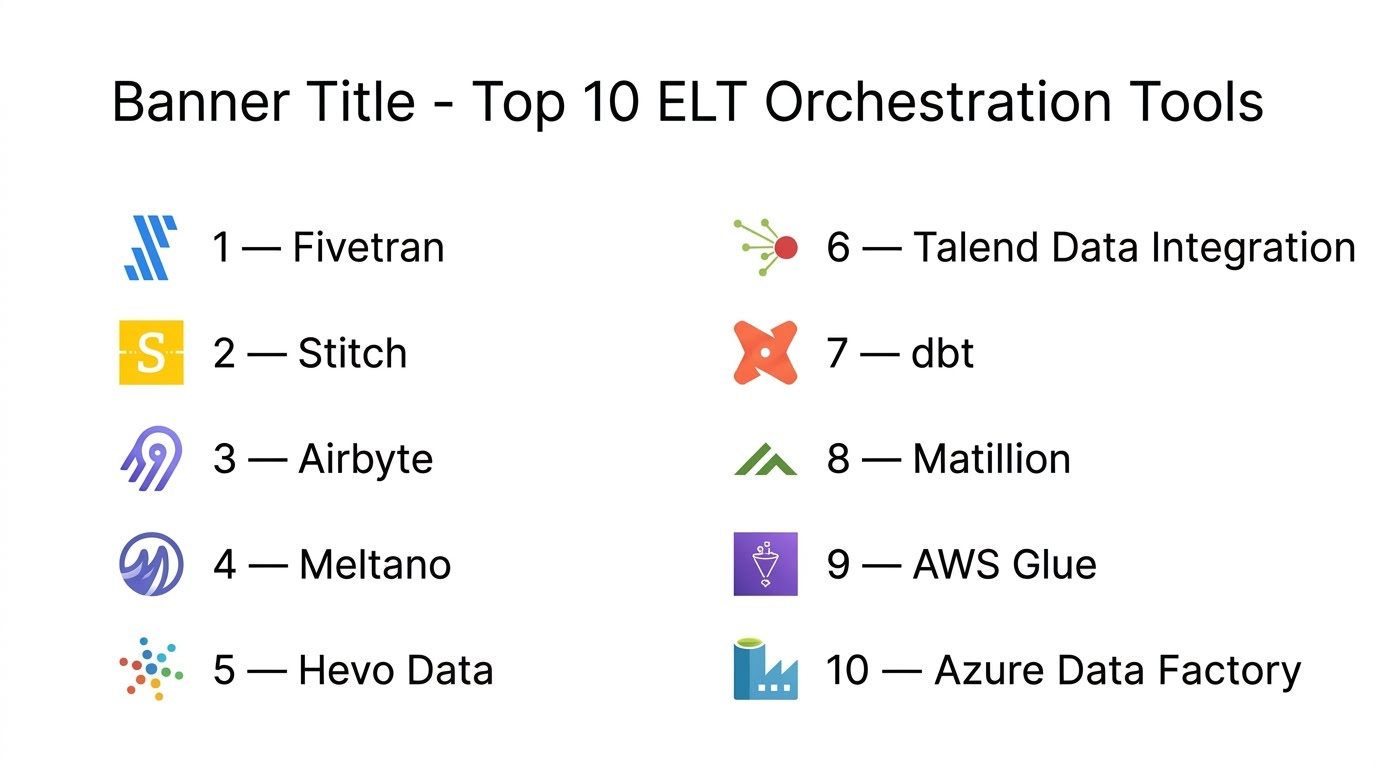
Top 10 ELT Orchestration Tools
#1 — Fivetran
Short description:
Fivetran is a fully managed ELT data integration platform that automates data extraction and loading from hundreds of sources into cloud data warehouses. It is widely used for building automated, low-maintenance ELT pipelines in modern analytics stacks.
Key Features
- Prebuilt connectors for SaaS and databases
- Automated schema migration handling
- Incremental and real-time sync capabilities
- Fully managed ELT pipelines
- Data warehouse optimization support
- Monitoring and alerting dashboard
- High reliability sync engine
Pros
- Extremely low maintenance
- Strong connector ecosystem
- Reliable and scalable ingestion
Cons
- Can become expensive at scale
- Limited transformation flexibility (focus is loading)
Platforms / Deployment
- Cloud
Security & Compliance
- Encryption in transit and at rest
- SOC 2, ISO 27001 (commonly supported, verify per deployment)
- RBAC and access controls
Integrations & Ecosystem
- Snowflake, BigQuery-style warehouses
- SaaS applications (CRM, marketing tools)
- Databases and APIs
- BI tools
Support & Community
Strong enterprise support and widespread adoption.
#2 — Stitch
Short description:
Stitch is a simple cloud ELT platform designed for extracting and loading data into data warehouses with minimal configuration. It is popular among small and mid-sized teams for straightforward data ingestion workflows.
Key Features
- Prebuilt data source connectors
- Incremental replication support
- Simple setup and configuration
- Cloud-based data loading
- Basic monitoring dashboard
- Lightweight pipeline management
- API-based extensibility
Pros
- Easy to use for beginners
- Quick setup and deployment
- Good for basic ELT pipelines
Cons
- Limited advanced orchestration features
- Fewer enterprise-grade controls
Platforms / Deployment
- Cloud
Security & Compliance
- Encryption in transit and at rest
- RBAC support (varies)
- Not fully publicly detailed compliance scope
Integrations & Ecosystem
- Data warehouses
- SaaS applications
- Databases and APIs
- BI tools
Support & Community
Moderate support with growing user base.
#3 — Airbyte
Short description:
Airbyte is an open-source ELT platform that focuses on data ingestion and replication with high flexibility and extensibility. It allows teams to build custom connectors and manage data pipelines in a modular way.
Key Features
- Open-source connector framework
- Large library of community connectors
- Incremental and full refresh sync modes
- Self-hosted and cloud options
- Schema evolution handling
- API-driven pipeline management
- Custom connector development support
Pros
- Highly flexible and extensible
- Strong open-source ecosystem
- Good for custom integrations
Cons
- Requires engineering effort to manage
- Operational overhead for self-hosted setups
Platforms / Deployment
- Linux
- Cloud / Self-hosted / Hybrid
Security & Compliance
- RBAC support (enterprise features)
- Encryption support
- Compliance certifications vary by deployment
Integrations & Ecosystem
- Data warehouses
- APIs and databases
- SaaS tools
- Data engineering stacks
Support & Community
Strong and fast-growing open-source community.
#4 — Meltano
Short description:
Meltano is a developer-focused ELT orchestration tool built around data pipelines and version-controlled workflows. It is commonly used by engineering teams that prefer Git-based data pipeline management.
Key Features
- Git-based pipeline definitions
- ELT pipeline orchestration
- Integration with Singer taps and targets
- CLI-based workflow management
- Scheduling and automation
- Modular pipeline architecture
- Extensible plugin system
Pros
- Strong developer-first design
- Flexible and customizable
- Good for version-controlled pipelines
Cons
- Requires technical expertise
- Smaller ecosystem compared to competitors
Platforms / Deployment
- Linux
- Self-hosted / Cloud
Security & Compliance
- Not publicly stated in detail
- Depends on deployment environment
Integrations & Ecosystem
- Data warehouses
- SaaS APIs via Singer ecosystem
- Databases
- CI/CD systems
Support & Community
Active open-source community.
#5 — Hevo Data
Short description:
Hevo Data is a no-code ELT platform designed for real-time data replication and automated pipelines. It is widely used by teams that want simple, reliable data movement without heavy engineering effort.
Key Features
- No-code pipeline setup
- Real-time data replication
- Prebuilt integrations
- Schema management automation
- Error handling and retry system
- Pipeline monitoring dashboard
- Incremental data sync
Pros
- Very easy to use
- Strong real-time ingestion
- Minimal setup required
Cons
- Less flexible for complex transformations
- Pricing may scale with usage
Platforms / Deployment
- Cloud
Security & Compliance
- Encryption in transit and at rest
- RBAC support
- Compliance varies by plan
Integrations & Ecosystem
- SaaS applications
- Databases
- Cloud warehouses
- BI tools
Support & Community
Good commercial support and onboarding assistance.
#6 — Talend Data Integration
Short description:
Talend is an enterprise-grade data integration platform that supports ELT workflows, data quality, and governance. It is widely used in large organizations with complex data environments.
Key Features
- Data integration and ELT workflows
- Data quality and cleansing tools
- Extensive connector library
- Batch and real-time processing
- Visual pipeline designer
- Metadata and governance tools
- Workflow scheduling
Pros
- Strong enterprise capabilities
- Excellent governance features
- Mature platform
Cons
- Complex and resource-heavy
- Higher cost of ownership
Platforms / Deployment
- Cloud / Self-hosted / Hybrid
Security & Compliance
- RBAC support
- Enterprise-grade encryption
- Compliance features vary
Integrations & Ecosystem
- Enterprise data systems
- Databases and warehouses
- Cloud platforms
- ERP/CRM systems
Support & Community
Strong enterprise support.
#7 — dbt (Data Build Tool)
Short description:
dbt is a transformation-focused ELT tool that runs inside data warehouses and enables SQL-based data modeling. It is widely used in modern analytics engineering workflows.
Key Features
- SQL-based transformation pipelines
- Version-controlled data models
- Testing and validation framework
- Documentation generation
- Dependency management for models
- Incremental transformations
- Modular analytics workflows
Pros
- Excellent for transformations
- Strong analytics engineering standard
- Highly scalable inside warehouses
Cons
- Not an ingestion tool
- Requires pairing with loaders
Platforms / Deployment
- Cloud / Self-hosted
Security & Compliance
- Depends on warehouse security model
- RBAC via connected systems
Integrations & Ecosystem
- Snowflake, BigQuery-style warehouses
- Airflow and orchestration tools
- BI tools
- CI/CD pipelines
Support & Community
Very strong global community adoption.
#8 — Matillion
Short description:
Matillion is a cloud-native ELT platform designed for building scalable data pipelines inside modern data warehouses. It combines visual workflow design with SQL-based transformations.
Key Features
- Visual ETL/ELT pipeline builder
- Native cloud data warehouse integration
- SQL-based transformations
- Job scheduling and orchestration
- Prebuilt connectors
- Data transformation templates
- Monitoring dashboard
Pros
- Easy visual interface
- Strong cloud warehouse support
- Good enterprise scalability
Cons
- Cloud dependency
- Licensing costs can be high
Platforms / Deployment
- Cloud
Security & Compliance
- RBAC support
- Encryption (cloud-managed)
- Enterprise compliance varies
Integrations & Ecosystem
- Cloud data warehouses
- SaaS applications
- APIs and databases
- BI platforms
Support & Community
Strong enterprise support.
#9 — AWS Glue
Short description:
AWS Glue is a serverless data integration service that supports ELT workflows, data cataloging, and transformation jobs within the AWS ecosystem.
Key Features
- Serverless ETL/ELT engine
- Data catalog and metadata management
- Automated schema discovery
- Spark-based transformation jobs
- Job scheduling and triggers
- Scalable processing engine
- Integration with AWS data services
Pros
- Fully managed serverless system
- Strong AWS integration
- Scales automatically
Cons
- AWS ecosystem lock-in
- Can be complex to configure
Platforms / Deployment
- Cloud (AWS)
Security & Compliance
- IAM-based access control
- Encryption via AWS services
- Enterprise compliance depends on AWS setup
Integrations & Ecosystem
- S3, Redshift
- Athena and analytics tools
- Lambda and event services
- AWS data stack
Support & Community
Strong AWS enterprise support.
#10 — Azure Data Factory
Short description:
Azure Data Factory is a cloud-based ELT orchestration service used for building data ingestion, transformation, and movement pipelines across cloud and hybrid environments.
Key Features
- Visual pipeline orchestration
- Data movement and transformation
- Hybrid data integration support
- Scheduling and triggers
- Mapping data flows
- Monitoring and logging
- Integration with Azure ecosystem
Pros
- Strong enterprise adoption
- Easy visual pipeline design
- Good hybrid capabilities
Cons
- Azure dependency
- Cost increases with scale
Platforms / Deployment
- Cloud (Azure)
Security & Compliance
- Azure Active Directory integration
- RBAC support
- Encryption via Azure infrastructure
Integrations & Ecosystem
- Azure Data Lake
- Synapse Analytics
- Databases and warehouses
- Cloud storage systems
Support & Community
Strong Microsoft enterprise support.
Comparison Table (Top 10)
| Tool Name | Best For | Platform(s) Supported | Deployment | Standout Feature | Public Rating |
|---|---|---|---|---|---|
| Fivetran | Automated ELT ingestion | Cloud | Cloud | Zero-maintenance pipelines | N/A |
| Stitch | Simple ELT pipelines | Cloud | Cloud | Easy setup | N/A |
| Airbyte | Open-source ELT | Linux | Cloud/Self | Connector extensibility | N/A |
| Meltano | Dev-first pipelines | Linux | Self/Cloud | Git-based ELT | N/A |
| Hevo Data | No-code ELT | Cloud | Cloud | Real-time sync | N/A |
| Talend | Enterprise integration | Cloud | Hybrid | Data governance suite | N/A |
| dbt | Transformations | Cloud/Self | Cloud/Self | SQL modeling standard | N/A |
| Matillion | Cloud ELT | Cloud | Cloud | Visual pipeline builder | N/A |
| AWS Glue | AWS-native ELT | Cloud | AWS Cloud | Serverless ETL engine | N/A |
| Azure Data Factory | Enterprise ELT | Cloud | Azure Cloud | Hybrid data pipelines | N/A |
Evaluation & Scoring (ELT Orchestration Tools)
| Tool Name | Core (25%) | Ease (15%) | Integrations (15%) | Security (10%) | Performance (10%) | Support (10%) | Value (15%) | Total |
|---|---|---|---|---|---|---|---|---|
| Fivetran | 10 | 9 | 10 | 9 | 9 | 9 | 8 | 9.2 |
| Stitch | 8 | 9 | 8 | 8 | 8 | 8 | 9 | 8.3 |
| Airbyte | 9 | 8 | 9 | 8 | 8 | 8 | 9 | 8.6 |
| Meltano | 8 | 8 | 8 | 7 | 7 | 7 | 9 | 7.9 |
| Hevo | 8 | 9 | 9 | 8 | 8 | 8 | 8 | 8.4 |
| Talend | 9 | 7 | 10 | 9 | 9 | 9 | 7 | 8.5 |
| dbt | 9 | 8 | 10 | 8 | 9 | 9 | 10 | 9.0 |
| Matillion | 9 | 8 | 9 | 9 | 8 | 9 | 8 | 8.6 |
| AWS Glue | 9 | 8 | 10 | 9 | 9 | 9 | 8 | 8.8 |
| Azure Data Factory | 9 | 8 | 10 | 9 | 8 | 9 | 8 | 8.7 |
Which ELT Orchestration Tools
Solo / Freelancer
Lightweight ELT needs:
Stitch, Airbyte (basic), dbt (for transformations)
SMB
Growing analytics pipelines:
Fivetran, Hevo Data, Airbyte, dbt
Mid-Market
Scalable ELT systems:
Airbyte, dbt, Matillion, AWS Glue
Enterprise
Large governed data ecosystems:
Fivetran, Talend, AWS Glue, Azure Data Factory, dbt
Frequently Asked Questions (FAQs)
1. What is an ELT orchestration tool?
It automates the extraction and loading of raw data into a warehouse and coordinates transformation workflows inside the target system.
2. How is ELT different from ETL?
ELT loads raw data first and transforms it later inside the data warehouse, while ETL transforms data before loading.
3. Why is ELT popular now?
Modern cloud warehouses are powerful enough to handle transformations efficiently, making ELT faster and more flexible.
4. Do I need coding skills for ELT tools?
Some tools require SQL or Python, while others offer no-code interfaces.
5. Which tool is easiest for beginners?
Stitch and Hevo Data are generally easiest for non-technical users.
6. Which tool is best for transformations?
dbt is widely considered the standard for ELT transformations.
7. Are these tools cloud-based?
Most modern ELT tools are cloud-native or hybrid.
8. Can ELT tools handle real-time data?
Yes, several tools support near real-time syncing and incremental updates.
9. Are ELT tools expensive?
Costs vary widely depending on data volume and usage scale.
10. What is the future of ELT orchestration?
Future systems will be more automated, AI-assisted, and deeply integrated with lakehouse architectures.
Conclusion
ELT orchestration tools are a core part of modern data infrastructure, enabling organizations to efficiently move and transform large volumes of data across cloud ecosystems. They are essential for analytics, AI, and business intelligence workflows.While tools like Fivetran and Stitch simplify ingestion, dbt dominates transformation workflows, and platforms like Airbyte and Talend offer flexibility and enterprise-grade control. Cloud-native solutions like AWS Glue and Azure Data Factory further strengthen the ecosystem.
