Introduction
Edge AI inference platforms are software systems that allow artificial intelligence models to run directly on or near devices where data is generated, instead of depending entirely on centralized cloud servers. In simple terms, they bring AI closer to the source of data so decisions can be made faster, more securely, and with lower latency.
In these platforms are becoming essential because industries increasingly rely on real-time intelligence. From autonomous machines to smart factories, cloud-only AI is often too slow or unreliable for mission-critical tasks. Edge AI solves this by enabling local processing on devices like sensors, cameras, gateways, and embedded systems.
Common use cases include real-time video analytics in security systems, predictive maintenance in manufacturing, autonomous driving systems, healthcare monitoring devices, and smart retail solutions. Each of these requires fast response times and often needs to work even without stable internet connectivity.
When evaluating Edge AI inference platforms, buyers should consider model compatibility (TensorFlow, PyTorch, ONNX), hardware acceleration support (GPU, TPU, NPU), latency performance, deployment flexibility (cloud, edge, hybrid), security controls, scalability, monitoring capabilities, and ease of integration with existing ML pipelines.
Best for: AI engineers, IoT developers, enterprise IT teams, and product companies building real-time intelligent systems across distributed environments such as manufacturing, automotive, healthcare, and smart infrastructure.
Not ideal for: Small experimental AI projects that only run in the cloud, beginners without deployment requirements, or teams that do not need real-time inference or device-level AI execution.
Key Trends in Edge AI Inference Platforms
- Rapid shift from cloud-only AI to hybrid edge-cloud architectures
- Growing use of lightweight model formats like ONNX and TensorFlow Lite
- Increasing adoption of NPUs, TPUs, and edge GPUs for acceleration
- Expansion of Kubernetes-based edge orchestration systems
- Rising demand for offline-first AI applications
- Strong focus on privacy-preserving on-device inference
- Containerized AI deployment becoming standard practice
- Better observability tools for distributed AI systems
- More low-code and automated edge AI deployment workflows
- Optimization of generative AI models for edge devices
How We Selected These Tools
- Market adoption and real-world usage across industries
- Technical maturity and production readiness
- Performance and optimization capabilities for edge workloads
- Support for multiple AI frameworks and model formats
- Hardware acceleration compatibility
- Integration with MLOps and DevOps ecosystems
- Scalability for large distributed deployments
- Security and governance readiness
- Community support and documentation quality
- Flexibility across cloud, hybrid, and offline environments
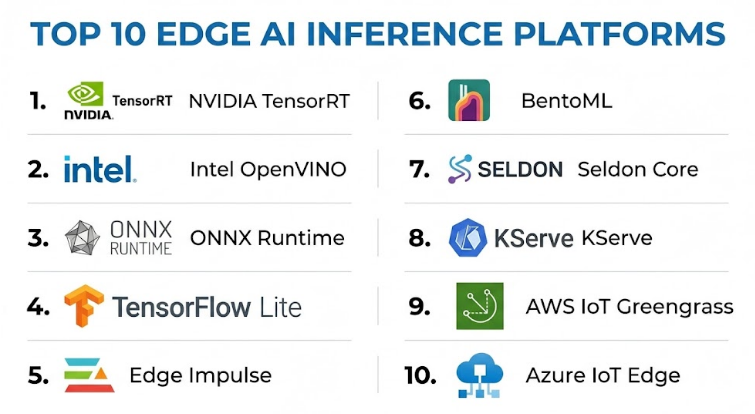
Top 10 Edge AI Inference Platforms
#1 — NVIDIA TensorRT
NVIDIA TensorRT is a high-performance inference optimization framework designed to accelerate deep learning models on NVIDIA GPUs. It is widely used in production environments where low latency and high throughput are critical, such as robotics, autonomous systems, and industrial AI applications. It focuses heavily on optimizing neural networks for inference efficiency.
Key Features
- GPU-accelerated inference engine
- Model optimization (quantization, pruning, layer fusion)
- Support for TensorFlow, PyTorch, and ONNX models
- FP16 and INT8 precision optimization
- Multi-stream inference execution
- CUDA ecosystem integration
- Dynamic tensor memory optimization
Pros
- Extremely fast inference performance
- Highly optimized for enterprise-grade workloads
- Strong GPU ecosystem integration
Cons
- Requires NVIDIA GPU hardware
- Steeper learning curve for beginners
Platforms / Deployment
- Linux, Windows
- Cloud / Self-hosted / Hybrid
Security & Compliance
Not publicly stated
Integrations & Ecosystem
Works with TensorFlow, PyTorch, ONNX, CUDA, cuDNN, and Kubernetes-based ML pipelines.
Support & Community
Strong enterprise support and large developer ecosystem through NVIDIA.
#2 — Intel OpenVINO
Intel OpenVINO is an AI inference optimization toolkit designed for Intel hardware. It enables efficient deployment of deep learning models across CPUs, integrated GPUs, and specialized vision processing units, making it ideal for edge and embedded systems.
Key Features
- Cross-device inference optimization
- Model quantization and compression
- Pre-trained model repository
- CPU and edge hardware acceleration
- Low-latency inference engine
- Multi-framework support
Pros
- Excellent CPU performance optimization
- Strong support for embedded edge systems
Cons
- Best performance limited to Intel hardware
- Less flexible outside Intel ecosystem
Platforms / Deployment
- Windows, Linux, macOS
- Cloud / Self-hosted / Hybrid
Security & Compliance
Not publicly stated
Integrations & Ecosystem
Supports TensorFlow, PyTorch, ONNX, and edge device deployment pipelines.
Support & Community
Good documentation and strong Intel ecosystem backing.
#3 — ONNX Runtime
ONNX Runtime is a high-performance inference engine designed to execute models in the Open Neural Network Exchange format. It provides cross-platform compatibility and is widely used for deploying AI models across different hardware environments.
Key Features
- Cross-platform inference engine
- Hardware acceleration support
- Model graph optimization
- ONNX model execution
- Quantization support
- Cloud and edge deployment flexibility
Pros
- Highly portable across platforms
- Strong performance optimization capabilities
Cons
- Requires ONNX model conversion
- Advanced tuning needed for best results
Platforms / Deployment
- Linux, Windows, macOS
- Cloud / Self-hosted / Hybrid
Security & Compliance
Not publicly stated
Integrations & Ecosystem
Works with TensorFlow, PyTorch (via ONNX conversion), Kubernetes, and cloud ML services.
Support & Community
Large open-source community and strong enterprise adoption.
#4 — TensorFlow Lite
TensorFlow Lite is a lightweight AI inference framework designed for mobile and embedded devices. It enables efficient on-device machine learning with minimal computational overhead, making it ideal for smartphones and IoT devices.
Key Features
- Lightweight inference runtime
- Model quantization tools
- Mobile hardware acceleration
- Offline inference support
- Cross-platform deployment
- Pre-trained model compatibility
Pros
- Very efficient for mobile and IoT devices
- Low memory and CPU usage
Cons
- Limited for large-scale enterprise workloads
- TensorFlow dependency required
Platforms / Deployment
- Android, iOS, Embedded Linux
- Edge / Self-hosted
Security & Compliance
Not publicly stated
Integrations & Ecosystem
Works with TensorFlow ecosystem and mobile hardware acceleration APIs.
Support & Community
Strong Google-backed developer ecosystem.
#5 — Edge Impulse
Edge Impulse is an end-to-end platform designed for building and deploying machine learning models on edge devices. It is widely used in embedded AI and TinyML applications where resource constraints are critical.
Key Features
- End-to-end ML pipeline for edge devices
- Data collection and labeling tools
- Automated model optimization
- Microcontroller deployment support
- TinyML capabilities
- Real-time testing environment
Pros
- Very easy for IoT and embedded developers
- Complete ML workflow in one platform
Cons
- Not ideal for large enterprise systems
- Limited deep customization options
Platforms / Deployment
- Cloud + Edge devices
- Hybrid
Security & Compliance
Not publicly stated
Integrations & Ecosystem
Works with Arduino, Raspberry Pi, microcontrollers, and embedded SDKs.
Support & Community
Strong developer community focused on embedded AI.
#6 — BentoML
BentoML is a model serving and deployment framework that helps package and deploy machine learning models into production environments, including edge and hybrid systems.
Key Features
- Model packaging and versioning
- REST and gRPC APIs
- Container-based deployment
- Multi-framework support
- Scalable inference serving
- Model registry integration
Pros
- Strong production deployment capabilities
- Flexible across environments
Cons
- Requires DevOps knowledge
- Not edge-specific out of the box
Platforms / Deployment
- Cloud / Self-hosted / Hybrid
Security & Compliance
Not publicly stated
Integrations & Ecosystem
Works with Docker, Kubernetes, CI/CD pipelines, and ML frameworks.
Support & Community
Active open-source community with enterprise options.
#7 — Seldon Core
Seldon Core is a Kubernetes-native platform for deploying and managing machine learning models at scale. It is widely used for production AI systems requiring robust orchestration.
Key Features
- Kubernetes-native model deployment
- A/B testing and canary rollout
- Model monitoring and observability
- Scalable inference pipelines
- REST and gRPC support
- Multi-model serving
Pros
- Strong scalability for enterprise use
- Excellent Kubernetes integration
Cons
- Complex setup and configuration
- Requires Kubernetes expertise
Platforms / Deployment
- Cloud / Self-hosted (Kubernetes-based)
Security & Compliance
Not publicly stated
Integrations & Ecosystem
Works with Kubernetes, Prometheus, CI/CD tools, and ML pipelines.
Support & Community
Strong enterprise adoption and open-source community.
#8 — KServe
KServe is a Kubernetes-based serverless inference platform designed for scalable and efficient ML model serving.
Key Features
- Serverless inference architecture
- Auto-scaling based on demand
- Multi-framework support
- Traffic routing and splitting
- GPU support
- Observability integrations
Pros
- Highly scalable architecture
- Efficient resource usage
Cons
- Requires Kubernetes knowledge
- Not suitable for small deployments
Platforms / Deployment
- Cloud / Self-hosted (Kubernetes)
Security & Compliance
Not publicly stated
Integrations & Ecosystem
Works with Kubernetes, Knative, TensorFlow, PyTorch, and ML pipelines.
Support & Community
Active open-source ecosystem.
#9 — AWS IoT Greengrass
AWS IoT Greengrass extends AWS cloud capabilities to edge devices, enabling local compute, messaging, and machine learning inference even in offline environments.
Key Features
- Local inference execution
- Offline edge operations
- Cloud-to-edge synchronization
- Secure device communication
- Lambda-based edge compute
- Fleet management
Pros
- Strong AWS ecosystem integration
- Reliable offline processing
Cons
- AWS vendor lock-in risk
- Complex setup outside AWS ecosystem
Platforms / Deployment
- Linux-based edge devices
- Cloud / Hybrid
Security & Compliance
Not publicly stated
Integrations & Ecosystem
Works with AWS IoT Core, Lambda, CloudWatch, and AWS ML services.
Support & Community
Strong enterprise-level AWS support.
#10 — Azure IoT Edge
Azure IoT Edge is a Microsoft platform that enables deployment of cloud intelligence and AI models to edge devices using containerized modules.
Key Features
- Container-based AI deployment
- Offline inference capability
- Device management and provisioning
- Integration with Azure ML
- Module-based architecture
- Security and identity management
Pros
- Strong Microsoft ecosystem integration
- Enterprise-grade reliability
Cons
- Best suited for Azure-centric organizations
- Setup complexity for small teams
Platforms / Deployment
- Windows, Linux
- Cloud / Hybrid / Edge
Security & Compliance
Not publicly stated
Integrations & Ecosystem
Works with Azure ML, IoT Hub, Kubernetes, and container services.
Support & Community
Strong enterprise support from Microsoft.
Comparison Table (Top 10)
| Tool Name | Best For | Platform(s) Supported | Deployment | Standout Feature | Public Rating |
|---|---|---|---|---|---|
| NVIDIA TensorRT | GPU inference | Linux, Windows | Cloud/Self/Hybrid | GPU acceleration | N/A |
| Intel OpenVINO | CPU edge AI | Windows, Linux, macOS | Cloud/Self/Hybrid | CPU optimization | N/A |
| ONNX Runtime | Cross-platform AI | Multi-platform | Cloud/Self/Hybrid | Model portability | N/A |
| TensorFlow Lite | Mobile/IoT | Android, iOS, Embedded | Edge/Self | Lightweight runtime | N/A |
| Edge Impulse | Embedded AI | Cloud + Edge | Hybrid | TinyML workflow | N/A |
| BentoML | ML deployment | Multi-platform | Cloud/Self/Hybrid | Model packaging | N/A |
| Seldon Core | Enterprise ML ops | Kubernetes | Cloud/Self/Hybrid | Scalable serving | N/A |
| KServe | Serverless AI | Kubernetes | Cloud/Self/Hybrid | Auto-scaling inference | N/A |
| AWS IoT Greengrass | AWS edge systems | Linux devices | Hybrid | Offline AWS edge compute | N/A |
| Azure IoT Edge | Microsoft IoT | Windows/Linux | Cloud/Hybrid/Edge | Containerized edge ML | N/A |
Evaluation & Scoring (Edge AI Inference Platforms)
| Tool Name | Core (25%) | Ease (15%) | Integrations (15%) | Security (10%) | Performance (10%) | Support (10%) | Value (15%) | Total |
|---|---|---|---|---|---|---|---|---|
| NVIDIA TensorRT | 10 | 7 | 9 | 8 | 10 | 9 | 8 | 8.9 |
| Intel OpenVINO | 9 | 7 | 8 | 8 | 9 | 8 | 9 | 8.5 |
| ONNX Runtime | 9 | 8 | 9 | 8 | 9 | 8 | 10 | 8.8 |
| TensorFlow Lite | 8 | 9 | 9 | 8 | 8 | 9 | 10 | 8.7 |
| Edge Impulse | 8 | 10 | 7 | 7 | 7 | 8 | 8 | 8.0 |
| BentoML | 8 | 8 | 9 | 8 | 8 | 8 | 9 | 8.3 |
| Seldon Core | 9 | 6 | 9 | 8 | 9 | 8 | 8 | 8.2 |
| KServe | 9 | 6 | 9 | 8 | 9 | 8 | 8 | 8.2 |
| AWS IoT Greengrass | 9 | 7 | 9 | 8 | 8 | 9 | 8 | 8.4 |
| Azure IoT Edge | 9 | 7 | 9 | 8 | 8 | 9 | 8 | 8.4 |
Scores are comparative and meant to help shortlist platforms based on real-world suitability. Higher scores indicate stronger enterprise readiness, performance optimization, and ecosystem maturity. No tool is universally “best”—selection depends on workload, infrastructure, and deployment needs.
Which Edge AI Inference Platforms
Solo / Freelancer
Best lightweight options:
TensorFlow Lite, Edge Impulse, ONNX Runtime
SMB
Balanced flexibility:
BentoML, AWS IoT Greengrass, Azure IoT Edge
Mid-Market
More scalable orchestration:
Seldon Core, KServe, OpenVINO, ONNX Runtime
Enterprise
High-performance systems:
NVIDIA TensorRT, Kubernetes-based platforms, AWS IoT Greengrass, Azure IoT Edge
Budget vs Premium
Budget-friendly: TensorFlow Lite, ONNX Runtime, Edge Impulse
Premium: TensorRT, Kubernetes-based enterprise stacks
Feature Depth vs Ease of Use
Deep control: Seldon Core, KServe, TensorRT
Easy adoption: Edge Impulse, TensorFlow Lite
Integrations & Scalability
Strong scalability: KServe, Seldon Core
Strong ecosystem integration: AWS IoT Greengrass, Azure IoT Edge
Security & Compliance Needs
Enterprise governance: AWS, Azure, Kubernetes-based systems
Lightweight setups: TensorFlow Lite, Edge Impulse
FAQs
1. What is an edge AI inference platform?
It is a system that runs AI models directly on devices like sensors, cameras, or edge servers instead of relying on centralized cloud computing. This enables faster and more reliable decision-making.
2. Why is edge AI important?
It reduces latency, improves privacy, and enables real-time decisions in environments where cloud connectivity may be slow or unavailable.
3. What industries use edge AI platforms?
Industries like manufacturing, automotive, healthcare, retail, agriculture, and security rely heavily on edge AI for real-time intelligence.
4. Do edge AI platforms require internet?
Not always. Many platforms support offline inference, allowing devices to operate independently from the cloud.
5. Are these platforms expensive?
Some tools are open-source, while enterprise solutions may require infrastructure and licensing costs depending on usage scale.
6. What skills are needed?
Machine learning, DevOps, containerization (Docker/Kubernetes), and familiarity with AI frameworks like TensorFlow or PyTorch.
7. Can I switch between platforms easily?
It depends on model format compatibility. ONNX improves portability, while proprietary systems may require more effort.
8. What are common mistakes in edge AI?
Ignoring hardware limits, poor model optimization, and lack of monitoring or observability.
9. How secure is edge AI?
Security depends on implementation. Enterprise systems typically include encryption, authentication, and access controls.
10. What is the future of edge AI?
The future includes more autonomous systems, optimized lightweight models, and tighter integration between cloud and edge environments.
Conclusion
Edge AI inference platforms are becoming a critical part of modern AI infrastructure, enabling real-time intelligence across distributed environments. They reduce dependence on cloud systems, improve performance, and support privacy-first computing models.However, no single platform fits every use case.
