Introduction
Cloud Policy as Code Tools are platforms that allow organizations to define, enforce, and manage cloud governance rules using code instead of manual processes. In simple terms, they help teams answer: “What is allowed in our cloud environment, and how do we enforce it automatically?”
As cloud environments become more complex in organizations are shifting from manual compliance checks to automated, code-driven governance. Policy as Code ensures that infrastructure decisions are consistent, auditable, and scalable across multi-cloud and Kubernetes environments.
These tools are especially important in DevSecOps workflows, where security, compliance, and infrastructure provisioning must be tightly integrated.
Real-world use cases
- Enforcing security rules (e.g., no public storage buckets) automatically
- Preventing non-compliant infrastructure deployments in CI/CD pipelines
- Standardizing cloud resource configurations across teams
- Enforcing tagging policies for cost and ownership tracking
- Ensuring regulatory compliance (SOC2, ISO, GDPR readiness)
- Managing Kubernetes admission control policies
Key evaluation criteria
- Multi-cloud and Kubernetes support
- Policy language flexibility (YAML, Rego, JSON, etc.)
- Integration with CI/CD pipelines
- Real-time vs pre-deployment enforcement
- Auditability and reporting capabilities
- Developer experience and learning curve
- Scalability for enterprise environments
- Security and compliance coverage
- Extensibility and API support
- Ecosystem maturity and community adoption
Best for: DevSecOps teams, cloud security engineers, platform engineers, and enterprises with strict compliance requirements.
Not ideal for: Very small teams with minimal infrastructure complexity or single-account cloud setups.
Key Trends in Cloud Policy as Code Tools
- Shift toward policy automation in CI/CD pipelines
- Increased Kubernetes-native policy enforcement adoption
- Growth of unified policy frameworks across multi-cloud environments
- AI-assisted policy generation and compliance recommendations
- Stronger integration with Infrastructure-as-Code (Terraform, etc.)
- Real-time policy enforcement at runtime (not just pre-deployment)
- Expansion of zero-trust governance models
- Policy reuse across environments using modular frameworks
- Increased focus on developer-friendly policy languages
- Convergence of security, compliance, and cost governance policies
How We Selected These Tools (Methodology)
- Evaluated adoption across DevSecOps and cloud security ecosystems
- Prioritized tools supporting Kubernetes and multi-cloud environments
- Assessed policy language flexibility and developer experience
- Reviewed integration capabilities with CI/CD and IaC tools
- Included both open-source and enterprise-grade solutions
- Focused on runtime and pre-deployment enforcement capabilities
- Considered scalability for enterprise workloads
- Evaluated audit logging and compliance support strength
- Included tools used widely in production environments
- Balanced security-first and developer-first approaches
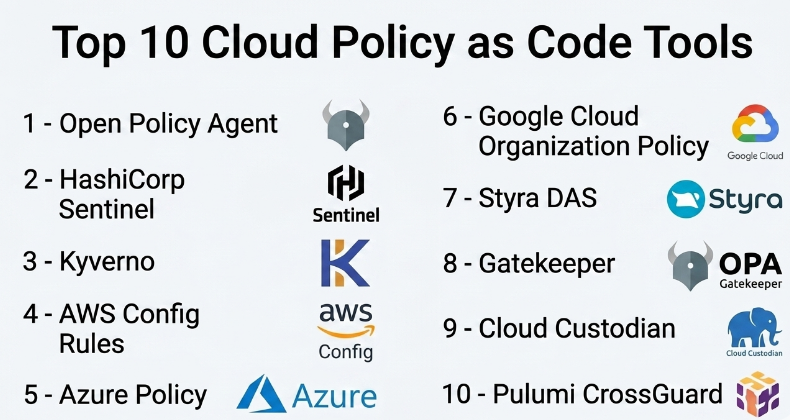
Top 10 Cloud Policy as Code Tools
#1 — Open Policy Agent (OPA)
Short description:
Open Policy Agent (OPA) is a general-purpose policy engine used to enforce policies across cloud infrastructure, Kubernetes, APIs, and microservices. It uses the Rego policy language and is widely adopted in DevSecOps environments. It is highly flexible and often considered the foundation of modern policy-as-code architectures.
Key Features
- Policy-as-code using Rego language
- Kubernetes admission control integration
- API authorization policies
- Multi-environment policy enforcement
- Decoupled policy decision engine
- Extensible with custom data sources
Pros
- Extremely flexible and powerful
- Strong Kubernetes integration
- Open-source and widely adopted
Cons
- Steep learning curve (Rego language)
- Requires engineering maturity
Platforms / Deployment
- Web / Linux / Self-hosted / Hybrid
Security & Compliance
- RBAC depends on deployment
- SOC 2 / ISO: Not applicable (open-source core)
Integrations & Ecosystem
- Kubernetes (Gatekeeper)
- CI/CD pipelines
- API gateways
- Terraform and cloud tooling via extensions
Strong ecosystem with community-contributed policies and enterprise distributions.
Support & Community
Large open-source community with strong documentation and enterprise vendor support options.
#2 — HashiCorp Sentinel
Short description:
HashiCorp Sentinel is a policy-as-code framework integrated into Terraform and HashiCorp ecosystem tools. It enables fine-grained policy enforcement during infrastructure provisioning.
Key Features
- Policy enforcement in Terraform workflows
- Fine-grained rule definitions
- Multi-level policy checks (soft/hard mandatory)
- Integration with Vault and Consul
- Governance for Infrastructure-as-Code
- Policy testing framework
Pros
- Deep integration with Terraform
- Strong enterprise governance model
- Flexible policy definitions
Cons
- Limited outside HashiCorp ecosystem
- Requires enterprise setup for full capabilities
Platforms / Deployment
- Web / Cloud / Self-hosted (Enterprise)
Security & Compliance
- SSO/SAML, RBAC (Enterprise features)
- SOC 2: Not publicly stated
Integrations & Ecosystem
- Terraform
- Vault
- Consul
- CI/CD pipelines
Strong Infrastructure-as-Code governance ecosystem.
Support & Community
Enterprise support available with strong HashiCorp documentation.
#3 — Kyverno
Short description:
Kyverno is a Kubernetes-native policy engine designed to simplify policy management using YAML-based definitions instead of complex languages.
Key Features
- Kubernetes-native policy enforcement
- YAML-based policy definitions
- Admission control for clusters
- Policy validation and mutation
- Resource generation policies
- CI/CD integration for Kubernetes
Pros
- Easy to learn (YAML-based)
- Strong Kubernetes-native design
- No need for custom languages
Cons
- Limited to Kubernetes environments
- Less flexible than OPA for complex policies
Platforms / Deployment
- Kubernetes / Self-hosted
Security & Compliance
- RBAC via Kubernetes
- Audit logging via cluster systems
- SOC2/ISO: Not publicly stated
Integrations & Ecosystem
- Kubernetes clusters
- Helm, ArgoCD
- CI/CD pipelines
Strong ecosystem in cloud-native Kubernetes environments.
Support & Community
Active open-source community and growing enterprise adoption.
#4 — AWS Config Rules
Short description:
AWS Config Rules is a native AWS service that evaluates AWS resources against compliance rules and best practices.
Key Features
- Resource configuration tracking
- Rule-based compliance evaluation
- Pre-built compliance packs
- Continuous monitoring of AWS resources
- Integration with AWS Security Hub
- Remediation workflows
Pros
- Native AWS integration
- Easy setup for AWS environments
- Strong compliance monitoring
Cons
- Limited to AWS ecosystem
- Less flexible than open policy engines
Platforms / Deployment
- Web / Cloud
Security & Compliance
- AWS IAM-based security
- SOC2/ISO: Not separately stated
Integrations & Ecosystem
- AWS Security Hub
- CloudWatch
- Lambda-based remediation
Fully AWS-native governance ecosystem.
Support & Community
AWS documentation and enterprise support plans.
#5 — Azure Policy
Short description:
Azure Policy is a governance tool that enforces rules and compliance standards across Azure resources.
Key Features
- Policy definition and assignment system
- Built-in compliance initiatives
- Real-time enforcement
- Resource auditing and remediation
- Tagging and configuration control
- Integration with Azure DevOps
Pros
- Deep Azure integration
- Strong compliance coverage
- Easy policy assignment
Cons
- Azure-only limitation
- Less flexible for multi-cloud setups
Platforms / Deployment
- Web / Cloud
Security & Compliance
- Azure IAM integration
- SOC2/ISO: Not publicly stated
Integrations & Ecosystem
- Azure Resource Manager
- Azure DevOps
- Microsoft Defender ecosystem
Support & Community
Microsoft enterprise support and documentation.
#6 — Google Cloud Organization Policy
Short description:
Google Cloud Organization Policy allows administrators to define constraints on resource usage across GCP projects.
Key Features
- Hierarchical policy enforcement
- Resource constraint definitions
- IAM integration
- Project-level governance
- Audit logging
- Policy inheritance system
Pros
- Strong hierarchical governance
- Native GCP integration
- Simple constraint-based model
Cons
- Limited to Google Cloud
- Less flexible than OPA
Platforms / Deployment
- Web / Cloud
Security & Compliance
- Google Cloud IAM model
- SOC2/ISO: Not publicly stated
Integrations & Ecosystem
- GCP services
- Cloud Asset Inventory
- Logging and monitoring tools
Support & Community
Google Cloud enterprise documentation.
#7 — Styra DAS
Short description:
Styra DAS is a commercial policy-as-code platform built on Open Policy Agent, providing enterprise-grade governance and management.
Key Features
- Centralized policy management for OPA
- Policy lifecycle management
- Real-time policy enforcement
- Multi-cluster Kubernetes governance
- Audit and compliance dashboards
- Policy analytics
Pros
- Enterprise-ready OPA management
- Strong governance visibility
- Scalable policy operations
Cons
- Commercial dependency
- Requires OPA understanding
Platforms / Deployment
- Web / Cloud / Hybrid
Security & Compliance
- SSO, RBAC, audit logs (enterprise features)
- SOC2/ISO: Not publicly stated
Integrations & Ecosystem
- Kubernetes
- CI/CD pipelines
- Cloud-native platforms
Strong enterprise OPA ecosystem extension.
Support & Community
Enterprise support with structured onboarding.
#8 — Gatekeeper (OPA for Kubernetes)
Short description:
Gatekeeper is a Kubernetes admission controller built on Open Policy Agent that enforces policies at cluster level.
Key Features
- Kubernetes admission control
- Constraint templates
- Policy enforcement at runtime
- Audit mode for compliance checking
- Integration with OPA engine
- Cluster-wide governance
Pros
- Strong Kubernetes enforcement
- Extends OPA capabilities
- Open-source and widely used
Cons
- Kubernetes-only focus
- Requires policy expertise
Platforms / Deployment
- Kubernetes / Self-hosted
Security & Compliance
- Kubernetes RBAC
- Audit logs via cluster tooling
- SOC2/ISO: Not publicly stated
Integrations & Ecosystem
- Kubernetes ecosystems
- CI/CD pipelines
- OPA framework
Support & Community
Strong open-source Kubernetes community.
#9 — Cloud Custodian
Short description:
Cloud Custodian is a rules engine for managing and automating cloud security, compliance, and governance policies.
Key Features
- YAML-based policy definitions
- Automated cloud resource management
- Scheduling and event-based policies
- Multi-cloud support
- Resource cleanup automation
- Compliance reporting
Pros
- Strong automation capabilities
- Multi-cloud support
- Easy YAML-based policies
Cons
- Less real-time enforcement
- Requires scripting knowledge for advanced use
Platforms / Deployment
- Web / Self-hosted / Cloud
Security & Compliance
- IAM-based integrations
- SOC2/ISO: Not publicly stated
Integrations & Ecosystem
- AWS, Azure, GCP
- Lambda and automation tools
- CI/CD pipelines
Support & Community
Active open-source community.
#10 — Pulumi CrossGuard
Short description:
Pulumi CrossGuard extends Infrastructure-as-Code with policy-as-code capabilities, enabling policy enforcement during infrastructure deployment.
Key Features
- Policy enforcement in IaC workflows
- Supports multiple programming languages
- Integration with Pulumi stacks
- Pre-deployment policy checks
- Reusable policy libraries
- Cloud-agnostic governance
Pros
- Developer-friendly (code-based policies)
- Strong IaC integration
- Multi-cloud support
Cons
- Requires Pulumi adoption
- Smaller ecosystem than Terraform
Platforms / Deployment
- Web / Cloud / Self-hosted
Security & Compliance
- RBAC via Pulumi Cloud
- SOC2/ISO: Not publicly stated
Integrations & Ecosystem
- Pulumi IaC platform
- CI/CD pipelines
- Cloud providers (AWS, Azure, GCP)
Support & Community
Growing developer community and enterprise support.
Comparison Table (Top 10)
| Tool Name | Best For | Platform(s) | Deployment | Standout Feature | Public Rating |
|---|---|---|---|---|---|
| OPA | General policy engine | Web | Self-hosted | Flexible policy engine | N/A |
| Sentinel | Terraform users | Web | Cloud/Self-hosted | IaC governance | N/A |
| Kyverno | Kubernetes teams | Web | Kubernetes | YAML policies | N/A |
| AWS Config | AWS users | Web | Cloud | Native compliance rules | N/A |
| Azure Policy | Azure users | Web | Cloud | Built-in governance | N/A |
| GCP Org Policy | GCP users | Web | Cloud | Hierarchical rules | N/A |
| Styra DAS | Enterprise OPA | Web | Hybrid | Policy management layer | N/A |
| Gatekeeper | Kubernetes enforcement | Web | Kubernetes | Admission control | N/A |
| Cloud Custodian | Automation governance | Web | Hybrid | YAML automation rules | N/A |
| Pulumi CrossGuard | IaC governance | Web | Cloud | Code-based policies | N/A |
Evaluation & Scoring (Cloud Policy as Code Tools)
| Tool | Core (25%) | Ease (15%) | Integrations (15%) | Security (10%) | Performance (10%) | Support (10%) | Value (15%) | Total |
|---|---|---|---|---|---|---|---|---|
| OPA | 10 | 6 | 9 | 9 | 9 | 9 | 9 | 8.7 |
| Sentinel | 9 | 7 | 9 | 9 | 8 | 9 | 7 | 8.3 |
| Kyverno | 8 | 9 | 8 | 8 | 8 | 8 | 9 | 8.2 |
| AWS Config | 7 | 9 | 8 | 9 | 8 | 8 | 10 | 8.2 |
| Azure Policy | 7 | 9 | 8 | 9 | 8 | 8 | 10 | 8.2 |
| GCP Policy | 7 | 9 | 8 | 8 | 8 | 8 | 10 | 8.1 |
| Styra DAS | 9 | 7 | 9 | 9 | 9 | 9 | 7 | 8.4 |
| Gatekeeper | 8 | 8 | 8 | 8 | 8 | 8 | 9 | 8.1 |
| Cloud Custodian | 8 | 8 | 8 | 8 | 8 | 8 | 9 | 8.1 |
| Pulumi CrossGuard | 8 | 8 | 8 | 8 | 8 | 8 | 8 | 8.0 |
Interpretation:
- Scores reflect policy flexibility, governance depth, and ecosystem maturity
- OPA and Styra lead in flexibility and enterprise governance
- Cloud-native tools excel in ease and native integration
- Kubernetes tools dominate in runtime enforcement scenarios
- IaC tools are strongest in pre-deployment governance
Which Cloud Policy as Code Tools Should You Choose?
Solo / Freelancer
Best: AWS Config, Azure Policy, GCP Policy
Focus: simplicity and native integration.
SMB
Best: Cloud Custodian, Kyverno
Focus: automation and Kubernetes readiness.
Mid-Market
Best: OPA, Kyverno, Pulumi CrossGuard
Focus: multi-cloud governance and CI/CD integration.
Enterprise
Best: OPA, Styra DAS, Sentinel
Focus: scalability, compliance, and centralized governance.
Budget vs Premium
- Budget: Open-source tools (OPA, Kyverno, Gatekeeper)
- Premium: Styra DAS, Sentinel
Feature Depth vs Ease of Use
- Depth: OPA, Sentinel
- Ease: Kyverno, AWS/Azure/GCP tools
Security & Compliance Needs
- Strong enterprise governance: Styra, Sentinel, OPA
- Cloud-native compliance: AWS, Azure, GCP tools
Frequently Asked Questions (FAQs)
1. What is Cloud Policy as Code?
It is the practice of defining cloud governance rules using code to automatically enforce compliance and security standards.
2. Why is it important?
It reduces human error, improves compliance consistency, and automates governance at scale.
3. Is it only for Kubernetes?
No, it applies to cloud infrastructure, APIs, CI/CD pipelines, and Kubernetes environments.
4. What language is used for policies?
It varies: Rego (OPA), YAML (Kyverno), JSON, or programming languages in IaC tools.
5. Do these tools support multi-cloud?
Yes, tools like OPA and Cloud Custodian support multi-cloud environments.
6. Are these tools hard to learn?
Some like OPA are complex, while others like Kyverno are simpler.
7. Can they enforce rules in real time?
Yes, Kubernetes tools and OPA Gatekeeper support real-time enforcement.
8. Do they integrate with CI/CD?
Yes, most tools integrate with pipelines like Jenkins, GitHub Actions, and GitLab CI.
9. What is the biggest challenge?
Policy complexity and managing large-scale rule sets across teams.
10. Are open-source tools enough?
They are often sufficient for SMBs, but enterprises may require commercial governance layers.
Conclusion
Cloud Policy as Code Tools are essential for modern cloud security and governance strategies. They allow organizations to shift from manual compliance checks to automated, scalable, and consistent policy enforcement across cloud and Kubernetes environments. While tools like AWS Config, Azure Policy, and GCP Organization Policy are ideal for native environments, solutions like Open Policy Agent, Kyverno, and Sentinel offer deeper flexibility and multi-cloud governance capabilities.
