Introduction
Infrastructure as Code (IaC) Tools are platforms that allow teams to provision, configure, and manage infrastructure using machine-readable definition files instead of manual processes. In simple terms, IaC turns infrastructure—servers, networks, databases, and cloud resources—into code that can be versioned, tested, and reused.
In IaC has become a foundational practice in cloud-native engineering, DevOps, and platform engineering. As organizations scale across multi-cloud and hybrid environments, manual infrastructure management becomes slow, error-prone, and unscalable. IaC tools solve this by enabling automation, consistency, and repeatability.
Typical use cases include:
- Provisioning cloud infrastructure (AWS, Azure, GCP)
- Managing Kubernetes clusters and workloads
- Automating CI/CD environment setups
- Standardizing development, staging, and production environments
- Disaster recovery infrastructure replication
- Security policy enforcement at infrastructure level
- Multi-cloud infrastructure orchestration
- Infrastructure version control and rollback
When evaluating Infrastructure as Code tools, organizations should consider:
- Declarative vs imperative approach
- Multi-cloud and hybrid support
- State management capabilities
- Integration with CI/CD pipelines
- Kubernetes and container support
- Security and policy enforcement features
- Scalability for enterprise workloads
- Ease of learning and developer experience
- Ecosystem and community support
- Drift detection and remediation
Best for: DevOps teams, cloud engineers, platform engineering teams, and enterprises managing large-scale cloud infrastructure.
Not ideal for: Very small static environments or teams without automation needs.
Key Trends in Infrastructure as Code (IaC) Tools
- Shift toward declarative and policy-as-code systems
- Increased adoption of GitOps workflows
- Kubernetes-native infrastructure management
- AI-assisted infrastructure provisioning and optimization
- Multi-cloud orchestration becoming standard
- Drift detection and self-healing infrastructure
- Rise of low-code/no-code infrastructure platforms
- Strong integration with CI/CD pipelines
- Improved secret management and security integration
- Modular and reusable infrastructure templates
How We Selected These Tools (Methodology)
The tools listed below were selected based on adoption in DevOps ecosystems, cloud compatibility, scalability, reliability, and infrastructure automation capabilities.
Selection criteria included:
- Cloud provider support (AWS, Azure, GCP)
- Declarative infrastructure capabilities
- State management and drift detection
- Kubernetes and container ecosystem integration
- CI/CD compatibility
- Enterprise readiness and scalability
- Community adoption and maturity
- Security and compliance capabilities
- Extensibility and plugin ecosystem
- Operational stability in production environments
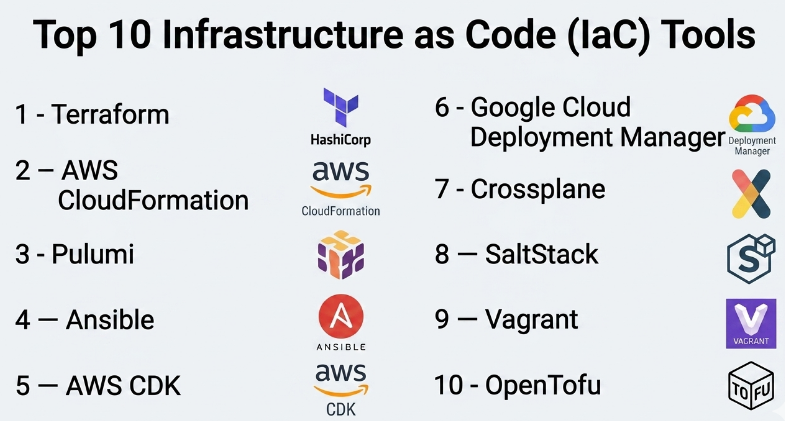
Infrastructure as Code (IaC) Tools
#1 — Terraform
Short description :
Terraform is one of the most widely adopted Infrastructure as Code tools that allows users to define and provision infrastructure across multiple cloud providers using a declarative configuration language.
Key Features
- Multi-cloud infrastructure provisioning
- Declarative configuration language (HCL)
- State management system
- Infrastructure drift detection
- Modular reusable templates
- Provider ecosystem for thousands of services
- CI/CD pipeline integration
Pros
- Strong multi-cloud support
- Large ecosystem and community
- Excellent modular infrastructure design
Cons
- State file management complexity
- Learning curve for advanced usage
- Enterprise features require additional setup
Platforms / Deployment
- CLI / Cloud / Self-hosted / Hybrid
Security & Compliance
- Role-based access control (via integrations)
- State file encryption options
- Policy-as-code support (via extensions)
- Audit logging (enterprise setups)
- Secrets management integrations
Integrations & Ecosystem
- AWS, Azure, GCP
- Kubernetes
- CI/CD tools
- Vault and secret managers
- Git-based workflows
Support & Community
Very strong global open-source and enterprise ecosystem.
#2 — AWS CloudFormation
Short description :
AWS CloudFormation is a native Infrastructure as Code service that enables users to define and manage AWS resources using JSON or YAML templates.
Key Features
- Native AWS infrastructure provisioning
- Stack-based resource management
- Automated dependency handling
- Change sets for safe updates
- Rollback on failure
- Deep AWS service integration
- Drift detection
Pros
- Deep AWS ecosystem integration
- Reliable and stable for AWS workloads
- No external tooling required
Cons
- Limited to AWS ecosystem
- Verbose template syntax
- Less flexible than multi-cloud tools
Platforms / Deployment
- Cloud (AWS-only)
Security & Compliance
- IAM-based access control
- Encryption via AWS services
- CloudTrail audit logs
- Policy enforcement via AWS tools
- Compliance support depending on AWS region
Integrations & Ecosystem
- AWS services (EC2, S3, RDS, etc.)
- AWS Lambda
- CI/CD pipelines
- Monitoring tools
- DevOps toolchains
Support & Community
Strong AWS enterprise support.
#3 — Pulumi
Short description :
Pulumi is a modern Infrastructure as Code tool that allows developers to define infrastructure using general-purpose programming languages like Python, TypeScript, Go, and C#.
Key Features
- Multi-language infrastructure definitions
- Multi-cloud support
- State management system
- Component-based architecture
- CI/CD integration
- Secrets management built-in
- Policy-as-code support
Pros
- Uses familiar programming languages
- Strong flexibility and expressiveness
- Good for developer-centric teams
Cons
- Requires programming knowledge
- Smaller ecosystem than Terraform
- Debugging can be complex
Platforms / Deployment
- Cloud / CLI / Self-hosted
Security & Compliance
- Secrets encryption
- Role-based access control
- Audit logs
- Policy enforcement
- Compliance integrations (varies)
Integrations & Ecosystem
- AWS, Azure, GCP
- Kubernetes
- CI/CD pipelines
- Git-based workflows
- Secret managers
Support & Community
Growing but smaller than Terraform ecosystem.
#4 — Ansible
Short description :
Ansible is a configuration management and automation tool used for infrastructure provisioning, application deployment, and system orchestration using YAML-based playbooks.
Key Features
- Agentless architecture
- YAML-based playbooks
- Configuration management
- Infrastructure automation
- Task orchestration
- Role-based reusable scripts
- Cloud provisioning modules
Pros
- Easy to learn and use
- Agentless setup simplifies deployment
- Strong configuration management capabilities
Cons
- Not fully declarative IaC
- Slower for large-scale infrastructure
- Limited state management
Platforms / Deployment
- CLI / On-prem / Cloud
Security & Compliance
- SSH-based authentication
- Vault for secrets management
- Role-based access control (via extensions)
- Audit logging (enterprise)
- Compliance automation support
Integrations & Ecosystem
- Cloud providers
- DevOps pipelines
- Configuration tools
- Kubernetes modules
- Enterprise IT systems
Support & Community
Very large open-source community.
#5 — AWS CDK (Cloud Development Kit)
Short description :
AWS CDK allows developers to define cloud infrastructure using familiar programming languages while synthesizing it into AWS CloudFormation templates.
Key Features
- Infrastructure defined in TypeScript, Python, Java, etc.
- High-level construct libraries
- AWS-native integration
- CloudFormation synthesis
- Reusable infrastructure components
- Strong abstraction capabilities
- CI/CD integration
Pros
- Developer-friendly abstraction
- Deep AWS integration
- Reduces CloudFormation complexity
Cons
- AWS-only focus
- Requires programming knowledge
- Abstraction can hide complexity
Platforms / Deployment
- Cloud (AWS)
Security & Compliance
- IAM-based security
- AWS encryption services
- CloudTrail logs
- Compliance via AWS ecosystem
- Policy enforcement tools
Integrations & Ecosystem
- AWS services
- CI/CD pipelines
- Lambda and serverless tools
- Monitoring systems
- DevOps tools
Support & Community
Strong AWS-backed support.
#6 — Google Cloud Deployment Manager
Short description :
Google Cloud Deployment Manager is an IaC service for provisioning and managing Google Cloud resources using YAML, Python, or Jinja2 templates.
Key Features
- Native GCP infrastructure provisioning
- Template-based deployments
- Dependency management
- Rollback support
- Resource configuration automation
- IAM integration
- Stack management
Pros
- Deep GCP integration
- Native service reliability
- Simple deployment model
Cons
- Limited to Google Cloud
- Less flexible than Terraform
- Smaller ecosystem
Platforms / Deployment
- Cloud (GCP-only)
Security & Compliance
- IAM-based access control
- Encryption via GCP services
- Audit logging
- Policy enforcement tools
- Compliance support via GCP
Integrations & Ecosystem
- Google Cloud services
- CI/CD pipelines
- Kubernetes Engine
- Monitoring tools
- DevOps tooling
Support & Community
Moderate enterprise support.
#7 — Crossplane
Short description :
Crossplane is a Kubernetes-native Infrastructure as Code tool that allows users to manage cloud infrastructure using Kubernetes-style declarative APIs.
Key Features
- Kubernetes-native infrastructure management
- Multi-cloud provisioning
- Declarative API-driven infrastructure
- GitOps compatibility
- Composable infrastructure resources
- Policy enforcement
- Extensible provider ecosystem
Pros
- Strong Kubernetes integration
- Excellent for platform engineering
- Unified control plane
Cons
- Complex learning curve
- Requires Kubernetes expertise
- Still maturing ecosystem
Platforms / Deployment
- Cloud / Kubernetes / Hybrid
Security & Compliance
- Kubernetes RBAC
- Policy-as-code support
- Secrets integration
- Audit logging via Kubernetes
- Enterprise security extensions
Integrations & Ecosystem
- Kubernetes
- Cloud providers
- GitOps tools
- CI/CD systems
- Service meshes
Support & Community
Fast-growing open-source community.
#8 — SaltStack
Short description :
SaltStack is an infrastructure automation and configuration management tool used for provisioning, orchestration, and system configuration at scale.
Key Features
- Event-driven automation
- Remote execution system
- Configuration management
- Infrastructure orchestration
- Agent-based and agentless modes
- Cloud provisioning support
- Real-time monitoring integration
Pros
- High-speed execution
- Strong scalability
- Flexible automation model
Cons
- Complex architecture
- Learning curve for beginners
- Less modern than newer IaC tools
Platforms / Deployment
- On-prem / Cloud / Hybrid
Security & Compliance
- Encryption support
- Role-based access control
- Audit logging
- Secure communication channels
- Compliance automation
Integrations & Ecosystem
- Cloud providers
- DevOps pipelines
- Monitoring tools
- Kubernetes
- Enterprise IT systems
Support & Community
Moderate enterprise and open-source support.
#9 — Vagrant
Short description :
Vagrant is a tool for building and managing lightweight, reproducible development environments using simple configuration files.
Key Features
- Development environment provisioning
- Virtual machine automation
- Multi-provider support
- Configuration file-based setup
- Environment reproducibility
- Plugin ecosystem
- Integration with provisioning tools
Pros
- Great for local development
- Easy environment replication
- Simple learning curve
Cons
- Not suited for production infrastructure
- Limited cloud-native capabilities
- Slower compared to modern IaC tools
Platforms / Deployment
- Local / CLI / Virtualized environments
Security & Compliance
- Depends on underlying provider
- Basic access control via VM systems
- Limited enterprise security features
- Not designed for compliance workloads
- Extension-based security support
Integrations & Ecosystem
- VirtualBox
- Docker
- Ansible
- CI/CD tools
- Dev environments
Support & Community
Strong developer community.
#10 — OpenTofu
Short description :
OpenTofu is an open-source Infrastructure as Code tool designed as a community-driven alternative to Terraform, focusing on transparency and multi-cloud infrastructure provisioning.
Key Features
- Terraform-compatible syntax
- Multi-cloud provisioning
- Open-source governance model
- State management system
- Modular infrastructure design
- CI/CD integration
- Plugin ecosystem compatibility
Pros
- Open-source and community-driven
- Terraform compatibility
- Strong multi-cloud capabilities
Cons
- Younger ecosystem
- Limited enterprise maturity
- Evolving feature set
Platforms / Deployment
- CLI / Cloud / Self-hosted / Hybrid
Security & Compliance
- State encryption options
- Role-based access control (via integrations)
- Audit logging support
- Policy-as-code capabilities
- Compliance support varies
Integrations & Ecosystem
- AWS, Azure, GCP
- Kubernetes
- CI/CD pipelines
- Terraform ecosystem tools
- DevOps platforms
Support & Community
Rapidly growing open-source community.
Comparison Table (Top 10)
| Tool Name | Best For | Platform(s) Supported | Deployment | Standout Feature | Public Rating |
|---|---|---|---|---|---|
| Terraform | Multi-cloud IaC | Cloud/CLI | Hybrid | Huge provider ecosystem | N/A |
| CloudFormation | AWS-native infra | AWS | Cloud | Native AWS integration | N/A |
| Pulumi | Dev-centric IaC | Multi-cloud | Hybrid | Programming language support | N/A |
| Ansible | Config automation | Multi-platform | Hybrid | Agentless architecture | N/A |
| AWS CDK | AWS developers | AWS | Cloud | Code-based AWS infra | N/A |
| GCP Deployment Manager | GCP infra | GCP | Cloud | Native GCP tooling | N/A |
| Crossplane | Kubernetes IaC | Multi-cloud | Kubernetes | K8s-native control plane | N/A |
| SaltStack | Large-scale automation | Multi-platform | Hybrid | Event-driven automation | N/A |
| Vagrant | Dev environments | Local | Local | Reproducible dev setups | N/A |
| OpenTofu | Open-source IaC | Multi-cloud | Hybrid | Terraform-compatible OSS | N/A |
Evaluation & Infrastructure as Code (IaC) Tools
| Tool Name | Core (25%) | Ease (15%) | Integrations (15%) | Security (10%) | Performance (10%) | Support (10%) | Value (15%) | Weighted Total |
|---|---|---|---|---|---|---|---|---|
| Terraform | 10 | 8 | 10 | 9 | 9 | 10 | 9 | 9.4 |
| CloudFormation | 9 | 8 | 9 | 10 | 9 | 9 | 9 | 9.0 |
| Pulumi | 9 | 8 | 9 | 9 | 9 | 8 | 8 | 8.6 |
| Ansible | 8 | 9 | 9 | 8 | 8 | 9 | 9 | 8.6 |
| AWS CDK | 9 | 8 | 9 | 9 | 9 | 9 | 8 | 8.8 |
| GCP Deployment Manager | 8 | 8 | 8 | 9 | 8 | 8 | 8 | 8.1 |
| Crossplane | 9 | 7 | 9 | 9 | 9 | 8 | 8 | 8.6 |
| SaltStack | 8 | 7 | 8 | 8 | 9 | 8 | 8 | 8.1 |
| Vagrant | 7 | 10 | 7 | 6 | 6 | 9 | 9 | 7.8 |
| OpenTofu | 9 | 8 | 9 | 8 | 8 | 8 | 9 | 8.7 |
Which Infrastructure as Code (IaC) Tools
Solo / Freelancer
- Vagrant
- Ansible
- Pulumi
SMB
- Ansible
- Terraform
- OpenTofu
Mid-Market
- Terraform
- Pulumi
- AWS CDK
Enterprise
- Terraform
- CloudFormation
- Crossplane
Budget vs Premium
- Budget-friendly: Ansible, OpenTofu
- Balanced: Terraform, Pulumi
- Premium enterprise: CloudFormation, Crossplane
Feature Depth vs Ease of Use
- Easiest: Vagrant, Ansible
- Most powerful multi-cloud: Terraform
- Most developer-friendly: Pulumi
Integrations & Scalability
- Best ecosystem: Terraform
- Best AWS scaling: CloudFormation
- Best Kubernetes-native scaling: Crossplane
Security & Compliance Needs
Highly regulated environments should prioritize:
- Terraform
- CloudFormation
- Crossplane
- AWS CDK
Frequently Asked Questions (FAQs)
1. What is Infrastructure as Code?
It is the practice of managing infrastructure using code instead of manual configuration.
2. Why is IaC important?
It improves consistency, automation, scalability, and reduces human error.
3. Is Terraform still the most popular IaC tool?
Yes, it remains one of the most widely adopted multi-cloud IaC tools.
4. What is the difference between IaC and configuration management?
IaC provisions infrastructure, while configuration management manages system state.
5. Is IaC only for cloud environments?
No, it can also manage on-prem and hybrid infrastructure.
6. What is GitOps in IaC?
It is a workflow where infrastructure is managed through Git repositories.
7. Do IaC tools support Kubernetes?
Yes, tools like Crossplane and Pulumi support Kubernetes deeply.
8. Is IaC secure?
Yes, when combined with proper access control and secret management.
9. What skills are needed for IaC?
Cloud knowledge, scripting, and basic DevOps practices.
10. What is the future of IaC?
It is moving toward AI-driven automation and self-healing infrastructure.
Conclusion
Infrastructure as Code (IaC) Tools have become essential for modern cloud infrastructure management, enabling teams to automate provisioning, ensure consistency, and scale across complex environments. As organizations adopt multi-cloud and Kubernetes-native architectures, IaC has shifted from a DevOps practice to a core platform engineering standard. Terraform remains the dominant multi-cloud leader, while CloudFormation and AWS CDK dominate AWS-native environments. Pulumi brings developer-friendly flexibility, and Crossplane represents the future of Kubernetes-native infrastructure management. Meanwhile, OpenTofu is emerging as a strong open-source alternative.
