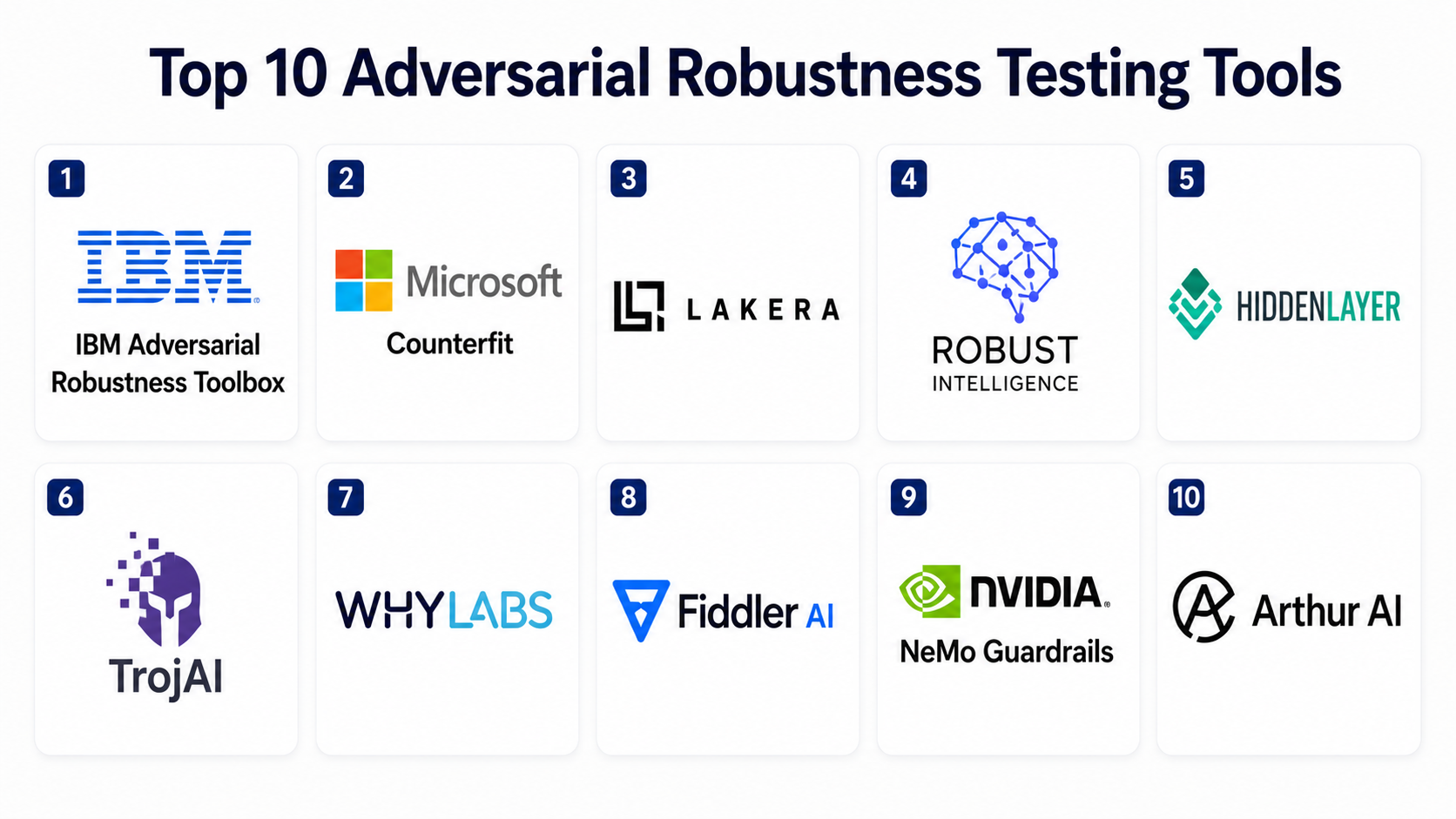
Introduction
Adversarial Robustness Testing Tools are specialized platforms and frameworks designed to evaluate how artificial intelligence and machine learning models respond to adversarial attacks, malicious inputs, prompt manipulation, and security vulnerabilities. These tools help organizations identify weaknesses in AI systems before deployment by simulating attacks that could cause inaccurate predictions, unsafe outputs, privacy leaks, or operational failures.
In 2026 and beyond, adversarial robustness testing has become increasingly important due to the rapid adoption of generative AI, autonomous systems, AI copilots, and enterprise machine learning applications. Organizations deploying AI in finance, healthcare, cybersecurity, defense, retail, and critical infrastructure sectors now require stronger AI security validation to reduce operational risk and improve trustworthiness.
Common real-world use cases include:
- LLM jailbreak and prompt injection testing
- AI security validation
- Autonomous system safety testing
- Fraud detection model hardening
- AI compliance and governance audits
When evaluating Adversarial Robustness Testing Tools, buyers should consider:
- Attack simulation coverage
- LLM and generative AI testing support
- Explainability and observability
- Automation capabilities
- Enterprise scalability
- Integration ecosystem
- Compliance and governance support
- Security controls
- Ease of deployment
- Monitoring and reporting features
Best for: Enterprise AI teams, cybersecurity teams, MLOps engineers, Responsible AI teams, government agencies, financial institutions, healthcare organizations, and companies deploying production AI systems.
Not ideal for: Small experimental AI projects with minimal security exposure or organizations that only use low-risk AI applications internally.
Key Trends in Adversarial Robustness Testing Tools
- LLM jailbreak testing is rapidly becoming standard practice.
- Prompt injection security testing is expanding across enterprise AI deployments.
- AI red teaming platforms are gaining mainstream enterprise adoption.
- Automated adversarial attack generation is improving rapidly.
- AI observability and security testing are increasingly converging.
- Multimodal AI robustness testing is becoming more important.
- Real-time AI threat monitoring is growing across regulated industries.
- Responsible AI governance now includes adversarial security testing.
- Open-source AI robustness frameworks remain highly influential.
- AI security testing is increasingly integrated into MLOps pipelines.
How We Selected These Tools (Methodology)
The platforms in this list were selected based on adversarial testing capabilities, enterprise adoption, security relevance, scalability, ecosystem maturity, and Responsible AI alignment.
Selection criteria included:
- Adversarial attack simulation support
- LLM and generative AI testing capabilities
- Enterprise AI security workflows
- Explainability and observability integration
- Monitoring and reporting features
- Security and governance support
- Documentation and community adoption
- Integration ecosystem maturity
- Operational scalability
- Innovation in AI robustness evaluation
The final list includes enterprise AI security platforms, open-source adversarial testing frameworks, AI observability systems, and Responsible AI tooling.
Adversarial Robustness Testing Tools
#1 — IBM Adversarial Robustness Toolbox (ART)
Short description :
IBM Adversarial Robustness Toolbox (ART) is one of the most widely adopted open-source frameworks for adversarial machine learning security testing. It helps organizations evaluate, defend, and benchmark AI models against adversarial attacks across multiple ML frameworks.
Key Features
- Adversarial attack simulation
- Defense algorithm support
- Model poisoning detection
- Evasion attack testing
- Privacy risk analysis
- Multi-framework compatibility
- Open-source ecosystem
Pros
- Strong research and enterprise adoption
- Broad attack coverage
- Flexible open-source architecture
Cons
- Requires technical expertise
- Enterprise operational tooling is limited
- Advanced deployments may require customization
Platforms / Deployment
- Windows / Linux / macOS
- Self-hosted
Security & Compliance
- Varies / N/A
Integrations & Ecosystem
ART integrates with modern machine learning ecosystems and AI research workflows.
- TensorFlow
- PyTorch
- Scikit-learn
- Keras
- Jupyter
Support & Community
ART has strong academic, research, and enterprise security community adoption.
#2 — Microsoft Counterfit
Short description :
Microsoft Counterfit is an open-source AI security testing framework designed for automating adversarial attack workflows and evaluating model robustness across enterprise AI systems.
Key Features
- Automated adversarial testing
- Attack orchestration
- AI security benchmarking
- Model vulnerability analysis
- Extensible attack modules
- Framework compatibility
- Security workflow automation
Pros
- Strong automation capabilities
- Good AI security experimentation support
- Open-source flexibility
Cons
- Requires security expertise
- Enterprise governance tooling is limited
- Smaller operational ecosystem
Platforms / Deployment
- Windows / Linux / macOS
- Self-hosted
Security & Compliance
- Varies / N/A
Integrations & Ecosystem
Counterfit integrates with AI experimentation and security workflows.
- Azure
- Python
- TensorFlow
- PyTorch
- ML experimentation systems
Support & Community
Microsoft maintains active documentation and open-source support resources.
#3 — Lakera
Short description :
Lakera focuses on generative AI security, prompt injection detection, and adversarial robustness testing for large language model applications and enterprise AI copilots.
Key Features
- Prompt injection detection
- LLM jailbreak protection
- Real-time AI threat monitoring
- Generative AI security analysis
- AI policy enforcement
- Risk scoring
- AI safety analytics
Pros
- Strong LLM security focus
- Good real-time monitoring capabilities
- Modern generative AI relevance
Cons
- Primarily focused on LLM security
- Enterprise deployment complexity
- Premium enterprise positioning
Platforms / Deployment
- Web
- Cloud
Security & Compliance
- RBAC
- Encryption
- Audit logs
Integrations & Ecosystem
Lakera integrates with enterprise generative AI systems and APIs.
- OpenAI integrations
- APIs
- AI copilots
- Enterprise AI gateways
- Cloud AI systems
Support & Community
Lakera provides enterprise onboarding and AI security support programs.
#4 — Robust Intelligence
Short description :
Robust Intelligence is an enterprise AI security and robustness platform focused on adversarial testing, AI firewall protection, governance, and production AI monitoring.
Key Features
- AI firewall protection
- Adversarial attack testing
- LLM security validation
- AI governance workflows
- Real-time monitoring
- Compliance analytics
- AI risk assessment
Pros
- Strong enterprise AI security capabilities
- Broad governance coverage
- Good production monitoring support
Cons
- Premium enterprise pricing
- Complex onboarding requirements
- Advanced workflows require expertise
Platforms / Deployment
- Web
- Cloud / Hybrid
Security & Compliance
- SSO/SAML
- RBAC
- Encryption
- Audit logs
Integrations & Ecosystem
Robust Intelligence integrates with enterprise AI and MLOps ecosystems.
- Databricks
- APIs
- Kubernetes
- Cloud infrastructure
- ML workflows
Support & Community
Robust Intelligence provides enterprise onboarding and technical support services.
#5 — HiddenLayer
Short description :
HiddenLayer is an AI security platform focused on protecting machine learning models from adversarial attacks, inference manipulation, model theft, and operational vulnerabilities.
Key Features
- AI threat detection
- Model security monitoring
- Adversarial defense workflows
- AI runtime protection
- Threat intelligence
- Drift analysis
- AI risk monitoring
Pros
- Strong AI security specialization
- Good runtime protection workflows
- Broad operational monitoring support
Cons
- Premium enterprise positioning
- Smaller ecosystem footprint
- Advanced operational setup complexity
Platforms / Deployment
- Web
- Cloud / Hybrid
Security & Compliance
- RBAC
- Encryption
- Audit logs
- SSO/SAML
Integrations & Ecosystem
HiddenLayer integrates with enterprise AI infrastructure and security systems.
- Cloud AI platforms
- APIs
- Security operations workflows
- MLOps systems
- Kubernetes
Support & Community
HiddenLayer provides enterprise onboarding and AI security consultation services.
#6 — TrojAI
Short description :
TrojAI is a research-focused AI robustness initiative and toolkit designed to detect Trojan attacks and hidden malicious behaviors in machine learning models.
Key Features
- Trojan attack analysis
- Model behavior inspection
- AI security benchmarking
- Malicious trigger detection
- Research experimentation
- Adversarial analysis
- Open-source workflows
Pros
- Strong AI security research support
- Specialized Trojan detection capabilities
- Good experimentation flexibility
Cons
- Limited enterprise operational tooling
- Primarily research-oriented
- Requires advanced technical expertise
Platforms / Deployment
- Windows / Linux / macOS
- Self-hosted
Security & Compliance
- Varies / N/A
Integrations & Ecosystem
TrojAI integrates with AI research and experimentation ecosystems.
- Python
- Jupyter
- TensorFlow
- PyTorch
- Research workflows
Support & Community
TrojAI has active academic and AI security research adoption.
#7 — WhyLabs
Short description :
WhyLabs is an AI observability platform that supports adversarial monitoring, anomaly detection, LLM observability, and AI safety analysis for production systems.
Key Features
- AI observability
- Anomaly detection
- Drift monitoring
- LLM monitoring
- Real-time analytics
- Data quality analysis
- AI performance tracking
Pros
- Strong monitoring capabilities
- Good operational visibility
- Developer-friendly integrations
Cons
- Governance tooling less extensive than some competitors
- Smaller enterprise ecosystem
- Advanced enterprise workflows may require customization
Platforms / Deployment
- Web
- Cloud
Security & Compliance
- RBAC
- Encryption
- Audit logs
Integrations & Ecosystem
WhyLabs integrates with modern AI infrastructure and monitoring systems.
- MLflow
- Kubernetes
- Databricks
- APIs
- Python
Support & Community
WhyLabs has active AI engineering communities and enterprise support programs.
#8 — Fiddler AI
Short description :
Fiddler AI is an AI observability and security monitoring platform supporting adversarial testing visibility, explainability, fairness analysis, and LLM observability workflows.
Key Features
- AI observability
- Explainability workflows
- LLM monitoring
- Drift analysis
- Bias monitoring
- Real-time analytics
- Governance dashboards
Pros
- Strong enterprise AI observability
- Broad monitoring capabilities
- Good explainability support
Cons
- Premium enterprise pricing
- Advanced deployment complexity
- Requires operational maturity
Platforms / Deployment
- Web
- Cloud / Hybrid
Security & Compliance
- SSO/SAML
- RBAC
- Encryption
- Audit logs
Integrations & Ecosystem
Fiddler AI integrates with enterprise AI and analytics ecosystems.
- Databricks
- AWS
- Azure
- MLflow
- APIs
Support & Community
Fiddler provides enterprise onboarding and technical support services.
#9 — NVIDIA NeMo Guardrails
Short description :
NVIDIA NeMo Guardrails is a framework designed to improve the safety, reliability, and robustness of conversational AI and LLM applications through programmable guardrails and policy enforcement.
Key Features
- LLM guardrails
- Prompt filtering
- AI policy enforcement
- Safety workflows
- Conversation control
- Open-source extensibility
- Generative AI security support
Pros
- Strong generative AI relevance
- Good programmable safety workflows
- Flexible open-source architecture
Cons
- Primarily focused on conversational AI
- Requires engineering expertise
- Governance tooling is limited
Platforms / Deployment
- Windows / Linux
- Self-hosted / Cloud
Security & Compliance
- Varies / N/A
Integrations & Ecosystem
NeMo Guardrails integrates with NVIDIA AI ecosystems and LLM workflows.
- NVIDIA AI Enterprise
- LangChain
- APIs
- Python
- LLM orchestration systems
Support & Community
NVIDIA provides active documentation and AI developer ecosystem support.
#10 — Arthur AI
Short description :
Arthur AI is an enterprise AI monitoring platform supporting robustness analysis, explainability, fairness monitoring, and operational observability across ML and LLM systems.
Key Features
- AI observability
- Drift detection
- Explainability analytics
- Bias analysis
- LLM monitoring
- Governance dashboards
- Real-time monitoring
Pros
- Strong operational monitoring
- Good enterprise AI visibility
- Broad ML and LLM support
Cons
- Premium enterprise positioning
- Advanced onboarding requirements
- Smaller ecosystem than hyperscalers
Platforms / Deployment
- Web
- Cloud / Hybrid
Security & Compliance
- RBAC
- Encryption
- Audit logs
- SSO/SAML
Integrations & Ecosystem
Arthur AI integrates with enterprise AI infrastructure and MLOps systems.
- Kubernetes
- Databricks
- APIs
- Cloud infrastructure
- ML workflows
Support & Community
Arthur AI provides enterprise onboarding and technical support services.
Comparison Table (Top 10)
| Tool Name | Best For | Platform(s) Supported | Deployment | Standout Feature | Public Rating |
|---|---|---|---|---|---|
| IBM ART | Open-source adversarial testing | Windows, Linux, macOS | Self-hosted | Adversarial attack simulation | N/A |
| Microsoft Counterfit | Automated AI security testing | Windows, Linux, macOS | Self-hosted | Attack orchestration | N/A |
| Lakera | LLM security | Web | Cloud | Prompt injection detection | N/A |
| Robust Intelligence | Enterprise AI security | Web | Hybrid | AI firewall protection | N/A |
| HiddenLayer | AI threat monitoring | Web | Hybrid | Runtime AI security | N/A |
| TrojAI | Trojan attack analysis | Windows, Linux, macOS | Self-hosted | Hidden behavior detection | N/A |
| WhyLabs | AI observability | Web | Cloud | Real-time monitoring | N/A |
| Fiddler AI | Enterprise observability | Web | Hybrid | AI monitoring dashboards | N/A |
| NVIDIA NeMo Guardrails | Conversational AI safety | Windows, Linux | Hybrid | LLM guardrails | N/A |
| Arthur AI | Enterprise AI monitoring | Web | Hybrid | Operational AI observability | N/A |
Evaluation & Adversarial Robustness Testing Tools
| Tool Name | Core (25%) | Ease (15%) | Integrations (15%) | Security (10%) | Performance (10%) | Support (10%) | Value (15%) | Weighted Total |
|---|---|---|---|---|---|---|---|---|
| IBM ART | 9 | 6 | 8 | 7 | 8 | 8 | 10 | 8.0 |
| Microsoft Counterfit | 8 | 7 | 7 | 7 | 7 | 7 | 9 | 7.5 |
| Lakera | 8 | 8 | 7 | 8 | 8 | 7 | 7 | 7.7 |
| Robust Intelligence | 9 | 7 | 8 | 9 | 8 | 8 | 7 | 8.1 |
| HiddenLayer | 8 | 7 | 7 | 9 | 8 | 7 | 7 | 7.7 |
| TrojAI | 7 | 5 | 6 | 6 | 7 | 6 | 9 | 6.7 |
| WhyLabs | 8 | 8 | 7 | 7 | 8 | 7 | 8 | 7.7 |
| Fiddler AI | 8 | 7 | 8 | 8 | 8 | 8 | 7 | 7.8 |
| NVIDIA NeMo Guardrails | 8 | 7 | 8 | 7 | 8 | 7 | 8 | 7.7 |
| Arthur AI | 8 | 7 | 8 | 8 | 8 | 8 | 7 | 7.8 |
These scores are comparative rather than absolute. Some platforms focus heavily on open-source adversarial research, while others prioritize enterprise AI governance, runtime monitoring, or generative AI protection. Buyers should evaluate robustness testing platforms based on deployment scale, AI risk exposure, operational maturity, and security requirements.
Which Adversarial Robustness Testing Tools
Solo / Freelancer
Independent developers and researchers may prefer:
- IBM ART
- Microsoft Counterfit
- NVIDIA NeMo Guardrails
These tools provide strong experimentation flexibility and open-source accessibility.
SMB
Small and medium-sized businesses should prioritize usability and manageable operational complexity.
Recommended options:
- WhyLabs
- Lakera
- Microsoft Counterfit
Mid-Market
Mid-sized organizations often require scalable AI monitoring and security validation.
Recommended options:
- Fiddler AI
- Arthur AI
- HiddenLayer
- WhyLabs
Enterprise
Large enterprises with strict AI governance and security requirements should prioritize operational visibility and AI protection workflows.
Recommended options:
- Robust Intelligence
- HiddenLayer
- Arthur AI
- Fiddler AI
Budget vs Premium
- Budget-friendly: IBM ART, Microsoft Counterfit
- Premium enterprise: Robust Intelligence, HiddenLayer
- Balanced value: WhyLabs, NVIDIA NeMo Guardrails
Feature Depth vs Ease of Use
- Deepest AI security workflows: Robust Intelligence, HiddenLayer
- Best usability: Lakera
- Best open-source flexibility: IBM ART
Integrations & Scalability
- Best enterprise AI observability: Fiddler AI
- Best generative AI ecosystem: NVIDIA NeMo Guardrails
- Best enterprise security integration: Robust Intelligence
Security & Compliance Needs
Organizations with strict AI security requirements should prioritize:
- Robust Intelligence
- HiddenLayer
- Arthur AI
- Lakera
Frequently Asked Questions (FAQs)
1. What are Adversarial Robustness Testing Tools?
These tools help organizations evaluate how AI systems respond to malicious inputs, adversarial attacks, prompt injections, and security vulnerabilities.
2. Why are adversarial testing tools important?
They improve AI system reliability, reduce security risks, strengthen governance, and help prevent unsafe or manipulated model behavior.
3. What is an adversarial attack?
An adversarial attack manipulates input data or prompts to intentionally cause incorrect or unsafe AI outputs.
4. What is prompt injection in generative AI?
Prompt injection is a technique where attackers manipulate prompts to bypass AI safety controls or alter model behavior.
5. Which industries rely most on adversarial robustness testing?
Finance, healthcare, defense, cybersecurity, government, retail, and enterprise technology sectors are major adopters.
6. Can these tools test LLMs?
Yes. Many modern platforms now support jailbreak testing, prompt injection analysis, hallucination monitoring, and generative AI security workflows.
7. What is AI red teaming?
AI red teaming involves simulating attacks against AI systems to identify weaknesses and improve defenses.
8. Are open-source robustness frameworks enterprise-ready?
Some open-source frameworks can support enterprise deployments when combined with governance, monitoring, and operational infrastructure.
9. What should buyers prioritize when selecting robustness testing tools?
Buyers should evaluate attack coverage, LLM support, scalability, integrations, governance capabilities, and operational monitoring.
10. Do robustness testing tools improve Responsible AI operations?
Yes. These tools strengthen AI reliability, transparency, governance, security, and operational trustworthiness.
Conclusion
Adversarial Robustness Testing Tools are becoming essential infrastructure for enterprise AI security, generative AI governance, and Responsible AI operations. As organizations increasingly deploy LLMs, autonomous systems, and AI-powered decision-making platforms, robustness testing and adversarial defense workflows are critical for maintaining operational trust and reducing AI risk exposure. IBM ART and Microsoft Counterfit remain important open-source adversarial testing frameworks, while enterprise platforms like Robust Intelligence, HiddenLayer, Arthur AI, and Fiddler AI provide broader AI security, monitoring, and governance capabilities.
