Introduction
Enterprise Data Fabric Platforms are technologies designed to connect, unify, govern, and manage data across multiple systems, cloud environments, applications, and business units. Instead of forcing organizations to move all data into a single warehouse or lake, data fabric platforms create an intelligent data layer that improves accessibility, governance, integration, and analytics across distributed environments.
In enterprise data fabrics have become increasingly important because organizations operate across hybrid cloud infrastructures, SaaS applications, AI systems, IoT devices, and distributed databases. Businesses need real-time access to trusted data without creating massive duplication, governance gaps, or integration bottlenecks.
Common real-world use cases include:
- Multi-cloud data management
- AI and machine learning data pipelines
- Enterprise-wide analytics and BI
- Regulatory compliance and governance
- Customer 360 and master data management
When evaluating Enterprise Data Fabric Platforms, buyers should consider:
- Integration capabilities
- Data governance and cataloging
- AI-driven automation
- Scalability
- Hybrid and multi-cloud support
- Security and compliance features
- Metadata management
- Real-time processing capabilities
- Ease of deployment
- Ecosystem and partner integrations
Best for: Large enterprises, regulated industries, data engineering teams, analytics leaders, cloud modernization initiatives, and organizations managing data across multiple environments.
Not ideal for: Small businesses with limited data complexity, startups using only a few SaaS tools, or teams that primarily need lightweight ETL instead of enterprise-grade data orchestration and governance.
Key Trends in Enterprise Data Fabric Platforms
- AI-assisted data discovery and metadata management are becoming standard features.
- Hybrid and multi-cloud deployments are now expected across enterprise environments.
- Data observability and data quality monitoring are increasingly integrated directly into platforms.
- Real-time streaming and event-driven architectures are replacing batch-heavy pipelines.
- Governance automation is improving compliance for GDPR, HIPAA, and regional regulations.
- Generative AI workloads are increasing demand for unified semantic data layers.
- Low-code and no-code data integration experiences are expanding adoption beyond engineering teams.
- Open table formats and interoperability with lakehouse architectures are gaining importance.
- Zero-trust security models and fine-grained access control are becoming mandatory.
- Consumption-based pricing models are increasingly replacing fixed licensing structures.
How We Selected These Tools (Methodology)
The platforms in this list were selected using a balanced evaluation framework focused on enterprise readiness and long-term viability.
Selection factors included:
- Strong market presence and enterprise adoption
- Broad integration ecosystems
- Advanced metadata and governance capabilities
- Multi-cloud and hybrid deployment flexibility
- Scalability for large datasets and distributed architectures
- Security and compliance capabilities
- AI and automation features
- Reliability and operational maturity
- Developer and analyst usability
- Support quality, documentation, and ecosystem strength
The list also balances traditional enterprise vendors, cloud-native platforms, and modern data-focused architectures.
Enterprise Data Fabric Platforms
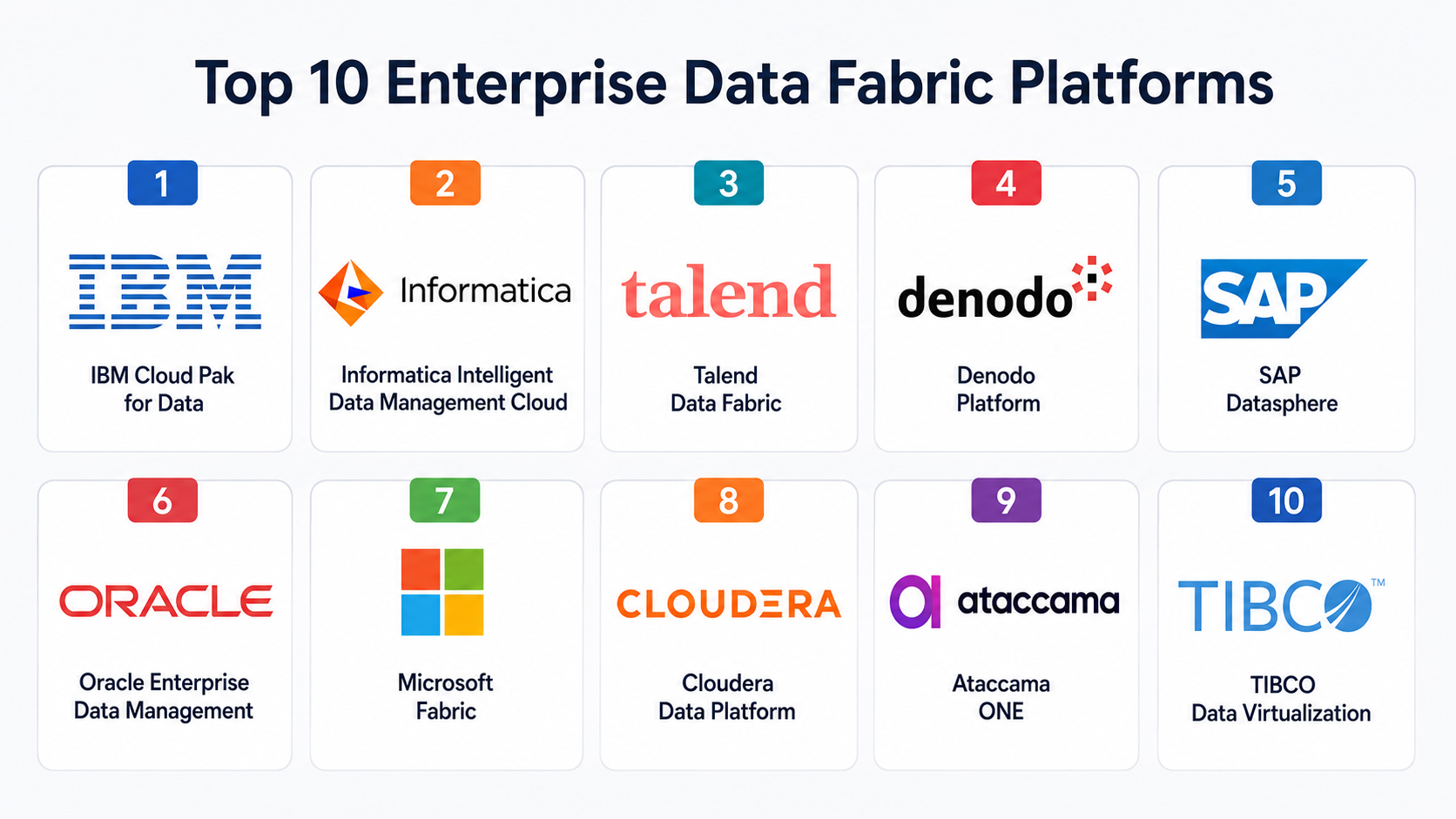
#1 — IBM Cloud Pak for Data
Short description :
IBM Cloud Pak for Data is one of the most recognized enterprise data fabric platforms for large-scale hybrid cloud environments. It combines data integration, governance, AI, analytics, and data virtualization into a unified architecture. The platform is designed primarily for large enterprises operating across complex infrastructures. It is widely used in financial services, healthcare, telecommunications, and government sectors. IBM emphasizes automation, governance, and AI-assisted data management. The platform also integrates closely with IBM Watson AI services.
Key Features
- Data virtualization across distributed environments
- AI-powered metadata discovery
- Integrated governance and cataloging
- Hybrid cloud deployment support
- Built-in machine learning workflows
- Data lineage and observability
- Enterprise-grade security controls
Pros
- Strong governance and compliance capabilities
- Excellent hybrid cloud support
- Mature enterprise ecosystem
Cons
- Complex implementation process
- Higher operational overhead
- Can require specialized expertise
Platforms / Deployment
- Web / Linux
- Cloud / Self-hosted / Hybrid
Security & Compliance
- SSO/SAML
- MFA
- RBAC
- Encryption
- Audit logs
- GDPR support
- ISO 27001
- SOC 2
Integrations & Ecosystem
IBM Cloud Pak for Data integrates with enterprise databases, analytics tools, cloud providers, and AI platforms. It supports extensive API connectivity and enterprise middleware integrations.
- Red Hat OpenShift
- Db2
- Hadoop ecosystems
- Apache Spark
- AWS
- Azure
- Google Cloud
Support & Community
IBM provides enterprise support tiers, consulting services, onboarding assistance, and extensive documentation. Community engagement is smaller than open-source ecosystems but strong within enterprise customers.
#2 — Informatica Intelligent Data Management Cloud
Short description :
Informatica is a leading enterprise data management provider known for integration, governance, MDM, and metadata intelligence. Its Intelligent Data Management Cloud platform delivers cloud-native data fabric capabilities across analytics, AI, and operational systems. Informatica focuses heavily on automation and AI-driven metadata discovery. It serves large enterprises undergoing cloud modernization and digital transformation initiatives. The platform is especially strong in regulated industries and global enterprises.
Key Features
- AI-powered CLAIRE metadata engine
- Data integration and ETL
- Master data management
- Data quality monitoring
- Cloud-native architecture
- API and application integration
- Enterprise governance controls
Pros
- Strong automation features
- Broad connector ecosystem
- Mature enterprise governance
Cons
- Pricing can be expensive
- Learning curve for advanced workflows
- Some features require additional licensing
Platforms / Deployment
- Web
- Cloud / Hybrid
Security & Compliance
- SSO/SAML
- MFA
- Encryption
- Audit logging
- RBAC
- GDPR support
- SOC 2
- ISO 27001
Integrations & Ecosystem
Informatica supports thousands of enterprise connectors and integrates deeply with cloud ecosystems, SaaS platforms, and analytics tools.
- Snowflake
- Salesforce
- SAP
- Oracle
- AWS
- Azure
- Databricks
Support & Community
Informatica offers enterprise onboarding, partner services, certification programs, and large-scale documentation libraries. Its ecosystem is mature and widely adopted.
#3 — Talend Data Fabric
Short description :
Talend Data Fabric combines data integration, governance, quality, and API services into a unified enterprise platform. It is known for balancing enterprise-grade functionality with relatively developer-friendly tooling. Talend is popular among organizations modernizing legacy data systems and building cloud analytics environments. The platform supports both batch and real-time integration workflows. Its open-source heritage also contributes to broader developer adoption.
Key Features
- Data integration pipelines
- Data quality monitoring
- Real-time streaming support
- API integration
- Metadata management
- Data governance workflows
- Multi-cloud compatibility
Pros
- Flexible integration capabilities
- Strong open-source ecosystem
- Good balance of usability and enterprise features
Cons
- UI complexity in advanced projects
- Enterprise licensing costs
- Performance tuning may require expertise
Platforms / Deployment
- Web / Windows / Linux
- Cloud / Self-hosted / Hybrid
Security & Compliance
- SSO/SAML
- Encryption
- RBAC
- Audit logs
- GDPR support
- SOC 2
Integrations & Ecosystem
Talend integrates with databases, cloud storage systems, streaming platforms, and enterprise applications.
- Kafka
- Snowflake
- AWS
- Azure
- SAP
- Salesforce
Support & Community
Talend benefits from a large user community due to its open-source origins. Enterprise support and training programs are available.
#4 — Denodo Platform
Short description :
Denodo specializes in data virtualization and logical data fabric architectures. Instead of centralizing all data physically, Denodo enables organizations to access distributed data through a unified semantic layer. The platform is widely used in enterprises that require real-time access across fragmented systems. Denodo is particularly strong in hybrid cloud and multi-cloud scenarios. It also emphasizes governance, metadata management, and query optimization.
Key Features
- Data virtualization
- Logical data fabric architecture
- Real-time query federation
- Semantic data layer
- Metadata management
- Governance controls
- Multi-cloud support
Pros
- Reduces data duplication
- Strong real-time access capabilities
- Excellent hybrid integration
Cons
- Requires careful performance optimization
- Advanced implementations can become complex
- Licensing may be costly
Platforms / Deployment
- Web / Linux
- Cloud / Self-hosted / Hybrid
Security & Compliance
- SSO/SAML
- Encryption
- Audit logging
- RBAC
- GDPR support
Integrations & Ecosystem
Denodo integrates with enterprise databases, cloud warehouses, APIs, and analytics platforms.
- Snowflake
- Oracle
- SQL Server
- AWS
- Azure
- Tableau
Support & Community
Denodo provides enterprise support, certification programs, and strong technical documentation. Community size is moderate compared to broader data integration vendors.
#5 — SAP Datasphere
Short description :
SAP Datasphere is SAP’s modern data fabric and business data platform designed for enterprise analytics and unified business semantics. It helps organizations connect SAP and non-SAP data sources while preserving business context. The platform is especially useful for enterprises deeply invested in SAP ecosystems. SAP Datasphere also supports governance, analytics, and AI workloads across distributed environments.
Key Features
- Business data fabric architecture
- SAP-native integration
- Semantic data modeling
- Governance capabilities
- Real-time analytics support
- Cloud-native deployment
- Unified business context
Pros
- Strong SAP ecosystem integration
- Enterprise analytics focus
- Unified business semantics
Cons
- Best suited for SAP-centric environments
- Can be expensive
- Complexity for non-SAP deployments
Platforms / Deployment
- Web
- Cloud / Hybrid
Security & Compliance
- SSO/SAML
- MFA
- Encryption
- RBAC
- Audit logs
- GDPR support
Integrations & Ecosystem
SAP Datasphere integrates tightly with SAP enterprise applications and analytics environments.
- SAP S/4HANA
- SAP BW
- SAP Analytics Cloud
- Databricks
- Snowflake
- Google Cloud
Support & Community
SAP offers enterprise support, consulting services, and extensive training resources. The SAP partner ecosystem is large and globally established.
#6 — Oracle Enterprise Data Management
Short description :
Oracle Enterprise Data Management focuses on governance, master data consistency, and enterprise-wide data orchestration. It is designed for organizations managing complex operational and financial data environments. Oracle’s platform integrates strongly with enterprise ERP and analytics systems. It is particularly popular among large enterprises already using Oracle infrastructure and applications.
Key Features
- Master data governance
- Metadata management
- Workflow automation
- Business policy enforcement
- Enterprise integration
- Audit and compliance tracking
- Cloud data management
Pros
- Strong governance capabilities
- Tight Oracle ecosystem integration
- Enterprise scalability
Cons
- Less flexible outside Oracle ecosystems
- Higher enterprise costs
- Complex deployment requirements
Platforms / Deployment
- Web
- Cloud / Hybrid
Security & Compliance
- SSO/SAML
- Encryption
- RBAC
- Audit logs
- GDPR support
Integrations & Ecosystem
Oracle integrates deeply with ERP, database, analytics, and cloud services.
- Oracle ERP
- Oracle Cloud
- OCI
- SQL databases
- Microsoft ecosystems
- SAP integrations
Support & Community
Oracle offers enterprise support and consulting programs. Documentation is extensive, though onboarding may require experienced administrators.
#7 — Microsoft Fabric
Short description :
Microsoft Fabric is a unified analytics and data platform combining data engineering, data integration, analytics, governance, and AI capabilities. Built around the Microsoft ecosystem, it aims to simplify enterprise data operations through integrated services. Microsoft Fabric is increasingly popular among organizations already invested in Azure, Power BI, and Microsoft 365.
Key Features
- Unified analytics environment
- OneLake architecture
- Power BI integration
- Data engineering tools
- AI-assisted workflows
- Governance capabilities
- Real-time analytics
Pros
- Strong Microsoft ecosystem alignment
- Simplified user experience
- Integrated analytics stack
Cons
- Best suited for Azure-heavy environments
- Rapid feature evolution may impact stability
- Some advanced governance needs external tools
Platforms / Deployment
- Web
- Cloud
Security & Compliance
- SSO/SAML
- MFA
- Encryption
- RBAC
- Audit logs
- SOC 2
- ISO 27001
- GDPR support
Integrations & Ecosystem
Microsoft Fabric integrates across Azure services, productivity tools, and analytics platforms.
- Azure Synapse
- Power BI
- Microsoft 365
- Azure AI
- Snowflake
- Databricks
Support & Community
Microsoft benefits from one of the largest enterprise ecosystems globally. Documentation and training resources are extensive.
#8 — Cloudera Data Platform (CDP)
Short description :
Cloudera Data Platform is designed for enterprise-scale hybrid data, analytics, and machine learning workloads. It combines data engineering, governance, streaming, and lakehouse capabilities into a unified environment. CDP is commonly used by organizations handling massive datasets and strict compliance requirements.
Key Features
- Hybrid data platform
- Data lakehouse architecture
- Streaming analytics
- Governance and lineage
- Machine learning support
- Multi-cloud deployment
- Data engineering workflows
Pros
- Excellent large-scale scalability
- Strong hybrid deployment support
- Mature big data ecosystem
Cons
- Operational complexity
- Requires specialized expertise
- Can be infrastructure-intensive
Platforms / Deployment
- Linux
- Cloud / Self-hosted / Hybrid
Security & Compliance
- RBAC
- Encryption
- Audit logs
- SSO/SAML
- GDPR support
Integrations & Ecosystem
Cloudera integrates with Hadoop ecosystems, cloud services, analytics platforms, and AI frameworks.
- Apache Spark
- Hive
- Kafka
- AWS
- Azure
- Kubernetes
Support & Community
Cloudera has a strong enterprise support organization and active big data community participation.
#9 — Ataccama ONE
Short description :
Ataccama ONE is a modern data management and data fabric platform focused on governance, data quality, and AI-powered automation. It helps enterprises unify metadata, automate data stewardship, and improve trust in analytics and AI systems. The platform is increasingly popular among organizations prioritizing data quality and governance modernization.
Key Features
- AI-powered data quality
- Metadata management
- Governance workflows
- Master data management
- Data lineage
- Automation capabilities
- Cloud-native architecture
Pros
- Strong data quality features
- Modern UI and automation
- Good governance workflows
Cons
- Smaller ecosystem than larger vendors
- Premium enterprise pricing
- Advanced deployments may require consulting
Platforms / Deployment
- Web
- Cloud / Hybrid
Security & Compliance
- SSO/SAML
- Encryption
- RBAC
- Audit logging
- GDPR support
Integrations & Ecosystem
Ataccama integrates with cloud data platforms, enterprise systems, and analytics environments.
- Snowflake
- Databricks
- AWS
- Azure
- Power BI
- Tableau
Support & Community
Ataccama provides enterprise onboarding and professional services. Community presence is growing but smaller than legacy vendors.
#10 — TIBCO Data Virtualization
Short description :
TIBCO Data Virtualization enables enterprises to access distributed data sources through a unified abstraction layer. The platform emphasizes real-time integration, operational analytics, and hybrid cloud flexibility. TIBCO is often used in industries requiring fast operational insights across fragmented systems.
Key Features
- Data virtualization
- Real-time query federation
- Metadata management
- Hybrid cloud support
- API-based integration
- Operational analytics
- Governance capabilities
Pros
- Strong real-time integration
- Reduces data replication
- Mature enterprise tooling
Cons
- UI can feel dated
- Performance tuning may be required
- Licensing complexity
Platforms / Deployment
- Windows / Linux
- Cloud / Self-hosted / Hybrid
Security & Compliance
- SSO/SAML
- Encryption
- Audit logs
- RBAC
Integrations & Ecosystem
TIBCO integrates with enterprise applications, databases, APIs, and analytics systems.
- Oracle
- SQL Server
- SAP
- AWS
- Salesforce
- Tableau
Support & Community
TIBCO offers enterprise-grade support and technical services. Documentation quality is solid though community activity is moderate.
Comparison Table (Top 10)
| Tool Name | Best For | Platform(s) Supported | Deployment | Standout Feature | Public Rating |
|---|---|---|---|---|---|
| IBM Cloud Pak for Data | Large regulated enterprises | Web, Linux | Hybrid | AI-powered data fabric | N/A |
| Informatica IDMC | Enterprise data governance | Web | Cloud, Hybrid | CLAIRE AI metadata engine | N/A |
| Talend Data Fabric | Flexible enterprise integration | Web, Windows, Linux | Hybrid | Open ecosystem flexibility | N/A |
| Denodo Platform | Data virtualization | Web, Linux | Hybrid | Logical data fabric | N/A |
| SAP Datasphere | SAP-centric enterprises | Web | Cloud, Hybrid | Business semantic layer | N/A |
| Oracle Enterprise Data Management | Oracle-heavy enterprises | Web | Cloud, Hybrid | Governance and policy management | N/A |
| Microsoft Fabric | Microsoft ecosystem users | Web | Cloud | Unified analytics platform | N/A |
| Cloudera Data Platform | Big data environments | Linux | Hybrid | Enterprise lakehouse | N/A |
| Ataccama ONE | Data quality modernization | Web | Cloud, Hybrid | AI-driven data quality | N/A |
| TIBCO Data Virtualization | Real-time operational analytics | Windows, Linux | Hybrid | Real-time federation | N/A |
Evaluation & Enterprise Data Fabric Platforms
| Tool Name | Core (25%) | Ease (15%) | Integrations (15%) | Security (10%) | Performance (10%) | Support (10%) | Value (15%) | Weighted Total |
|---|---|---|---|---|---|---|---|---|
| IBM Cloud Pak for Data | 9 | 6 | 9 | 9 | 9 | 8 | 6 | 8.0 |
| Informatica IDMC | 9 | 7 | 10 | 9 | 8 | 8 | 6 | 8.2 |
| Talend Data Fabric | 8 | 7 | 8 | 8 | 7 | 7 | 8 | 7.7 |
| Denodo Platform | 8 | 7 | 8 | 8 | 9 | 7 | 6 | 7.7 |
| SAP Datasphere | 8 | 7 | 8 | 8 | 8 | 8 | 6 | 7.6 |
| Oracle Enterprise Data Management | 8 | 6 | 8 | 8 | 8 | 8 | 6 | 7.4 |
| Microsoft Fabric | 8 | 9 | 8 | 8 | 8 | 9 | 8 | 8.2 |
| Cloudera Data Platform | 9 | 5 | 8 | 8 | 9 | 8 | 6 | 7.5 |
| Ataccama ONE | 8 | 8 | 7 | 8 | 7 | 7 | 7 | 7.5 |
| TIBCO Data Virtualization | 7 | 6 | 7 | 7 | 8 | 7 | 7 | 7.0 |
These scores are comparative rather than absolute. Higher scores indicate stronger overall enterprise readiness across multiple evaluation categories. Organizations should prioritize the criteria most aligned with their business needs. For example, governance-heavy enterprises may prioritize security and metadata management, while cloud-native organizations may focus more on ease of integration and deployment flexibility.
Which Enterprise Data Fabric Platforms
Solo / Freelancer
Most solo users and freelancers do not require full enterprise data fabric capabilities. Lightweight ETL or analytics tools are usually more practical. Microsoft Fabric may be suitable for advanced independent consultants already using Azure ecosystems.
SMB
Small and medium-sized businesses should focus on ease of use, cost efficiency, and integration simplicity.
Recommended options:
- Talend Data Fabric
- Microsoft Fabric
- Ataccama ONE
These platforms provide strong functionality without the operational complexity of larger enterprise systems.
Mid-Market
Mid-sized organizations often require hybrid integration, governance, and scalable analytics.
Recommended options:
- Informatica IDMC
- Denodo Platform
- SAP Datasphere
- Microsoft Fabric
These platforms balance enterprise-grade functionality with manageable deployment complexity.
Enterprise
Large enterprises with distributed infrastructures, compliance requirements, and AI workloads should prioritize governance, scalability, and operational maturity.
Recommended options:
- IBM Cloud Pak for Data
- Informatica IDMC
- Cloudera Data Platform
- Oracle Enterprise Data Management
These platforms are designed for large-scale enterprise operations and complex governance requirements.
Budget vs Premium
- Budget-conscious: Talend, Microsoft Fabric
- Premium enterprise: IBM, Informatica, Oracle
- Balanced value: Denodo, Ataccama
Feature Depth vs Ease of Use
- Deepest enterprise features: IBM, Informatica, Cloudera
- Best usability: Microsoft Fabric, Ataccama
- Balanced approach: Talend, Denodo
Integrations & Scalability
- Broadest integrations: Informatica, IBM
- Best Microsoft ecosystem fit: Microsoft Fabric
- Best SAP ecosystem fit: SAP Datasphere
Security & Compliance Needs
Organizations in regulated industries should prioritize:
- IBM Cloud Pak for Data
- Informatica IDMC
- Oracle Enterprise Data Management
- Cloudera Data Platform
These vendors have mature enterprise governance and compliance capabilities.
Frequently Asked Questions (FAQs)
1. What is an Enterprise Data Fabric Platform?
An Enterprise Data Fabric Platform is a system that connects and manages data across multiple environments using metadata, automation, governance, and integration technologies. It creates unified access to distributed data without requiring complete centralization.
2. How is a data fabric different from a data warehouse?
A data warehouse stores centralized structured data for analytics, while a data fabric connects distributed data systems through virtualization, integration, metadata, and governance layers. Data fabrics often complement warehouses rather than replace them.
3. Are Enterprise Data Fabric Platforms only for large companies?
Not necessarily. While many platforms target enterprises, some vendors now provide cloud-native and scalable pricing models suitable for mid-market organizations. However, smaller businesses may not require the full complexity of enterprise-grade solutions.
4. What are the biggest implementation challenges?
Common challenges include data silos, governance alignment, integration complexity, metadata consistency, and organizational adoption. Successful implementations usually require strong cross-functional collaboration between IT, security, analytics, and business teams.
5. How important is AI in modern data fabric platforms?
AI is increasingly central to modern data fabrics. AI helps automate metadata discovery, data quality monitoring, governance recommendations, lineage mapping, and anomaly detection. AI-driven automation also reduces manual administration overhead.
6. Can these platforms support hybrid and multi-cloud environments?
Yes. Most modern enterprise data fabric platforms are designed specifically for hybrid and multi-cloud architectures. They commonly integrate across AWS, Azure, Google Cloud, private infrastructure, and SaaS environments.
7. What security features should buyers prioritize?
Important security capabilities include:
- Role-based access control
- Encryption
- Audit logging
- MFA
- SSO/SAML
- Data lineage tracking
- Compliance reporting
Organizations in regulated industries should also evaluate governance automation and regional compliance support.
8. How long does implementation usually take?
Implementation timelines vary significantly based on organizational complexity. Smaller deployments may take a few weeks, while enterprise-wide deployments can require several months or longer depending on integration scope and governance requirements.
9. Are open-source technologies relevant in this category?
Yes. Many enterprise platforms integrate with open-source technologies like Apache Spark, Kafka, Hadoop, and Kubernetes. Some vendors also originated from open-source ecosystems, such as Talend.
10. What are common mistakes when selecting a platform?
Common mistakes include:
- Prioritizing features over integration fit
- Ignoring governance requirements
- Underestimating implementation complexity
- Failing to validate scalability
- Overlooking long-term operational costs
Organizations should run pilot projects and validate integration compatibility before committing to large deployments.
Conclusion
Enterprise Data Fabric Platforms have become foundational technologies for organizations managing distributed, multi-cloud, and AI-driven data environments. As businesses continue expanding across cloud services, analytics systems, operational applications, and regulatory frameworks, the need for unified governance, intelligent integration, and scalable data accessibility continues to grow.There is no universal “best” platform for every organization. IBM and Informatica remain strong choices for large regulated enterprises, while Microsoft Fabric offers compelling simplicity for Azure-focused organizations.
