Introduction
Device Certificate Provisioning Tools are platforms that help organizations securely issue, manage, rotate, and revoke digital certificates used to authenticate devices. In simple terms, they ensure that only trusted devices can connect to enterprise networks, cloud services, IoT platforms, and internal systems.
In today’s environment, where hybrid work, IoT expansion, zero-trust security models, and large-scale API-driven ecosystems dominate, device identity has become a critical security layer. Password-based authentication is no longer sufficient, and certificates are now a core mechanism for machine-to-machine trust.
Device certificate provisioning platforms automate the lifecycle of certificates—from generation and enrollment to renewal and revocation—reducing manual effort and eliminating security gaps.
Real-world use cases:
- Securing IoT fleets such as sensors, smart meters, and industrial machines
- Enabling mutual TLS (mTLS) for microservices and APIs
- Device authentication in enterprise VPN and zero-trust networks
- Secure onboarding of laptops, mobile devices, and BYOD environments
- Managing PKI (Public Key Infrastructure) at scale for hybrid cloud environments
What buyers should evaluate:
- Certificate lifecycle automation
- Scalability for millions of devices
- Integration with identity providers and cloud platforms
- Support for IoT protocols (MQTT, TLS, etc.)
- PKI architecture flexibility (public, private, hybrid)
- Policy-based certificate issuance
- Revocation and audit capabilities
- Security compliance readiness
- Developer APIs and automation support
- Deployment model (cloud, on-prem, hybrid)
Best for: IT security teams, DevOps engineers, IoT platform architects, enterprise infrastructure teams, and regulated industries like finance, healthcare, and manufacturing.
Not ideal for: Small projects with minimal device authentication needs, or organizations that rely only on basic username/password authentication without device-level security requirements.
Key Trends in Device Certificate Provisioning Tools
- Zero Trust adoption: Certificates are becoming central to verifying device identity in zero-trust architectures.
- IoT explosion: Massive scaling needs for device identity provisioning across billions of endpoints.
- Automation-first PKI: Shift from manual certificate issuance to fully automated lifecycle management.
- Cloud-native PKI services: Increasing adoption of managed PKI services integrated into cloud ecosystems.
- mTLS everywhere: Microservices architectures are standardizing mutual TLS for service-to-service authentication.
- Short-lived certificates: Reduced certificate validity periods improve security posture and reduce risk exposure.
- Policy-based provisioning: Dynamic issuance rules based on device type, location, and risk level.
- Integration with IAM platforms: Tight coupling with identity providers, SSO systems, and device management tools.
- Hardware-backed security: Use of TPMs, HSMs, and secure enclaves for key protection.
- Developer-driven PKI: APIs and Infrastructure-as-Code approaches replacing legacy certificate management workflows.
How We Selected These Tools (Methodology)
- Market adoption and enterprise presence
- Recognition in PKI and device identity ecosystems
- Breadth of certificate lifecycle management capabilities
- Scalability for enterprise and IoT environments
- Security architecture maturity and trust model design
- Integration capabilities with cloud, IAM, and DevOps tools
- Support for automation, APIs, and policy-based issuance
- Suitability across SMB, enterprise, and developer segments
- Flexibility in deployment models (cloud, hybrid, on-prem)
- Practical real-world usability in production environments
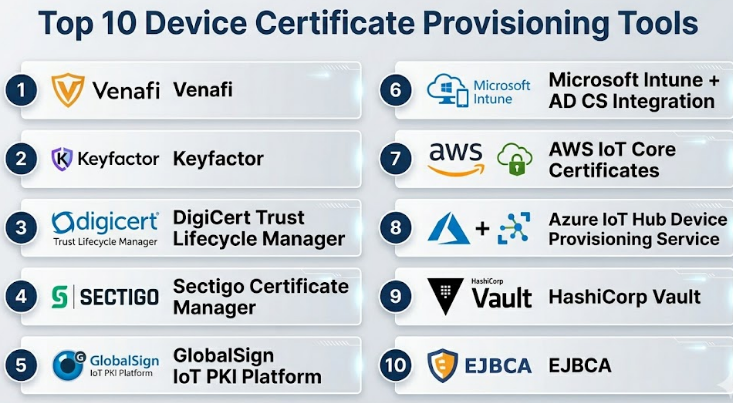
Top 10 Device Certificate Provisioning Tools
#1 — Venafi
Venafi is an enterprise-grade machine identity management platform focused on securing and managing cryptographic keys and certificates across large-scale environments. It is widely used in organizations adopting zero-trust security models and complex hybrid infrastructures.
It helps enterprises control certificate sprawl, automate lifecycle management, and enforce strong policies across all machine identities, including servers, applications, and devices.
Key Features
- Centralized certificate lifecycle management
- Policy-based certificate issuance and governance
- Integration with enterprise PKI systems
- Automated discovery of unmanaged certificates
- Machine identity risk analytics
- Workflow automation for approvals and renewals
- Strong support for zero-trust environments
Pros
- Excellent for large enterprise environments
- Strong governance and compliance capabilities
- Deep visibility into certificate landscape
Cons
- Complex deployment and configuration
- Higher cost compared to SMB-focused tools
Platforms / Deployment
- Cloud / Hybrid / On-prem (varies by deployment model)
Security & Compliance
- SAML/SSO, RBAC, audit logs supported
- SOC 2 / ISO 27001: Not publicly stated
Integrations & Ecosystem
- Integrates with cloud providers, PKI systems, DevOps pipelines
- APIs for automation and certificate orchestration
- Supports enterprise IAM tools and HSM integrations
Support & Community
Enterprise-grade support with structured onboarding and professional services. Community resources are limited compared to open-source tools.
#2 — Keyfactor
Keyfactor is a leading platform for digital identity and PKI automation, focusing on securing machine identities at scale. It is widely adopted in IoT, enterprise IT, and regulated industries.
Key Features
- Full PKI lifecycle automation
- IoT device identity provisioning
- Certificate discovery and management
- Support for hybrid and multi-cloud environments
- Policy-driven certificate issuance
- Automation APIs and SDKs
- Integration with HSM and cloud PKI services
Pros
- Strong IoT identity capabilities
- Scalable PKI automation engine
- Flexible deployment options
Cons
- Learning curve for advanced configurations
- Enterprise pricing may be high
Platforms / Deployment
- Cloud / Hybrid / On-prem
Security & Compliance
- SSO, RBAC, audit logging supported
- SOC 2 / ISO 27001: Not publicly stated
Integrations & Ecosystem
- Integrates with AWS, Azure, Kubernetes environments
- Supports DevOps pipelines and CI/CD tools
- Extensible API-first architecture
Support & Community
Strong enterprise support and documentation; moderate developer community.
#3 — DigiCert Trust Lifecycle Manager
DigiCert provides enterprise certificate lifecycle management with a strong focus on secure PKI infrastructure and identity assurance.
Key Features
- Centralized certificate lifecycle management
- Automated certificate renewal and provisioning
- Support for device and application certificates
- Cloud-based PKI services
- Certificate discovery across environments
- Policy-driven governance engine
- Strong domain validation mechanisms
Pros
- Trusted global PKI provider
- Strong security infrastructure
- Reliable enterprise-grade performance
Cons
- Less flexible for developer-centric workflows
- Pricing can be enterprise-heavy
Platforms / Deployment
- Cloud / Hybrid
Security & Compliance
- Strong PKI security model
- SOC 2 / ISO 27001: Not publicly stated
Integrations & Ecosystem
- Integrates with enterprise ITSM tools
- Supports APIs for automation
- Works with cloud and on-prem infrastructure
Support & Community
Enterprise-grade support with global presence.
#4 — Sectigo Certificate Manager
Sectigo provides a scalable certificate lifecycle management platform for enterprises managing large volumes of certificates and device identities.
Key Features
- Automated certificate lifecycle workflows
- Device and application certificate provisioning
- Cloud-based PKI management
- Certificate inventory and tracking
- Role-based access controls
- Policy enforcement engine
- Multi-CA support
Pros
- Strong scalability for enterprise use cases
- Good balance of usability and control
Cons
- Advanced customization may require expertise
- UI complexity for new users
Platforms / Deployment
- Cloud / Hybrid
Security & Compliance
- RBAC, audit logs supported
- SOC 2 / ISO 27001: Not publicly stated
Integrations & Ecosystem
- Integrates with cloud platforms and enterprise IAM
- API-driven certificate automation
- Supports DevOps workflows
Support & Community
Strong enterprise support and documentation.
#5 — GlobalSign IoT PKI Platform
GlobalSign provides PKI solutions focused on IoT identity provisioning and secure device authentication at scale.
Key Features
- IoT device certificate provisioning
- Automated device onboarding workflows
- Secure key generation and storage
- Scalable PKI infrastructure
- Policy-based identity management
- Integration with IoT ecosystems
- Certificate revocation management
Pros
- Strong IoT-focused identity features
- Scalable global infrastructure
- Reliable certificate authority backing
Cons
- Less flexible for non-IoT workloads
- Enterprise-focused pricing structure
Platforms / Deployment
- Cloud
Security & Compliance
- PKI-grade encryption and identity validation
- SOC 2 / ISO 27001: Not publicly stated
Integrations & Ecosystem
- IoT platforms and cloud services
- API-based provisioning
- Device onboarding automation tools
Support & Community
Enterprise-level support with IoT specialization.
#6 — Microsoft Intune + AD CS Integration
Microsoft provides certificate provisioning through Intune and Active Directory Certificate Services (AD CS), commonly used in enterprise Windows ecosystems.
Key Features
- Device certificate enrollment via Intune
- Integration with Active Directory
- SCEP and PKCS certificate support
- Automated certificate deployment policies
- Device compliance integration
- Conditional access policies
- Hybrid identity support
Pros
- Deep integration with Microsoft ecosystem
- Strong enterprise device management capabilities
- Good automation for Windows environments
Cons
- Limited flexibility outside Microsoft stack
- Complex setup for hybrid environments
Platforms / Deployment
- Cloud / Hybrid / On-prem
Security & Compliance
- Strong enterprise identity controls
- Compliance support varies by configuration
Integrations & Ecosystem
- Microsoft 365, Azure AD, Endpoint Manager
- APIs for automation and policy enforcement
- Works best within Microsoft ecosystem
Support & Community
Extensive enterprise documentation and global support.
#7 — AWS IoT Core Certificates
AWS IoT Core provides device certificate provisioning for IoT devices connected to AWS ecosystems.
Key Features
- Automatic device certificate generation
- Secure device authentication using X.509 certificates
- Integration with AWS IoT policies
- Device registry management
- mTLS support for secure communication
- Scalable IoT identity provisioning
- Lifecycle management APIs
Pros
- Highly scalable cloud-native solution
- Deep integration with AWS services
- Strong IoT security model
Cons
- AWS-specific ecosystem lock-in
- Requires cloud expertise
Platforms / Deployment
- Cloud
Security & Compliance
- IAM integration, encryption in transit and at rest
- Compliance: Varies by AWS region/service
Integrations & Ecosystem
- AWS Lambda, IoT Analytics, CloudWatch
- REST APIs and SDK support
- Works within AWS IoT ecosystem
Support & Community
Strong AWS documentation and global developer community.
#8 — Azure IoT Hub Device Provisioning Service
Azure IoT Hub DPS enables secure provisioning and certificate-based authentication for IoT devices.
Key Features
- Automated device enrollment
- X.509 certificate authentication
- Load-balanced device provisioning
- Integration with Azure IoT Hub
- Policy-based device identity assignment
- Secure key management integration
- Global device scaling support
Pros
- Strong enterprise IoT integration
- Highly scalable architecture
- Tight Azure ecosystem integration
Cons
- Complex setup for beginners
- Azure dependency
Platforms / Deployment
- Cloud
Security & Compliance
- Azure identity and security controls
- Compliance: Not publicly stated in tool-specific detail
Integrations & Ecosystem
- Azure IoT Hub, Azure AD, Event Hub
- REST APIs and SDKs
- Cloud-native automation support
Support & Community
Strong enterprise support via Microsoft ecosystem.
#9 — HashiCorp Vault (PKI Engine)
HashiCorp Vault provides a dynamic PKI engine for generating and managing certificates programmatically.
Key Features
- Dynamic certificate generation
- Short-lived certificate issuance
- PKI secrets engine
- Automated certificate rotation
- Policy-based access control
- API-first architecture
- Integration with DevOps pipelines
Pros
- Excellent for DevOps and automation
- Strong security posture with short-lived certs
- Highly flexible and programmable
Cons
- Requires strong operational expertise
- Not a full PKI platform out of the box
Platforms / Deployment
- Cloud / Self-hosted / Hybrid
Security & Compliance
- Strong encryption and policy-based access control
- SOC 2 / ISO 27001: Not publicly stated
Integrations & Ecosystem
- Kubernetes, Terraform, CI/CD pipelines
- API-driven automation
- Cloud provider integrations
Support & Community
Strong open-source community and enterprise support.
#10 — EJBCA (Enterprise Java Beans Certificate Authority)
EJBCA is a widely used open-source and enterprise PKI solution for certificate authority and lifecycle management.
Key Features
- Full PKI lifecycle management
- Certificate issuance and revocation
- Multi-tenancy support
- Role-based access control
- CRL and OCSP support
- Hardware security module integration
- Customizable PKI policies
Pros
- Highly flexible and customizable
- Strong open-source foundation
- Suitable for enterprise and government use cases
Cons
- Requires expertise to operate
- UI and UX less modern compared to SaaS tools
Platforms / Deployment
- Self-hosted / Hybrid
Security & Compliance
- Strong PKI controls and cryptographic support
- SOC 2 / ISO 27001: Not publicly stated
Integrations & Ecosystem
- APIs for integration with enterprise systems
- Supports HSMs and external identity systems
- Extensible architecture
Support & Community
Strong open-source community with enterprise support options.
Comparison Table (Top 10)
| Tool Name | Best For | Platform(s) Supported | Deployment | Standout Feature | Public Rating |
|---|---|---|---|---|---|
| Venafi | Enterprise machine identity | Web | Cloud/Hybrid/On-prem | Machine identity governance | N/A |
| Keyfactor | IoT + enterprise PKI | Web | Cloud/Hybrid/On-prem | PKI automation engine | N/A |
| DigiCert Trust Lifecycle Manager | Enterprise certificate lifecycle | Web | Cloud/Hybrid | Trusted CA ecosystem | N/A |
| Sectigo Certificate Manager | Scalable certificate management | Web | Cloud/Hybrid | Multi-CA support | N/A |
| GlobalSign IoT PKI | IoT device identity | Web | Cloud | IoT provisioning | N/A |
| Microsoft Intune + AD CS | Windows enterprise environments | Web/Windows | Cloud/Hybrid/On-prem | Active Directory integration | N/A |
| AWS IoT Core Certificates | AWS IoT ecosystems | Web | Cloud | Native AWS IoT provisioning | N/A |
| Azure IoT Hub DPS | Azure IoT environments | Web | Cloud | Automated device provisioning | N/A |
| HashiCorp Vault | DevOps PKI automation | Web/Linux | Cloud/Self-hosted | Dynamic certificate issuance | N/A |
| EJBCA | Open-source PKI control | Web/Linux | Self-hosted/Hybrid | Fully customizable PKI | N/A |
Evaluation & Device Certificate Provisioning Tools Scoring
| Tool Name | Core (25%) | Ease (15%) | Integrations (15%) | Security (10%) | Performance (10%) | Support (10%) | Value (15%) | Weighted Total |
|---|---|---|---|---|---|---|---|---|
| Venafi | 9 | 7 | 9 | 9 | 9 | 9 | 6 | 8.3 |
| Keyfactor | 9 | 7 | 9 | 9 | 9 | 8 | 7 | 8.3 |
| DigiCert | 8 | 8 | 8 | 9 | 9 | 9 | 7 | 8.2 |
| Sectigo | 8 | 8 | 8 | 8 | 8 | 8 | 8 | 8.0 |
| GlobalSign | 8 | 7 | 8 | 8 | 8 | 8 | 7 | 7.8 |
| Microsoft Intune + AD CS | 8 | 7 | 9 | 8 | 8 | 9 | 9 | 8.2 |
| AWS IoT Core | 9 | 7 | 9 | 9 | 10 | 9 | 8 | 8.7 |
| Azure IoT Hub DPS | 9 | 7 | 9 | 9 | 10 | 9 | 8 | 8.7 |
| HashiCorp Vault | 9 | 6 | 9 | 9 | 9 | 8 | 9 | 8.4 |
| EJBCA | 8 | 6 | 8 | 9 | 8 | 8 | 9 | 8.0 |
How to interpret scores:
- Scores are comparative across enterprise-grade PKI and device provisioning tools.
- Higher scores indicate stronger automation, scalability, and integration maturity.
- Ease of use reflects onboarding complexity and operational overhead.
- Security is weighted based on identity controls, encryption strength, and policy enforcement.
- Value considers cost efficiency relative to capabilities offered.
- Weighted totals help shortlist tools but should not be the sole decision factor.
Which Device Certificate Provisioning Tools
Solo / Freelancer
For small-scale or experimental environments, full PKI platforms may be excessive. Lightweight or cloud-managed options like HashiCorp Vault (for learning automation) are more appropriate.
SMB
SMBs benefit from simplified lifecycle management platforms:
- Sectigo Certificate Manager
- DigiCert Trust Lifecycle Manager
- Microsoft Intune (if already in Microsoft ecosystem)
Mid-Market
Mid-sized companies need scalability and automation:
- Keyfactor
- GlobalSign IoT PKI
- AWS IoT Core (for cloud-native IoT)
Enterprise
Large organizations require governance, scale, and compliance:
- Venafi
- Keyfactor
- EJBCA (for customizable environments)
- Microsoft Intune + AD CS
Budget vs Premium
- Budget-friendly: EJBCA, HashiCorp Vault (self-managed)
- Premium: Venafi, DigiCert, Keyfactor
Feature Depth vs Ease of Use
- Feature depth: Venafi, Keyfactor, EJBCA
- Ease of use: DigiCert, Sectigo, Microsoft Intune
Integrations & Scalability
- Strongest: AWS IoT Core, Azure IoT Hub, Keyfactor, Venafi
- Best for cloud-native scaling: AWS and Azure platforms
Security & Compliance Needs
- High-compliance environments: Venafi, DigiCert, Keyfactor, EJBCA
- DevSecOps environments: HashiCorp Vault
Frequently Asked Questions (FAQs)
1. What are Device Certificate Provisioning Tools?
These tools manage the creation, distribution, renewal, and revocation of digital certificates used to authenticate devices. They ensure secure machine identity across networks and cloud systems.
2. Why are device certificates important?
They provide strong authentication using cryptographic identity instead of passwords. This reduces risks like spoofing, unauthorized access, and data interception.
3. How do these tools improve security?
They automate certificate lifecycle management, enforce policies, and ensure only trusted devices can access systems through encrypted communication channels.
4. Are these tools suitable for IoT devices?
Yes, most modern platforms like AWS IoT Core, Azure IoT Hub, and Keyfactor are specifically designed for IoT-scale certificate provisioning.
5. What is the difference between PKI and certificate provisioning tools?
PKI is the underlying cryptographic infrastructure, while provisioning tools manage automation, lifecycle workflows, and policy enforcement on top of PKI.
6. Can these tools integrate with cloud platforms?
Yes, most tools integrate with AWS, Azure, Google Cloud, and hybrid infrastructures through APIs and SDKs.
7. What industries use device certificate provisioning tools?
Common industries include finance, healthcare, manufacturing, telecommunications, automotive, and government sectors.
8. How long does implementation take?
It varies significantly. Cloud-native solutions may take days, while enterprise PKI deployments can take weeks or months depending on complexity.
9. Are open-source options reliable?
Yes, tools like EJBCA and HashiCorp Vault are widely used, but they require strong operational expertise and maintenance.
10. What are common mistakes when using these tools?
Common mistakes include poor certificate rotation policies, weak key management, lack of automation, and insufficient monitoring of certificate expiry.
Conclusion
Device Certificate Provisioning Tools are now a foundational layer of modern cybersecurity and infrastructure design. As organizations move toward zero-trust architectures, IoT expansion, and cloud-native systems, managing device identity securely and at scale has become essential.
The best tool depends heavily on your environment—whether you are running a cloud-native IoT platform, a regulated enterprise system, or a DevOps-heavy infrastructure.
