Introduction
Healthcare Electronic Medical Record (EMR) Systems are digital tools used by clinics and hospitals to capture, store, and manage patient medical data within a single organization. Unlike broader EHR systems that focus on sharing data across networks, EMRs are primarily used for internal clinical workflows, helping doctors and staff track patient history, diagnoses, medications, and treatment plans efficiently.
In the current healthcare landscape, EMR systems play a critical role in improving clinical accuracy, reducing paperwork, and speeding up patient care. With increasing patient loads, telemedicine expansion, and regulatory pressures, EMR platforms are evolving to include automation, AI-driven documentation, and integrated workflows.
Real-world use cases:
- Managing patient visits and clinical documentation
- Tracking prescriptions and treatment plans
- Automating appointment scheduling and billing
- Supporting diagnostic workflows within clinics
- Maintaining structured patient history records
What buyers should evaluate:
- Ease of use for clinicians and staff
- Speed of data entry and retrieval
- Customization for specialties
- Integration with billing and labs
- Security and compliance readiness
- Deployment model (cloud vs on-premise)
- Scalability as practice grows
- Reporting and analytics capabilities
- Mobile accessibility
Best for: Small to mid-sized clinics, physician practices, specialty care providers, and diagnostic centers that need efficient internal patient record management.
Not ideal for: Large healthcare networks requiring cross-organization interoperability—those typically need full EHR systems instead.
Key Trends in Healthcare EMR Systems
- Voice-enabled clinical documentation reducing manual data entry
- AI-assisted note generation improving productivity
- Cloud-native EMR adoption for flexibility and remote access
- Mobile-first interfaces for clinicians on the go
- Integrated telemedicine features within EMR platforms
- Automation of coding and billing workflows
- Stronger data privacy controls with role-based access
- Improved UI/UX design for clinician efficiency
- Specialty-specific EMR solutions gaining traction
- Lightweight modular platforms replacing bulky legacy systems
How We Selected These Tools (Methodology)
- Focused on widely adopted EMR platforms across healthcare segments
- Evaluated core clinical functionality and usability
- Assessed performance and reliability indicators
- Considered security and compliance readiness
- Reviewed integration capabilities with labs, billing, and imaging
- Included tools suitable for SMB, mid-market, and enterprise clinics
- Balanced ease of use vs feature depth
- Prioritized modern cloud-based solutions
- Considered vendor reputation and long-term viability
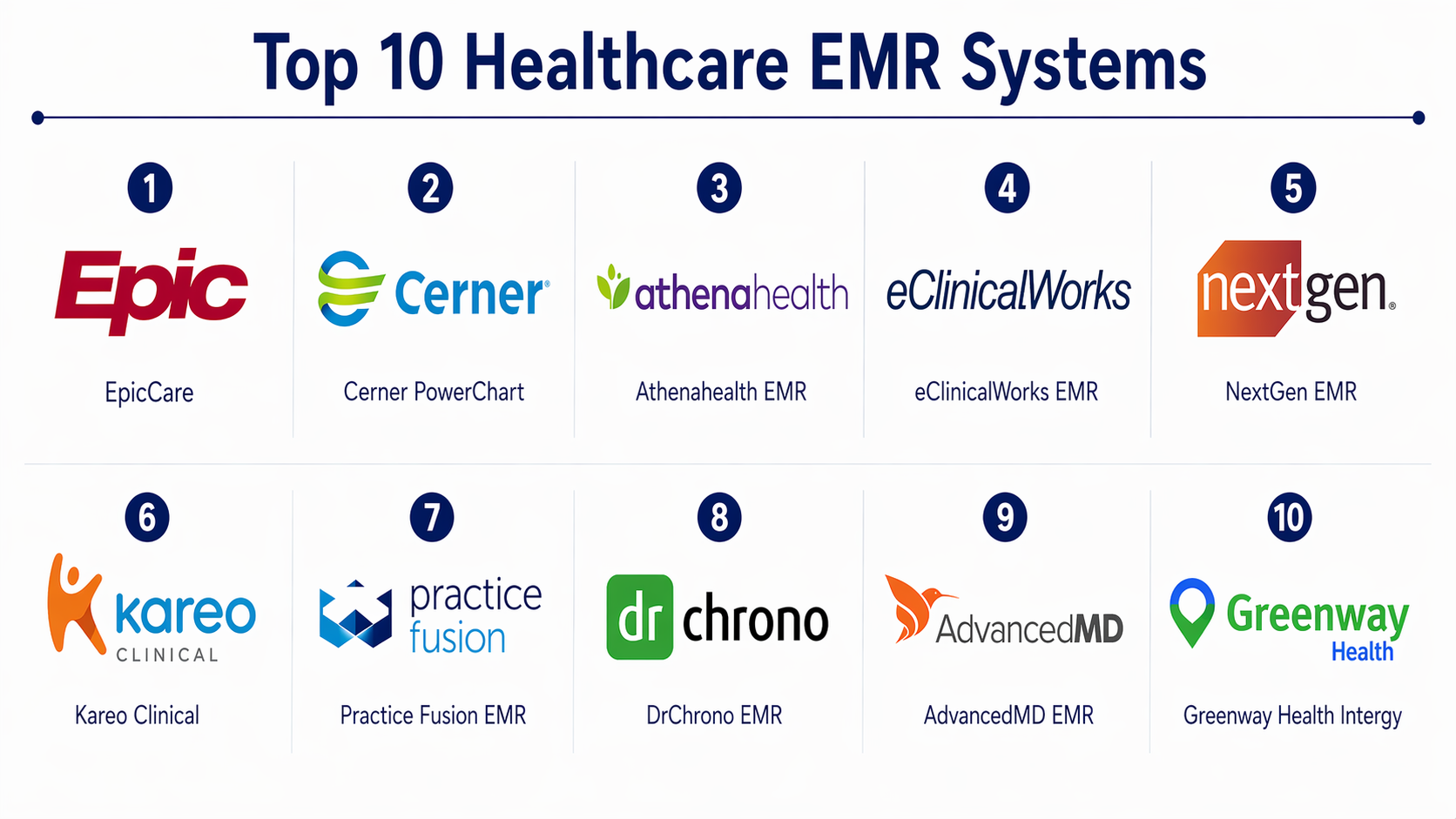
Top 10 Healthcare EMR Systems
#1 — EpicCare (Epic EMR)
Short description :
EpicCare is a leading EMR solution used by hospitals and large clinics for internal patient record management. It provides deep clinical workflows, structured documentation, and strong reporting capabilities. While often part of Epic’s broader EHR ecosystem, EpicCare is widely used for EMR functionality within organizations.
Key Features
- Comprehensive patient charting
- Clinical decision support
- Medication tracking and ePrescribing
- Custom workflows for departments
- Reporting and analytics
- Integrated scheduling
Pros
- Highly robust clinical features
- Scales well for large organizations
Cons
- Expensive and complex
- Requires extensive training
Platforms / Deployment
Web / Windows / Mobile
Cloud / Hybrid
Security & Compliance
HIPAA-ready, encryption, RBAC, audit logs
Integrations & Ecosystem
EpicCare integrates with labs, imaging, billing, and hospital systems.
- HL7 and FHIR APIs
- Pharmacy integrations
- Clinical tools
- Internal hospital modules
Support & Community
Strong enterprise-grade support with structured onboarding.
#2 — Cerner PowerChart
Short description :
Cerner PowerChart is a widely used EMR solution designed for hospitals and healthcare providers. It focuses on real-time clinical documentation and patient record management with strong interoperability features.
Key Features
- Real-time patient charting
- Clinical documentation
- Medication management
- Workflow automation
- Reporting tools
Pros
- Reliable and scalable
- Strong clinical workflows
Cons
- Complex interface
- High implementation effort
Platforms / Deployment
Web / Mobile
Cloud / Hybrid
Security & Compliance
HIPAA-ready
Integrations & Ecosystem
- Lab systems
- Imaging tools
- APIs
- Oracle ecosystem
Support & Community
Enterprise support with documentation and onboarding.
#3 — Athenahealth EMR
Short description :
Athenahealth offers a cloud-based EMR focused on ease of use and ambulatory care. It combines clinical documentation with billing and scheduling features for streamlined workflows.
Key Features
- Cloud-based EMR
- Clinical documentation
- Scheduling and billing
- Reporting dashboards
- Patient engagement tools
Pros
- Easy to use
- Strong cloud performance
Cons
- Limited customization
- Less suitable for large hospitals
Platforms / Deployment
Web / Mobile
Cloud
Security & Compliance
HIPAA-ready
Integrations & Ecosystem
- APIs
- Telehealth tools
- Billing systems
Support & Community
Strong support with onboarding assistance.
#4 — eClinicalWorks EMR
Short description :
eClinicalWorks provides an affordable and scalable EMR platform for clinics and physician practices. It supports clinical documentation, telehealth, and patient engagement.
Key Features
- Clinical documentation
- Telehealth integration
- Patient portal
- Billing tools
- AI-assisted charting
Pros
- Cost-effective
- Feature-rich for SMBs
Cons
- Performance inconsistencies
- Limited customization
Platforms / Deployment
Web / Mobile
Cloud
Security & Compliance
HIPAA-ready
Integrations & Ecosystem
- Labs
- Pharmacies
- APIs
Support & Community
Moderate support with a large user base.
#5 — NextGen EMR
Short description :
NextGen EMR is tailored for specialty practices, offering customizable workflows and strong clinical documentation features.
Key Features
- Specialty workflows
- Patient charting
- Scheduling
- Reporting
- Telehealth
Pros
- Highly customizable
- Good for specialty clinics
Cons
- Setup complexity
- UI may feel outdated
Platforms / Deployment
Web / Mobile
Cloud / Hybrid
Security & Compliance
HIPAA-ready
Integrations & Ecosystem
- Labs
- Billing tools
- APIs
Support & Community
Moderate support.
#6 — Kareo Clinical
Short description :
Kareo Clinical is designed for small practices and independent physicians. It focuses on simplicity and quick setup.
Key Features
- Patient records
- Scheduling
- Billing integration
- Reporting
- Clinical documentation
Pros
- Easy to use
- Affordable
Cons
- Limited scalability
- Fewer advanced features
Platforms / Deployment
Web
Cloud
Security & Compliance
HIPAA-ready
Integrations & Ecosystem
- Billing tools
- Labs
- APIs
Support & Community
Basic support focused on SMB users.
#7 — Practice Fusion EMR
Short description :
Practice Fusion offers a lightweight EMR system for small clinics. It is known for its simple interface and quick deployment.
Key Features
- Patient charting
- ePrescribing
- Scheduling
- Reporting
- Cloud access
Pros
- Simple setup
- Cost-effective
Cons
- Limited advanced features
- Smaller ecosystem
Platforms / Deployment
Web
Cloud
Security & Compliance
HIPAA-ready
Integrations & Ecosystem
- Labs
- Pharmacies
- APIs
Support & Community
Basic support.
#8 — DrChrono EMR
Short description :
DrChrono is a mobile-friendly EMR platform with strong customization options and integrated billing.
Key Features
- Mobile EMR
- Scheduling
- Billing
- Patient portal
- Telehealth
Pros
- Strong mobile experience
- Flexible workflows
Cons
- Limited enterprise support
- Pricing varies
Platforms / Deployment
Web / Mobile
Cloud
Security & Compliance
HIPAA-ready
Integrations & Ecosystem
- APIs
- Labs
- Billing tools
Support & Community
Moderate support.
#9 — AdvancedMD EMR
Short description :
AdvancedMD provides a cloud-based EMR solution for mid-sized practices with strong billing and reporting features.
Key Features
- Clinical documentation
- Billing and scheduling
- Reporting
- Patient portal
- Workflow automation
Pros
- Strong financial tools
- Scalable
Cons
- Learning curve
- UI complexity
Platforms / Deployment
Web
Cloud
Security & Compliance
HIPAA-ready
Integrations & Ecosystem
- Billing systems
- APIs
- Labs
Support & Community
Good support with onboarding resources.
#10 — Greenway Health Intergy
Short description :
Greenway Intergy is an EMR platform designed for ambulatory practices with integrated clinical and financial tools.
Key Features
- Patient records
- Scheduling
- Billing
- Reporting
- Clinical workflows
Pros
- Balanced feature set
- Good for mid-sized practices
Cons
- Interface may feel outdated
- Setup complexity
Platforms / Deployment
Web
Cloud / Hybrid
Security & Compliance
HIPAA-ready
Integrations & Ecosystem
- Labs
- Billing systems
- APIs
Support & Community
Moderate support.
Comparison Table (Top 10)
| Tool Name | Best For | Platform(s) Supported | Deployment | Standout Feature | Public Rating |
|---|---|---|---|---|---|
| EpicCare | Large hospitals | Web, Mobile | Hybrid | Deep clinical workflows | N/A |
| Cerner PowerChart | Hospitals | Web, Mobile | Hybrid | Real-time charting | N/A |
| Athenahealth | Ambulatory care | Web, Mobile | Cloud | Ease of use | N/A |
| eClinicalWorks | SMB clinics | Web, Mobile | Cloud | Telehealth integration | N/A |
| NextGen | Specialty clinics | Web, Mobile | Hybrid | Custom workflows | N/A |
| Kareo Clinical | Small practices | Web | Cloud | Simplicity | N/A |
| Practice Fusion | Small clinics | Web | Cloud | Quick deployment | N/A |
| DrChrono | Mobile-first clinics | Web, Mobile | Cloud | Mobile usability | N/A |
| AdvancedMD | Mid-market | Web | Cloud | Billing integration | N/A |
| Greenway Intergy | Ambulatory practices | Web | Hybrid | Balanced features | N/A |
Evaluation & Healthcare EMR Systems
| Tool Name | Core | Ease | Integrations | Security | Performance | Support | Value | Weighted Total |
|---|---|---|---|---|---|---|---|---|
| EpicCare | 10 | 7 | 9 | 9 | 9 | 9 | 6 | 8.6 |
| Cerner PowerChart | 9 | 7 | 9 | 9 | 8 | 8 | 7 | 8.3 |
| Athenahealth | 8 | 9 | 8 | 8 | 8 | 8 | 7 | 8.2 |
| eClinicalWorks | 7 | 8 | 7 | 8 | 7 | 7 | 8 | 7.5 |
| NextGen | 8 | 7 | 7 | 8 | 7 | 7 | 7 | 7.4 |
| Kareo Clinical | 6 | 9 | 6 | 7 | 7 | 6 | 9 | 7.3 |
| Practice Fusion | 6 | 9 | 6 | 7 | 6 | 6 | 9 | 7.1 |
| DrChrono | 7 | 8 | 7 | 8 | 7 | 7 | 8 | 7.6 |
| AdvancedMD | 8 | 7 | 7 | 8 | 8 | 7 | 7 | 7.7 |
| Greenway Intergy | 7 | 7 | 7 | 8 | 7 | 7 | 7 | 7.3 |
How to interpret:
- Enterprise tools score higher in features and integration
- SMB tools score higher in usability and cost efficiency
- Scores are comparative and depend on use case
- Choose based on workflow fit, not just score
Which Healthcare EMR Systems
Solo / Freelancer
Best choices: Kareo Clinical, Practice Fusion, DrChrono for simplicity and low cost.
SMB
eClinicalWorks and Athenahealth provide the best balance of features and usability.
Mid-Market
AdvancedMD and NextGen offer scalability with manageable complexity.
Enterprise
EpicCare and Cerner PowerChart are ideal for large hospitals.
Budget vs Premium
- Budget: Practice Fusion, Kareo
- Premium: EpicCare, Cerner
Feature Depth vs Ease of Use
- Deep features: EpicCare, Cerner
- Easy use: Athenahealth, Kareo
Integrations & Scalability
- Strong: EpicCare, Cerner
- Moderate: Athenahealth, NextGen
Security & Compliance Needs
- High compliance: Enterprise tools
- Standard compliance: SMB tools
Frequently Asked Questions (FAQs)
1. What is the difference between EMR and EHR?
EMR is used within a single organization, while EHR supports data sharing across multiple healthcare providers.
2. How much does an EMR system cost?
Costs vary depending on features and scale. Cloud systems usually follow subscription pricing.
3. Are EMR systems secure?
Yes, most systems include encryption, access control, and audit logs, but configuration is important.
4. Can EMR systems integrate with labs?
Most modern EMRs support integrations with labs, pharmacies, and billing systems.
5. How long does implementation take?
Small systems may take weeks, while larger deployments can take months.
6. Is cloud EMR better than on-premise?
Cloud offers flexibility and lower upfront cost, while on-premise gives more control.
7. Can EMR systems scale with growth?
Yes, many platforms support scaling from small clinics to larger practices.
8. What are common mistakes when choosing EMR?
Ignoring usability, underestimating training needs, and not checking integrations.
9. Can small clinics use EMR systems?
Yes, many EMRs are designed specifically for small practices.
10. How do you switch EMR systems?
Switching requires data migration, staff training, and careful planning.
Conclusion
Healthcare EMR systems are essential tools for improving clinical efficiency, accuracy, and patient care within healthcare organizations. While enterprise solutions offer deep functionality and scalability, smaller practices benefit from simpler and more cost-effective platforms. The right choice depends on your organization’s size, workflow complexity, and long-term growth plans. Instead of chasing the most feature-rich option, focus on usability, integration capabilities, and compliance readines.
