Introduction
Medical Billing & Coding Software is designed to automate and manage the process of translating healthcare services into standardized codes and submitting claims for reimbursement. In simple terms, it helps healthcare providers get paid accurately and faster by ensuring that patient diagnoses, treatments, and procedures are correctly coded and billed.
healthcare environment, this category has become essential due to increasing insurance complexity, compliance requirements, and the need for revenue optimization. Errors in coding can lead to claim denials, compliance risks, and revenue leakage—making modern billing systems a core operational necessity.
Real-world use cases:
- Automating insurance claims submission and tracking
- Ensuring compliance with ICD and CPT coding standards
- Managing revenue cycle workflows
- Reducing claim denials and rework
- Integrating billing with EHR and practice management systems
What buyers should evaluate:
- Accuracy and automation in coding
- Integration with EHR and clearinghouses
- Compliance support (ICD, CPT updates)
- Claim tracking and denial management
- Ease of use for billing staff
- Reporting and analytics capabilities
- Scalability for growing practices
- Cost and ROI
- Support and training
Best for: Hospitals, clinics, billing companies, and healthcare providers managing high volumes of claims and insurance interactions.
Not ideal for: Solo practitioners with minimal billing needs or those using outsourced billing services.
Key Trends in Medical Billing & Coding Software
- AI-assisted coding reducing manual errors and improving accuracy
- Automated claim scrubbing before submission
- Cloud-based billing platforms replacing legacy systems
- Real-time eligibility verification with insurers
- Revenue cycle automation end-to-end
- Integration with telehealth services
- Predictive analytics for denial management
- Regulatory updates automation for coding standards
- Mobile-friendly billing dashboards
- Subscription-based SaaS pricing models
How We Selected These Tools (Methodology)
- Market presence and adoption in healthcare organizations
- Feature completeness across billing and coding workflows
- Reliability and performance signals
- Compliance readiness and updates
- Integration capabilities with EHR systems
- Flexibility across practice sizes
- Ease of use for billing teams
- Vendor support and training quality
- Innovation in automation and AI features
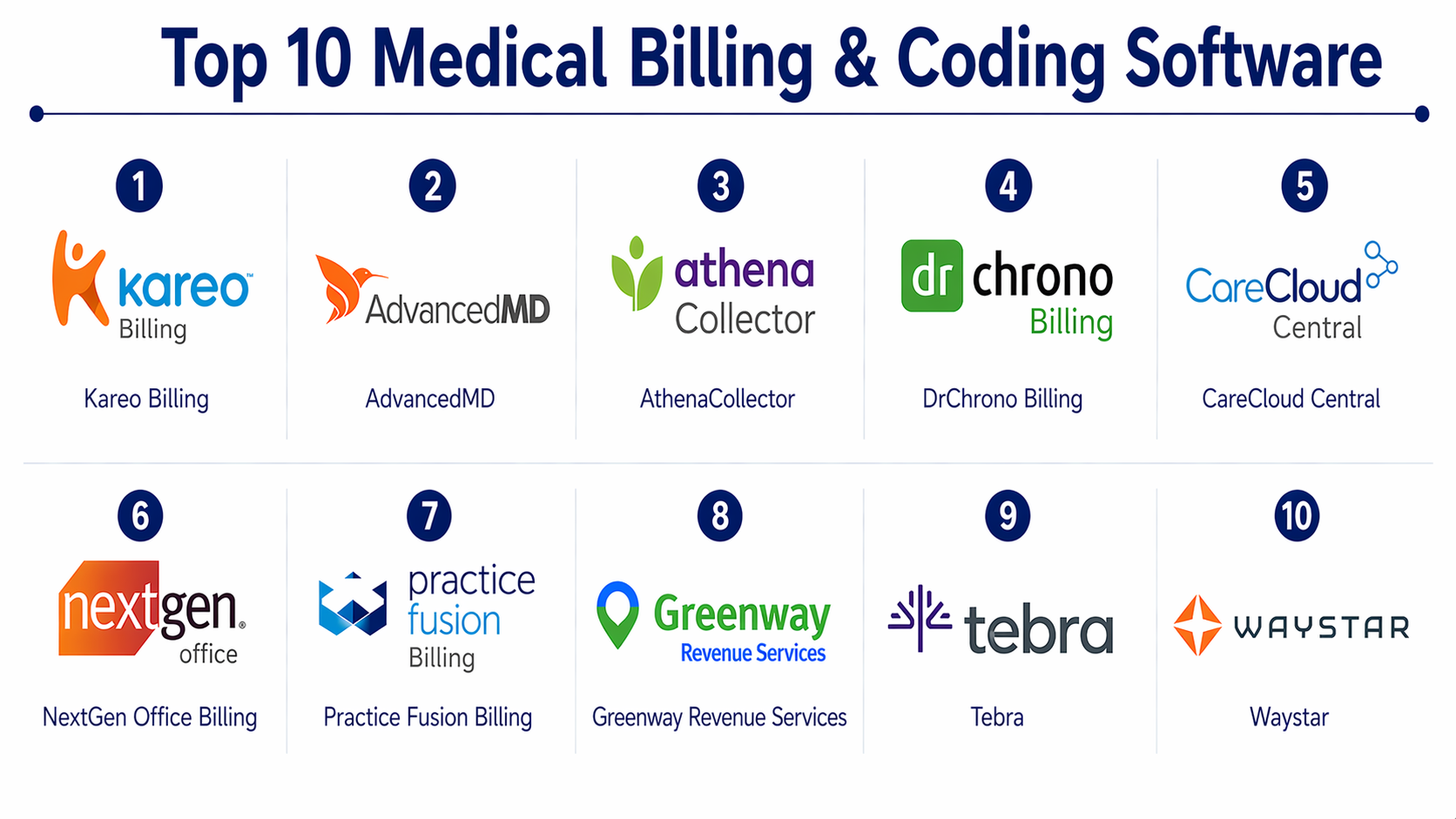
Top 10 Medical Billing & Coding Software
#1 — Kareo Billing
Short description :
Kareo Billing is a widely used cloud-based solution designed for small to mid-sized practices. It simplifies billing workflows, automates claim submissions, and provides real-time financial insights. The platform is known for its ease of use and strong integration with practice management tools. It is especially popular among independent practices.
Key Features
- Automated claims management
- Real-time insurance verification
- Revenue cycle management
- Billing analytics and reporting
- Patient payment tracking
- Integration with EHR systems
Pros
- User-friendly interface
- Strong support for small practices
Cons
- Limited enterprise-level features
- Customization constraints
Platforms / Deployment
Web / Cloud
Security & Compliance
HIPAA (others not publicly stated)
Integrations & Ecosystem
Kareo integrates with healthcare systems and billing tools.
- EHR integrations
- Clearinghouses
- Payment gateways
Support & Community
Good onboarding and customer support for SMB users.
#2 — AdvancedMD
Short description :
AdvancedMD offers a comprehensive billing and coding platform with strong automation features. It is suitable for mid-sized practices and healthcare groups looking for integrated billing and practice management.
Key Features
- Automated billing workflows
- Claims tracking and reporting
- Coding compliance tools
- Patient payment management
- Analytics dashboards
Pros
- Strong feature set
- Scalable for growing practices
Cons
- Learning curve for new users
- Pricing may be higher
Platforms / Deployment
Web / Cloud
Security & Compliance
HIPAA (others not publicly stated)
Integrations & Ecosystem
Supports integration with healthcare tools.
- EHR systems
- Payment platforms
Support & Community
Reliable support and training resources.
#3 — AthenaCollector
Short description :
AthenaCollector is part of the Athenahealth ecosystem, focusing on revenue cycle management and billing optimization. It leverages cloud infrastructure and analytics to improve reimbursement rates.
Key Features
- Revenue cycle management
- Automated claim submission
- Denial management tools
- Real-time analytics
- Insurance verification
Pros
- Strong analytics capabilities
- Cloud-native platform
Cons
- Less flexibility in customization
- Best suited for existing Athena users
Platforms / Deployment
Cloud
Security & Compliance
HIPAA (others not publicly stated)
Integrations & Ecosystem
Integrates within Athena ecosystem.
- EHR tools
- Healthcare APIs
Support & Community
Strong vendor support.
#4 — DrChrono Billing
Short description :
DrChrono Billing offers a modern cloud-based billing system with mobile support. It is designed for small practices and emphasizes ease of use and flexibility.
Key Features
- Mobile billing access
- Automated claims processing
- Patient billing tools
- Reporting and analytics
- Integration with EHR
Pros
- Mobile-friendly
- Easy setup
Cons
- Limited enterprise features
- Smaller ecosystem
Platforms / Deployment
Web / iOS / Cloud
Security & Compliance
HIPAA (others not publicly stated)
Integrations & Ecosystem
Supports integrations via APIs.
- EHR systems
- Payment platforms
Support & Community
Good SMB support.
#5 — CareCloud Central
Short description :
CareCloud Central provides a cloud-based billing platform with strong financial and operational tools. It is designed for small to mid-sized healthcare providers.
Key Features
- Revenue cycle management
- Billing automation
- Financial reporting
- Patient engagement tools
- Analytics dashboards
Pros
- Modern UI
- Strong reporting features
Cons
- Limited customization
- May not scale for large hospitals
Platforms / Deployment
Cloud
Security & Compliance
Not publicly stated
Integrations & Ecosystem
Supports integrations with healthcare tools.
- APIs
- Third-party apps
Support & Community
Good onboarding support.
#6 — NextGen Office Billing
Short description :
NextGen Office Billing focuses on small practices and offers a simplified billing and coding experience. It combines ease of use with essential revenue cycle features.
Key Features
- Claims management
- Coding assistance
- Patient billing
- Reporting tools
- Scheduling integration
Pros
- Simple interface
- Affordable pricing
Cons
- Limited advanced features
- Less scalable
Platforms / Deployment
Cloud
Security & Compliance
Not publicly stated
Integrations & Ecosystem
Basic integrations available.
- EHR systems
- Billing tools
Support & Community
Moderate support quality.
#7 — Practice Fusion Billing
Short description :
Practice Fusion offers a billing solution integrated with its EHR platform. It is designed for small practices looking for an all-in-one solution.
Key Features
- Integrated billing and EHR
- Claims management
- Patient billing
- Reporting tools
- Workflow automation
Pros
- Integrated ecosystem
- Easy to use
Cons
- Limited customization
- Smaller feature set
Platforms / Deployment
Web / Cloud
Security & Compliance
HIPAA (others not publicly stated)
Integrations & Ecosystem
Works within Practice Fusion ecosystem.
- EHR integration
- APIs
Support & Community
Varies / Not publicly stated
#8 — Greenway Revenue Services
Short description :
Greenway Revenue Services provides billing and coding solutions with a focus on compliance and workflow efficiency. It is suitable for clinics and specialty practices.
Key Features
- Revenue cycle management
- Coding compliance tools
- Billing automation
- Reporting and analytics
Pros
- Compliance-focused
- Easy workflow management
Cons
- Limited scalability
- UI may feel outdated
Platforms / Deployment
Cloud
Security & Compliance
Not publicly stated
Integrations & Ecosystem
Supports integrations with healthcare tools.
- APIs
- Third-party systems
Support & Community
Varies / Not publicly stated
#9 — Tebra (Kareo Platform)
Short description :
Tebra combines billing, practice management, and patient engagement into one platform. It is built for small to mid-sized practices.
Key Features
- Billing automation
- Patient engagement tools
- Revenue cycle management
- Analytics dashboards
Pros
- All-in-one platform
- Easy to deploy
Cons
- Limited enterprise capabilities
- Customization constraints
Platforms / Deployment
Cloud
Security & Compliance
HIPAA (others not publicly stated)
Integrations & Ecosystem
Supports integrations with healthcare tools.
- EHR systems
- Payment platforms
Support & Community
Strong SMB support.
#10 — Waystar
Short description :
Waystar is a healthcare payments and revenue cycle platform focused on improving billing efficiency and reducing claim denials. It is widely used by large healthcare organizations.
Key Features
- Claims management
- Payment processing
- Denial analytics
- Revenue optimization tools
Pros
- Strong enterprise capabilities
- Advanced analytics
Cons
- Complex implementation
- Higher cost
Platforms / Deployment
Cloud
Security & Compliance
Not publicly stated
Integrations & Ecosystem
Strong integration ecosystem.
- Healthcare systems
- Payment networks
Support & Community
Enterprise-grade support.
Comparison Table (Top 10)
| Tool Name | Best For | Platform(s) Supported | Deployment | Standout Feature | Public Rating |
|---|---|---|---|---|---|
| Kareo Billing | SMB practices | Web | Cloud | Easy billing workflows | N/A |
| AdvancedMD | Mid-sized practices | Web | Cloud | Automation features | N/A |
| AthenaCollector | Revenue optimization | Web | Cloud | Analytics | N/A |
| DrChrono Billing | Small practices | Web/iOS | Cloud | Mobile support | N/A |
| CareCloud Central | SMB providers | Web | Cloud | Reporting tools | N/A |
| NextGen Office Billing | Small clinics | Web | Cloud | Simplicity | N/A |
| Practice Fusion Billing | Small practices | Web | Cloud | EHR integration | N/A |
| Greenway Revenue Services | Clinics | Web | Cloud | Compliance tools | N/A |
| Tebra | SMB providers | Web | Cloud | All-in-one platform | N/A |
| Waystar | Enterprise | Web | Cloud | Denial analytics | N/A |
Evaluation & Medical Billing & Coding Software
| Tool Name | Core (25%) | Ease (15%) | Integrations (15%) | Security (10%) | Performance (10%) | Support (10%) | Value (15%) | Weighted Total |
|---|---|---|---|---|---|---|---|---|
| Kareo Billing | 8 | 9 | 7 | 7 | 8 | 8 | 9 | 8.2 |
| AdvancedMD | 8 | 7 | 8 | 8 | 8 | 8 | 7 | 7.8 |
| AthenaCollector | 9 | 8 | 8 | 8 | 9 | 8 | 7 | 8.3 |
| DrChrono Billing | 7 | 9 | 7 | 7 | 8 | 7 | 8 | 7.8 |
| CareCloud Central | 7 | 8 | 7 | 7 | 8 | 7 | 8 | 7.6 |
| NextGen Office Billing | 7 | 8 | 7 | 7 | 7 | 7 | 8 | 7.4 |
| Practice Fusion Billing | 7 | 8 | 7 | 7 | 7 | 7 | 8 | 7.4 |
| Greenway Revenue Services | 7 | 7 | 7 | 7 | 7 | 7 | 7 | 7.0 |
| Tebra | 8 | 9 | 7 | 7 | 8 | 8 | 8 | 8.1 |
| Waystar | 9 | 7 | 9 | 8 | 9 | 8 | 7 | 8.4 |
How to interpret scores:
These scores compare tools across key dimensions. Higher scores indicate stronger overall capability, but the “best” tool depends on your needs. SMB tools prioritize usability and value, while enterprise platforms focus on scalability and advanced features.
Which Medical Billing & Coding Software
Solo / Freelancer
Use lightweight tools like DrChrono or Practice Fusion.
SMB
Best options: Kareo, Tebra, CareCloud.
Mid-Market
Best options: AdvancedMD, AthenaCollector.
Enterprise
Best options: Waystar, AthenaCollector.
Budget vs Premium
- Budget: Kareo, Practice Fusion
- Premium: Waystar, Athena
Feature Depth vs Ease of Use
- Deep features: Waystar, Athena
- Ease of use: Kareo, DrChrono
Integrations & Scalability
Choose Waystar or Athena for advanced integrations.
Security & Compliance Needs
Enterprise tools provide better compliance readiness.
Frequently Asked Questions (FAQs)
1. What is medical billing software?
It automates claims processing, coding, and payments in healthcare systems.
2. How much does it cost?
Pricing varies based on features and provider size.
3. Is coding automated?
Modern tools use AI to assist coding but still require human oversight.
4. Can it reduce claim denials?
Yes, through validation and analytics tools.
5. Is cloud billing secure?
Yes, with proper encryption and compliance measures.
6. Can it integrate with EHR?
Most tools support EHR integration.
7. How long is implementation?
Usually weeks to months.
8. Do small clinics need it?
Yes, especially if managing billing internally.
9. Can I switch tools later?
Yes, but migration can be complex.
10. What features matter most?
Automation, integration, and reporting.
Conclusion
Medical Billing & Coding Software plays a critical role in ensuring financial stability and operational efficiency in healthcare organizations. From reducing claim denials to automating complex coding processes, these tools are essential for modern healthcare providers. However, the right choice depends heavily on your organization’s size, budget, and workflow requirements. Small practices may benefit from user-friendly and affordable platforms like Kareo or Tebra, while larger organizations may require advanced solutions like Waystar or AthenaCollector for scalability and analytics.
