Introduction
Genomics Analysis Pipelines are structured workflows that process raw sequencing data into meaningful biological insights. In simple terms, they automate steps like quality control, alignment, variant calling, and annotation—turning large genomic datasets into actionable results.
With the explosion of next-generation sequencing (NGS), these pipelines have become essential in precision medicine, clinical diagnostics, and large-scale research. As data volumes grow, automation, reproducibility, and scalability are no longer optional—they are critical.
Real-world use cases include:
- Variant detection for disease diagnosis
- Cancer genomics and tumor profiling
- Population genetics studies
- Microbial genome analysis
- Personalized medicine workflows
What buyers should evaluate:
- Pipeline automation and reproducibility
- Scalability (cloud/HPC support)
- Accuracy and validation standards
- Integration with bioinformatics tools
- Ease of customization
- Workflow orchestration capabilities
- Data security and compliance
- Cost and licensing model
- Community support and updates
- Compatibility with sequencing platforms
Best for: Bioinformaticians, genomics researchers, healthcare labs, pharmaceutical companies, and biotech startups managing large-scale sequencing data.
Not ideal for: Small teams with minimal sequencing data, organizations needing only basic data analysis, or non-technical users without bioinformatics expertise.
Key Trends in Genomics Analysis Pipelines
- AI-powered variant calling and interpretation improving diagnostic accuracy
- Cloud-native pipelines enabling large-scale genomic processing
- Workflow standardization using frameworks like CWL and WDL
- Automation-first pipelines reducing manual intervention
- Integration with clinical systems for healthcare workflows
- Reproducibility focus with version-controlled pipelines
- Containerization (Docker/Kubernetes) for portability
- Real-time genomics processing for faster insights
- Data privacy and compliance improvements in healthcare environments
How We Selected These Tools (Methodology)
- Considered industry adoption in genomics labs and research institutions
- Evaluated pipeline flexibility and automation capabilities
- Reviewed performance and scalability benchmarks
- Assessed integration with sequencing and analysis tools
- Looked at ease of use for bioinformatics teams
- Checked community support and ecosystem maturity
- Included a mix of open-source and enterprise solutions
- Focused on real-world deployment readiness
- Balanced tools across research and clinical use cases
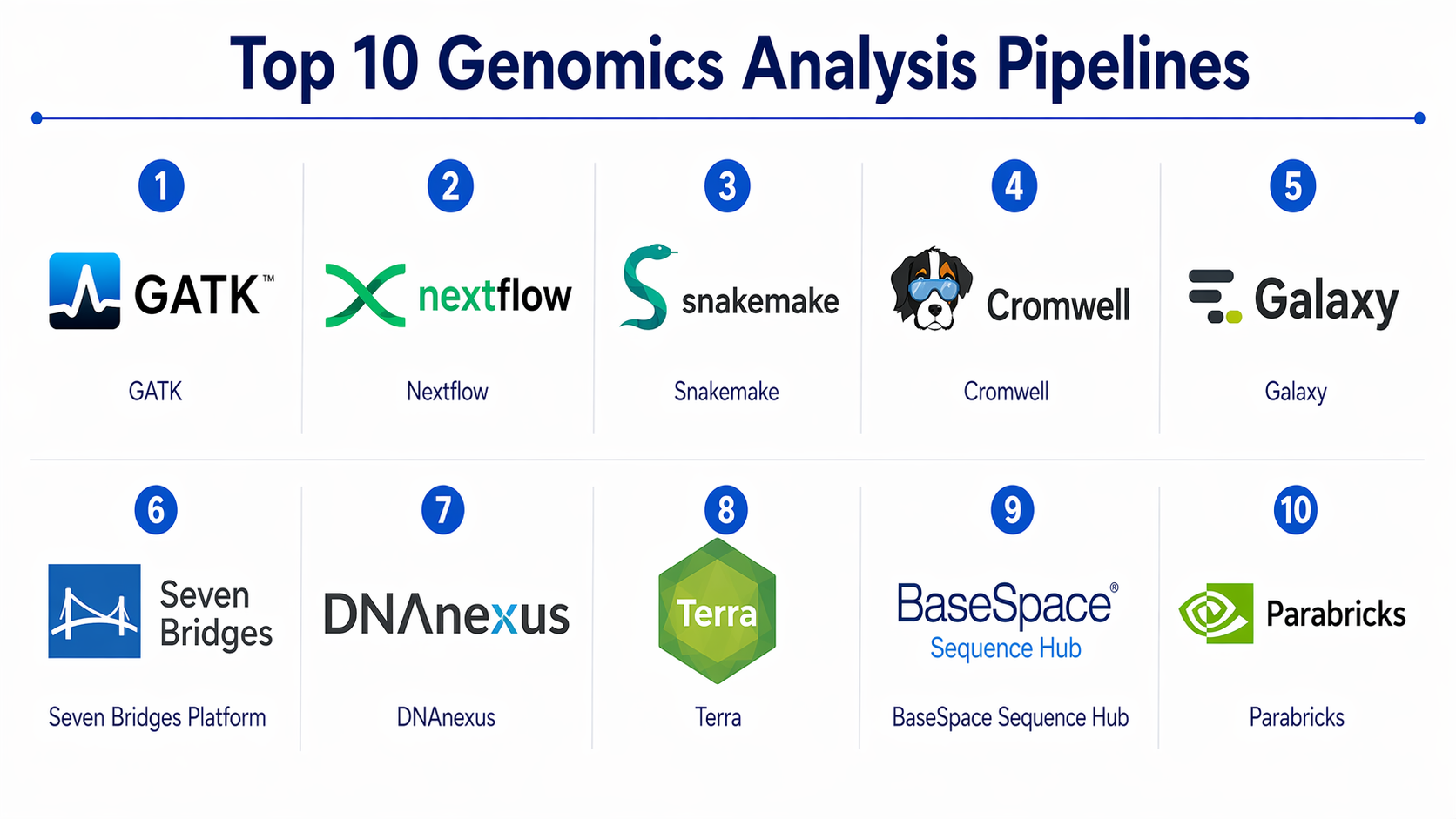
Top 10 Genomics Analysis Pipelines
#1 — GATK (Genome Analysis Toolkit)
Short description:
A widely used genomics pipeline framework developed for variant discovery and genotyping. It is considered an industry standard for high-throughput sequencing data analysis, especially in clinical and research environments.
Key Features
- Variant calling and genotyping
- Data preprocessing pipelines
- High scalability for large datasets
- Best-practice workflows
- Integration with cloud environments
Pros
- Industry standard for accuracy
- Strong documentation and support
Cons
- Complex setup
- Requires expertise
Platforms / Deployment
Linux / macOS
Cloud / Self-hosted
Security & Compliance
Not publicly stated
Integrations & Ecosystem
Strong ecosystem with genomics tools and workflows.
- Integration with sequencing platforms
- Workflow engines
- Cloud platforms
Support & Community
Very strong global community and extensive documentation.
#2 — Nextflow
Short description:
A workflow management system designed for building scalable and reproducible genomics pipelines. Popular for its flexibility and support for cloud and container environments.
Key Features
- Workflow orchestration
- Container support (Docker/Singularity)
- Cloud-native execution
- Reproducible pipelines
- Parallel processing
Pros
- Highly flexible
- Strong scalability
Cons
- Requires scripting knowledge
- Setup complexity
Platforms / Deployment
Linux / macOS
Cloud / Hybrid
Security & Compliance
Not publicly stated
Integrations & Ecosystem
- Integration with cloud providers
- Container ecosystems
- Bioinformatics tools
Support & Community
Active community and growing adoption.
#3 — Snakemake
Short description:
A Python-based workflow engine that simplifies pipeline creation and management. Widely used in academic and research environments.
Key Features
- Rule-based workflows
- Reproducibility support
- Scalable execution
- Integration with HPC
- Easy debugging
Pros
- Python-friendly
- Highly reproducible
Cons
- Limited enterprise features
- Requires coding
Platforms / Deployment
Linux / macOS
Self-hosted
Security & Compliance
Not publicly stated
Integrations & Ecosystem
- Integration with Python tools
- HPC environments
Support & Community
Strong academic community.
#4 — Cromwell (WDL Engine)
Short description:
A workflow execution engine for WDL pipelines, commonly used in genomics research and clinical workflows.
Key Features
- WDL support
- Workflow orchestration
- Cloud and local execution
- Scalable processing
- Pipeline reproducibility
Pros
- Standardized workflows
- Cloud integration
Cons
- Limited flexibility outside WDL
- Learning curve
Platforms / Deployment
Linux
Cloud / Hybrid
Security & Compliance
Not publicly stated
Integrations & Ecosystem
- Integration with genomics pipelines
- Cloud platforms
Support & Community
Active user base.
#5 — Galaxy
Short description:
A web-based platform for accessible and reproducible genomic research. Ideal for users with limited coding experience.
Key Features
- Web interface
- Workflow builder
- Reproducibility
- Tool integration
- Data sharing
Pros
- Beginner-friendly
- No coding required
Cons
- Limited scalability
- Performance constraints
Platforms / Deployment
Web / Linux
Cloud / Self-hosted
Security & Compliance
Not publicly stated
Integrations & Ecosystem
- Integration with bioinformatics tools
- Data repositories
Support & Community
Large global community.
#6 — Seven Bridges Platform
Short description:
A cloud-based genomics platform designed for large-scale data analysis and collaboration.
Key Features
- Cloud-native pipelines
- Workflow automation
- Collaboration tools
- Data management
- Scalable infrastructure
Pros
- Enterprise-ready
- Strong collaboration features
Cons
- Costly
- Vendor lock-in risk
Platforms / Deployment
Web
Cloud
Security & Compliance
Not publicly stated
Integrations & Ecosystem
- Cloud ecosystems
- Data analysis tools
Support & Community
Enterprise-level support.
#7 — DNAnexus
Short description:
A cloud-based genomics data platform focused on secure and scalable analysis workflows.
Key Features
- Data security
- Pipeline automation
- Scalable cloud computing
- Compliance features
- Collaboration
Pros
- Strong security focus
- Scalable
Cons
- Expensive
- Complex onboarding
Platforms / Deployment
Web
Cloud
Security & Compliance
Not publicly stated
Integrations & Ecosystem
- Integration with sequencing tools
- Cloud services
Support & Community
Enterprise support available.
#8 — Terra (Broad Institute)
Short description:
A cloud-based platform for biomedical research offering scalable genomics workflows and data sharing.
Key Features
- Workflow execution
- Data sharing
- Cloud integration
- Reproducibility
- Collaboration
Pros
- Research-focused
- Scalable
Cons
- Learning curve
- Cloud dependency
Platforms / Deployment
Web
Cloud
Security & Compliance
Not publicly stated
Integrations & Ecosystem
- Integration with genomics datasets
- Workflow tools
Support & Community
Strong research community.
#9 — BaseSpace Sequence Hub
Short description:
A genomics analysis platform designed for Illumina sequencing workflows.
Key Features
- Sequencing integration
- Data analysis pipelines
- Cloud-based workflows
- Data storage
- Automation
Pros
- Seamless Illumina integration
- Easy setup
Cons
- Limited flexibility
- Vendor dependency
Platforms / Deployment
Web
Cloud
Security & Compliance
Not publicly stated
Integrations & Ecosystem
- Integration with sequencing hardware
- Data tools
Support & Community
Good vendor support.
#10 — Parabricks
Short description:
A GPU-accelerated genomics pipeline designed for ultra-fast processing of sequencing data.
Key Features
- GPU acceleration
- Fast variant calling
- Scalable processing
- Cloud compatibility
- Optimized workflows
Pros
- Extremely fast
- High performance
Cons
- Requires GPU hardware
- Cost considerations
Platforms / Deployment
Linux
Cloud / Self-hosted
Security & Compliance
Not publicly stated
Integrations & Ecosystem
- HPC environments
- Cloud systems
Support & Community
Growing adoption.
Comparison Table (Top 10)
| Tool Name | Best For | Platform(s) Supported | Deployment | Standout Feature | Public Rating |
|---|---|---|---|---|---|
| GATK | Variant analysis | Linux/macOS | Hybrid | Industry standard workflows | N/A |
| Nextflow | Pipeline orchestration | Linux/macOS | Hybrid | Container support | N/A |
| Snakemake | Academic pipelines | Linux/macOS | Self-hosted | Python-based workflows | N/A |
| Cromwell | Standardized pipelines | Linux | Hybrid | WDL support | N/A |
| Galaxy | Beginners | Web/Linux | Hybrid | No-code workflows | N/A |
| Seven Bridges | Enterprise genomics | Web | Cloud | Collaboration tools | N/A |
| DNAnexus | Secure analysis | Web | Cloud | Data security | N/A |
| Terra | Research workflows | Web | Cloud | Data sharing | N/A |
| BaseSpace | Sequencing workflows | Web | Cloud | Illumina integration | N/A |
| Parabricks | High-performance computing | Linux | Hybrid | GPU acceleration | N/A |
Evaluation & Genomics Analysis Pipelines
| Tool Name | Core (25%) | Ease (15%) | Integrations (15%) | Security (10%) | Performance (10%) | Support (10%) | Value (15%) | Weighted Total |
|---|---|---|---|---|---|---|---|---|
| GATK | 9 | 6 | 8 | 7 | 9 | 9 | 7 | 8.2 |
| Nextflow | 9 | 7 | 9 | 6 | 8 | 8 | 8 | 8.3 |
| Snakemake | 8 | 7 | 7 | 5 | 7 | 8 | 9 | 7.8 |
| Cromwell | 8 | 6 | 8 | 6 | 8 | 7 | 7 | 7.6 |
| Galaxy | 7 | 9 | 7 | 5 | 6 | 8 | 9 | 7.7 |
| Seven Bridges | 9 | 8 | 8 | 7 | 8 | 8 | 6 | 8.0 |
| DNAnexus | 9 | 7 | 8 | 8 | 8 | 8 | 6 | 8.0 |
| Terra | 8 | 7 | 8 | 6 | 8 | 8 | 7 | 7.8 |
| BaseSpace | 8 | 8 | 7 | 6 | 7 | 7 | 6 | 7.5 |
| Parabricks | 9 | 6 | 7 | 6 | 10 | 7 | 7 | 8.1 |
How to interpret scores:
These scores compare tools relative to each other. Higher scores indicate better balance across features, usability, and value. Enterprise tools perform well in features and scalability, while open-source tools often score higher in value.
Which Genomics Analysis Pipelines
Solo / Freelancer
Galaxy or Snakemake are ideal due to simplicity and low cost.
SMB
Nextflow and GATK provide strong flexibility and scalability.
Mid-Market
Terra or Cromwell offer balance between performance and usability.
Enterprise
Seven Bridges or DNAnexus for secure, large-scale operations.
Budget vs Premium
- Budget: Snakemake, Galaxy
- Premium: DNAnexus, Seven Bridges
Feature Depth vs Ease of Use
- Deep features: GATK, Parabricks
- Easy to use: Galaxy
Integrations & Scalability
- Strong: Nextflow, DNAnexus
- Moderate: Snakemake
Security & Compliance Needs
- Best: DNAnexus, enterprise cloud platforms
- Open-source requires custom security setup
Frequently Asked Questions (FAQs)
1. What is a genomics analysis pipeline?
It is a workflow that processes raw sequencing data into meaningful biological insights.
2. Are these tools cloud-based?
Many modern pipelines support cloud deployment, but some are self-hosted.
3. Do I need coding skills?
Most tools require some scripting knowledge, except beginner tools like Galaxy.
4. How much do these tools cost?
Open-source tools are free; enterprise platforms vary widely in cost.
5. What industries use these pipelines?
Healthcare, pharma, biotech, and research institutions.
6. Can pipelines handle large datasets?
Yes, especially those designed for HPC and cloud environments.
7. How secure are these platforms?
Enterprise platforms offer better security; open-source requires setup.
8. Can I customize pipelines?
Yes, most tools allow customization through scripts or configurations.
9. What are common mistakes?
Choosing tools without considering scalability or team expertise.
10. Can I switch pipelines later?
Yes, but it may require workflow redesign and data migration.
Conclusion
Genomics analysis pipelines are essential for modern data-driven biology and healthcare. The right choice depends on your scale, expertise, and infrastructure needs. Open-source tools offer flexibility and cost advantages, while enterprise platforms deliver scalability, security, and collaboration. Instead of choosing a single “best” solution, shortlist two or three pipelines that match your workflow, test them with real datasets, and validate performance, integration, and ease of use before making a long-term commitment.
