Introduction
Pharmacovigilance software is used by pharmaceutical companies, biotech firms, and contract research organizations to monitor, detect, assess, and report adverse drug reactions (ADRs). In simple terms, it helps ensure that medicines remain safe after they are released into the market.
In today’s regulatory-heavy and data-driven environment, especially post-digital transformation, pharmacovigilance has become more complex. Organizations now deal with massive volumes of safety data, real-time reporting expectations, and global compliance requirements. Modern pharmacovigilance systems combine automation, AI, and analytics to streamline these processes.
Common Use Cases
- Adverse event case intake and processing
- Signal detection and risk assessment
- Regulatory reporting (e.g., FDA, EMA submissions)
- Literature monitoring and safety surveillance
- Risk management planning and compliance tracking
What Buyers Should Evaluate
- Case processing automation capabilities
- Global regulatory compliance support
- AI/ML-based signal detection
- Integration with clinical and regulatory systems
- Scalability and performance
- Data security and audit trails
- Workflow customization
- Reporting and analytics
- Deployment flexibility
- Vendor support and ecosystem
Best for: Pharmaceutical companies, CROs, biotech firms, safety teams, regulatory professionals, and compliance officers managing drug safety operations.
Not ideal for: Small clinics, standalone research labs, or teams without regulatory reporting needs—simpler data tracking tools may be sufficient in such cases.
Key Trends in Pharmacovigilance Software
- AI-driven case processing improving speed and accuracy
- Automated signal detection using machine learning models
- Cloud-first deployments for scalability and global access
- Real-time pharmacovigilance dashboards for decision-making
- Regulatory harmonization support (FDA, EMA, ICH standards)
- Natural Language Processing (NLP) for literature and case intake
- Integration with EHR and clinical trial systems
- Risk-based pharmacovigilance approaches
- Increased focus on data privacy and compliance
- Subscription-based pricing models replacing legacy licensing
How We Selected These Tools (Methodology)
- Strong market adoption across pharma and biotech
- Comprehensive safety and compliance feature sets
- Proven scalability for enterprise-level workloads
- Reliable performance and uptime signals
- Security posture and compliance readiness
- Integration capabilities with enterprise systems
- Vendor ecosystem and long-term viability
- Flexibility across different organization sizes
- User feedback trends and industry recognition
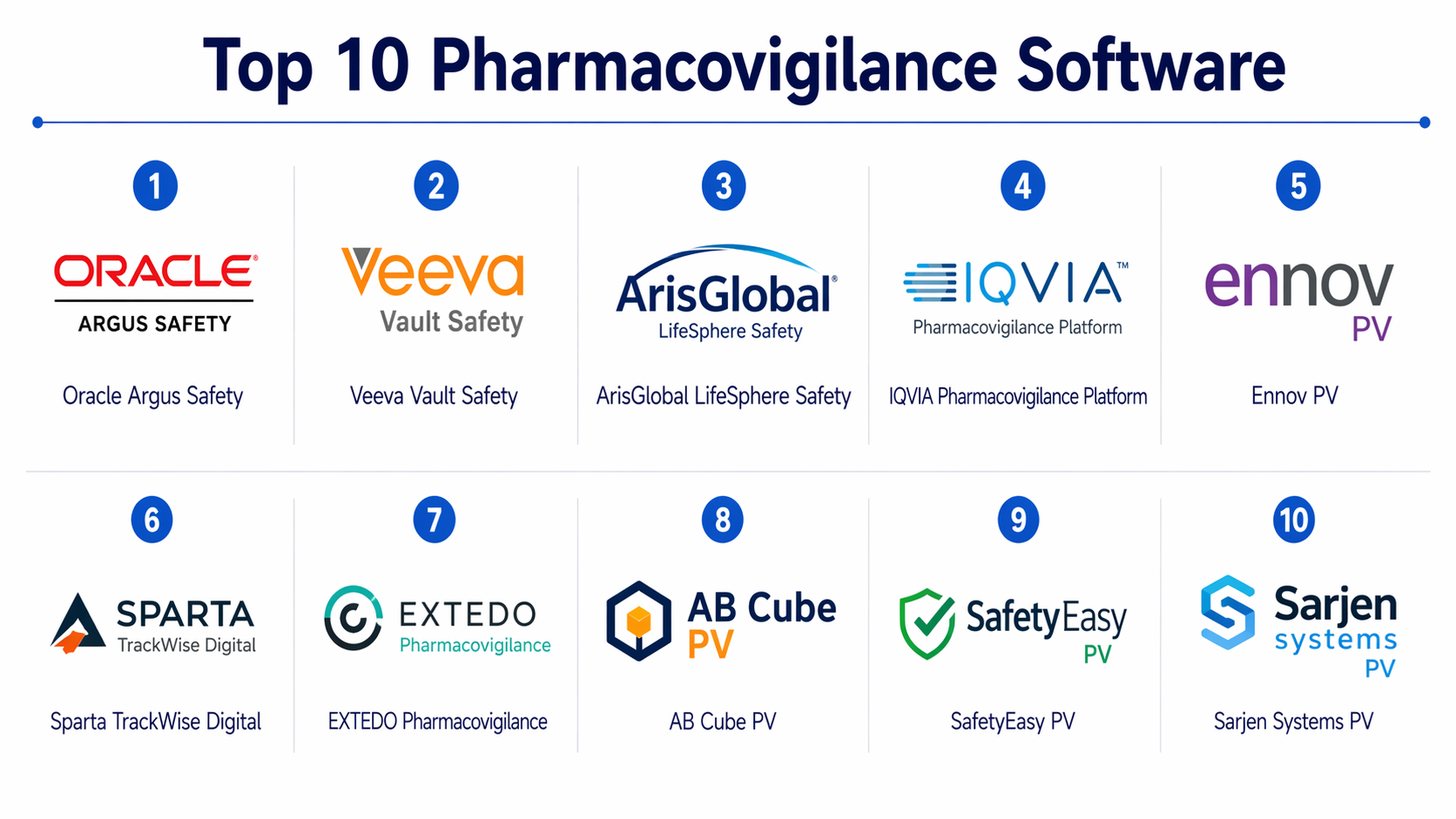
Top 10 Pharmacovigilance Software
#1 — Oracle Argus Safety
Short description:
Oracle Argus Safety is one of the most widely used pharmacovigilance platforms globally. It provides end-to-end safety case management, signal detection, and regulatory reporting. Designed for large enterprises, it supports complex workflows and global compliance requirements. It is particularly strong in automation and scalability. Many pharma giants rely on it for centralized safety operations.
Key Features
- Advanced case processing workflows
- Global regulatory reporting automation
- Signal detection and analytics
- Literature monitoring integration
- Configurable dashboards
- Audit trail and compliance tracking
Pros
- Highly scalable for enterprise use
- Strong regulatory compliance capabilities
Cons
- Complex implementation
- Requires training for full utilization
Platforms / Deployment
Cloud / Self-hosted / Hybrid
Security & Compliance
Supports RBAC, audit logs, encryption; other certifications Not publicly stated
Integrations & Ecosystem
Integrates with clinical, regulatory, and ERP systems
- Oracle ecosystem
- EHR systems
- Data warehouses
- APIs for customization
Support & Community
Strong enterprise support; extensive documentation; widely used in industry
#2 — Veeva Vault Safety
Short description:
Veeva Vault Safety is a cloud-native pharmacovigilance platform focused on usability and compliance. It provides unified safety data management with strong integration capabilities. It is widely used by mid-to-large pharma organizations. Known for modern UI and faster deployment.
Key Features
- Unified safety database
- Automated case intake
- Signal detection tools
- Regulatory submission workflows
- Cloud-based scalability
Pros
- User-friendly interface
- Fast deployment
Cons
- Premium pricing
- Limited customization compared to legacy systems
Platforms / Deployment
Cloud
Security & Compliance
Encryption, RBAC; other certifications Not publicly stated
Integrations & Ecosystem
Strong integration with Veeva ecosystem
- Clinical systems
- CRM tools
- APIs
Support & Community
Strong support; active enterprise adoption
#3 — ArisGlobal LifeSphere Safety
Short description:
ArisGlobal LifeSphere Safety offers a modern, AI-enabled pharmacovigilance platform. It focuses on automation and real-time insights. The platform supports global compliance and is suitable for organizations seeking advanced analytics.
Key Features
- AI-powered case processing
- Signal detection automation
- Regulatory reporting
- Real-time analytics
- Workflow automation
Pros
- Strong AI capabilities
- Modern platform architecture
Cons
- Learning curve
- Customization complexity
Platforms / Deployment
Cloud
Security & Compliance
Not publicly stated
Integrations & Ecosystem
Supports enterprise integrations
- Clinical systems
- APIs
- Data platforms
Support & Community
Growing ecosystem; enterprise-focused support
#4 — IQVIA Pharmacovigilance Platform
Short description:
IQVIA offers a comprehensive pharmacovigilance solution integrated with its data analytics ecosystem. It is widely used for large-scale safety operations and data-driven insights.
Key Features
- Case processing
- Signal detection
- Real-world data integration
- Regulatory compliance
- Advanced analytics
Pros
- Strong data analytics capabilities
- Global reach
Cons
- High cost
- Complex setup
Platforms / Deployment
Cloud / Hybrid
Security & Compliance
Not publicly stated
Integrations & Ecosystem
Deep integration with IQVIA data services
- Clinical data
- Real-world evidence
- APIs
Support & Community
Enterprise-level support
#5 — Ennov PV
Short description:
Ennov PV is a flexible pharmacovigilance system suitable for mid-sized organizations. It provides modular features and strong compliance capabilities.
Key Features
- Case management
- Signal detection
- Workflow automation
- Regulatory reporting
- Document management
Pros
- Flexible deployment
- Cost-effective
Cons
- Limited AI features
- UI may feel outdated
Platforms / Deployment
Cloud / Self-hosted
Security & Compliance
Not publicly stated
Integrations & Ecosystem
- APIs
- Document systems
- Clinical tools
Support & Community
Moderate support ecosystem
#6 — Sparta TrackWise Digital
Short description:
TrackWise Digital extends quality management into pharmacovigilance workflows. It is best suited for organizations already using Sparta systems.
Key Features
- Quality and safety integration
- Workflow automation
- Compliance tracking
- Audit management
Pros
- Strong quality integration
- Scalable
Cons
- Not purely PV-focused
- Complex setup
Platforms / Deployment
Cloud
Security & Compliance
Not publicly stated
Integrations & Ecosystem
- QMS systems
- APIs
Support & Community
Enterprise support
#7 — EXTEDO Pharmacovigilance
Short description:
EXTEDO provides pharmacovigilance tools with strong regulatory submission capabilities. It is known for its compliance focus.
Key Features
- Regulatory submissions
- Case processing
- Compliance tracking
- Data validation
Pros
- Strong regulatory expertise
- Reliable performance
Cons
- Limited analytics features
- Smaller ecosystem
Platforms / Deployment
Cloud
Security & Compliance
Not publicly stated
Integrations & Ecosystem
- Regulatory systems
- APIs
Support & Community
Niche but reliable support
#8 — AB Cube PV
Short description:
AB Cube PV is a modern SaaS pharmacovigilance platform designed for flexibility and cost efficiency. It suits small to mid-sized companies.
Key Features
- Case management
- Signal detection
- Workflow automation
- Reporting
Pros
- Cost-effective
- Easy to deploy
Cons
- Limited enterprise features
- Smaller ecosystem
Platforms / Deployment
Cloud
Security & Compliance
Not publicly stated
Integrations & Ecosystem
- APIs
- Basic integrations
Support & Community
Growing support network
#9 — SafetyEasy PV
Short description:
SafetyEasy PV is a simplified pharmacovigilance solution targeting smaller organizations and startups.
Key Features
- Case processing
- Reporting
- Workflow management
- Compliance tools
Pros
- Easy to use
- Affordable
Cons
- Limited scalability
- Fewer advanced features
Platforms / Deployment
Cloud
Security & Compliance
Not publicly stated
Integrations & Ecosystem
- Basic API integrations
Support & Community
Limited but improving
#10 — Sarjen Systems PV
Short description:
Sarjen Systems provides pharmacovigilance solutions with a focus on emerging markets and mid-sized pharma companies.
Key Features
- Case management
- Regulatory reporting
- Workflow automation
- Compliance tracking
Pros
- Cost-efficient
- Flexible
Cons
- Limited global presence
- Smaller ecosystem
Platforms / Deployment
Cloud / Hybrid
Security & Compliance
Not publicly stated
Integrations & Ecosystem
- APIs
- Clinical systems
Support & Community
Moderate support availability
Comparison Table (Top 10)
| Tool Name | Best For | Platform(s) Supported | Deployment | Standout Feature | Public Rating |
|---|---|---|---|---|---|
| Oracle Argus Safety | Enterprise pharma | Web | Hybrid | Regulatory automation | N/A |
| Veeva Vault Safety | Cloud-first teams | Web | Cloud | Modern UI | N/A |
| ArisGlobal LifeSphere | AI-driven PV | Web | Cloud | AI automation | N/A |
| IQVIA PV Platform | Data-heavy orgs | Web | Hybrid | Analytics integration | N/A |
| Ennov PV | Mid-market | Web | Hybrid | Flexibility | N/A |
| Sparta TrackWise | Quality-focused | Web | Cloud | QMS integration | N/A |
| EXTEDO PV | Compliance-heavy | Web | Cloud | Regulatory expertise | N/A |
| AB Cube PV | SMB pharma | Web | Cloud | Cost efficiency | N/A |
| SafetyEasy PV | Startups | Web | Cloud | Simplicity | N/A |
| Sarjen Systems PV | Emerging markets | Web | Hybrid | Affordability | N/A |
Evaluation & Pharmacovigilance Software
| Tool Name | Core | Ease | Integrations | Security | Performance | Support | Value | Weighted Total |
|---|---|---|---|---|---|---|---|---|
| Oracle Argus | 9 | 6 | 9 | 8 | 9 | 8 | 6 | 8.0 |
| Veeva Vault | 8 | 8 | 8 | 8 | 8 | 8 | 6 | 7.8 |
| ArisGlobal | 8 | 7 | 8 | 7 | 8 | 7 | 7 | 7.6 |
| IQVIA | 9 | 6 | 9 | 8 | 9 | 8 | 6 | 8.0 |
| Ennov | 7 | 7 | 7 | 7 | 7 | 7 | 8 | 7.2 |
| TrackWise | 7 | 6 | 7 | 7 | 8 | 7 | 6 | 6.9 |
| EXTEDO | 7 | 6 | 6 | 7 | 7 | 7 | 7 | 6.8 |
| AB Cube | 6 | 8 | 6 | 6 | 7 | 6 | 8 | 6.9 |
| SafetyEasy | 6 | 8 | 5 | 6 | 6 | 6 | 8 | 6.6 |
| Sarjen | 6 | 7 | 6 | 6 | 7 | 6 | 8 | 6.8 |
How to interpret:
Scores are comparative, not absolute. A higher score indicates stronger overall capability relative to peers. Enterprises should prioritize core features and integrations, while smaller teams may value ease of use and pricing more.
Which Pharmacovigilance Software
Solo / Freelancer
Simple tools like SafetyEasy or AB Cube are sufficient. Avoid enterprise platforms.
SMB
Choose Ennov or AB Cube for cost-effective flexibility.
Mid-Market
Veeva Vault or ArisGlobal offers balance between usability and power.
Enterprise
Oracle Argus or IQVIA for scalability and compliance.
Budget vs Premium
Budget: SafetyEasy, Sarjen
Premium: Oracle, Veeva
Feature Depth vs Ease of Use
Deep features: Oracle Argus
Ease of use: Veeva Vault
Integrations & Scalability
Best: Oracle, IQVIA
Security & Compliance Needs
High compliance: Oracle, EXTEDO
Frequently Asked Questions (FAQs)
1. What is pharmacovigilance software used for?
It is used to monitor drug safety by collecting, analyzing, and reporting adverse events.
2. Is pharmacovigilance software mandatory?
Yes, for pharma companies dealing with regulated markets.
3. How much does it cost?
Pricing varies widely depending on scale and vendor.
4. How long does implementation take?
From weeks to several months depending on complexity.
5. Does it support AI features?
Modern tools include AI for automation and signal detection.
6. Can it integrate with clinical systems?
Yes, most enterprise tools support integrations.
7. What are common mistakes?
Underestimating complexity and poor data management.
8. Is cloud deployment safe?
Yes, if proper security measures are implemented.
9. Can small companies use it?
Yes, there are lightweight solutions available.
10. How to choose the right tool?
Evaluate based on scale, compliance, and budget.
Conclusion
Pharmacovigilance software is no longer just a compliance requirement—it has become a strategic capability for modern pharmaceutical and biotech organizations. As safety data volumes grow and regulatory expectations become stricter, choosing the right platform can directly impact operational efficiency, patient safety, and global market access. While enterprise platforms like Oracle Argus and IQVIA dominate in scalability and depth, newer cloud-based solutions like Veeva Vault and ArisGlobal are redefining usability and speed. Smaller organizations can still benefit from flexible, cost-effective tools like AB Cube or SafetyEasy. Ultimately, the “best” solution depends on your organization’s size, regulatory exposure, and technical maturity.
