Introduction
Research Data Management Platforms (RDMPs) are systems designed to collect, organize, store, share, and preserve research data across its lifecycle. These platforms help researchers, institutions, and organizations manage structured and unstructured data while ensuring compliance, reproducibility, and collaboration.
In today’s data-driven world, research is no longer limited to spreadsheets or local storage. With growing datasets, cross-border collaborations, and strict compliance requirements, RDMPs have become essential. They enable teams to manage data securely, automate workflows, and ensure long-term accessibility.
Common use cases include:
- Academic research data storage and sharing
- Clinical trial data management
- Enterprise R&D collaboration
- Government and policy research archives
- AI/ML dataset versioning and governance
What buyers should evaluate:
- Data lifecycle management capabilities
- Collaboration and sharing features
- Security and compliance controls
- Integration with research tools
- Scalability and performance
- Metadata and indexing capabilities
- Version control and audit logs
- Cost and licensing model
Best for: Universities, research labs, healthcare organizations, government bodies, and enterprises handling large datasets or compliance-heavy workflows.
Not ideal for: Small teams with minimal data complexity or those needing only basic file storage (simple cloud drives may be enough).
Key Trends in Research Data Management Platforms
- AI-driven data classification for automatic tagging and metadata generation
- Automation of data lifecycle workflows (collection → storage → archival)
- Integration with AI/ML pipelines for dataset versioning and reproducibility
- Stronger compliance enforcement (GDPR, HIPAA, research ethics)
- Cloud-first architectures replacing on-premise systems
- Open science and data sharing initiatives driving interoperability
- API-first ecosystems enabling custom workflows and integrations
- Decentralized and federated data models for cross-institution collaboration
- Increased focus on FAIR principles (Findable, Accessible, Interoperable, Reusable)
- Usage-based pricing models aligned with storage and compute consumption
How We Selected These Tools (Methodology)
- Evaluated market adoption and recognition in academia and enterprise
- Assessed feature completeness across the data lifecycle
- Reviewed performance and reliability signals from user feedback
- Considered security and compliance capabilities
- Analyzed integration ecosystems and extensibility
- Included tools suitable for different organization sizes
- Balanced open-source and enterprise solutions
- Focused on modern architecture and future readiness
- Ensured tools support collaboration and reproducibility
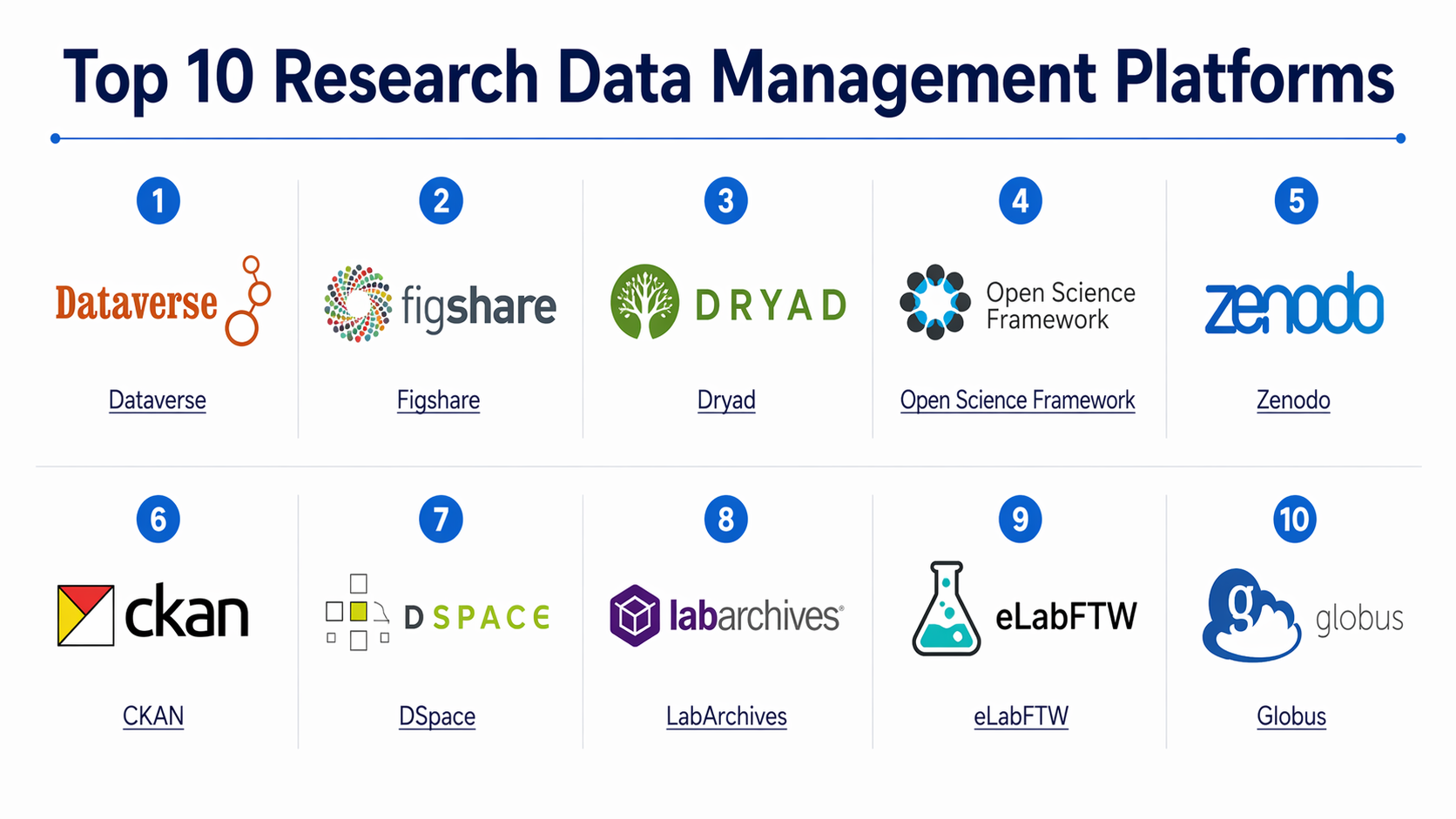
Top 10 Research Data Management Platforms
#1 — Dataverse
Short description :
Dataverse is an open-source platform designed for sharing, citing, and preserving research data. It is widely used by universities and research institutions. The platform emphasizes data accessibility and reproducibility while supporting metadata standards. It allows researchers to publish datasets with proper citations. Ideal for academic environments focusing on open science.
Key Features
- Dataset publishing with DOI support
- Metadata management
- Version control
- Data sharing and access control
- Search and indexing capabilities
Pros
- Strong academic adoption
- Open-source flexibility
Cons
- Limited enterprise features
- UI can feel outdated
Platforms / Deployment
Web / Cloud / Self-hosted
Security & Compliance
Basic access controls, encryption – Not publicly stated
Integrations & Ecosystem
Supports APIs and integrates with institutional repositories
- DOI services
- Metadata standards tools
- Research databases
Support & Community
Strong academic community; documentation is available but varies in depth
#2 — Figshare
Short description :
Figshare is a cloud-based platform that enables researchers to store, share, and publish datasets. It is popular among universities and publishers. The platform supports open access initiatives and collaboration. It is user-friendly and suitable for institutions promoting data transparency.
Key Features
- Data publishing with DOIs
- Collaboration tools
- Version tracking
- File previews
- Analytics
Pros
- Easy to use
- Strong sharing capabilities
Cons
- Limited customization
- Cost can scale with usage
Platforms / Deployment
Web / Cloud
Security & Compliance
SSO, encryption – Not publicly stated
Integrations & Ecosystem
Integrates with publishing platforms and institutional systems
- ORCID
- Research repositories
- APIs
Support & Community
Good documentation and institutional support
#3 — Dryad
Short description :
Dryad is a nonprofit platform focused on publishing and preserving research data. It is widely used in scientific communities. The platform ensures datasets are discoverable and reusable. It is particularly strong in journal-linked data publishing.
Key Features
- Data publishing workflows
- DOI assignment
- Metadata standardization
- Peer-review integration
- Data curation
Pros
- Trusted by journals
- Strong curation support
Cons
- Limited customization
- Not enterprise-focused
Platforms / Deployment
Web / Cloud
Security & Compliance
Not publicly stated
Integrations & Ecosystem
Works closely with academic journals
- Publishing systems
- Metadata services
Support & Community
Moderate support; strong academic presence
#4 — Open Science Framework (OSF)
Short description :
OSF is a collaborative platform designed for managing research projects and data. It supports versioning, sharing, and reproducibility. It is widely used in academic and research communities.
Key Features
- Project management
- Data versioning
- Collaboration tools
- File storage
- Workflow tracking
Pros
- Strong collaboration features
- Free core offering
Cons
- Limited enterprise integrations
- UI complexity
Platforms / Deployment
Web / Cloud
Security & Compliance
Not publicly stated
Integrations & Ecosystem
Supports integrations with research tools
- GitHub
- Cloud storage services
- APIs
Support & Community
Active community and documentation
#5 — Zenodo
Short description :
Zenodo is a research data repository developed for open science. It supports long-term data preservation and citation. It is widely used by researchers globally.
Key Features
- Dataset archiving
- DOI generation
- Metadata tagging
- Open access support
- Versioning
Pros
- Free to use
- Strong preservation capabilities
Cons
- Limited enterprise features
- Basic UI
Platforms / Deployment
Web / Cloud
Security & Compliance
Not publicly stated
Integrations & Ecosystem
Supports integration with research ecosystems
- GitHub
- APIs
Support & Community
Community-driven support
#6 — CKAN
Short description :
CKAN is an open-source data management platform widely used by governments and organizations. It focuses on data publishing and sharing.
Key Features
- Data cataloging
- Metadata management
- API access
- Data visualization
- Access control
Pros
- Highly customizable
- Strong open data support
Cons
- Requires technical setup
- Maintenance overhead
Platforms / Deployment
Web / Self-hosted
Security & Compliance
RBAC, basic controls – Not publicly stated
Integrations & Ecosystem
Extensive plugin ecosystem
- APIs
- Data portals
- Visualization tools
Support & Community
Strong open-source community
#7 — DSpace
Short description :
DSpace is a repository platform used by institutions for managing digital assets and research data. It supports archiving and access.
Key Features
- Digital repository
- Metadata support
- Access control
- Search functionality
- Preservation tools
Pros
- Widely adopted
- Flexible deployment
Cons
- Requires customization
- UI limitations
Platforms / Deployment
Web / Self-hosted
Security & Compliance
Not publicly stated
Integrations & Ecosystem
Supports institutional integrations
- APIs
- Repository systems
Support & Community
Large global community
#8 — LabArchives
Short description :
LabArchives is a cloud-based electronic lab notebook with data management capabilities. It is ideal for labs and research teams.
Key Features
- Electronic lab notebook
- Data organization
- Collaboration
- Audit trails
- File storage
Pros
- Easy for lab workflows
- Good compliance features
Cons
- Limited large-scale data management
- Subscription pricing
Platforms / Deployment
Web / Cloud
Security & Compliance
Encryption, audit logs – Not publicly stated
Integrations & Ecosystem
Integrates with lab tools
- APIs
- Research software
Support & Community
Good support and onboarding
#9 — eLabFTW
Short description :
eLabFTW is an open-source electronic lab notebook with strong data management capabilities. It is suitable for research teams needing control.
Key Features
- Experiment tracking
- Data storage
- Audit trails
- Access control
- Open-source customization
Pros
- Highly flexible
- Free and open-source
Cons
- Requires setup
- Limited enterprise features
Platforms / Deployment
Web / Self-hosted
Security & Compliance
RBAC, audit logs – Not publicly stated
Integrations & Ecosystem
Supports plugins and APIs
- Custom integrations
- Lab systems
Support & Community
Active open-source community
#10 — Globus
Short description :
Globus is a data management platform focused on secure data transfer and sharing. It is widely used in research and high-performance computing environments.
Key Features
- Secure data transfer
- Access management
- Automation workflows
- Data sharing
- Identity management
Pros
- Excellent performance
- Strong security
Cons
- Not a full RDM platform
- Learning curve
Platforms / Deployment
Web / Cloud
Security & Compliance
SSO, encryption, identity federation
Integrations & Ecosystem
Integrates with HPC and research systems
- APIs
- Identity providers
- Storage systems
Support & Community
Strong institutional support
Comparison Table (Top 10)
| Tool Name | Best For | Platform(s) Supported | Deployment | Standout Feature | Public Rating |
|---|---|---|---|---|---|
| Dataverse | Academia | Web | Hybrid | Data publishing | N/A |
| Figshare | Universities | Web | Cloud | Easy sharing | N/A |
| Dryad | Journals | Web | Cloud | Data curation | N/A |
| OSF | Collaboration | Web | Cloud | Project workflows | N/A |
| Zenodo | Open science | Web | Cloud | Free archive | N/A |
| CKAN | Government | Web | Self-hosted | Data cataloging | N/A |
| DSpace | Institutions | Web | Self-hosted | Digital repository | N/A |
| LabArchives | Labs | Web | Cloud | ELN integration | N/A |
| eLabFTW | Research teams | Web | Self-hosted | Open-source ELN | N/A |
| Globus | HPC | Web | Cloud | Secure transfer | N/A |
Evaluation & Research Data Management Platform
| Tool Name | Core (25%) | Ease (15%) | Integrations (15%) | Security (10%) | Performance (10%) | Support (10%) | Value (15%) | Weighted Total |
|---|---|---|---|---|---|---|---|---|
| Dataverse | 8 | 6 | 7 | 6 | 7 | 7 | 8 | 7.2 |
| Figshare | 8 | 8 | 7 | 7 | 7 | 7 | 7 | 7.5 |
| Dryad | 7 | 7 | 6 | 6 | 7 | 7 | 6 | 6.7 |
| OSF | 8 | 7 | 7 | 6 | 7 | 7 | 8 | 7.3 |
| Zenodo | 7 | 7 | 6 | 6 | 7 | 6 | 9 | 7.0 |
| CKAN | 9 | 5 | 8 | 7 | 8 | 7 | 7 | 7.6 |
| DSpace | 8 | 6 | 7 | 6 | 7 | 7 | 7 | 7.1 |
| LabArchives | 7 | 8 | 6 | 7 | 7 | 8 | 6 | 7.0 |
| eLabFTW | 7 | 6 | 6 | 6 | 7 | 6 | 9 | 6.9 |
| Globus | 9 | 7 | 8 | 8 | 9 | 8 | 7 | 8.2 |
How to interpret scores:
- Scores are comparative within this category, not absolute.
- A higher score indicates better balance across features and usability.
- Enterprise tools tend to score higher in performance and security.
- Open-source tools often score high in value but lower in ease of use.
Which Research Data Management Platforms
Solo / Freelancer
- Zenodo, OSF
Simple, free, and easy to use
SMB
- Figshare, LabArchives
Balance between usability and features
Mid-Market
- Dataverse, DSpace
Better control and scalability
Enterprise
- CKAN, Globus
Advanced integrations and performance
Budget vs Premium
- Budget: Zenodo, eLabFTW
- Premium: Globus, Figshare
Feature Depth vs Ease of Use
- Easy: Figshare, LabArchives
- Advanced: CKAN, Dataverse
Integrations & Scalability
- High: CKAN, Globus
- Moderate: OSF, Dataverse
Security & Compliance Needs
- High-security: Globus
- Moderate: LabArchives, CKAN
Frequently Asked Questions (FAQs)
1. What is a Research Data Management Platform?
It is a system used to store, organize, and share research data while ensuring compliance and accessibility.
2. Are these platforms only for universities?
No, they are also used by enterprises, healthcare, and government organizations.
3. How much do these tools cost?
Pricing varies widely from free open-source options to enterprise subscriptions.
4. Can these platforms handle large datasets?
Yes, especially tools like Globus and CKAN.
5. Are they secure?
Most platforms offer encryption and access controls, but specifics vary.
6. Do they support integrations?
Yes, many provide APIs and integrations with research tools.
7. How long does implementation take?
It can range from hours (cloud tools) to weeks (self-hosted solutions).
8. Can I migrate from one platform to another?
Yes, but data migration requires planning and validation.
9. What are common mistakes?
Ignoring metadata, poor access control, and lack of backup planning.
10. Are open-source tools reliable?
Yes, but they require technical expertise for setup and maintenance.
Conclusion
Research Data Management Platforms are no longer optional for organizations handling complex datasets. They play a critical role in ensuring data integrity, collaboration, compliance, and long-term usability. However, the “best” platform depends heavily on your specific needs—whether you prioritize ease of use, scalability, security, or cost.
