Introduction
A Payment Gateway Platform is the technology that enables businesses to accept, process, and manage online payments securely. It acts as a bridge between customers, merchants, banks, and payment networks—ensuring that transactions are authorized, encrypted, and completed in real time.
In today’s digital economy, payment gateways are no longer just transaction processors. They now support multi-currency payments, fraud detection, subscription billing, mobile wallets, and global compliance, making them critical for e-commerce, SaaS, fintech, and digital-first businesses.
Real-world use cases:
- Accepting online payments for e-commerce websites
- Handling subscription billing for SaaS platforms
- Processing mobile wallet and UPI payments
- Managing international payments and currency conversions
- Enabling in-app payments for mobile applications
What buyers should evaluate:
- Transaction fees and pricing structure
- Supported payment methods (cards, wallets, UPI, etc.)
- Global coverage and multi-currency support
- Security features and compliance standards
- API quality and developer experience
- Settlement time and payout flexibility
- Fraud detection and risk management
- Integration capabilities with platforms (Shopify, ERP, CRM)
- Scalability and uptime reliability
Best for: E-commerce businesses, SaaS companies, fintech startups, marketplaces, and enterprises processing digital payments.
Not ideal for: Businesses that operate only in cash or do not require digital transactions.
Key Trends in Payment Gateway Platforms
- Rapid growth of real-time payments and instant settlements
- Expansion of UPI, mobile wallets, and QR-based payments
- Adoption of AI-driven fraud detection systems
- Increasing focus on cross-border payments and currency optimization
- Rise of embedded payments within apps and platforms
- Strong push toward tokenization and PCI compliance
- Growth of subscription and recurring billing models
- API-first design for seamless developer integration
- Expansion of Buy Now Pay Later (BNPL) support
- Cloud-native and microservices-based payment architectures
How We Selected These Tools (Methodology)
- Evaluated market adoption and global usage
- Assessed transaction reliability and uptime performance
- Compared feature completeness and payment method support
- Reviewed security and compliance capabilities
- Analyzed developer experience and API quality
- Considered integration ecosystem and scalability
- Checked fit across SMB, mid-market, and enterprise segments
- Evaluated pricing flexibility and value proposition
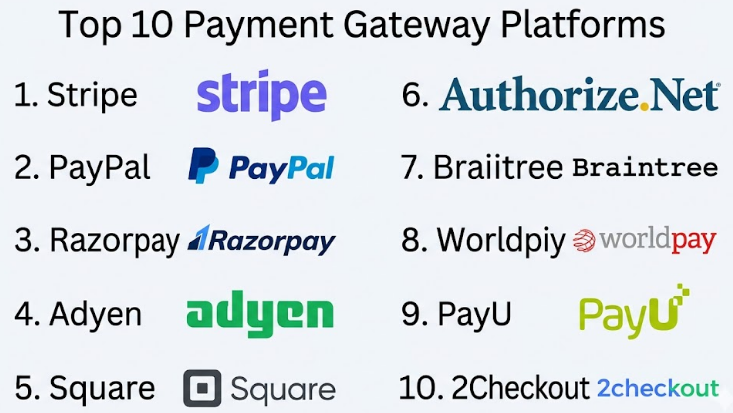
Top 10 Payment Gateway Platforms
#1 — Stripe
Short description :
Stripe is a developer-first payment gateway platform widely used by startups and enterprises. It supports global payments, subscriptions, and advanced customization through APIs. Known for its flexibility, Stripe is ideal for businesses building custom payment flows. It also offers tools for billing, fraud detection, and financial reporting.
Key Features
- API-first payment processing
- Subscription billing and invoicing
- Multi-currency support
- Advanced fraud detection (Radar)
- Custom checkout experiences
- Real-time analytics
Pros
- Excellent developer experience
- Highly customizable
Cons
- Complex for non-technical users
- Pricing can add up with scale
Platforms / Deployment
Web / Cloud
Security & Compliance
Supports encryption, PCI compliance, tokenization
Integrations & Ecosystem
Strong API ecosystem with wide integrations.
- E-commerce platforms
- SaaS billing tools
- CRM and ERP systems
- Mobile SDKs
Support & Community
Extensive documentation and active developer community.
#2 — PayPal
Short description:
PayPal is one of the most recognized payment platforms globally, offering easy checkout experiences and strong buyer protection. It is widely used by small businesses and international sellers.
Key Features
- Global payment acceptance
- Wallet-based checkout
- Subscription billing
- Mobile payments
- Buyer/seller protection
Pros
- Trusted brand
- Easy setup
Cons
- Higher transaction fees
- Limited customization
Platforms / Deployment
Web / Mobile / Cloud
Security & Compliance
Not publicly stated
Integrations & Ecosystem
- E-commerce platforms
- Marketplaces
- POS systems
Support & Community
Strong global support.
#3 — Razorpay
Short description:
Razorpay is a leading payment gateway in India offering support for UPI, cards, wallets, and subscriptions. It is widely used by startups and SMBs.
Key Features
- UPI and local payment support
- Subscription billing
- Payment links
- Smart routing
- Dashboard analytics
Pros
- Strong India-focused features
- Easy integration
Cons
- Limited global reach
- Settlement delays in some cases
Platforms / Deployment
Web / Cloud
Security & Compliance
Not publicly stated
Integrations & Ecosystem
- Indian banking systems
- E-commerce platforms
- SaaS tools
Support & Community
Good support for Indian market.
#4 — Adyen
Short description:
Adyen is an enterprise-grade payment platform supporting global businesses with unified commerce and omnichannel payments.
Key Features
- Global payment coverage
- Omnichannel payments
- Fraud detection
- Real-time insights
- Unified reporting
Pros
- Enterprise scalability
- Strong global coverage
Cons
- Complex onboarding
- Premium pricing
Platforms / Deployment
Cloud
Security & Compliance
Not publicly stated
Integrations & Ecosystem
- POS systems
- Retail platforms
- ERP integrations
Support & Community
Enterprise-level support.
#5 — Square
Short description:
Square offers payment solutions for small businesses, including POS systems and online payments.
Key Features
- POS integration
- Online payments
- Inventory tracking
- Mobile payments
- Reporting tools
Pros
- Easy to use
- Great for small businesses
Cons
- Limited international support
- Not ideal for large enterprises
Platforms / Deployment
Web / Mobile / Cloud
Security & Compliance
Not publicly stated
Integrations & Ecosystem
- Retail tools
- POS hardware
- Business apps
Support & Community
Strong SMB support.
#6 — Authorize.Net
Short description:
Authorize.Net is a long-established payment gateway offering secure payment processing and fraud management.
Key Features
- Payment processing
- Recurring billing
- Fraud detection
- Virtual terminal
- Customer profiles
Pros
- Reliable and stable
- Wide merchant support
Cons
- Older interface
- Limited innovation
Platforms / Deployment
Web / Cloud
Security & Compliance
Not publicly stated
Integrations & Ecosystem
- E-commerce platforms
- Accounting systems
Support & Community
Established support ecosystem.
#7 — Braintree
Short description:
Braintree, owned by PayPal, provides payment processing for mobile apps and online businesses with strong developer tools.
Key Features
- Mobile SDKs
- Multi-currency payments
- Vault storage
- Fraud protection
- Subscription support
Pros
- Great for mobile apps
- Flexible APIs
Cons
- Limited standalone features
- Requires technical setup
Platforms / Deployment
Cloud
Security & Compliance
Not publicly stated
Integrations & Ecosystem
- Mobile apps
- E-commerce platforms
Support & Community
Developer-focused support.
#8 — Worldpay
Short description:
Worldpay is a global payment processor offering solutions for enterprise and international businesses.
Key Features
- Global payment processing
- Risk management
- Multi-currency support
- Reporting tools
- POS integration
Pros
- Strong enterprise capabilities
- Global reach
Cons
- Complex pricing
- Integration challenges
Platforms / Deployment
Cloud / Hybrid
Security & Compliance
Not publicly stated
Integrations & Ecosystem
- Enterprise systems
- Retail platforms
Support & Community
Enterprise support.
#9 — PayU
Short description:
PayU is widely used in emerging markets, offering flexible payment solutions for businesses.
Key Features
- Local payment methods
- Subscription billing
- Risk management
- Multi-currency support
- Analytics
Pros
- Strong regional presence
- Flexible payment options
Cons
- Limited global consistency
- UI challenges
Platforms / Deployment
Cloud
Security & Compliance
Not publicly stated
Integrations & Ecosystem
- Regional banking systems
- E-commerce platforms
Support & Community
Regional support strength.
#10 — 2Checkout (Verifone)
Short description:
2Checkout is a global payment platform focusing on digital goods and subscription billing.
Key Features
- Global payments
- Subscription management
- Tax handling
- Multi-currency support
- Fraud protection
Pros
- Strong for SaaS businesses
- Global reach
Cons
- Pricing complexity
- Limited customization
Platforms / Deployment
Cloud
Security & Compliance
Not publicly stated
Integrations & Ecosystem
- SaaS platforms
- Billing systems
Support & Community
Reliable support.
Comparison Table (Top 10)
| Tool Name | Best For | Platform(s) Supported | Deployment | Standout Feature | Public Rating |
|---|---|---|---|---|---|
| Stripe | Developers, SaaS | Web | Cloud | API-first payments | N/A |
| PayPal | SMBs, global sellers | Web/Mobile | Cloud | Trusted wallet | N/A |
| Razorpay | India SMBs | Web | Cloud | UPI support | N/A |
| Adyen | Enterprises | Web | Cloud | Omnichannel | N/A |
| Square | Small businesses | Web/Mobile | Cloud | POS integration | N/A |
| Authorize.Net | Traditional merchants | Web | Cloud | Stability | N/A |
| Braintree | Mobile apps | Web | Cloud | Mobile SDKs | N/A |
| Worldpay | Enterprise global | Web | Hybrid | Global reach | N/A |
| PayU | Emerging markets | Web | Cloud | Local payments | N/A |
| 2Checkout | SaaS companies | Web | Cloud | Subscription billing | N/A |
Evaluation & Core Banking Systems
| Tool | Core | Ease | Integrations | Security | Performance | Support | Value | Weighted Total |
|---|---|---|---|---|---|---|---|---|
| Stripe | 9 | 8 | 9 | 8 | 9 | 8 | 7 | 8.4 |
| PayPal | 8 | 9 | 7 | 7 | 8 | 8 | 6 | 7.7 |
| Razorpay | 8 | 8 | 8 | 7 | 8 | 7 | 8 | 7.9 |
| Adyen | 9 | 7 | 8 | 8 | 9 | 8 | 6 | 8.1 |
| Square | 7 | 9 | 7 | 7 | 7 | 8 | 8 | 7.7 |
| Authorize.Net | 7 | 7 | 7 | 7 | 8 | 7 | 7 | 7.2 |
| Braintree | 8 | 8 | 8 | 7 | 8 | 7 | 7 | 7.8 |
| Worldpay | 9 | 6 | 8 | 8 | 9 | 8 | 6 | 8.0 |
| PayU | 7 | 7 | 7 | 7 | 7 | 7 | 7 | 7.0 |
| 2Checkout | 8 | 7 | 7 | 7 | 8 | 7 | 7 | 7.4 |
How to interpret:
These scores compare platforms relative to each other. Higher scores indicate better balance across features, usability, and scalability. Choose based on your use case rather than total score.
Which Payment Gateway Platforms
Solo / Freelancer
- PayPal, Square
- Simple setup, minimal tech effort
SMB
- Razorpay, Stripe
- Balanced features and pricing
Mid-Market
- Stripe, Braintree
- Customization and scaling
Enterprise
- Adyen, Worldpay
- Global reach and performance
Budget vs Premium
- Budget: Razorpay, PayU
- Premium: Adyen, Stripe
Feature Depth vs Ease of Use
- Depth: Stripe, Adyen
- Ease: PayPal, Square
Integrations & Scalability
- Best: Stripe, Adyen
Security & Compliance Needs
- Enterprise tools recommended
Frequently Asked Questions (FAQs)
1. What is a payment gateway?
A payment gateway processes online payments securely between customers and merchants.
2. How do payment gateways make money?
They charge transaction fees, setup fees, or subscription charges.
3. Which gateway is best for startups?
Stripe and Razorpay are popular for startups due to flexibility.
4. Are payment gateways secure?
Yes, they use encryption and compliance standards.
5. Can I accept international payments?
Yes, most gateways support global payments.
6. What is settlement time?
It is the time taken to transfer funds to your account.
7. Can I integrate with apps?
Yes, most offer APIs and SDKs.
8. What is PCI compliance?
It ensures secure handling of card data.
9. Are there hidden fees?
Depends on provider; always check pricing.
10. Can I switch gateways later?
Yes, but migration requires planning.
Conclusion
Payment gateway platforms have become a critical part of modern digital businesses, enabling secure, fast, and scalable transactions across the globe. Whether you are a startup looking for a simple integration or an enterprise managing millions of transactions, the right platform can significantly impact your operational efficiency and customer experience.
