Introduction
Debt Collection Software is a digital platform that helps businesses track, manage, and recover overdue payments efficiently. Instead of relying on manual follow-ups, spreadsheets, or disconnected tools, these systems automate workflows, prioritize accounts, and streamline communication with debtors across channels like email, SMS, and calls.
In the modern financial landscape rising credit usage, stricter compliance rules, and customer experience expectations make collection processes more complex. Organizations now need intelligent systems that combine automation, analytics, and compliance tracking to maximize recovery while maintaining ethical standards.
Real-world use cases include:
- Banks managing overdue loans and credit card payments
- Fintech companies automating repayment reminders
- Telecom companies handling unpaid bills
- Healthcare providers tracking patient billing collections
- Collection agencies managing portfolios for multiple clients
What buyers should evaluate:
- Automation and workflow capabilities
- Compliance management (regional regulations)
- AI-driven prioritization and analytics
- Integration with CRM, ERP, and payment systems
- Omnichannel communication support
- Reporting and dashboard capabilities
- Scalability and customization
- Security and data protection features
- Ease of use for agents
- Cost structure and ROI
Best for: Financial institutions, collection agencies, fintech startups, telecom companies, and healthcare billing departments that manage large volumes of receivables.
Not ideal for: Small businesses with minimal receivables or companies that only need simple invoicing tools—basic accounting software may be sufficient in those cases.
Key Trends in Debt Collection Software
- AI-powered debtor segmentation and risk scoring
- Automation of communication workflows across channels
- Shift toward cloud-based SaaS platforms
- Increased focus on compliance automation (GDPR, regional laws)
- Integration with digital payment gateways and fintech APIs
- Use of predictive analytics for recovery optimization
- Mobile-first agent dashboards and remote operations
- Customer-friendly self-service payment portals
- Subscription-based pricing replacing legacy licensing
- Real-time reporting and analytics dashboards
How We Selected These Tools (Methodology)
- Strong market adoption and brand recognition
- Feature completeness across collection lifecycle
- Proven reliability and scalability in enterprise environments
- Security and compliance readiness signals
- Integration ecosystem and API flexibility
- Fit across SMB, mid-market, and enterprise users
- Innovation in AI and automation features
- Customer feedback trends and usability insights
- Vendor support and onboarding capabilities
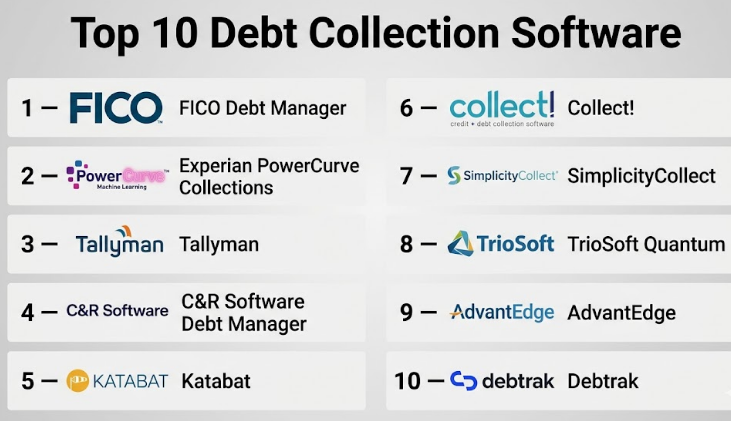
Top 10 Debt Collection Software
#1 — FICO Debt Manager
Short description :
FICO Debt Manager is a highly advanced enterprise-grade collection platform designed for banks and financial institutions. It uses analytics-driven workflows to prioritize accounts and improve recovery rates. The platform is known for its predictive modeling and decision automation. It integrates deeply with core banking systems. It is best suited for organizations handling high-value debt portfolios.
Key Features
- AI-based collection prioritization
- Workflow automation engine
- Predictive analytics dashboards
- Multi-channel communication tools
- Compliance tracking capabilities
- Portfolio segmentation tools
Pros
- Strong analytics capabilities
- Highly scalable for large institutions
Cons
- Complex implementation
- High cost for smaller businesses
Platforms / Deployment
Cloud / Hybrid
Security & Compliance
RBAC, encryption, audit logs; other details Not publicly stated
Integrations & Ecosystem
Integrates with banking systems, CRMs, and payment gateways.
- API-based integrations
- Core banking systems
- CRM platforms
- Data warehouses
Support & Community
Enterprise-grade support with onboarding services; documentation is strong but complex.
#2 — Experian PowerCurve Collections
Short description :
Experian PowerCurve Collections focuses on intelligent decisioning for collections strategies. It enables organizations to use data and analytics to optimize recovery strategies. It is widely used in financial services. The platform supports real-time decision-making and customer engagement.
Key Features
- Decision engine for collections
- Real-time analytics
- Customer segmentation
- Omnichannel engagement
- Strategy testing tools
Pros
- Data-driven approach
- Strong integration with credit data
Cons
- Requires skilled users
- Setup can be time-consuming
Platforms / Deployment
Cloud
Security & Compliance
Not publicly stated
Integrations & Ecosystem
Connects with credit bureaus, CRM systems, and internal databases.
- API integrations
- Data platforms
- Financial systems
Support & Community
Enterprise-level support; documentation varies by deployment.
#3 — Tallyman
Short description :
Tallyman is a modular debt collection platform used by financial institutions globally. It supports end-to-end collections lifecycle management. Known for flexibility and customization, it allows organizations to tailor workflows to their needs.
Key Features
- Case management tools
- Workflow customization
- Reporting dashboards
- Compliance tracking
- Multi-channel communication
Pros
- Highly customizable
- Suitable for complex workflows
Cons
- Requires configuration expertise
- UI may feel outdated
Platforms / Deployment
Cloud / On-premise
Security & Compliance
Not publicly stated
Integrations & Ecosystem
Supports integrations with enterprise systems.
- CRM tools
- ERP systems
- APIs
Support & Community
Vendor-led support; customization assistance available.
#4 — C&R Software Debt Manager
Short description :
C&R Software provides a comprehensive debt collection platform focusing on automation and analytics. It is widely used by large enterprises for managing complex portfolios. It supports global compliance requirements.
Key Features
- Automation workflows
- Advanced analytics
- Customer engagement tools
- Compliance management
- Portfolio segmentation
Pros
- Strong global capabilities
- Flexible deployment options
Cons
- Higher cost
- Requires training
Platforms / Deployment
Cloud / Hybrid
Security & Compliance
Not publicly stated
Integrations & Ecosystem
Supports enterprise integrations.
- CRM integration
- Payment systems
- Data platforms
Support & Community
Strong enterprise support and onboarding services.
#5 — Katabat
Short description :
Katabat is a cloud-based collections platform designed for digital-first collections. It focuses on customer engagement and automation. It is popular among modern financial institutions and fintechs.
Key Features
- Omnichannel communication
- AI-driven workflows
- Digital payment integration
- Customer self-service portals
- Analytics dashboards
Pros
- Modern UI and UX
- Strong automation features
Cons
- Limited legacy system support
- May require integrations for full functionality
Platforms / Deployment
Cloud
Security & Compliance
Not publicly stated
Integrations & Ecosystem
Designed for API-first integrations.
- Payment gateways
- CRM systems
- APIs
Support & Community
Good onboarding support; documentation is user-friendly.
#6 — Collect!
Short description :
Collect! is a widely used solution for small to mid-sized collection agencies. It provides essential tools for managing accounts and tracking payments. It is known for affordability and ease of use.
Key Features
- Account management
- Payment tracking
- Reporting tools
- Custom workflows
- Contact management
Pros
- Affordable
- Easy to use
Cons
- Limited advanced analytics
- Basic UI
Platforms / Deployment
Windows / Cloud
Security & Compliance
Not publicly stated
Integrations & Ecosystem
Supports basic integrations.
- Accounting tools
- Payment systems
- APIs (limited)
Support & Community
Community support available; vendor support varies.
#7 — SimplicityCollect
Short description :
SimplicityCollect is a user-friendly platform aimed at SMB collection agencies. It focuses on automation and ease of use. It supports compliance workflows and communication tracking.
Key Features
- Automated workflows
- Compliance tracking
- Communication logs
- Reporting dashboards
- Account segmentation
Pros
- Easy onboarding
- Good for SMBs
Cons
- Limited enterprise features
- Fewer integrations
Platforms / Deployment
Cloud
Security & Compliance
Not publicly stated
Integrations & Ecosystem
Basic integrations supported.
- CRM tools
- Payment systems
- APIs
Support & Community
Responsive support; limited community ecosystem.
#8 — TrioSoft Quantum
Short description :
TrioSoft Quantum is designed for collection agencies needing scalable solutions. It offers strong reporting and automation features. It supports multi-client portfolio management.
Key Features
- Multi-client management
- Automation workflows
- Reporting tools
- Payment tracking
- Compliance features
Pros
- Scalable for agencies
- Strong reporting
Cons
- UI may feel dated
- Learning curve
Platforms / Deployment
Cloud / Windows
Security & Compliance
Not publicly stated
Integrations & Ecosystem
Supports integrations with business systems.
- CRM
- Accounting tools
- APIs
Support & Community
Vendor support available; training resources provided.
#9 — AdvantEdge
Short description :
AdvantEdge is a cloud-based debt collection platform focused on automation and compliance. It provides strong reporting and workflow management capabilities. It is suitable for agencies and financial organizations.
Key Features
- Workflow automation
- Reporting dashboards
- Compliance tools
- Communication tracking
- Account management
Pros
- Cloud-native
- Good reporting capabilities
Cons
- Limited customization
- Smaller ecosystem
Platforms / Deployment
Cloud
Security & Compliance
Not publicly stated
Integrations & Ecosystem
Supports integrations via APIs.
- CRM systems
- Payment platforms
- Data tools
Support & Community
Support available; documentation varies.
#10 — Debtrak
Short description :
Debtrak is a modern collections platform focused on digital-first engagement. It offers automation and analytics for improving recovery rates. It is designed for growing businesses and agencies.
Key Features
- Automation workflows
- Analytics dashboards
- Digital communication tools
- Payment integrations
- Customer segmentation
Pros
- Modern interface
- Good automation
Cons
- Limited enterprise capabilities
- Smaller market presence
Platforms / Deployment
Cloud
Security & Compliance
Not publicly stated
Integrations & Ecosystem
API-first integration approach.
- CRM tools
- Payment gateways
- APIs
Support & Community
Support available; ecosystem still growing.
Comparison Table (Top 10)
| Tool Name | Best For | Platform(s) Supported | Deployment | Standout Feature | Public Rating |
|---|---|---|---|---|---|
| FICO Debt Manager | Enterprise banks | Web | Hybrid | Predictive analytics | N/A |
| Experian PowerCurve | Data-driven collections | Web | Cloud | Decision engine | N/A |
| Tallyman | Custom workflows | Web | Hybrid | Flexibility | N/A |
| C&R Software | Global enterprises | Web | Hybrid | Automation | N/A |
| Katabat | Digital collections | Web | Cloud | Omnichannel engagement | N/A |
| Collect! | SMB agencies | Windows/Web | Cloud | Ease of use | N/A |
| SimplicityCollect | SMB | Web | Cloud | Simplicity | N/A |
| TrioSoft Quantum | Agencies | Windows/Web | Cloud | Multi-client support | N/A |
| AdvantEdge | Compliance-focused | Web | Cloud | Reporting | N/A |
| Debtrak | Growing businesses | Web | Cloud | Automation | N/A |
Evaluation & Debt Collection Software
| Tool Name | Core (25%) | Ease (15%) | Integrations (15%) | Security (10%) | Performance (10%) | Support (10%) | Value (15%) | Weighted Total |
|---|---|---|---|---|---|---|---|---|
| FICO Debt Manager | 9 | 6 | 9 | 8 | 9 | 8 | 6 | 8.0 |
| Experian PowerCurve | 9 | 6 | 9 | 8 | 9 | 8 | 6 | 8.0 |
| Tallyman | 8 | 6 | 8 | 7 | 8 | 7 | 7 | 7.5 |
| C&R Software | 8 | 6 | 8 | 7 | 8 | 7 | 6 | 7.3 |
| Katabat | 8 | 8 | 8 | 7 | 8 | 7 | 7 | 7.8 |
| Collect! | 6 | 8 | 6 | 6 | 7 | 6 | 8 | 6.8 |
| SimplicityCollect | 6 | 8 | 6 | 6 | 7 | 6 | 7 | 6.7 |
| TrioSoft Quantum | 7 | 6 | 7 | 6 | 7 | 6 | 7 | 6.8 |
| AdvantEdge | 7 | 7 | 7 | 6 | 7 | 6 | 7 | 6.9 |
| Debtrak | 7 | 7 | 7 | 6 | 7 | 6 | 7 | 6.9 |
How to interpret scores:
These scores are comparative, not absolute. A higher score indicates stronger overall capability across weighted criteria. Enterprise tools score higher on features and scalability, while SMB tools may score better on ease of use and value. Choose based on your business size, complexity, and integration needs.
Which Debt Collection Software
Solo / Freelancer
Basic tools like Collect! are sufficient due to simplicity and low cost.
SMB
SimplicityCollect or Debtrak offer good balance between automation and usability.
Mid-Market
Katabat and AdvantEdge provide scalable automation and integrations.
Enterprise
FICO Debt Manager and Experian PowerCurve are best for large-scale operations.
Budget vs Premium
Budget tools focus on essential features; premium tools offer analytics and AI.
Feature Depth vs Ease of Use
Advanced tools provide flexibility but require training; simpler tools are easier but limited.
Integrations & Scalability
Choose API-driven platforms if integrating with multiple systems.
Security & Compliance Needs
Enterprises should prioritize compliance-ready platforms.
Frequently Asked Questions (FAQs)
1. What is debt collection software?
It is a system used to manage overdue payments, automate follow-ups, and track collections efficiently.
2. How much does it cost?
Pricing varies widely based on features, users, and deployment model.
3. Is it suitable for small businesses?
Yes, but only basic tools may be needed for small operations.
4. Can it integrate with CRM systems?
Most modern platforms support CRM integrations.
5. Is it secure?
Security depends on vendor capabilities; many offer encryption and access controls.
6. How long does implementation take?
It can range from a few days to several months depending on complexity.
7. What are common mistakes?
Choosing overly complex tools or ignoring integration requirements.
8. Can it automate communication?
Yes, most platforms support automated emails, SMS, and notifications.
9. Is training required?
Yes, especially for enterprise-level tools.
10. Can I switch platforms easily?
Migration is possible but requires planning and data mapping.
Conclusion
Debt Collection Software has evolved from simple tracking systems into intelligent platforms that combine automation, analytics, and compliance. The right tool depends heavily on your organization’s size, industry, and operational complexity. Enterprises may require advanced AI-driven platforms like FICO or Experian, while smaller agencies can benefit from simpler, cost-effective solutions.
