Introduction
AI Agent Platforms are systems that allow developers and organizations to build, deploy, and manage intelligent agents capable of performing tasks autonomously. These agents can reason, plan, execute workflows, interact with APIs, and adapt based on context—moving beyond simple chatbots into full automation engines.
In the current landscape, AI agents are becoming central to automation strategies. Businesses are shifting from static workflows to dynamic, AI-driven processes that can handle customer support, internal operations, DevOps tasks, and data analysis with minimal human intervention.
Real-world use cases include:
- Automating customer support workflows
- Managing IT operations and DevOps tasks
- Executing multi-step business processes
- Data extraction and analysis
- Personal AI assistants for productivity
What buyers should evaluate:
- Agent reasoning and planning capabilities
- Workflow orchestration features
- Integration with APIs and tools
- Security and data handling
- Customization and extensibility
- Deployment flexibility
- Performance and scalability
- Monitoring and observability
- Cost and pricing model
Best for: Developers, AI engineers, startups, enterprise automation teams, and organizations aiming to build intelligent workflows and reduce manual operations.
Not ideal for: Small teams with simple automation needs, non-technical users without developer support, or businesses that only need rule-based automation tools.
Key Trends in AI Agent Platforms
- Autonomous multi-step workflows: Agents can execute entire processes end-to-end
- Tool-augmented intelligence: Integration with APIs, databases, and SaaS tools
- Memory and context persistence: Agents retain knowledge across sessions
- Hybrid AI models: Combining LLMs with rule-based systems
- Enterprise governance: Increasing focus on auditability and compliance
- Agent orchestration frameworks: Managing multiple agents working together
- Low-code/no-code layers: Expanding accessibility beyond developers
- On-prem deployment demand: For privacy-sensitive industries
- Usage-based pricing models: Pay per task or token usage
- Observability tools: Monitoring agent behavior and performance
How We Selected These Tools (Methodology)
- Considered tools with strong industry adoption and developer interest
- Evaluated support for autonomous agent workflows and orchestration
- Assessed integration capabilities with external systems and APIs
- Reviewed performance and scalability signals
- Considered enterprise readiness including security and governance
- Included both developer-first frameworks and enterprise platforms
- Prioritized tools with active ecosystems and ongoing innovation
- Ensured coverage across different user segments and use cases
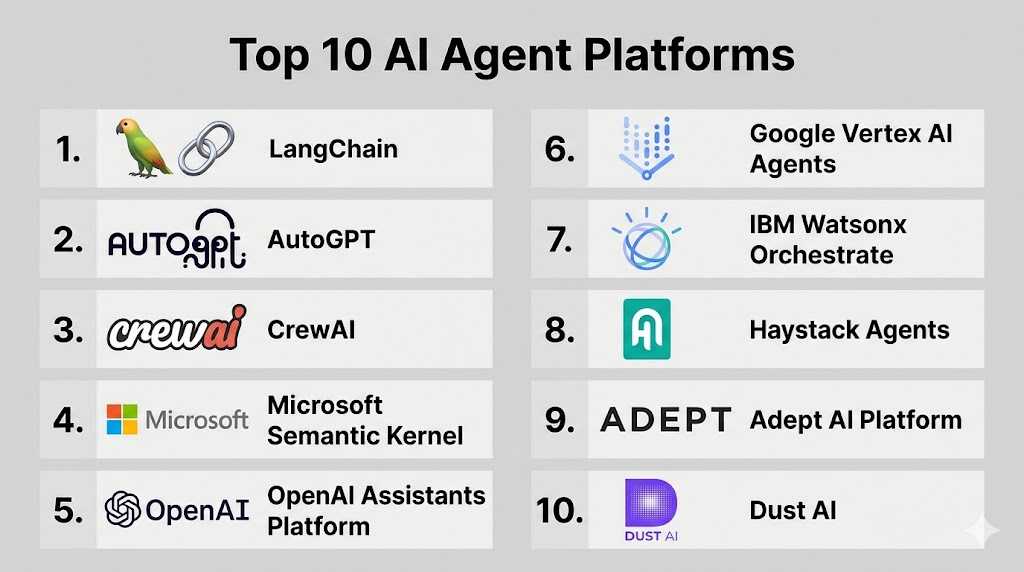
Top 10 AI Agent Platforms
#1 — LangChain
Short description: A leading framework for building AI agents and applications, widely used by developers for creating complex workflows.
Key Features
- Agent orchestration
- Memory management
- Tool integration
- Prompt templates
- Multi-step reasoning
- Modular architecture
Pros
- Highly flexible
- Large ecosystem
Cons
- Steep learning curve
- Requires development effort
Platforms / Deployment
Windows / macOS / Linux
Cloud / Self-hosted
Security & Compliance
Not publicly stated
Integrations & Ecosystem
Strong ecosystem for building AI applications.
- APIs
- Databases
- Vector stores
- Cloud services
Support & Community
Very active community and extensive documentation.
#2 — AutoGPT
Short description: Open-source autonomous agent platform designed for experimental and research-driven automation tasks.
Key Features
- Autonomous task execution
- Goal-based workflows
- Multi-step reasoning
- Plugin support
- Memory system
Pros
- Fully autonomous workflows
- Open-source flexibility
Cons
- Unpredictable outputs
- High resource usage
Platforms / Deployment
Windows / macOS / Linux
Self-hosted
Security & Compliance
Not publicly stated
Integrations & Ecosystem
Focused on extensibility through plugins.
- APIs
- External tools
Support & Community
Active open-source community.
#3 — CrewAI
Short description: Multi-agent collaboration framework designed to coordinate teams of AI agents working together.
Key Features
- Multi-agent orchestration
- Role-based agents
- Task delegation
- Workflow automation
- Collaboration logic
Pros
- Strong multi-agent support
- Flexible workflows
Cons
- Requires configuration
- Limited enterprise tooling
Platforms / Deployment
Windows / macOS / Linux
Cloud / Self-hosted
Security & Compliance
Not publicly stated
Integrations & Ecosystem
Supports integration with development tools.
- APIs
- Databases
Support & Community
Growing developer community.
#4 — Microsoft Semantic Kernel
Short description: Enterprise-focused framework for building AI agents and integrating them into business applications.
Key Features
- Plugin architecture
- AI orchestration
- Memory management
- Multi-language SDKs
- Enterprise integration
Pros
- Strong enterprise support
- Scalable architecture
Cons
- Requires technical expertise
- Complex setup
Platforms / Deployment
Windows / Linux
Cloud / Hybrid
Security & Compliance
Supports enterprise identity systems; other details not publicly stated
Integrations & Ecosystem
Deep integration with enterprise tools.
- Azure services
- APIs
- Databases
Support & Community
Backed by strong enterprise ecosystem.
#5 — OpenAI Assistants Platform
Short description: Platform for building AI agents with built-in tools, memory, and API integration.
Key Features
- Tool calling
- Memory persistence
- Multi-modal capabilities
- API integration
- Scalable infrastructure
Pros
- Easy to start
- Powerful capabilities
Cons
- Vendor dependency
- Limited customization
Platforms / Deployment
Cloud
Security & Compliance
Not publicly stated
Integrations & Ecosystem
Designed for flexible integrations.
- APIs
- Developer platforms
Support & Community
Large global developer community.
#6 — Google Vertex AI Agents
Short description: Enterprise-grade AI agent platform integrated into Google Cloud ecosystem.
Key Features
- Managed AI services
- Agent orchestration
- Integration with cloud tools
- Scalable infrastructure
- Data processing capabilities
Pros
- Strong scalability
- Enterprise-ready
Cons
- Cloud dependency
- Cost complexity
Platforms / Deployment
Cloud
Security & Compliance
Supports enterprise cloud security; details vary
Integrations & Ecosystem
Deep integration with cloud ecosystem.
- Google Cloud services
- APIs
- Data tools
Support & Community
Enterprise-level support available.
#7 — IBM Watsonx Orchestrate
Short description: AI agent platform focused on enterprise automation and business workflows.
Key Features
- Workflow automation
- AI assistants
- Business process integration
- Data handling
- Enterprise tools
Pros
- Strong enterprise focus
- Business-friendly features
Cons
- Complex implementation
- Higher cost
Platforms / Deployment
Cloud / Hybrid
Security & Compliance
Enterprise-grade security; details not publicly stated
Integrations & Ecosystem
Designed for enterprise workflows.
- Business apps
- APIs
- Data systems
Support & Community
Enterprise support with structured onboarding.
#8 — Haystack Agents
Short description: Open-source framework for building search-based and task-driven AI agents.
Key Features
- NLP pipelines
- Agent workflows
- Document processing
- Integration with models
- Modular architecture
Pros
- Open-source flexibility
- Strong search capabilities
Cons
- Requires setup
- Limited enterprise features
Platforms / Deployment
Windows / macOS / Linux
Self-hosted
Security & Compliance
Not publicly stated
Integrations & Ecosystem
Focused on NLP and search workflows.
- APIs
- Databases
Support & Community
Active open-source community.
#9 — Adept AI Platform
Short description: AI agent platform designed for automating tasks across software tools and interfaces.
Key Features
- Task automation
- UI interaction
- Multi-step workflows
- Learning from user actions
- Cross-platform automation
Pros
- Strong automation focus
- Unique UI interaction capability
Cons
- Limited public availability
- Evolving feature set
Platforms / Deployment
Varies / N/A
Security & Compliance
Not publicly stated
Integrations & Ecosystem
Focused on automation across tools.
- Applications
- APIs
Support & Community
Not publicly stated
#10 — Dust AI
Short description: Platform for building internal AI agents tailored for company workflows and knowledge systems.
Key Features
- Internal agent creation
- Knowledge integration
- Workflow automation
- Collaboration tools
- Customization
Pros
- Strong internal use cases
- Easy customization
Cons
- Limited public documentation
- Smaller ecosystem
Platforms / Deployment
Cloud
Security & Compliance
Not publicly stated
Integrations & Ecosystem
Focused on internal tools and workflows.
- SaaS tools
- APIs
Support & Community
Growing but limited community.
Comparison Table (Top 10)
| Tool Name | Best For | Platform(s) Supported | Deployment | Standout Feature | Public Rating |
|---|---|---|---|---|---|
| LangChain | Developers | Windows, macOS, Linux | Hybrid | Agent orchestration | N/A |
| AutoGPT | Experimentation | Windows, macOS, Linux | Self-hosted | Autonomous agents | N/A |
| CrewAI | Multi-agent systems | Windows, macOS, Linux | Hybrid | Role-based agents | N/A |
| Microsoft Semantic Kernel | Enterprises | Windows, Linux | Hybrid | Enterprise AI integration | N/A |
| OpenAI Assistants Platform | Developers | Cloud | Cloud | Built-in tools | N/A |
| Google Vertex AI Agents | Enterprises | Cloud | Cloud | Cloud-native scaling | N/A |
| IBM Watsonx Orchestrate | Business automation | Cloud | Hybrid | Workflow automation | N/A |
| Haystack Agents | NLP workflows | Windows, macOS, Linux | Self-hosted | Search pipelines | N/A |
| Adept AI Platform | Automation | Varies | Varies | UI automation | N/A |
| Dust AI | Internal tools | Cloud | Cloud | Internal agents | N/A |
Evaluation & Scoring of AI Agent Platforms
| Tool Name | Core | Ease | Integrations | Security | Performance | Support | Value | Weighted Total |
|---|---|---|---|---|---|---|---|---|
| LangChain | 9 | 7 | 9 | 7 | 8 | 9 | 8 | 8.3 |
| AutoGPT | 8 | 6 | 7 | 6 | 7 | 7 | 7 | 7.1 |
| CrewAI | 8 | 7 | 7 | 6 | 7 | 7 | 7 | 7.2 |
| Microsoft Semantic Kernel | 9 | 7 | 9 | 8 | 8 | 8 | 7 | 8.2 |
| OpenAI Assistants Platform | 9 | 8 | 8 | 7 | 9 | 8 | 7 | 8.3 |
| Google Vertex AI Agents | 9 | 7 | 9 | 8 | 9 | 8 | 6 | 8.2 |
| IBM Watsonx Orchestrate | 8 | 6 | 8 | 8 | 8 | 8 | 6 | 7.6 |
| Haystack Agents | 7 | 6 | 7 | 6 | 7 | 7 | 7 | 6.9 |
| Adept AI Platform | 7 | 6 | 6 | 6 | 7 | 6 | 6 | 6.5 |
| Dust AI | 7 | 7 | 7 | 6 | 7 | 6 | 7 | 6.9 |
How to interpret scores:
- Scores compare tools relative to each other, not absolute performance
- Higher scores indicate better overall balance across criteria
- Enterprise users should focus on security and integrations
- Smaller teams may prioritize ease of use and value
- Always validate based on real-world testing
Which AI Agent Platformsfor You?
Solo / Freelancer
- Best options: OpenAI Assistants Platform, Code-first tools
- Focus on ease of use and quick deployment
SMB
- Best options: LangChain, CrewAI
- Balance flexibility with cost
Mid-Market
- Best options: Microsoft Semantic Kernel, Dust AI
- Require scalability and integrations
Enterprise
- Best options: Google Vertex AI Agents, IBM Watsonx Orchestrate
- Focus on governance, security, and reliability
Budget vs Premium
- Budget: Open-source tools like AutoGPT, Haystack
- Premium: Vertex AI, Watsonx
Feature Depth vs Ease of Use
- Deep features: LangChain, Semantic Kernel
- Easy use: OpenAI Assistants
Integrations & Scalability
- Strong: Vertex AI, Semantic Kernel
Security & Compliance Needs
- Best: Enterprise cloud platforms
Frequently Asked Questions (FAQs)
What is an AI agent platform?
It is a system that allows you to build autonomous AI agents that can perform tasks, make decisions, and interact with tools.
Are AI agents fully autonomous?
They can automate many tasks but still require monitoring and human oversight.
Do these platforms require coding?
Most require some technical knowledge, though low-code options are emerging.
Are they secure?
Security varies by platform. Enterprises should review compliance and data handling policies.
What industries use AI agents?
Technology, finance, healthcare, e-commerce, and customer support industries use them widely.
How scalable are these platforms?
Most cloud-based platforms scale well, while open-source tools depend on infrastructure.
Can AI agents integrate with existing systems?
Yes, most platforms support APIs and integrations with business tools.
What are common mistakes?
Over-automation, lack of monitoring, and poor data quality.
Are there free options?
Yes, some open-source tools are available.
How do I choose the best platform?
Evaluate based on your use case, budget, integrations, and technical capability.
Conclusion
AI Agent Platforms are rapidly becoming a core part of modern automation strategies. They enable organizations to move from manual processes to intelligent, autonomous workflows that can adapt and scale. However, not every platform fits every use case. If you are a developer or startup, tools like LangChain or OpenAI Assistants Platform provide flexibility and fast experimentation. For enterprises, platforms like Google Vertex AI or IBM Watsonx offer stronger governance and scalability.
