Introduction
Text Analytics Platforms are software tools that help organizations extract meaningful insights from unstructured text data such as emails, customer reviews, social media posts, support tickets, and documents. Instead of manually reading thousands of texts, these platforms use natural language processing (NLP), machine learning, and AI to identify patterns, sentiments, topics, and key entities.
In the current landscape, where businesses generate massive volumes of textual data daily, text analytics has become critical. Organizations rely on it for faster decision-making, improved customer experience, and operational efficiency.
Real-world use cases include:
- Customer sentiment analysis from reviews and feedback
- Automated support ticket categorization and routing
- Social media monitoring and brand analysis
- Risk detection in financial or compliance documents
- Knowledge extraction from internal documents
What buyers should evaluate:
- NLP and AI capabilities (accuracy, language support)
- Ease of use and learning curve
- Integration with existing systems
- Scalability and performance
- Security and compliance features
- Customization and model training options
- Pricing and total cost of ownership
- Deployment flexibility (cloud vs on-prem)
- Real-time vs batch processing capabilities
Best for: IT teams, data analysts, marketers, customer experience teams, and enterprises dealing with high volumes of text data across industries like finance, healthcare, e-commerce, and SaaS.
Not ideal for: Very small teams with minimal text data or organizations that only need basic keyword search instead of advanced analytics.
Key Trends in Text Analytics Platforms
- Increased adoption of Generative AI for summarization and contextual insights
- Growth of real-time text analytics for customer interaction monitoring
- Expansion of multilingual NLP capabilities for global operations
- Integration with data lakes and analytics ecosystems
- Focus on explainable AI models for compliance-heavy industries
- Rise of low-code/no-code analytics platforms
- Enhanced data privacy and governance features
- Increased use of domain-specific NLP models (healthcare, legal, finance)
- Hybrid deployments combining cloud and on-premise models
- Shift toward API-first architectures for better extensibility
How We Selected These Tools (Methodology)
- Evaluated market adoption and enterprise usage trends
- Assessed feature completeness, including NLP depth and AI capabilities
- Reviewed performance indicators such as scalability and latency
- Considered security posture based on publicly available standards
- Examined integration capabilities with modern tech stacks
- Looked at ease of onboarding and usability
- Evaluated support ecosystems and documentation quality
- Ensured coverage across different user segments (SMB to enterprise)
- Considered flexibility in deployment models
- Focused on tools relevant to modern data-driven organizations
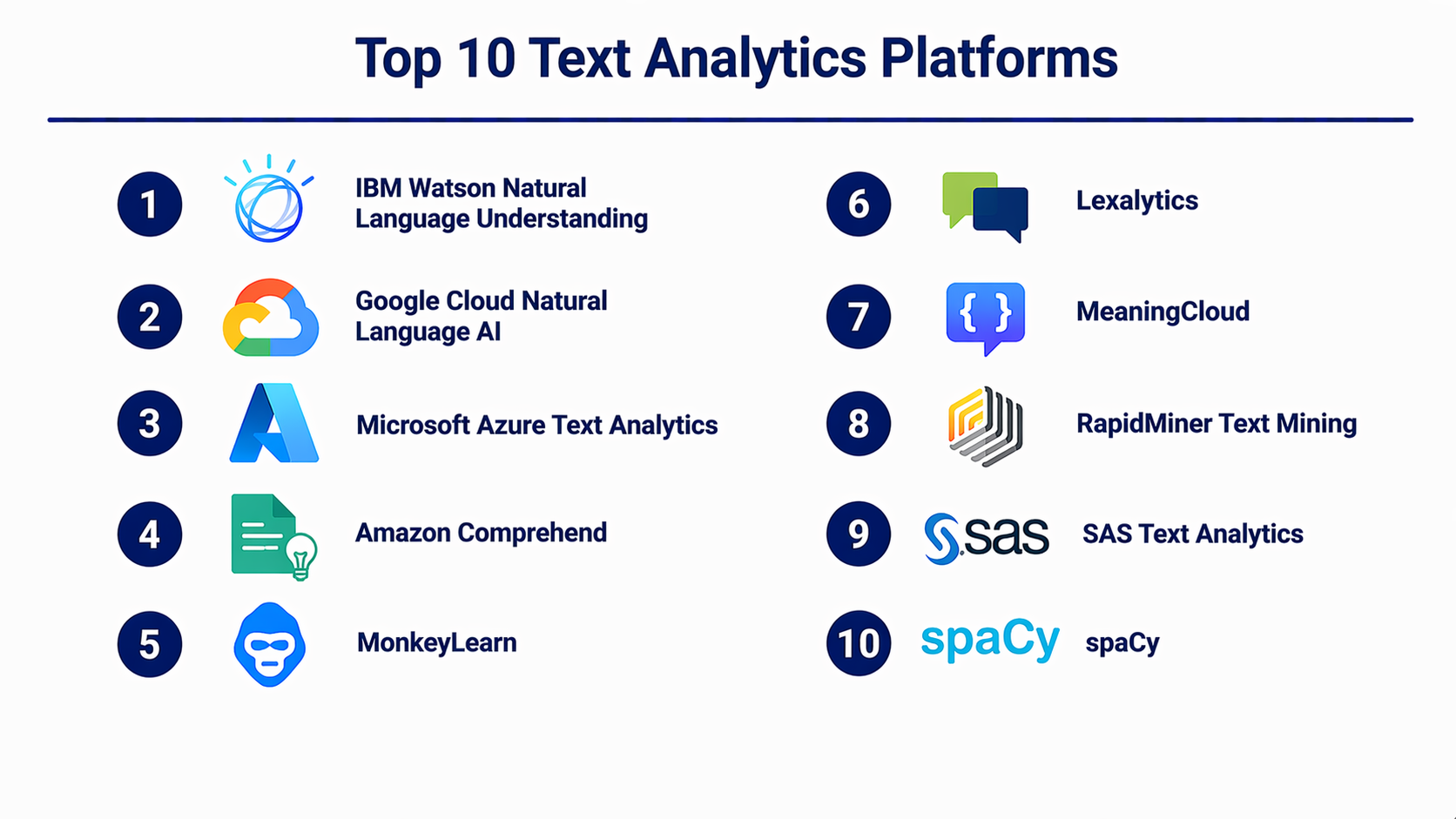
Top 10 Text Analytics Platforms
#1 — IBM Watson Natural Language Understanding
Short description: Enterprise-grade NLP platform for extracting insights from text, widely used in large-scale analytics and AI applications.
Key Features
- Sentiment and emotion analysis
- Entity and keyword extraction
- Category classification
- Custom model training
- Multilingual support
- API-based integration
- Deep AI model capabilities
Pros
- Strong enterprise-grade NLP capabilities
- Highly customizable models
Cons
- Steeper learning curve
- Pricing can be complex
Platforms / Deployment
Cloud
Security & Compliance
Encryption, access controls; other certifications: Not publicly stated
Integrations & Ecosystem
Integrates with cloud services, APIs, and enterprise systems.
- REST APIs
- Data pipelines
- Cloud platforms
Support & Community
Strong enterprise support and documentation; community moderate.
#2 — Google Cloud Natural Language AI
Short description: Scalable NLP platform designed for developers and enterprises to analyze text using Google’s AI infrastructure.
Key Features
- Syntax and sentiment analysis
- Entity recognition
- Content classification
- AutoML customization
- Multilingual processing
- High scalability
Pros
- Easy integration with Google ecosystem
- Highly scalable
Cons
- Requires cloud familiarity
- Limited offline deployment
Platforms / Deployment
Cloud
Security & Compliance
Encryption, IAM controls; certifications: Not publicly stated
Integrations & Ecosystem
Strong integration within Google Cloud ecosystem.
- BigQuery
- Cloud Storage
- APIs
Support & Community
Strong documentation and community support.
#3 — Microsoft Azure Text Analytics
Short description: NLP service within Azure that provides text analytics and language understanding capabilities.
Key Features
- Sentiment analysis
- Key phrase extraction
- Named entity recognition
- Language detection
- Custom NLP models
- Integration with Azure services
Pros
- Seamless Azure integration
- Enterprise-ready
Cons
- Limited flexibility outside Azure
- Requires Azure ecosystem knowledge
Platforms / Deployment
Cloud
Security & Compliance
Azure security standards; certifications: Not publicly stated
Integrations & Ecosystem
Deep integration with Microsoft ecosystem.
- Power BI
- Azure Data Factory
- APIs
Support & Community
Strong enterprise support and documentation.
#4 — Amazon Comprehend
Short description: AWS NLP service for analyzing text data at scale using machine learning.
Key Features
- Entity recognition
- Sentiment analysis
- Topic modeling
- Custom classification
- Real-time processing
- Multilingual support
Pros
- Scalable and reliable
- Strong AWS ecosystem
Cons
- AWS dependency
- Pricing complexity
Platforms / Deployment
Cloud
Security & Compliance
AWS security controls; certifications: Not publicly stated
Integrations & Ecosystem
Works well within AWS stack.
- S3
- Lambda
- API Gateway
Support & Community
Extensive documentation and support tiers.
#5 — MonkeyLearn
Short description: User-friendly text analytics platform focused on business users and no-code workflows.
Key Features
- Text classification
- Sentiment analysis
- Custom workflows
- Data visualization
- API access
- No-code interface
Pros
- Easy to use
- Quick setup
Cons
- Limited advanced AI features
- Less scalable for enterprise
Platforms / Deployment
Cloud
Security & Compliance
Not publicly stated
Integrations & Ecosystem
Connects with business tools.
- Zapier
- APIs
- Data tools
Support & Community
Good documentation; moderate community.
#6 — Lexalytics
Short description: Advanced text analytics platform focused on sentiment and semantic analysis.
Key Features
- Deep linguistic processing
- Sentiment and intent analysis
- Custom taxonomy
- Multi-language support
- On-premise options
Pros
- Strong NLP accuracy
- Flexible deployment
Cons
- Complex setup
- Requires expertise
Platforms / Deployment
Cloud / Self-hosted
Security & Compliance
Not publicly stated
Integrations & Ecosystem
API-driven integrations.
- Enterprise systems
- Data platforms
Support & Community
Enterprise support; smaller community.
#7 — MeaningCloud
Short description: Cloud-based text analytics solution for classification and extraction tasks.
Key Features
- Text classification
- Sentiment analysis
- Topic extraction
- Language detection
- Custom models
Pros
- Affordable pricing
- Good multilingual support
Cons
- Limited enterprise scalability
- UI improvements needed
Platforms / Deployment
Cloud
Security & Compliance
Not publicly stated
Integrations & Ecosystem
API-based integration model.
- REST APIs
- Data pipelines
Support & Community
Moderate support and documentation.
#8 — RapidMiner Text Mining
Short description: Data science platform with built-in text mining capabilities for advanced analytics workflows.
Key Features
- Text preprocessing
- Topic modeling
- NLP workflows
- Integration with ML pipelines
- Visual interface
Pros
- Strong analytics capabilities
- Visual workflow design
Cons
- Requires learning curve
- Heavy for simple use cases
Platforms / Deployment
Cloud / Desktop
Security & Compliance
Not publicly stated
Integrations & Ecosystem
Integrates with analytics tools.
- Data connectors
- APIs
Support & Community
Strong community and documentation.
#9 — SAS Text Analytics
Short description: Enterprise analytics platform offering advanced text mining and NLP features.
Key Features
- Entity extraction
- Topic detection
- Sentiment analysis
- Predictive analytics integration
- Visualization tools
Pros
- Enterprise-grade capabilities
- Strong analytics depth
Cons
- Expensive
- Complex setup
Platforms / Deployment
Cloud / On-premise
Security & Compliance
Enterprise security controls; details not publicly stated
Integrations & Ecosystem
Integrates with SAS ecosystem and enterprise systems.
- BI tools
- Data warehouses
Support & Community
Strong enterprise support.
#10 — spaCy
Short description: Developer-focused open-source NLP library for building custom text analytics solutions.
Key Features
- High-performance NLP pipeline
- Named entity recognition
- Tokenization and parsing
- Custom model training
- Open-source flexibility
Pros
- Highly customizable
- Free and open-source
Cons
- Requires coding expertise
- No built-in UI
Platforms / Deployment
Windows / macOS / Linux
Security & Compliance
Varies / N/A
Integrations & Ecosystem
Integrates with Python ecosystem.
- ML frameworks
- APIs
- Data tools
Support & Community
Strong open-source community.
Comparison Table (Top 10)
| Tool Name | Best For | Platform(s) Supported | Deployment | Standout Feature | Public Rating |
|---|---|---|---|---|---|
| IBM Watson NLU | Enterprise NLP | Web | Cloud | Advanced AI models | N/A |
| Google NLP | Developers & enterprises | Web | Cloud | Scalability | N/A |
| Azure Text Analytics | Microsoft ecosystem users | Web | Cloud | Azure integration | N/A |
| Amazon Comprehend | AWS users | Web | Cloud | Real-time NLP | N/A |
| MonkeyLearn | SMBs | Web | Cloud | No-code workflows | N/A |
| Lexalytics | Custom NLP solutions | Web | Hybrid | Deep linguistic analysis | N/A |
| MeaningCloud | Budget users | Web | Cloud | Multilingual support | N/A |
| RapidMiner | Data scientists | Desktop/Web | Hybrid | Visual workflows | N/A |
| SAS Text Analytics | Enterprises | Web | Hybrid | Predictive analytics integration | N/A |
| spaCy | Developers | Desktop | Self-hosted | Open-source NLP | N/A |
Evaluation & Scoring of Text Analytics Platforms
| Tool Name | Core (25%) | Ease (15%) | Integrations (15%) | Security (10%) | Performance (10%) | Support (10%) | Value (15%) | Weighted Total |
|---|---|---|---|---|---|---|---|---|
| IBM Watson | 9 | 7 | 8 | 8 | 9 | 8 | 7 | 8.2 |
| Google NLP | 9 | 8 | 9 | 8 | 9 | 8 | 7 | 8.5 |
| Azure Text | 9 | 8 | 9 | 9 | 8 | 8 | 7 | 8.6 |
| Amazon Comprehend | 9 | 8 | 9 | 8 | 9 | 8 | 7 | 8.5 |
| MonkeyLearn | 7 | 9 | 7 | 6 | 7 | 7 | 8 | 7.5 |
| Lexalytics | 8 | 6 | 7 | 7 | 8 | 7 | 7 | 7.4 |
| MeaningCloud | 7 | 8 | 7 | 6 | 7 | 6 | 8 | 7.2 |
| RapidMiner | 8 | 7 | 8 | 7 | 8 | 8 | 7 | 7.8 |
| SAS Text | 9 | 6 | 8 | 9 | 9 | 9 | 6 | 8.3 |
| spaCy | 8 | 6 | 8 | 6 | 8 | 8 | 9 | 7.8 |
How to interpret scores:
- Scores are comparative across tools, not absolute ratings
- Higher score indicates better overall fit for enterprise-grade use
- Weighting prioritizes core features and value
- Tools with lower ease scores may still be powerful for experts
- Choose based on your specific use case, not just total score
Which Text Analytics Platforms for You?
Solo / Freelancer
Choose MonkeyLearn or spaCy. They are simple or flexible without heavy enterprise overhead.
SMB
MonkeyLearn and MeaningCloud are ideal due to ease of use and affordability.
Mid-Market
RapidMiner and Lexalytics provide balance between features and flexibility.
Enterprise
IBM Watson, Azure Text Analytics, and SAS Text Analytics are strong choices.
Budget vs Premium
- Budget: MeaningCloud, spaCy
- Premium: IBM Watson, SAS, Azure
Feature Depth vs Ease of Use
- Easy: MonkeyLearn
- Deep features: IBM Watson, Lexalytics
Integrations & Scalability
- Best integrations: Google NLP, AWS Comprehend
- Best scalability: Azure, AWS
Security & Compliance Needs
- Strongest: Azure, SAS, IBM
- Basic: SMB-focused tools
Frequently Asked Questions (FAQs)
What is a Text Analytics Platform?
A tool that processes and analyzes text data to extract insights like sentiment, entities, and topics.
How much do these platforms cost?
Pricing varies widely. Most follow usage-based or subscription models.
Are these tools easy to use?
Some are no-code, while others require technical expertise.
Can they handle multiple languages?
Yes, many support multilingual text processing.
Do I need coding skills?
Depends on the tool. spaCy requires coding, while MonkeyLearn does not.
How secure are these platforms?
Enterprise tools offer strong security; others may have basic protections.
Can I integrate with existing systems?
Most platforms provide APIs and integrations.
What industries use text analytics?
Finance, healthcare, retail, SaaS, and marketing.
How long does implementation take?
From a few hours (simple tools) to several weeks (enterprise solutions).
What are alternatives?
Basic search tools or manual analysis, though less efficient.
Conclusion
Text analytics platforms have become essential for organizations aiming to extract actionable insights from unstructured data. Whether you are analyzing customer sentiment, automating workflows, or uncovering hidden trends, the right platform can significantly improve efficiency and decision-making. There is no single “best” solution for everyone. Enterprises may benefit from robust platforms like IBM Watson or Azure Text Analytics, while smaller teams might prefer simpler tools like MonkeyLearn or open-source solutions like spaCy. The key is to align the platform with your technical capabilities, data volume, and business goals.
