Introduction
Speech Recognition Platforms convert spoken language into text and actionable insights using AI. In simple terms, they allow machines to understand human speech—whether it’s a customer call, a voice command, or a meeting recording.
This technology has become essential in modern digital systems. With the rise of voice assistants, remote work, call automation, and AI-driven analytics, speech recognition is now a core capability rather than a niche feature. platforms are combining speech-to-text with natural language understanding, real-time analytics, and multilingual capabilities.
Real-world use cases include:
- Customer support call transcription and sentiment analysis
- Voice assistants and chatbots
- Meeting transcription and productivity tools
- Healthcare dictation and clinical documentation
- Voice-enabled applications and IoT systems
What buyers should evaluate:
- Accuracy across languages and accents
- Real-time vs batch processing capability
- Custom vocabulary and domain adaptation
- Latency and performance
- API and SDK availability
- Integration with existing systems
- Security and compliance features
- Pricing and scalability
- Speaker recognition and diarization
- Multilingual support
Best for: Developers, product teams, call centers, healthcare providers, enterprises building AI-driven voice systems, and startups creating voice-enabled apps.
Not ideal for: Businesses without voice data workflows or those needing simple transcription—basic tools may suffice instead of full platforms.
Key Trends in Speech Recognition Platforms
- AI-powered transcription accuracy improvements using deep learning models
- Real-time streaming transcription for live applications
- Multilingual and accent-aware models for global usage
- Integration with generative AI for summarization and insights
- Voice biometrics and speaker identification
- Edge speech processing for low-latency environments
- Privacy-first and on-device processing
- Low-code/no-code voice workflow builders
- Unified conversational AI platforms combining speech + NLP
- Usage-based pricing models with flexible scaling
How We Selected These Tools (Methodology)
- Evaluated market adoption and developer popularity
- Assessed accuracy and speech model quality signals
- Compared real-time vs batch processing capabilities
- Reviewed security and compliance posture (where known)
- Analyzed integration capabilities and APIs
- Included tools across enterprise, SMB, and developer-first segments
- Considered deployment flexibility (cloud, edge, hybrid)
- Looked at ecosystem maturity and documentation quality
- Balanced innovation, usability, and reliability
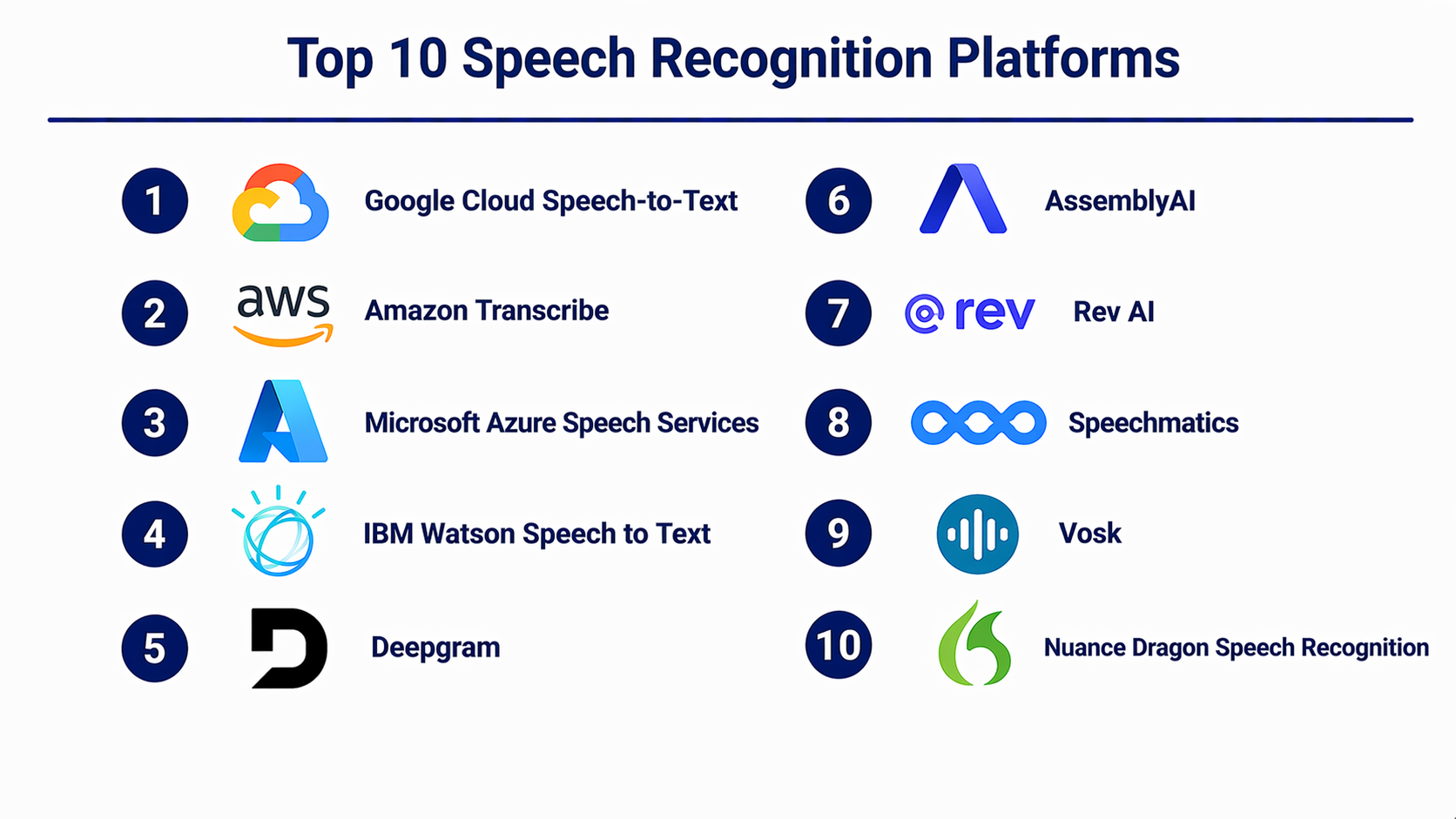
Top 10 Speech Recognition Platforms
#1 — Google Cloud Speech-to-Text
Short description: A powerful cloud-based speech recognition service offering real-time and batch transcription, widely used by developers and enterprises.
Key Features
- Real-time streaming transcription
- Automatic punctuation and formatting
- Speaker diarization
- Multi-language support
- Custom vocabulary support
- Integration with AI tools
Pros
- High accuracy across languages
- Easy API integration
Cons
- Pricing can increase with scale
- Requires cloud dependency
Platforms / Deployment
Cloud
Security & Compliance
Encryption, IAM, GDPR support (varies by setup)
Integrations & Ecosystem
Strong integration with Google Cloud ecosystem
- BigQuery
- Vertex AI
- Cloud Functions
Support & Community
Extensive documentation and strong enterprise support
#2 — Amazon Transcribe
Short description: AWS-powered speech-to-text service designed for real-time transcription and analytics.
Key Features
- Real-time and batch transcription
- Speaker identification
- Custom vocabularies
- Call analytics features
- Multi-language support
Pros
- Scalable and reliable
- Deep AWS integration
Cons
- Pricing complexity
- Requires AWS knowledge
Platforms / Deployment
Cloud
Security & Compliance
IAM, encryption, compliance varies
Integrations & Ecosystem
- S3
- Lambda
- Contact center tools
Support & Community
Strong enterprise support and documentation
#3 — Microsoft Azure Speech Services
Short description: A comprehensive speech platform with transcription, translation, and voice AI capabilities.
Key Features
- Speech-to-text and text-to-speech
- Real-time transcription
- Language translation
- Custom speech models
- Voice recognition
Pros
- Enterprise-ready features
- Strong integration with Azure ecosystem
Cons
- Complex setup
- Pricing tiers can be confusing
Platforms / Deployment
Cloud
Security & Compliance
RBAC, encryption, compliance varies
Integrations & Ecosystem
- Azure AI
- Power Platform
- APIs
Support & Community
Good enterprise documentation
#4 — IBM Watson Speech to Text
Short description: Enterprise-grade speech recognition platform focused on customization and domain-specific models.
Key Features
- Custom acoustic models
- Real-time transcription
- Speaker labeling
- Language support
- API access
Pros
- Strong customization capabilities
- Enterprise reliability
Cons
- Smaller ecosystem
- Limited recent innovation
Platforms / Deployment
Cloud
Security & Compliance
Enterprise-grade controls (varies)
Integrations & Ecosystem
- IBM Cloud
- Watson AI tools
Support & Community
Enterprise support available
#5 — Deepgram
Short description: A developer-first speech recognition platform known for high accuracy and fast performance.
Key Features
- Real-time and batch transcription
- AI-based model optimization
- Custom training capabilities
- Low-latency processing
- Multilingual support
Pros
- High performance
- Developer-friendly APIs
Cons
- Requires technical expertise
- Pricing varies
Platforms / Deployment
Cloud
Security & Compliance
Not publicly stated
Integrations & Ecosystem
- APIs
- SDKs
- Streaming pipelines
Support & Community
Active developer community
#6 — AssemblyAI
Short description: A modern API-first platform for speech recognition and audio intelligence.
Key Features
- Speech-to-text API
- Audio intelligence features (sentiment, summarization)
- Real-time transcription
- Speaker detection
- Custom workflows
Pros
- Easy to use APIs
- Strong AI features
Cons
- Limited enterprise controls
- Pricing varies
Platforms / Deployment
Cloud
Security & Compliance
Not publicly stated
Integrations & Ecosystem
- APIs
- Webhooks
- AI pipelines
Support & Community
Good documentation and support
#7 — Rev AI
Short description: A speech recognition platform offering both automated and human transcription services.
Key Features
- Speech-to-text API
- Human transcription option
- Real-time streaming
- Language support
- High accuracy
Pros
- Flexible transcription options
- High accuracy with human fallback
Cons
- Higher cost for human services
- Limited advanced AI features
Platforms / Deployment
Cloud
Security & Compliance
Not publicly stated
Integrations & Ecosystem
- APIs
- Media tools
Support & Community
Moderate support and documentation
#8 — Speechmatics
Short description: A speech recognition platform focused on global language support and enterprise applications.
Key Features
- Multi-language support
- Real-time transcription
- Speaker identification
- Customization options
- On-premise deployment support
Pros
- Strong multilingual support
- Flexible deployment
Cons
- Less developer-friendly
- Limited ecosystem
Platforms / Deployment
Cloud / On-premise
Security & Compliance
Not publicly stated
Integrations & Ecosystem
- APIs
- Enterprise systems
Support & Community
Enterprise-focused support
#9 — Vosk
Short description: An open-source speech recognition toolkit designed for offline and embedded use cases.
Key Features
- Offline speech recognition
- Lightweight models
- Multi-language support
- Integration with Python and C++
- Edge device compatibility
Pros
- Free and open-source
- Works offline
Cons
- Lower accuracy vs cloud tools
- Requires technical setup
Platforms / Deployment
Windows / Linux / macOS / Android
Security & Compliance
Not publicly stated
Integrations & Ecosystem
- Python
- Embedded systems
Support & Community
Open-source community support
#10 — Nuance Dragon Speech Recognition
Short description: A widely used speech recognition solution for professional and enterprise use, especially in healthcare.
Key Features
- High-accuracy dictation
- Voice commands
- Industry-specific models
- Offline capabilities
- Integration with enterprise systems
Pros
- Very high accuracy for dictation
- Strong domain specialization
Cons
- Expensive
- Limited flexibility for developers
Platforms / Deployment
Windows / Cloud
Security & Compliance
Not publicly stated
Integrations & Ecosystem
- Healthcare systems
- Enterprise tools
Support & Community
Strong enterprise support
Comparison Table (Top 10)
| Tool Name | Best For | Platform(s) Supported | Deployment | Standout Feature | Public Rating |
|---|---|---|---|---|---|
| Google Speech-to-Text | Developers | Web | Cloud | High accuracy | N/A |
| Amazon Transcribe | Enterprises | Web | Cloud | Call analytics | N/A |
| Azure Speech Services | Enterprises | Web | Cloud | AI ecosystem | N/A |
| IBM Watson STT | Enterprise customization | Web | Cloud | Custom models | N/A |
| Deepgram | Developers | Web | Cloud | Low latency | N/A |
| AssemblyAI | Startups | Web | Cloud | Audio intelligence | N/A |
| Rev AI | Media | Web | Cloud | Human transcription | N/A |
| Speechmatics | Global enterprises | Web | Cloud/On-prem | Multilingual support | N/A |
| Vosk | Offline apps | Cross-platform | Self-hosted | Offline capability | N/A |
| Nuance Dragon | Professionals | Windows | Hybrid | Dictation accuracy | N/A |
Evaluation & Scoring of Speech Recognition Platforms
| Tool Name | Core | Ease | Integrations | Security | Performance | Support | Value | Weighted Total |
|---|---|---|---|---|---|---|---|---|
| Google Speech-to-Text | 9 | 8 | 9 | 8 | 9 | 9 | 7 | 8.5 |
| Amazon Transcribe | 9 | 7 | 9 | 8 | 9 | 9 | 7 | 8.4 |
| Azure Speech | 9 | 7 | 9 | 8 | 8 | 8 | 7 | 8.2 |
| IBM Watson | 7 | 6 | 7 | 7 | 7 | 7 | 6 | 6.9 |
| Deepgram | 8 | 7 | 8 | 6 | 9 | 7 | 7 | 7.7 |
| AssemblyAI | 8 | 8 | 7 | 6 | 8 | 7 | 7 | 7.6 |
| Rev AI | 7 | 8 | 6 | 6 | 7 | 6 | 6 | 6.8 |
| Speechmatics | 8 | 7 | 6 | 6 | 8 | 7 | 7 | 7.2 |
| Vosk | 6 | 5 | 6 | 6 | 7 | 6 | 9 | 6.5 |
| Nuance Dragon | 9 | 8 | 6 | 7 | 9 | 8 | 6 | 7.9 |
How to interpret scores:
- These scores are comparative across tools in this list
- Higher scores indicate better overall balance
- Enterprise tools score higher in integrations and performance
- Open-source tools score higher in value but lower in ease
- Always validate based on your specific use case
Which Speech Recognition Platforms for You?
Solo / Freelancer
- Best: Vosk, AssemblyAI
- Focus on low cost and simplicity
SMB
- Best: AssemblyAI, Rev AI
- Balance between ease and functionality
Mid-Market
- Best: Deepgram, Azure Speech
- Need performance and integration
Enterprise
- Best: AWS Transcribe, Google, Azure
- Focus on scalability and compliance
Budget vs Premium
- Budget: Vosk, AssemblyAI
- Premium: Google, AWS, Azure
Feature Depth vs Ease of Use
- Feature-rich: AWS, Azure
- Easy-to-use: AssemblyAI
Integrations & Scalability
- Best: AWS, Azure, Google
Security & Compliance Needs
- Best: AWS, Azure, Google
Frequently Asked Questions (FAQs)
What is a speech recognition platform?
It is a system that converts spoken language into text using AI models.
How accurate are these tools?
Accuracy varies but top platforms offer high precision with proper tuning.
Do I need coding skills?
Some tools require APIs, while others offer no-code options.
Can I use them offline?
Yes, tools like Vosk support offline use.
Are they expensive?
Pricing varies; most use pay-as-you-go models.
Can they handle multiple languages?
Many platforms support multiple languages and accents.
How long does implementation take?
Basic integration can be done quickly; advanced setups take longer.
Are these tools secure?
Security varies; cloud providers offer strong controls.
Can I switch platforms later?
Yes, but migration effort depends on integration complexity.
What is the biggest mistake buyers make?
Ignoring integration and scalability requirements.
Conclusion
Speech Recognition Platforms have become a critical part of modern software systems, enabling automation, analytics, and voice-driven interactions at scale. From cloud-native enterprise tools to open-source offline solutions, the category offers a wide range of options tailored to different needs. The key takeaway is that there is no single “best” platform. The right choice depends on your use case—whether you prioritize real-time performance, cost efficiency, integration depth, or security requirements. Enterprises often benefit from cloud ecosystems like AWS, Azure, or Google, while developers and smaller teams may find flexibility in tools like AssemblyAI or Vosk.
