Introduction
Model Registry Tools are platforms that help teams store, version, manage, and govern machine learning models throughout their lifecycle. In simple terms, they act like a “source of truth” for ML models—tracking versions, metadata, approvals, and deployment readiness.
In today’s AI-driven landscape, especially with rapid adoption of GenAI, LLMs, and MLOps pipelines, managing models manually is no longer practical. Organizations now require traceability, governance, and automation to ensure models are reliable, secure, and compliant.
Real-world use cases include:
- Managing multiple versions of fraud detection models in fintech
- Tracking A/B tested recommendation models in e-commerce
- Governing healthcare ML models for compliance and auditability
- Managing LLM versions and fine-tuned models in AI applications
- Enabling CI/CD pipelines for ML deployment
What buyers should evaluate:
- Versioning and lineage tracking
- Integration with ML pipelines (CI/CD, feature stores)
- Governance workflows (approval, rollback)
- Deployment support (batch, real-time, edge)
- Security (RBAC, audit logs)
- Scalability and performance
- Multi-cloud or hybrid compatibility
- Ease of use for data scientists vs DevOps teams
Best for:
ML engineers, data scientists, platform engineers, AI teams, and enterprises managing multiple models across environments.
Not ideal for:
Small teams running one-off models or simple scripts where version control tools like Git alone are sufficient.
Key Trends in Model Registry Tools
- Integration with GenAI workflows: Model registries now support LLM tracking, prompt versioning, and fine-tuning artifacts.
- Automated governance: Approval workflows, model validation gates, and audit logs are becoming standard.
- Tighter MLOps integration: Deep coupling with CI/CD pipelines, feature stores, and monitoring tools.
- Cloud-native architecture: Most tools now offer managed cloud services with auto-scaling.
- Multi-environment deployment support: Edge, on-prem, hybrid, and multi-cloud deployments are increasingly supported.
- Data lineage and explainability: Tracking input data, features, and training context is becoming critical.
- Security-first design: RBAC, encryption, and compliance-ready features are expected in enterprise setups.
- AI-assisted operations: Automated model comparison, performance insights, and drift detection integration.
- Interoperability focus: Open standards and APIs for seamless integration across ecosystems.
How We Selected These Tools (Methodology)
- Evaluated market adoption and industry mindshare
- Assessed feature completeness across model lifecycle stages
- Considered reliability and scalability indicators
- Reviewed security and compliance capabilities
- Analyzed integration depth with ML ecosystems
- Checked support for modern AI workflows (LLMs, pipelines)
- Evaluated ease of use across technical roles
- Considered fit across startups, SMBs, and enterprises
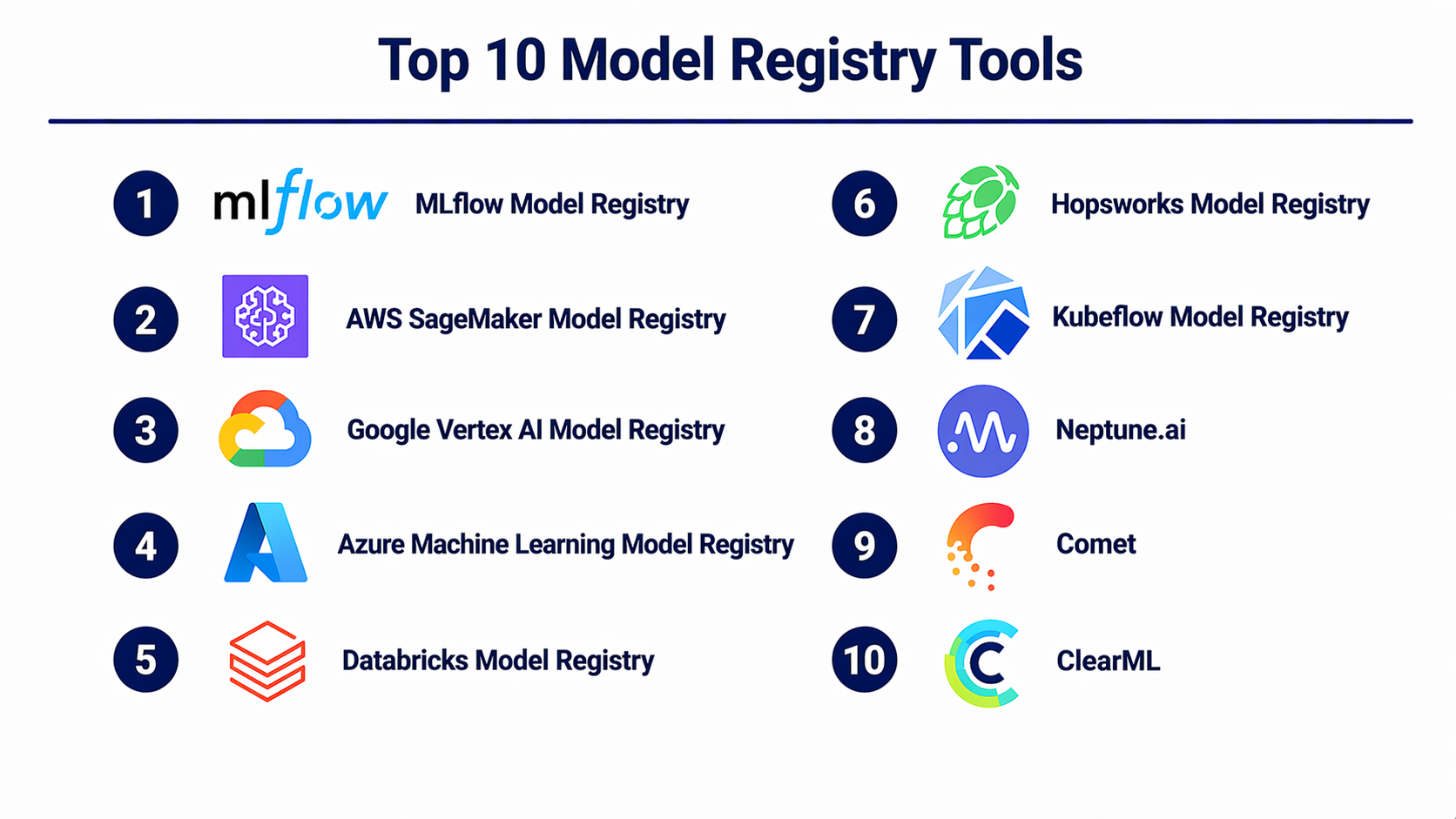
Top 10 Model Registry Tools
#1 — MLflow Model Registry
Short description:
An open-source model registry integrated with MLflow, widely used for experiment tracking and model lifecycle management.
Key Features
- Model versioning and lifecycle stages
- Integration with MLflow tracking
- REST API support
- Deployment integration
- Model lineage tracking
- Flexible storage backends
Pros
- Open-source and widely adopted
- Strong community support
Cons
- Limited enterprise governance features
- Requires setup for production-scale usage
Platforms / Deployment
Cloud / Self-hosted
Security & Compliance
Basic RBAC and authentication; compliance not fully defined
Integrations & Ecosystem
Integrates with ML frameworks, cloud storage, CI/CD pipelines
- TensorFlow, PyTorch
- Databricks
- Kubernetes
Support & Community
Strong open-source community; enterprise support via partners
#2 — AWS SageMaker Model Registry
Short description:
A managed model registry within AWS SageMaker for enterprise ML workflows.
Key Features
- Model version control
- Approval workflows
- Integration with SageMaker pipelines
- Automated deployment
- Monitoring integration
Pros
- Fully managed service
- Strong AWS ecosystem integration
Cons
- AWS vendor lock-in
- Complex pricing structure
Platforms / Deployment
Cloud
Security & Compliance
Supports IAM, encryption, audit logs
Integrations & Ecosystem
Deep AWS integrations
- S3
- Lambda
- CloudWatch
Support & Community
Enterprise-grade support
#3 — Google Vertex AI Model Registry
Short description:
A model registry within Google’s Vertex AI platform designed for scalable AI operations.
Key Features
- Model versioning
- Metadata tracking
- Pipeline integration
- Deployment management
- Monitoring integration
Pros
- Strong AI ecosystem
- Scalable infrastructure
Cons
- Requires GCP expertise
- Limited flexibility outside GCP
Platforms / Deployment
Cloud
Security & Compliance
Supports IAM, encryption
Integrations & Ecosystem
- BigQuery
- AI pipelines
- Kubernetes
Support & Community
Enterprise support
#4 — Azure Machine Learning Model Registry
Short description:
Microsoft’s model registry integrated into Azure ML for enterprise AI workflows.
Key Features
- Model lifecycle management
- Versioning
- Deployment pipelines
- Monitoring
- Integration with Azure services
Pros
- Strong enterprise features
- Hybrid cloud support
Cons
- Complex setup
- Azure dependency
Platforms / Deployment
Cloud / Hybrid
Security & Compliance
RBAC, encryption, enterprise compliance
Integrations & Ecosystem
- Azure DevOps
- Power BI
- Kubernetes
Support & Community
Strong enterprise support
#5 — Databricks Model Registry
Short description:
A unified model registry within Databricks Lakehouse for data and ML lifecycle management.
Key Features
- Unified data + model governance
- Versioning
- Approval workflows
- MLflow integration
- Deployment support
Pros
- Strong data integration
- Enterprise-ready
Cons
- Requires Databricks ecosystem
- Cost can scale quickly
Platforms / Deployment
Cloud
Security & Compliance
Enterprise-grade controls
Integrations & Ecosystem
- Spark
- MLflow
- Delta Lake
Support & Community
Enterprise support
#6 — Hopsworks Model Registry
Short description:
A model registry tightly integrated with feature stores for end-to-end ML pipelines.
Key Features
- Feature + model integration
- Version control
- Deployment pipelines
- Metadata tracking
Pros
- Strong feature store integration
- Open-source option
Cons
- Smaller ecosystem
- Learning curve
Platforms / Deployment
Cloud / Self-hosted
Security & Compliance
Not publicly stated
Integrations & Ecosystem
- Feature stores
- Kubernetes
- ML frameworks
Support & Community
Growing community
#7 — Kubeflow Model Registry
Short description:
Part of Kubeflow, providing model management in Kubernetes-native environments.
Key Features
- Kubernetes-native
- Pipeline integration
- Model versioning
- Deployment orchestration
Pros
- Open-source flexibility
- Highly customizable
Cons
- Complex setup
- Requires Kubernetes expertise
Platforms / Deployment
Self-hosted
Security & Compliance
Depends on deployment setup
Integrations & Ecosystem
- Kubernetes
- TensorFlow
- CI/CD tools
Support & Community
Strong open-source community
#8 — Neptune.ai
Short description:
A metadata store and model registry focused on experiment tracking and collaboration.
Key Features
- Experiment tracking
- Model metadata management
- Versioning
- Collaboration tools
Pros
- Easy to use
- Strong experiment tracking
Cons
- Limited deployment features
- Not full MLOps suite
Platforms / Deployment
Cloud
Security & Compliance
Not publicly stated
Integrations & Ecosystem
- Python ML frameworks
- APIs
Support & Community
Good documentation
#9 — Comet
Short description:
An ML lifecycle platform with model registry and experiment tracking capabilities.
Key Features
- Model registry
- Experiment tracking
- Visualization
- Deployment monitoring
Pros
- Strong UI
- Good tracking features
Cons
- Limited enterprise governance
- Pricing varies
Platforms / Deployment
Cloud
Security & Compliance
Not publicly stated
Integrations & Ecosystem
- ML frameworks
- APIs
Support & Community
Active community
#10 — ClearML
Short description:
An open-source MLOps platform with model registry and pipeline orchestration.
Key Features
- Experiment tracking
- Model versioning
- Pipeline automation
- Deployment tools
Pros
- Open-source flexibility
- End-to-end MLOps
Cons
- Requires setup effort
- UI can feel complex
Platforms / Deployment
Cloud / Self-hosted
Security & Compliance
Not publicly stated
Integrations & Ecosystem
- Python ML tools
- Kubernetes
- CI/CD
Support & Community
Active open-source community
Comparison Table (Top 10)
| Tool Name | Best For | Platform(s) Supported | Deployment | Standout Feature | Public Rating |
|---|---|---|---|---|---|
| MLflow Model Registry | Open-source users | Web/Linux | Self-hosted | Experiment + model integration | N/A |
| AWS SageMaker Model Registry | AWS users | Cloud | Cloud | Fully managed ML pipeline | N/A |
| Google Vertex AI Model Registry | GCP users | Cloud | Cloud | AI-native ecosystem | N/A |
| Azure ML Model Registry | Enterprise users | Cloud/Hybrid | Hybrid | Enterprise compliance | N/A |
| Databricks Model Registry | Data-driven teams | Cloud | Cloud | Lakehouse integration | N/A |
| Hopsworks Model Registry | Feature store users | Cloud/Linux | Hybrid | Feature + model integration | N/A |
| Kubeflow Model Registry | DevOps teams | Linux | Self-hosted | Kubernetes-native | N/A |
| Neptune.ai | Experiment tracking teams | Web | Cloud | Metadata tracking | N/A |
| Comet | ML teams | Web | Cloud | Visualization tools | N/A |
| ClearML | Open-source teams | Linux/Web | Hybrid | End-to-end MLOps | N/A |
Evaluation & Scoring of Model Registry Tools
| Tool Name | Core (25%) | Ease (15%) | Integrations (15%) | Security (10%) | Performance (10%) | Support (10%) | Value (15%) | Weighted Total |
|---|---|---|---|---|---|---|---|---|
| MLflow | 9 | 7 | 9 | 6 | 8 | 8 | 9 | 8.2 |
| AWS SageMaker | 9 | 7 | 9 | 9 | 9 | 9 | 7 | 8.5 |
| Vertex AI | 9 | 7 | 8 | 9 | 9 | 8 | 7 | 8.3 |
| Azure ML | 9 | 7 | 9 | 9 | 9 | 9 | 7 | 8.5 |
| Databricks | 9 | 8 | 9 | 9 | 9 | 9 | 7 | 8.7 |
| Hopsworks | 8 | 6 | 8 | 6 | 8 | 7 | 8 | 7.6 |
| Kubeflow | 8 | 5 | 9 | 7 | 8 | 7 | 8 | 7.5 |
| Neptune.ai | 7 | 9 | 7 | 6 | 7 | 7 | 8 | 7.5 |
| Comet | 7 | 8 | 7 | 6 | 7 | 7 | 7 | 7.2 |
| ClearML | 8 | 6 | 8 | 6 | 8 | 7 | 9 | 7.8 |
How to interpret scores:
- Scores are relative comparisons, not absolute benchmarks
- Higher scores indicate stronger overall capability in production environments
- Enterprise tools score higher in security and scalability
- Open-source tools score higher in value and flexibility
- Choose based on fit, not just total score
Which Model Registry Tools for You?
Solo / Freelancer
- Best: MLflow, ClearML
- Focus on simplicity and cost
SMB
- Best: Neptune.ai, Comet
- Balance ease of use and collaboration
Mid-Market
- Best: Databricks, Hopsworks
- Need integration with data pipelines
Enterprise
- Best: AWS SageMaker, Azure ML, Vertex AI
- Strong governance and compliance required
Budget vs Premium
- Budget: MLflow, ClearML
- Premium: Databricks, AWS
Feature Depth vs Ease of Use
- Deep features: Kubeflow, Databricks
- Easy to use: Neptune.ai, Comet
Integrations & Scalability
- Strongest: AWS, Azure, Databricks
- Flexible: MLflow, Kubeflow
Security & Compliance Needs
- Enterprise-grade: Azure, AWS
- Basic: Open-source tools
Frequently Asked Questions (FAQs)
What is a model registry?
A model registry is a system to store, version, and manage machine learning models across their lifecycle.
Why is a model registry important?
It ensures reproducibility, governance, and safe deployment of ML models.
Are model registries only for large companies?
No, even small teams benefit from version control and tracking.
What is the difference between experiment tracking and model registry?
Experiment tracking logs runs, while a registry manages production-ready models.
Can I use Git instead of a model registry?
Git works for code but not for managing model metadata and deployment workflows.
Are these tools expensive?
Pricing varies; open-source tools are free, while cloud tools follow usage-based pricing.
How long does it take to implement?
Basic setup can take hours, but enterprise deployment may take weeks.
Do these tools support LLMs?
Yes, most modern tools now support LLM workflows.
Can I switch between tools later?
Yes, but migration effort depends on data and integrations.
What are alternatives to model registries?
Basic alternatives include file storage and version control, but they lack governance features.
Conclusion
Model Registry Tools have become a core component of modern MLOps and AI platforms. As organizations scale their AI initiatives, managing models effectively is no longer optional—it is critical for reliability, governance, and performance. There is no single “best” tool for everyone. Open-source options like MLflow and ClearML provide flexibility and cost advantages, while enterprise platforms like AWS SageMaker, Azure ML, and Databricks deliver advanced governance, scalability, and security.
