Introduction
Synthetic Data Generation Tools are platforms that create artificial datasets that mimic real-world data without exposing sensitive or proprietary information. Instead of using actual customer or operational data, these tools generate statistically similar data that preserves patterns, relationships, and distributions.
In today’s data-driven environment, especially with stricter privacy regulations and rapid AI adoption, synthetic data has become essential. organizations are increasingly relying on synthetic data to train AI models, test systems, and ensure compliance without risking data breaches.
Real-world use cases include:
- Training machine learning models when real data is limited or sensitive
- Testing applications in staging environments without exposing production data
- Sharing datasets across teams or partners securely
- Generating edge-case scenarios for fraud detection or cybersecurity
- Enhancing datasets to improve model accuracy and fairness
What buyers should evaluate:
- Data fidelity and realism
- Privacy guarantees (anonymization, differential privacy)
- Scalability and performance
- Support for structured, unstructured, and multimodal data
- Ease of integration with ML pipelines
- Customization and control over data generation
- Compliance readiness (GDPR, HIPAA-like requirements)
- Deployment flexibility (cloud vs on-prem)
- Cost and licensing model
Best for:
Data scientists, ML engineers, AI teams, QA teams, and enterprises in regulated industries like healthcare, finance, and telecom.
Not ideal for:
Teams working with small, non-sensitive datasets where real data is readily usable, or scenarios requiring exact real-world accuracy without approximation.
Key Trends in Synthetic Data Generation Tools
- Generative AI adoption: GANs, VAEs, and diffusion models are powering more realistic data generation.
- Privacy-first design: Tools are integrating differential privacy and advanced anonymization techniques.
- Multimodal data support: Expansion beyond tabular data to images, text, video, and time-series.
- Synthetic data for LLMs: Growing use for prompt training, fine-tuning, and evaluation datasets.
- Cloud-native scalability: Managed platforms offering large-scale data generation on demand.
- Regulatory alignment: Built-in features for compliance with global data protection laws.
- Automation & pipelines: Integration into CI/CD and MLOps workflows.
- Simulation environments: Use in autonomous systems, robotics, and digital twins.
- Hybrid data strategies: Combining synthetic and real data for better model performance.
How We Selected These Tools (Methodology)
- Evaluated market recognition and adoption across industries
- Assessed breadth of data types supported (tabular, image, text, etc.)
- Reviewed quality and realism of generated data
- Considered privacy-preserving capabilities
- Analyzed integration with ML and analytics ecosystems
- Checked deployment flexibility (cloud, hybrid, on-prem)
- Evaluated usability for both technical and non-technical users
- Considered fit for startups, SMBs, and enterprises
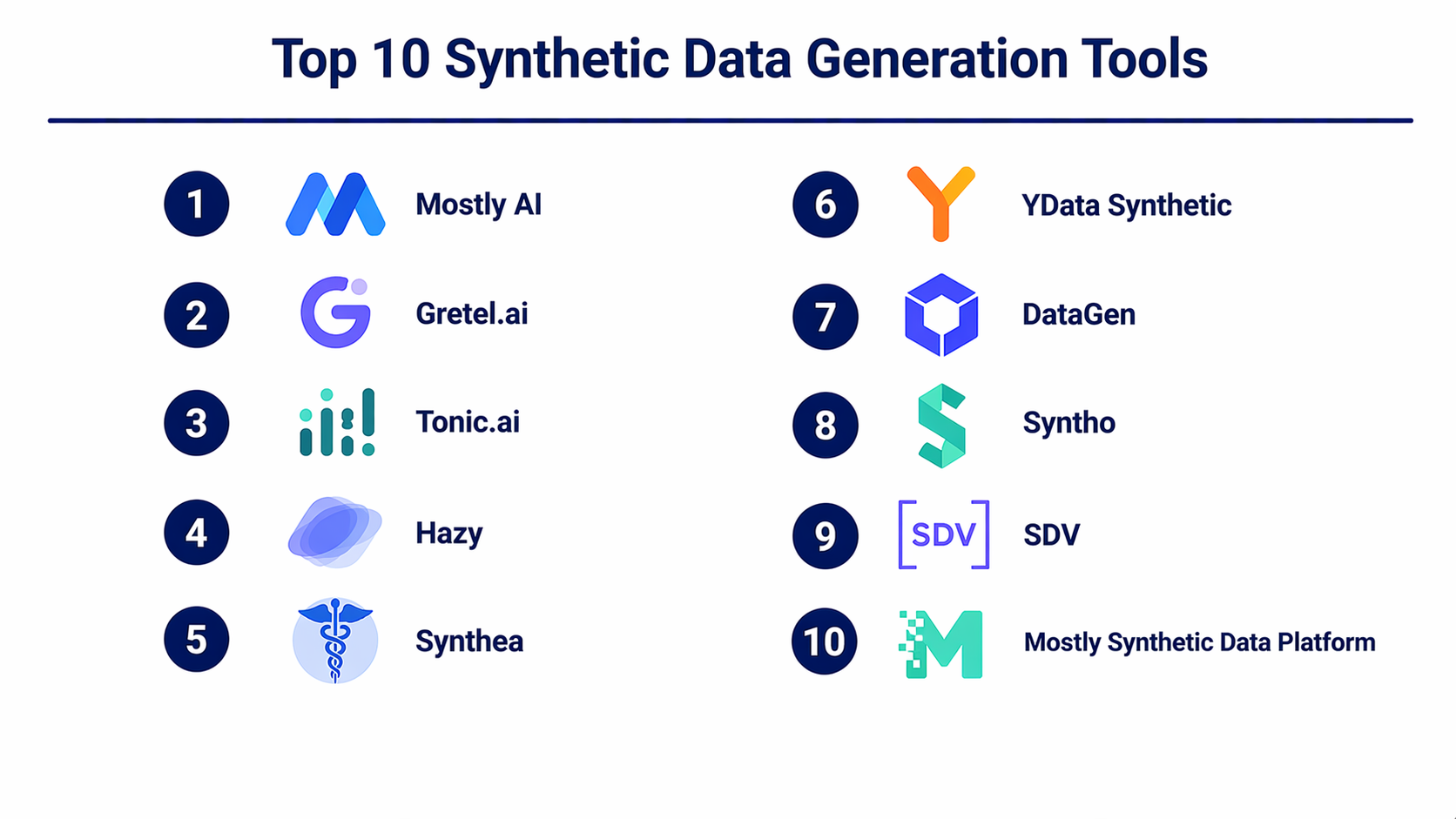
Top 10 Synthetic Data Generation Tools
#1 — Mostly AI
Short description:
An enterprise-grade synthetic data platform focused on privacy-preserving data generation for regulated industries.
Key Features
- High-fidelity tabular data generation
- Privacy-preserving algorithms
- Data anonymization
- Scalable enterprise architecture
- Integration with data warehouses
- Metadata-driven generation
Pros
- Strong privacy focus
- Enterprise-ready capabilities
Cons
- Premium pricing
- Learning curve for setup
Platforms / Deployment
Cloud / Self-hosted
Security & Compliance
Supports encryption, GDPR-aligned privacy techniques
Integrations & Ecosystem
Integrates with enterprise data platforms and analytics pipelines
- Data warehouses
- APIs
- ML pipelines
Support & Community
Enterprise support with onboarding assistance
#2 — Gretel.ai
Short description:
A developer-friendly platform for generating synthetic data with strong APIs and automation capabilities.
Key Features
- API-first synthetic data generation
- Privacy-preserving models
- Text and tabular data support
- Automated pipelines
- Data quality evaluation tools
Pros
- Easy API integration
- Supports multiple data types
Cons
- Advanced features require tuning
- Pricing varies
Platforms / Deployment
Cloud
Security & Compliance
Not publicly stated
Integrations & Ecosystem
Strong API ecosystem
- Python SDK
- Data pipelines
- Cloud platforms
Support & Community
Good documentation and developer support
#3 — Tonic.ai
Short description:
A platform designed for generating safe test data for developers and QA teams.
Key Features
- Data masking and synthesis
- Test data generation
- Database cloning
- Schema-aware generation
- Integration with DevOps workflows
Pros
- Ideal for testing environments
- Developer-friendly
Cons
- Limited advanced ML features
- Focused mainly on structured data
Platforms / Deployment
Cloud / Self-hosted
Security & Compliance
Supports RBAC and data masking
Integrations & Ecosystem
- Databases
- CI/CD pipelines
- DevOps tools
Support & Community
Strong enterprise support
#4 — Hazy
Short description:
A synthetic data platform focused on generating realistic datasets for financial and enterprise use cases.
Key Features
- High-quality tabular data generation
- Privacy-preserving models
- Data augmentation
- Compliance-ready design
- Scalable infrastructure
Pros
- Strong data realism
- Focus on regulated industries
Cons
- Limited multimodal support
- Enterprise-focused pricing
Platforms / Deployment
Cloud
Security & Compliance
Not publicly stated
Integrations & Ecosystem
- Data platforms
- ML tools
- APIs
Support & Community
Enterprise-grade support
#5 — Synthea
Short description:
An open-source synthetic patient data generator widely used in healthcare research.
Key Features
- Healthcare-specific data generation
- Patient record simulation
- Open-source flexibility
- Scenario-based data generation
- Customizable models
Pros
- Free and open-source
- Highly customizable
Cons
- Limited to healthcare domain
- Requires technical setup
Platforms / Deployment
Self-hosted
Security & Compliance
Not publicly stated
Integrations & Ecosystem
- Healthcare systems
- Research tools
- APIs
Support & Community
Strong open-source community
#6 — YData Synthetic
Short description:
A platform providing synthetic data solutions for ML model training and testing.
Key Features
- Tabular and time-series data generation
- Data quality validation
- Privacy metrics
- Model training integration
- Scalable generation
Pros
- Good ML integration
- Strong validation features
Cons
- Limited enterprise ecosystem
- Smaller community
Platforms / Deployment
Cloud / Self-hosted
Security & Compliance
Not publicly stated
Integrations & Ecosystem
- Python ecosystem
- ML frameworks
- APIs
Support & Community
Growing community
#7 — DataGen
Short description:
A platform specializing in synthetic data for computer vision and AI training.
Key Features
- Image and video data generation
- Simulation environments
- Annotation automation
- High realism rendering
- AI model training support
Pros
- Strong for vision use cases
- High-quality data
Cons
- Niche focus
- High computational requirements
Platforms / Deployment
Cloud
Security & Compliance
Not publicly stated
Integrations & Ecosystem
- Computer vision frameworks
- Simulation tools
- APIs
Support & Community
Enterprise-focused support
#8 — Syntho
Short description:
A synthetic data platform designed for privacy-safe data sharing and analytics.
Key Features
- Automated data synthesis
- Privacy scoring
- Data quality metrics
- Multi-dataset support
- Compliance-focused design
Pros
- Easy to use
- Strong compliance focus
Cons
- Limited customization
- Smaller ecosystem
Platforms / Deployment
Cloud
Security & Compliance
Privacy-focused design; specific certifications not publicly stated
Integrations & Ecosystem
- BI tools
- Data platforms
- APIs
Support & Community
Enterprise support
#9 — SDV (Synthetic Data Vault)
Short description:
An open-source library for generating synthetic tabular data using advanced statistical models.
Key Features
- Multiple generative models
- Tabular data focus
- Python-based
- Customizable pipelines
- Model evaluation tools
Pros
- Open-source flexibility
- Strong research backing
Cons
- Requires coding expertise
- Limited enterprise features
Platforms / Deployment
Self-hosted
Security & Compliance
Not publicly stated
Integrations & Ecosystem
- Python ecosystem
- Data science tools
Support & Community
Strong open-source community
#10 — Mostly Synthetic Data Platform
Short description:
A platform focused on generating high-quality synthetic datasets for enterprise analytics and AI.
Key Features
- Data generation pipelines
- Privacy preservation
- Data augmentation
- Integration tools
- Metadata-driven models
Pros
- Enterprise-ready
- Strong scalability
Cons
- Premium pricing
- Limited public documentation
Platforms / Deployment
Cloud / Hybrid
Security & Compliance
Not publicly stated
Integrations & Ecosystem
- Data warehouses
- APIs
- ML platforms
Support & Community
Enterprise support
Comparison Table (Top 10)
| Tool Name | Best For | Platform(s) Supported | Deployment | Standout Feature | Public Rating |
|---|---|---|---|---|---|
| Mostly AI | Enterprise privacy use cases | Web/Linux | Hybrid | High-fidelity tabular data | N/A |
| Gretel.ai | Developers | Web | Cloud | API-first design | N/A |
| Tonic.ai | QA/testing teams | Web/Linux | Hybrid | Test data generation | N/A |
| Hazy | Financial services | Web | Cloud | Data realism | N/A |
| Synthea | Healthcare | Linux | Self-hosted | Patient data simulation | N/A |
| YData Synthetic | ML teams | Web/Linux | Hybrid | Validation metrics | N/A |
| DataGen | Computer vision | Web | Cloud | Image data generation | N/A |
| Syntho | Data sharing | Web | Cloud | Privacy scoring | N/A |
| SDV | Developers | Python | Self-hosted | Open-source models | N/A |
| Mostly Synthetic Data Platform | Enterprises | Web | Hybrid | Scalable pipelines | N/A |
Evaluation & Scoring of Synthetic Data Generation Tools
| Tool Name | Core (25%) | Ease (15%) | Integrations (15%) | Security (10%) | Performance (10%) | Support (10%) | Value (15%) | Weighted Total |
|---|---|---|---|---|---|---|---|---|
| Mostly AI | 9 | 7 | 8 | 9 | 9 | 9 | 7 | 8.4 |
| Gretel.ai | 8 | 8 | 9 | 7 | 8 | 8 | 8 | 8.1 |
| Tonic.ai | 8 | 9 | 8 | 8 | 8 | 9 | 7 | 8.2 |
| Hazy | 8 | 7 | 7 | 8 | 8 | 8 | 7 | 7.8 |
| Synthea | 7 | 6 | 6 | 6 | 7 | 7 | 9 | 7.1 |
| YData | 8 | 7 | 7 | 7 | 8 | 7 | 8 | 7.6 |
| DataGen | 9 | 6 | 7 | 7 | 9 | 8 | 7 | 7.9 |
| Syntho | 7 | 8 | 7 | 8 | 7 | 8 | 7 | 7.6 |
| SDV | 7 | 6 | 7 | 6 | 7 | 7 | 9 | 7.2 |
| Mostly Platform | 8 | 7 | 8 | 8 | 8 | 8 | 7 | 7.9 |
How to interpret scores:
- Scores are comparative across tools in this category
- Enterprise tools score higher in security and performance
- Open-source tools score higher in value
- Use scores as guidance, not final decision criteria
- Always validate with your use case
Which Synthetic Data Generation Tools for You?
Solo / Freelancer
- Best: SDV, Synthea
- Focus on flexibility and cost
SMB
- Best: Gretel.ai, Syntho
- Balance ease of use and capability
Mid-Market
- Best: YData, Tonic.ai
- Need integration and scalability
Enterprise
- Best: Mostly AI, Hazy
- Strong privacy and governance
Budget vs Premium
- Budget: SDV, Synthea
- Premium: Mostly AI, Hazy
Feature Depth vs Ease of Use
- Deep features: DataGen, Mostly AI
- Easy tools: Syntho, Tonic
Integrations & Scalability
- Strong: Gretel.ai, Mostly AI
- Flexible: Open-source tools
Security & Compliance Needs
- Enterprise-grade: Mostly AI, Tonic
- Basic: SDV, Synthea
Frequently Asked Questions (FAQs)
What is synthetic data?
Synthetic data is artificially generated data that mimics real-world datasets.
Is synthetic data safe?
Yes, when generated properly, it avoids exposing sensitive information.
Can synthetic data replace real data?
It can supplement or replace it in many scenarios but not all.
How accurate is synthetic data?
Accuracy depends on the generation model and tuning.
Is synthetic data expensive?
Pricing varies from free open-source tools to enterprise platforms.
Can I use it for AI training?
Yes, it is widely used for ML and AI model training.
How long does setup take?
From hours for simple tools to weeks for enterprise deployment.
Does it support images and videos?
Some tools support multimodal data including images and video.
Can synthetic data help with compliance?
Yes, it reduces risk in regulated environments.
What are alternatives?
Data anonymization and masking are alternatives but less flexible.
Conclusion
Synthetic Data Generation Tools are becoming a critical part of modern data and AI strategies. As privacy regulations tighten and AI adoption grows, organizations need safe, scalable ways to generate and share data without compromising security. From open-source tools like SDV to enterprise platforms like Mostly AI and Hazy, each tool offers a different balance of cost, scalability, privacy, and usability. The right choice depends on your data sensitivity, technical expertise, and integration needs.
