Introduction
Machine Learning Platforms are software environments that help teams build, train, deploy, and manage machine learning models without starting from scratch. They bring together data processing, model development, experimentation, deployment, and monitoring into one unified workflow.
In the current landscape, these platforms are no longer optional. Organizations are using machine learning for automation, prediction, personalization, fraud detection, and operational optimization. With the rapid growth of AI-driven products, companies need platforms that reduce complexity and speed up delivery.
Real-world use cases:
- Predictive analytics for sales and demand forecasting
- Fraud detection in banking and fintech
- Recommendation systems for e-commerce and media
- Predictive maintenance in manufacturing
- Chatbots and AI assistants in customer service
What buyers should evaluate:
- Ease of use and learning curve
- Model training and deployment capabilities
- Integration with data sources and tools
- Scalability and performance
- Security and compliance features
- Cost structure and pricing flexibility
- Collaboration and version control
- Monitoring and model lifecycle management
Best for: Data scientists, ML engineers, developers, startups, enterprises, and teams building AI-powered products across industries like finance, healthcare, retail, and SaaS.
Not ideal for: Very small teams with no ML use cases, or businesses needing only simple analytics (where BI tools or spreadsheets may be enough).
Key Trends in Machine Learning Platforms
- AutoML adoption: Platforms now automate model selection, tuning, and feature engineering.
- MLOps integration: End-to-end lifecycle management including CI/CD for ML models.
- Low-code/no-code ML: Enabling non-technical users to build models.
- Generative AI integration: Built-in support for LLMs and AI assistants.
- Hybrid and multi-cloud support: Flexibility across cloud providers and on-prem setups.
- Data-centric AI: Focus shifting toward data quality and governance.
- Real-time inference: Faster deployment for streaming and edge use cases.
- Cost optimization tools: Better monitoring of compute and storage usage.
- Security-first design: Increasing emphasis on compliance and data privacy.
- Open ecosystem integration: Compatibility with open-source tools like TensorFlow and PyTorch.
How We Selected These Tools (Methodology)
- Strong market adoption and enterprise usage
- Comprehensive ML lifecycle capabilities
- Proven scalability and reliability
- Security and compliance readiness signals
- Integration with major cloud and data ecosystems
- Developer and data scientist usability
- Availability of automation (AutoML, pipelines)
- Community and ecosystem strength
- Support for modern AI trends (LLMs, real-time ML)
- Fit across startups, SMBs, and enterprises
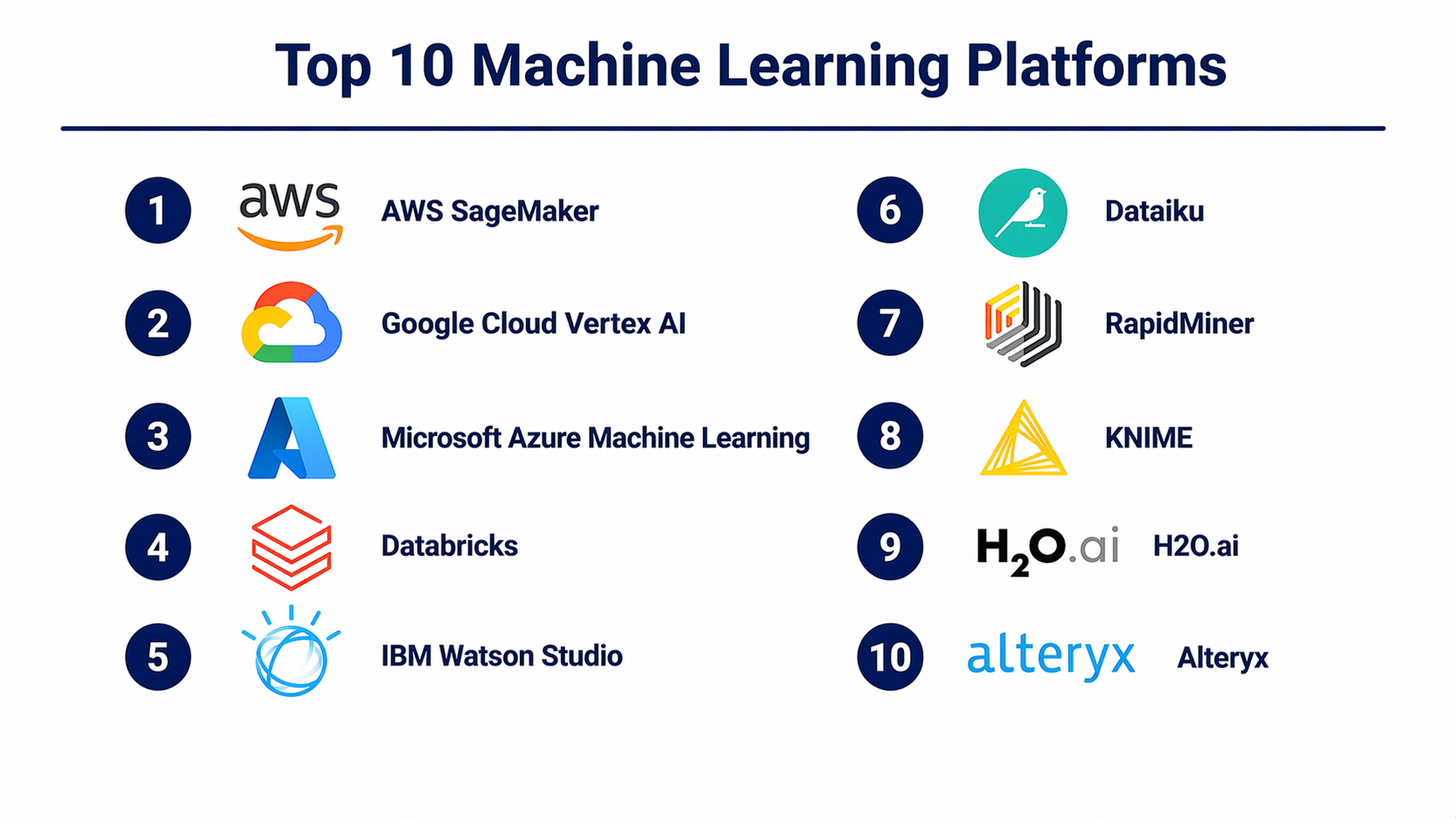
Top 10 Machine Learning Platforms
#1 — AWS SageMaker
Short description: A fully managed machine learning platform designed for building, training, and deploying models at scale, primarily for cloud-native teams.
Key Features
- End-to-end ML lifecycle support
- Built-in algorithms and frameworks
- Automated model tuning
- Scalable training infrastructure
- Real-time and batch inference
- Integrated notebooks
- MLOps capabilities
Pros
- Highly scalable infrastructure
- Deep integration with AWS ecosystem
Cons
- Complex for beginners
- Cost can increase quickly
Platforms / Deployment
Cloud
Security & Compliance
Supports encryption, IAM, RBAC, audit logs; compliance varies by configuration
Integrations & Ecosystem
Works seamlessly with AWS services like storage, databases, and analytics tools.
- Data pipelines
- Monitoring tools
- APIs for automation
Support & Community
Strong documentation and enterprise support; large global community
#2 — Google Cloud Vertex AI
Short description: Unified ML platform combining AutoML and custom model training for AI development.
Key Features
- AutoML capabilities
- Feature store
- Model registry
- End-to-end pipelines
- Real-time predictions
- Notebook integration
Pros
- Strong AutoML tools
- Excellent scalability
Cons
- Learning curve for new users
- Pricing complexity
Platforms / Deployment
Cloud
Security & Compliance
Supports IAM, encryption, audit logs; compliance varies
Integrations & Ecosystem
Integrates with Google data and analytics tools.
- Data warehouses
- APIs
- AI services
Support & Community
Well-documented with enterprise support options
#3 — Microsoft Azure Machine Learning
Short description: Enterprise-grade ML platform for building, deploying, and managing models.
Key Features
- Automated ML
- Drag-and-drop designer
- Model management
- Pipeline automation
- Integration with DevOps
- Monitoring tools
Pros
- Strong enterprise integration
- Hybrid deployment support
Cons
- UI complexity
- Pricing transparency varies
Platforms / Deployment
Cloud / Hybrid
Security & Compliance
Supports RBAC, encryption, compliance certifications (varies)
Integrations & Ecosystem
Deep integration with Microsoft ecosystem.
- Data services
- DevOps tools
- APIs
Support & Community
Strong enterprise support and documentation
#4 — Databricks
Short description: Unified data analytics and ML platform built around lakehouse architecture.
Key Features
- Collaborative notebooks
- MLflow integration
- Data pipelines
- Model tracking
- Scalable clusters
- Real-time analytics
Pros
- Strong collaboration features
- Excellent for big data
Cons
- Cost management required
- Learning curve
Platforms / Deployment
Cloud
Security & Compliance
Supports RBAC, encryption, audit logs
Integrations & Ecosystem
Integrates with major data platforms and tools.
- Data lakes
- APIs
- Open-source tools
Support & Community
Strong community and documentation
#5 — IBM Watson Studio
Short description: AI platform for building and training models with enterprise focus.
Key Features
- AutoAI tools
- Data preparation
- Model deployment
- Notebook support
- Visualization tools
Pros
- Enterprise-ready features
- Strong AI capabilities
Cons
- Interface complexity
- Limited flexibility in some areas
Platforms / Deployment
Cloud / Hybrid
Security & Compliance
Not publicly stated
Integrations & Ecosystem
Supports integration with enterprise tools.
- Data platforms
- APIs
Support & Community
Enterprise support available
#6 — Dataiku
Short description: Collaborative data science platform for analytics and machine learning.
Key Features
- Visual workflows
- AutoML capabilities
- Model deployment
- Collaboration tools
- Data preparation
Pros
- User-friendly interface
- Strong collaboration
Cons
- Premium pricing
- Limited open-source flexibility
Platforms / Deployment
Cloud / On-prem
Security & Compliance
Not publicly stated
Integrations & Ecosystem
Works with multiple data systems and tools.
- Databases
- APIs
Support & Community
Strong enterprise support
#7 — RapidMiner
Short description: Data science platform focusing on ease of use and automation.
Key Features
- Visual model building
- Automated ML
- Data prep tools
- Deployment options
Pros
- Beginner-friendly
- Strong automation
Cons
- Limited scalability for large workloads
- Licensing cost
Platforms / Deployment
Cloud / Desktop
Security & Compliance
Not publicly stated
Integrations & Ecosystem
Supports integrations with data sources and APIs.
Support & Community
Moderate community support
#8 — KNIME
Short description: Open-source analytics platform with strong visual workflows.
Key Features
- Drag-and-drop workflows
- Data integration
- ML model building
- Extensibility
Pros
- Free and open-source
- Highly customizable
Cons
- UI may feel outdated
- Limited enterprise features
Platforms / Deployment
Desktop / Server
Security & Compliance
Not publicly stated
Integrations & Ecosystem
Supports plugins and integrations with various tools.
Support & Community
Strong open-source community
#9 — H2O.ai
Short description: AI platform known for AutoML and scalable ML solutions.
Key Features
- AutoML
- Model interpretability
- Scalable architecture
- AI applications
Pros
- Strong AutoML
- High performance
Cons
- Enterprise pricing
- Setup complexity
Platforms / Deployment
Cloud / On-prem
Security & Compliance
Not publicly stated
Integrations & Ecosystem
Integrates with major ML frameworks and tools.
Support & Community
Active community and enterprise support
#10 — Alteryx
Short description: Data analytics platform with machine learning capabilities for business users.
Key Features
- Data preparation
- Predictive analytics
- Workflow automation
- Visualization
Pros
- Easy to use
- Strong analytics tools
Cons
- Expensive
- Limited deep ML capabilities
Platforms / Deployment
Desktop / Cloud
Security & Compliance
Not publicly stated
Integrations & Ecosystem
Supports integrations with enterprise systems.
Support & Community
Strong enterprise support
Comparison Table (Top 10)
| Tool Name | Best For | Platform(s) Supported | Deployment | Standout Feature | Public Rating |
|---|---|---|---|---|---|
| AWS SageMaker | Enterprise ML | Web | Cloud | End-to-end ML pipeline | N/A |
| Google Vertex AI | AI automation | Web | Cloud | AutoML capabilities | N/A |
| Azure ML | Enterprise | Web | Cloud/Hybrid | DevOps integration | N/A |
| Databricks | Big data ML | Web | Cloud | Lakehouse architecture | N/A |
| IBM Watson Studio | Enterprise AI | Web | Cloud/Hybrid | AutoAI | N/A |
| Dataiku | Collaboration | Web | Cloud/On-prem | Visual workflows | N/A |
| RapidMiner | Beginners | Desktop/Web | Cloud/Desktop | Visual ML | N/A |
| KNIME | Open-source | Desktop | On-prem | Workflow-based ML | N/A |
| H2O.ai | AutoML | Web | Cloud/On-prem | Model automation | N/A |
| Alteryx | Business analytics | Desktop | Cloud/Desktop | Data prep tools | N/A |
Evaluation & Scoring of Machine Learning Platforms
| Tool Name | Core (25%) | Ease (15%) | Integrations (15%) | Security (10%) | Performance (10%) | Support (10%) | Value (15%) | Weighted Total |
|---|---|---|---|---|---|---|---|---|
| AWS SageMaker | 9 | 7 | 9 | 9 | 9 | 8 | 7 | 8.4 |
| Google Vertex AI | 9 | 7 | 8 | 9 | 9 | 8 | 7 | 8.3 |
| Azure ML | 8 | 7 | 9 | 9 | 8 | 8 | 7 | 8.2 |
| Databricks | 9 | 7 | 9 | 8 | 9 | 8 | 7 | 8.3 |
| IBM Watson | 8 | 6 | 7 | 8 | 7 | 7 | 6 | 7.2 |
| Dataiku | 8 | 8 | 8 | 7 | 7 | 7 | 6 | 7.6 |
| RapidMiner | 7 | 9 | 6 | 6 | 6 | 6 | 7 | 7.0 |
| KNIME | 7 | 8 | 7 | 6 | 6 | 7 | 9 | 7.3 |
| H2O.ai | 8 | 7 | 7 | 7 | 8 | 7 | 6 | 7.5 |
| Alteryx | 7 | 9 | 7 | 6 | 7 | 8 | 6 | 7.4 |
How to interpret:
- Scores are comparative across tools, not absolute.
- Higher total = better overall balance.
- Choose based on your specific needs, not just score.
Which Machine Learning Platforms for You?
Solo / Freelancer
- Best: KNIME, RapidMiner
- Focus on ease of use and cost
SMB
- Best: Dataiku, H2O.ai
- Balance between automation and scalability
Mid-Market
- Best: Azure ML, Databricks
- Need collaboration and scalability
Enterprise
- Best: AWS SageMaker, Vertex AI
- Full-scale ML lifecycle and infrastructure
Budget vs Premium
- Budget: KNIME
- Premium: AWS, Azure
Feature Depth vs Ease of Use
- Depth: SageMaker, Databricks
- Ease: RapidMiner, Alteryx
Integrations & Scalability
- Strong: AWS, Azure, Google
Security & Compliance Needs
- Enterprise tools provide better compliance readiness
Frequently Asked Questions (FAQs)
What is a Machine Learning Platform?
A tool that helps build, train, and deploy ML models efficiently.
How much do these platforms cost?
Pricing varies widely depending on usage and infrastructure.
Are these platforms beginner-friendly?
Some offer low-code features, but many require technical knowledge.
What is AutoML?
Automated machine learning that reduces manual effort.
Can I deploy models easily?
Most platforms support real-time and batch deployment.
Do I need coding skills?
Yes for advanced usage; some tools offer no-code options.
Are these platforms secure?
Most offer enterprise-grade security features.
Can I switch platforms later?
Yes, but migration can be complex.
What integrations should I look for?
Data sources, APIs, and cloud services.
What’s the biggest mistake when choosing?
Ignoring scalability and long-term cost.
Conclusion
Machine Learning Platforms have become essential for organizations that want to stay competitive in an AI-driven world. Each platform offers a unique mix of automation, scalability, usability, and integration capabilities, making the selection process highly dependent on your specific needs. There is no single “best” platform for everyone. Startups may prioritize ease of use and cost efficiency, while enterprises focus on scalability, governance, and deep integrations. The smartest approach is to shortlist two or three platforms, run pilot projects, and evaluate how well they fit your workflows, data pipelines, and security requirements.
