Introduction
Deep Learning Frameworks are software libraries and tools that help developers and data scientists design, train, and deploy neural networks efficiently. Instead of building complex mathematical models from scratch, these frameworks provide ready-made components like layers, optimizers, and GPU acceleration.
In the current AI-driven landscape, deep learning frameworks are the backbone of innovations such as generative AI, computer vision, natural language processing, and autonomous systems. As organizations move toward AI-first strategies, choosing the right framework directly impacts speed, scalability, and model performance.
Real-world use cases:
- Image recognition in healthcare and security systems
- Natural language processing for chatbots and AI assistants
- Autonomous driving systems
- Fraud detection using deep neural networks
- Generative AI applications like text and image creation
What buyers should evaluate:
- Ease of use and learning curve
- Performance (GPU/TPU support)
- Model flexibility and customization
- Community and ecosystem support
- Integration with cloud and data tools
- Deployment capabilities (edge, cloud, mobile)
- Scalability and distributed training
- Debugging and visualization tools
- Security and compliance considerations
Best for: AI engineers, ML engineers, data scientists, research teams, and organizations building advanced AI models across industries such as healthcare, fintech, automotive, and SaaS.
Not ideal for: Teams that only need simple analytics or rule-based automation; traditional BI tools or lightweight ML libraries may be sufficient in those cases.
Key Trends in Deep Learning Frameworks
- Integration with generative AI: Native support for large language models and transformers
- Hardware optimization: Better GPU, TPU, and custom accelerator support
- Distributed training: Scaling across multiple nodes and clusters
- Low-code AI tools: Simplifying deep learning for non-experts
- Model compression: Efficient deployment on edge devices
- Cross-framework interoperability: Easier model portability
- AutoML integration: Reducing manual tuning efforts
- Focus on MLOps: Lifecycle management and monitoring
- Security enhancements: Improved model governance and access control
- Cloud-native development: Tight integration with cloud ML platforms
How We Selected These Tools (Methodology)
- High adoption among developers and enterprises
- Comprehensive deep learning capabilities
- Strong performance benchmarks (GPU/TPU utilization)
- Active community and ecosystem
- Integration with modern AI workflows
- Flexibility for research and production use
- Support for distributed and scalable training
- Compatibility with cloud and edge environments
- Longevity and continuous innovation
- Fit across startups, research labs, and enterprises
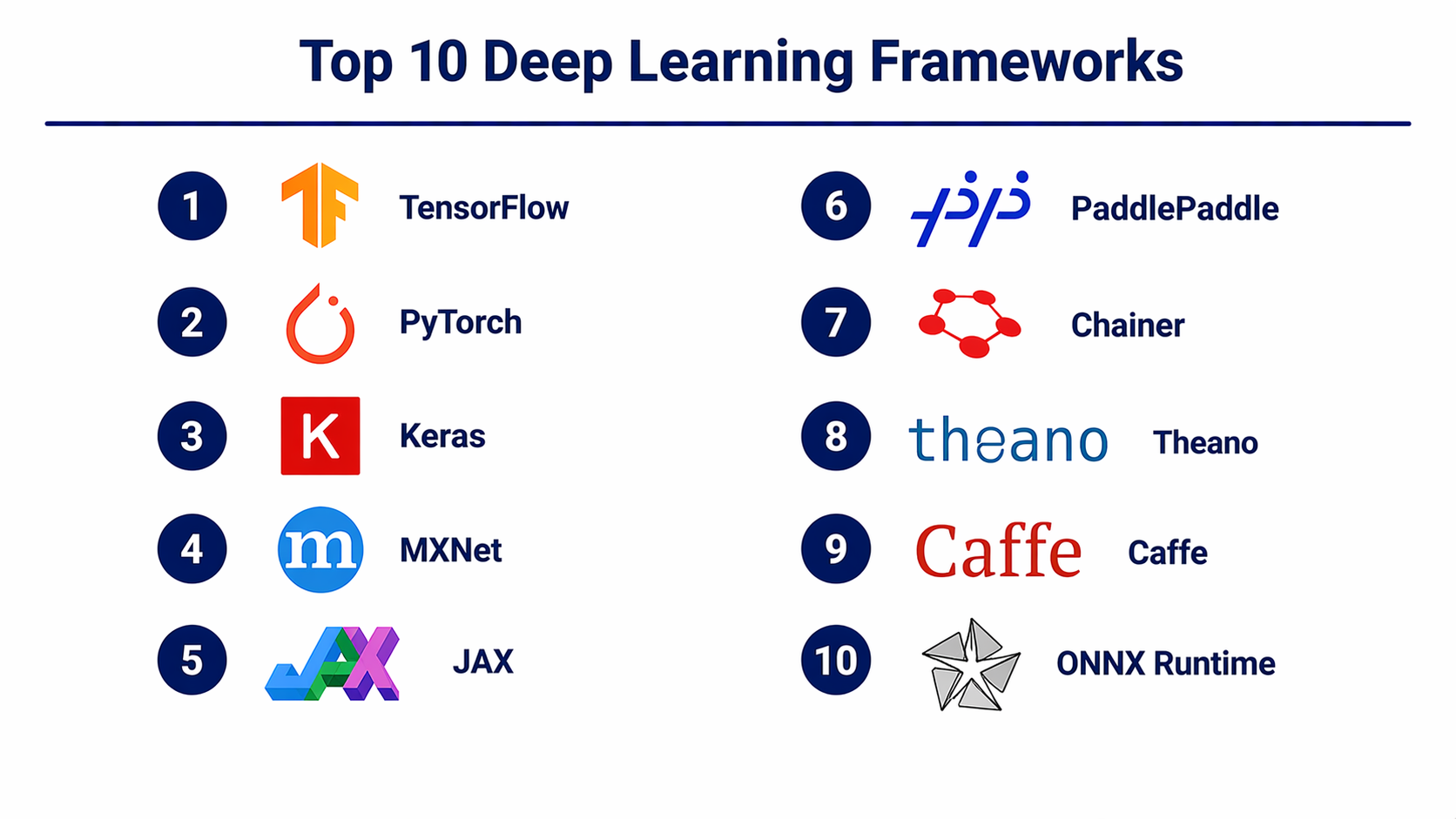
Top 10 Deep Learning Frameworks
#1 — TensorFlow
Short description: A widely used deep learning framework developed for building scalable and production-ready AI models.
Key Features
- Flexible architecture for model building
- TensorFlow Extended (TFX) for pipelines
- GPU and TPU support
- TensorBoard visualization
- Deployment across cloud, edge, and mobile
- Large ecosystem
Pros
- Highly scalable for production
- Strong community support
Cons
- Steeper learning curve
- Complex debugging
Platforms / Deployment
Windows / macOS / Linux / Cloud / Mobile
Security & Compliance
Supports encryption, access control; compliance varies
Integrations & Ecosystem
Integrates with cloud platforms and ML tools.
- Data pipelines
- APIs
- Visualization tools
Support & Community
Extensive documentation and large global community
#2 — PyTorch
Short description: A popular deep learning framework known for flexibility and ease of use, especially in research.
Key Features
- Dynamic computation graphs
- GPU acceleration
- Strong Python integration
- TorchScript for deployment
- Distributed training
Pros
- Easy to learn and debug
- Preferred by researchers
Cons
- Slightly less mature for production workflows
- Deployment setup can require effort
Platforms / Deployment
Windows / macOS / Linux / Cloud
Security & Compliance
Not publicly stated
Integrations & Ecosystem
Works with multiple AI tools and libraries.
- APIs
- Data tools
Support & Community
Very strong community and rapid innovation
#3 — Keras
Short description: High-level neural network API designed for simplicity and fast experimentation.
Key Features
- User-friendly API
- Fast prototyping
- Built on TensorFlow
- Pre-trained models
- Modular design
Pros
- Easy for beginners
- Quick model development
Cons
- Less control for advanced use cases
- Depends on backend
Platforms / Deployment
Cloud / Desktop
Security & Compliance
Not publicly stated
Integrations & Ecosystem
Integrates with TensorFlow ecosystem.
Support & Community
Strong community and documentation
#4 — MXNet
Short description: Scalable deep learning framework known for efficiency and flexibility.
Key Features
- Hybrid programming model
- Distributed training
- Multi-language support
- Efficient memory usage
Pros
- High performance
- Scalable
Cons
- Smaller community
- Less intuitive
Platforms / Deployment
Cloud / Linux / Windows
Security & Compliance
Not publicly stated
Integrations & Ecosystem
Supports integration with cloud environments.
Support & Community
Moderate community support
#5 — JAX
Short description: High-performance framework focused on numerical computing and deep learning research.
Key Features
- Automatic differentiation
- GPU/TPU acceleration
- Functional programming model
- High performance
Pros
- Excellent performance
- Flexible research workflows
Cons
- Steep learning curve
- Limited production tooling
Platforms / Deployment
Linux / Cloud
Security & Compliance
Not publicly stated
Integrations & Ecosystem
Works with research tools and libraries.
Support & Community
Growing community
#6 — PaddlePaddle
Short description: Open-source deep learning platform optimized for industrial applications.
Key Features
- Distributed training
- Pre-trained models
- NLP and CV support
- Production-ready tools
Pros
- Strong enterprise features
- Scalable
Cons
- Limited global adoption
- Documentation gaps
Platforms / Deployment
Cloud / Linux
Security & Compliance
Not publicly stated
Integrations & Ecosystem
Supports integration with AI tools.
Support & Community
Moderate community
#7 — Chainer
Short description: Flexible deep learning framework focused on dynamic computation graphs.
Key Features
- Define-by-run approach
- GPU support
- Flexible architecture
- Research-friendly
Pros
- Easy experimentation
- Flexible
Cons
- Declining adoption
- Limited updates
Platforms / Deployment
Linux / Windows
Security & Compliance
Not publicly stated
Integrations & Ecosystem
Basic integrations available
Support & Community
Limited support
#8 — Theano
Short description: Early deep learning library used for mathematical computations.
Key Features
- Symbolic computation
- GPU acceleration
- Efficient operations
Pros
- Strong mathematical foundation
- Lightweight
Cons
- No longer actively maintained
- Limited features
Platforms / Deployment
Linux
Security & Compliance
Not publicly stated
Integrations & Ecosystem
Minimal ecosystem
Support & Community
Limited community
Short description: Deep learning framework optimized for image processing tasks.
#9 — Caffe
Key Features
- Fast model execution
- Pre-trained models
- Modular architecture
Pros
- High performance in CV tasks
- Lightweight
Cons
- Limited flexibility
- Less active development
Platforms / Deployment
Linux
Security & Compliance
Not publicly stated
Integrations & Ecosystem
Basic integrations
Support & Community
Declining community
#10 — ONNX Runtime
Short description: Runtime engine for deploying machine learning models across frameworks.
Key Features
- Cross-platform inference
- High performance
- Hardware acceleration
- Model interoperability
Pros
- Excellent deployment performance
- Framework-agnostic
Cons
- Not a full training framework
- Limited development tools
Platforms / Deployment
Cloud / Edge / Windows / Linux
Security & Compliance
Not publicly stated
Integrations & Ecosystem
Supports multiple ML frameworks and hardware platforms.
Support & Community
Growing ecosystem
Comparison Table (Top 10)
| Tool Name | Best For | Platform(s) Supported | Deployment | Standout Feature | Public Rating |
|---|---|---|---|---|---|
| TensorFlow | Production ML | Multi-platform | Cloud/Edge | Scalable pipelines | N/A |
| PyTorch | Research & dev | Multi-platform | Cloud | Dynamic graphs | N/A |
| Keras | Beginners | Multi-platform | Cloud | Simplicity | N/A |
| MXNet | Scalable ML | Multi-platform | Cloud | Efficiency | N/A |
| JAX | Research | Linux | Cloud | Performance | N/A |
| PaddlePaddle | Enterprise AI | Linux | Cloud | Industrial focus | N/A |
| Chainer | Research | Multi-platform | Local | Flexibility | N/A |
| Theano | Legacy | Linux | Local | Mathematical engine | N/A |
| Caffe | Computer vision | Linux | Local | Speed | N/A |
| ONNX Runtime | Deployment | Multi-platform | Cloud/Edge | Interoperability | N/A |
Evaluation & Scoring of Deep Learning Frameworks
| Tool Name | Core (25%) | Ease (15%) | Integrations (15%) | Security (10%) | Performance (10%) | Support (10%) | Value (15%) | Weighted Total |
|---|---|---|---|---|---|---|---|---|
| TensorFlow | 9 | 7 | 9 | 8 | 9 | 9 | 8 | 8.5 |
| PyTorch | 9 | 9 | 8 | 7 | 9 | 9 | 9 | 8.7 |
| Keras | 7 | 9 | 7 | 6 | 7 | 8 | 9 | 7.8 |
| MXNet | 8 | 6 | 7 | 7 | 8 | 7 | 7 | 7.4 |
| JAX | 8 | 6 | 7 | 6 | 9 | 7 | 8 | 7.6 |
| PaddlePaddle | 7 | 6 | 6 | 6 | 8 | 6 | 7 | 6.9 |
| Chainer | 6 | 7 | 5 | 5 | 6 | 5 | 7 | 6.1 |
| Theano | 5 | 5 | 4 | 5 | 6 | 4 | 8 | 5.6 |
| Caffe | 6 | 6 | 5 | 5 | 7 | 5 | 7 | 6.2 |
| ONNX Runtime | 7 | 7 | 9 | 7 | 9 | 8 | 8 | 8.0 |
How to interpret:
- Scores reflect relative strengths across frameworks.
- Higher scores indicate better balance across categories.
- Choose based on your specific use case rather than ranking alone.
Which Deep Learning Frameworks for You?
Solo / Freelancer
- Best: Keras, PyTorch
- Focus on ease of use and flexibility
SMB
- Best: PyTorch, TensorFlow
- Balance between performance and usability
Mid-Market
- Best: TensorFlow, MXNet
- Need scalability and production readiness
Enterprise
- Best: TensorFlow, ONNX Runtime
- Strong deployment and interoperability
Budget vs Premium
- Most frameworks are open-source
- Costs mainly depend on infrastructure
Feature Depth vs Ease of Use
- Depth: TensorFlow, JAX
- Ease: Keras, PyTorch
Integrations & Scalability
- Strong: TensorFlow, ONNX Runtime
Security & Compliance Needs
- Prefer enterprise-backed frameworks with governance features
Frequently Asked Questions (FAQs)
What is a deep learning framework?
A tool that helps build and train neural networks efficiently.
Are these frameworks free?
Most are open-source and free to use.
Which framework is best for beginners?
Keras and PyTorch are easier to start with.
Which is best for production?
TensorFlow is widely used for production systems.
Do I need a GPU?
Not mandatory, but highly recommended for performance.
Can I switch frameworks later?
Yes, but it may require model conversion.
What is ONNX Runtime used for?
It helps deploy models across platforms efficiently.
Are these frameworks secure?
Security depends on deployment and configuration.
Which framework is best for research?
PyTorch and JAX are popular for research.
What is the biggest mistake?
Choosing based on popularity instead of use case.
Conclusion
Deep Learning Frameworks are the foundation of modern AI systems, enabling teams to build everything from simple neural networks to complex generative AI models. Each framework comes with its own strengths—some prioritize ease of use, others focus on scalability, performance, or research flexibility. There is no one-size-fits-all solution. If you are just starting, frameworks like Keras or PyTorch offer simplicity and faster learning. For enterprise-scale applications, TensorFlow and ONNX Runtime provide robust deployment and scalability. Research-focused teams may benefit from JAX or PyTorch due to flexibility and performance.
