Introduction
Data Science Platforms are integrated environments that help teams collect, prepare, analyze, and deploy data-driven models at scale. Instead of juggling multiple disconnected tools, these platforms bring together data engineering, machine learning, visualization, and collaboration into one unified system.
In today’s AI-driven world, organizations are under pressure to turn raw data into real business value faster than ever. With the rise of automation, generative AI, and real-time analytics, modern data science platforms now go beyond notebooks—they offer end-to-end lifecycle management, governance, and production-ready deployment.
Real-world use cases include:
- Predictive analytics for sales and demand forecasting
- Fraud detection in financial services
- Customer segmentation and personalization
- AI-powered recommendations and automation
- Operational analytics for supply chain optimization
What buyers should evaluate:
- Data integration capabilities
- Model development and deployment tools
- Collaboration features
- Scalability and performance
- Security and compliance support
- Ease of use vs flexibility
- Integration with existing tech stack
- Cost and pricing model
- Monitoring and lifecycle management
Best for: Data scientists, ML engineers, analytics teams, and enterprises handling large-scale data or AI workloads.
Not ideal for: Small teams needing simple reporting tools or organizations with minimal data complexity—lighter BI or analytics tools may be more suitable.
Key Trends in Data Science Platforms
- AI-assisted development: AutoML, generative AI, and code assistants are speeding up model building.
- Unified data + AI platforms: Convergence of data engineering, analytics, and ML into a single platform.
- Real-time analytics: Increasing demand for streaming data processing and instant insights.
- MLOps integration: Built-in pipelines for versioning, deployment, and monitoring of models.
- Cloud-first architectures: Majority of platforms are now cloud-native with elastic scalability.
- Security-first design: Emphasis on RBAC, audit logs, encryption, and compliance frameworks.
- Low-code / no-code tools: Expanding accessibility to non-technical users.
- Interoperability: Open APIs and integrations with modern data stacks.
- Cost optimization: Usage-based pricing models and resource efficiency tools.
How We Selected These Tools (Methodology)
- Strong market adoption and industry presence
- Comprehensive feature sets covering end-to-end workflows
- Proven performance and scalability signals
- Security and compliance readiness (where applicable)
- Rich integration ecosystems
- Flexibility across enterprise and developer use cases
- Balanced mix of cloud-native, enterprise, and open-source tools
- Positive signals around community, support, and usability
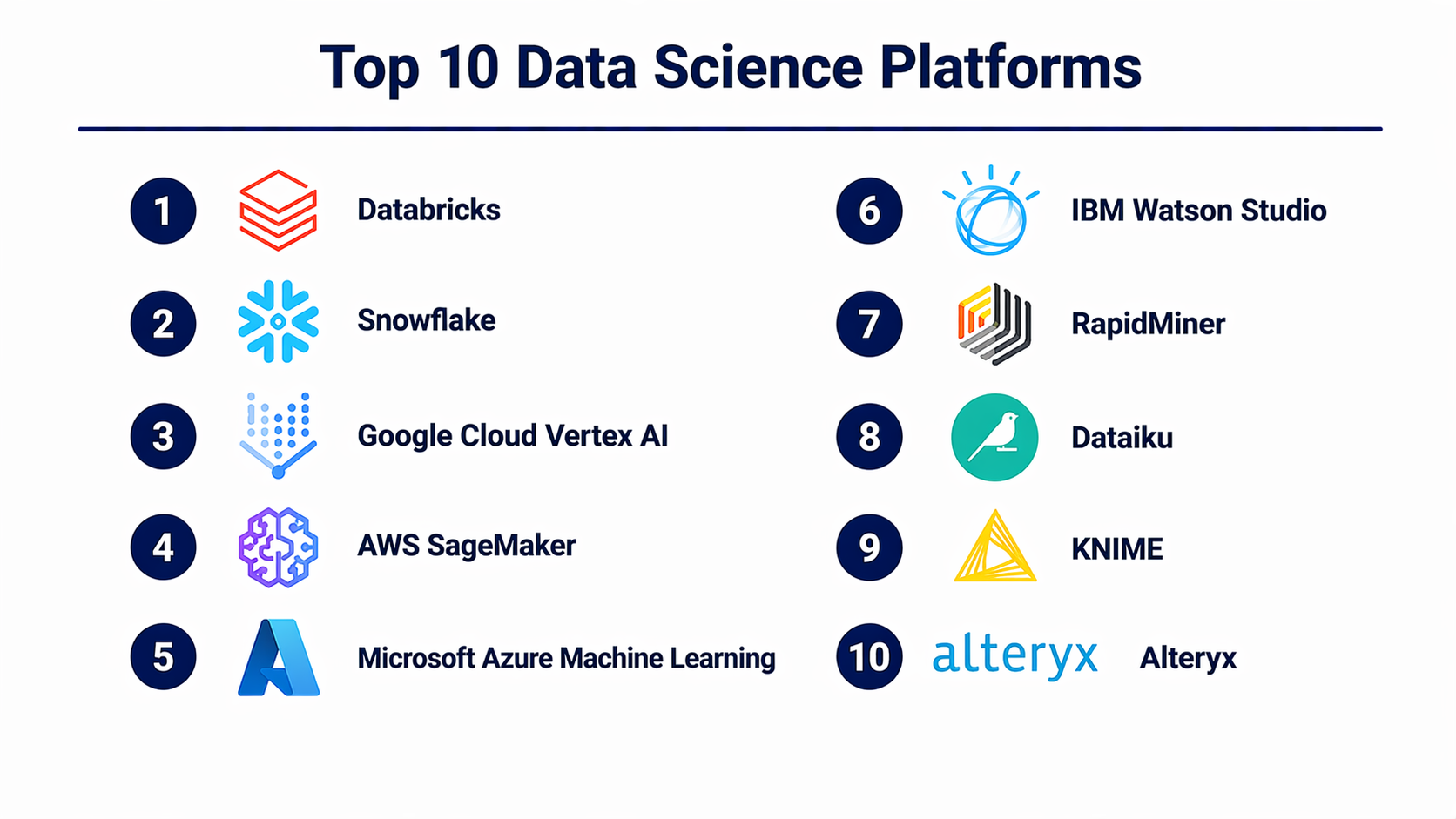
Top 10 Data Science Platforms
#1 — Databricks
Short description: A unified analytics platform built on Apache Spark, designed for big data processing, machine learning, and collaborative data science workflows.
Key Features
- Unified data lakehouse architecture
- Apache Spark-based processing
- Collaborative notebooks
- MLflow integration for lifecycle management
- Auto-scaling clusters
- Delta Lake for data reliability
Pros
- Strong performance for large-scale data
- Excellent collaboration features
- Mature ecosystem
Cons
- Can be expensive at scale
- Requires expertise for optimization
Platforms / Deployment
Cloud
Security & Compliance
RBAC, encryption, audit logs (specific certifications not publicly stated)
Integrations & Ecosystem
Databricks integrates with cloud providers, data warehouses, and BI tools.
- AWS, Azure, GCP
- Power BI, Tableau
- APIs and connectors
Support & Community
Strong enterprise support and active community ecosystem.
#2 — Snowflake
Short description: Cloud-based data platform that supports analytics and data science workloads with scalable data warehousing.
Key Features
- Cloud-native architecture
- Data sharing capabilities
- Elastic scaling
- SQL-based analytics
- Secure data exchange
Pros
- Easy to scale
- Strong performance for analytics
Cons
- Limited native ML capabilities
- Cost management complexity
Platforms / Deployment
Cloud
Security & Compliance
Encryption, RBAC (certifications not publicly stated)
Integrations & Ecosystem
- BI tools and ETL tools
- APIs and connectors
Support & Community
Strong documentation and enterprise support.
#3 — Google Cloud Vertex AI
Short description: End-to-end AI platform for building, deploying, and scaling machine learning models.
Key Features
- AutoML and custom model training
- Integrated MLOps pipelines
- Feature store
- Model monitoring
- Managed infrastructure
Pros
- Deep integration with Google Cloud
- Strong AI capabilities
Cons
- Vendor lock-in
- Learning curve
Platforms / Deployment
Cloud
Security & Compliance
SSO, encryption (details vary)
Integrations & Ecosystem
- BigQuery, TensorFlow
- APIs and SDKs
Support & Community
Strong enterprise support; growing community.
#4 — AWS SageMaker
Short description: Fully managed machine learning service for building, training, and deploying models at scale.
Key Features
- Built-in algorithms
- AutoML capabilities
- Notebook environments
- Model deployment pipelines
- Monitoring tools
Pros
- Scalable and flexible
- Wide AWS ecosystem integration
Cons
- Complex pricing
- Requires AWS knowledge
Platforms / Deployment
Cloud
Security & Compliance
IAM, encryption, audit logs (certifications not publicly stated)
Integrations & Ecosystem
- AWS services
- APIs and SDKs
Support & Community
Large ecosystem and strong documentation.
#5 — Microsoft Azure Machine Learning
Short description: Enterprise-grade platform for building, training, and deploying machine learning models.
Key Features
- Drag-and-drop ML tools
- Automated ML
- MLOps pipelines
- Model registry
- Integration with Azure services
Pros
- Strong enterprise integration
- Flexible workflows
Cons
- Complex setup
- UI can feel heavy
Platforms / Deployment
Cloud / Hybrid
Security & Compliance
RBAC, encryption (details vary)
Integrations & Ecosystem
- Azure services
- Power BI
Support & Community
Strong enterprise support.
#6 — IBM Watson Studio
Short description: Data science and AI platform for building and deploying models with collaboration tools.
Key Features
- Collaborative notebooks
- AutoAI
- Data preparation tools
- Model deployment
- Visualization tools
Pros
- Strong enterprise focus
- Built-in AI tools
Cons
- Less flexible than open tools
- Learning curve
Platforms / Deployment
Cloud / Hybrid
Security & Compliance
Not publicly stated
Integrations & Ecosystem
- IBM Cloud services
- APIs
Support & Community
Enterprise support available.
#7 — RapidMiner
Short description: Low-code data science platform for analytics and machine learning workflows.
Key Features
- Visual workflow builder
- AutoML
- Data prep tools
- Model deployment
- Integration capabilities
Pros
- Easy to use
- Good for non-technical users
Cons
- Limited scalability
- Less flexible for advanced users
Platforms / Deployment
Desktop / Cloud
Security & Compliance
Not publicly stated
Integrations & Ecosystem
- APIs
- Data connectors
Support & Community
Moderate community support.
#8 — Dataiku
Short description: Collaborative data science platform focused on enterprise AI and analytics.
Key Features
- Visual workflows
- Collaboration tools
- AutoML
- Data governance features
- Model deployment
Pros
- Strong governance features
- User-friendly interface
Cons
- Expensive
- Requires training
Platforms / Deployment
Cloud / On-premise
Security & Compliance
RBAC, audit logs (details vary)
Integrations & Ecosystem
- Cloud platforms
- Data sources
Support & Community
Strong enterprise support.
#9 — KNIME
Short description: Open-source data analytics platform with visual workflows for data science.
Key Features
- Drag-and-drop interface
- Data blending
- Machine learning tools
- Extensible plugins
- Open-source
Pros
- Free and open-source
- Easy to use
Cons
- Limited enterprise features
- Performance constraints
Platforms / Deployment
Desktop / Server
Security & Compliance
Not publicly stated
Integrations & Ecosystem
- Plugins
- APIs
Support & Community
Active open-source community.
#10 — Alteryx
Short description: Analytics automation platform focused on data preparation, blending, and advanced analytics.
Key Features
- Drag-and-drop workflows
- Data blending
- Predictive analytics
- Automation tools
- Reporting capabilities
Pros
- Strong data prep capabilities
- User-friendly
Cons
- Expensive
- Limited deep ML capabilities
Platforms / Deployment
Desktop / Cloud
Security & Compliance
Not publicly stated
Integrations & Ecosystem
- BI tools
- Data sources
Support & Community
Strong enterprise support.
Comparison Table (Top 10)
| Tool Name | Best For | Platform(s) | Deployment | Standout Feature | Public Rating |
|---|---|---|---|---|---|
| Databricks | Big data ML | Web | Cloud | Lakehouse architecture | N/A |
| Snowflake | Data warehousing | Web | Cloud | Data sharing | N/A |
| Vertex AI | AI/ML pipelines | Web | Cloud | AutoML | N/A |
| SageMaker | ML lifecycle | Web | Cloud | Managed ML workflows | N/A |
| Azure ML | Enterprise ML | Web | Cloud/Hybrid | MLOps integration | N/A |
| Watson Studio | Enterprise AI | Web | Cloud/Hybrid | AutoAI | N/A |
| RapidMiner | Low-code ML | Desktop/Web | Hybrid | Visual workflows | N/A |
| Dataiku | Enterprise analytics | Web | Hybrid | Governance tools | N/A |
| KNIME | Open-source analytics | Desktop | Self-hosted | Free workflows | N/A |
| Alteryx | Data prep & analytics | Desktop/Web | Hybrid | Automation tools | N/A |
Evaluation & Scoring of Data Science Platforms
| Tool Name | Core | Ease | Integrations | Security | Performance | Support | Value | Total |
|---|---|---|---|---|---|---|---|---|
| Databricks | 9 | 7 | 9 | 8 | 9 | 8 | 7 | 8.3 |
| Snowflake | 8 | 8 | 8 | 8 | 9 | 8 | 7 | 8.1 |
| Vertex AI | 9 | 7 | 8 | 8 | 9 | 8 | 7 | 8.2 |
| SageMaker | 9 | 7 | 9 | 8 | 9 | 8 | 7 | 8.3 |
| Azure ML | 8 | 7 | 9 | 8 | 8 | 8 | 7 | 8.0 |
| Watson Studio | 7 | 7 | 7 | 7 | 7 | 7 | 6 | 7.0 |
| RapidMiner | 7 | 9 | 6 | 6 | 6 | 6 | 8 | 7.2 |
| Dataiku | 8 | 8 | 8 | 8 | 8 | 8 | 7 | 8.0 |
| KNIME | 7 | 8 | 6 | 6 | 6 | 7 | 9 | 7.3 |
| Alteryx | 8 | 9 | 7 | 7 | 7 | 8 | 6 | 7.8 |
How to interpret scores:
- Scores are relative comparisons, not absolute performance measures.
- Higher scores indicate better balance across enterprise needs.
- Value score reflects cost vs capability.
- Choose based on your specific use case, not just total score.
Which Data Science Platforms Right for You?
Solo / Freelancer
- KNIME, RapidMiner
- Focus on ease of use and low cost
SMB
- Dataiku, Alteryx
- Balance of usability and features
Mid-Market
- Azure ML, SageMaker
- Scalable with enterprise features
Enterprise
- Databricks, Snowflake
- High scalability and governance
Budget vs Premium
- Budget: KNIME
- Premium: Databricks, Snowflake
Feature Depth vs Ease of Use
- Depth: SageMaker, Vertex AI
- Ease: RapidMiner, Alteryx
Integrations & Scalability
- Best: Databricks, Azure ML
Security & Compliance Needs
- Enterprise-grade: Azure ML, Databricks
Frequently Asked Questions (FAQs)
What is a data science platform?
A platform that combines tools for data analysis, machine learning, and deployment in one environment.
How much do these platforms cost?
Pricing varies widely based on usage, features, and scale.
Do I need coding skills?
Some platforms require coding, while others offer low-code options.
Are these platforms secure?
Most provide security features, but specifics vary.
Can I deploy models easily?
Yes, most platforms include deployment tools.
What is AutoML?
Automated machine learning that simplifies model building.
Can small businesses use these tools?
Yes, especially low-code platforms.
How do I choose the right one?
Evaluate based on scale, budget, and use case.
Can I switch platforms later?
Possible but may require migration effort.
What are alternatives?
BI tools or custom ML pipelines depending on needs.
Conclusion
Data science platforms have become essential for organizations that want to move from raw data to actionable intelligence quickly and reliably. The tools covered here show a clear divide between enterprise-grade platforms focused on scalability and governance and user-friendly platforms designed for accessibility and speed.
