Introduction
Data Catalog & Metadata Management Tools help organizations organize, discover, and understand their data assets. In simple terms, they act like a “Google search” for your company’s data—making it easy to find datasets, understand their meaning, track lineage, and ensure proper governance.
As organizations move toward data-driven decision-making, modern data stacks, and AI adoption, the volume and complexity of data have increased significantly. Without proper cataloging and metadata management, teams struggle with data silos, duplication, and lack of trust. In 2026 and beyond, these tools are essential for building reliable analytics and AI systems.
Real-world use cases include:
- Discovering datasets across data lakes and warehouses
- Tracking data lineage for compliance and audits
- Enabling self-service analytics for business teams
- Managing metadata for AI/ML pipelines
- Improving collaboration between data teams
What buyers should evaluate:
- Metadata ingestion and discovery capabilities
- Data lineage and impact analysis
- Search and usability features
- AI-driven tagging and classification
- Integration with data tools (ETL, BI, cloud)
- Governance and access control
- Scalability across large environments
- Deployment flexibility
- Automation and workflow features
- Pricing and total cost of ownership
Best for: Data engineers, data analysts, governance teams, compliance officers, and enterprises managing large-scale data environments across industries like finance, healthcare, and SaaS.
Not ideal for: Small teams with minimal data complexity or those relying on basic spreadsheets where full-scale metadata management is unnecessary.
Key Trends in Data Catalog & Metadata Management Tools
- AI-powered metadata discovery: Automatic tagging, classification, and relationship mapping
- Data observability integration: Combining cataloging with monitoring and data health insights
- Active metadata platforms: Metadata used for automation, not just documentation
- Cloud-native architectures: SaaS-first tools dominating adoption
- Self-service analytics enablement: Business users accessing data without technical help
- Real-time lineage tracking: Tracking data changes across pipelines instantly
- Integration with modern data stacks: Seamless support for dbt, Snowflake, BigQuery, etc.
- Compliance-first design: Built-in support for regulatory and governance frameworks
- Collaboration features: Comments, documentation, and data ownership tracking
- API-first ecosystems: Easy extensibility and integration across platforms
How We Selected These Tools (Methodology)
- Considered market adoption and enterprise usage trends
- Evaluated feature completeness across cataloging and metadata management
- Assessed data lineage and governance capabilities
- Reviewed integration support with modern data stacks
- Examined security posture and compliance readiness
- Balanced enterprise, SMB, and open-source tools
- Considered ease of use and onboarding experience
- Evaluated performance in large-scale data environments
- Reviewed community and ecosystem strength
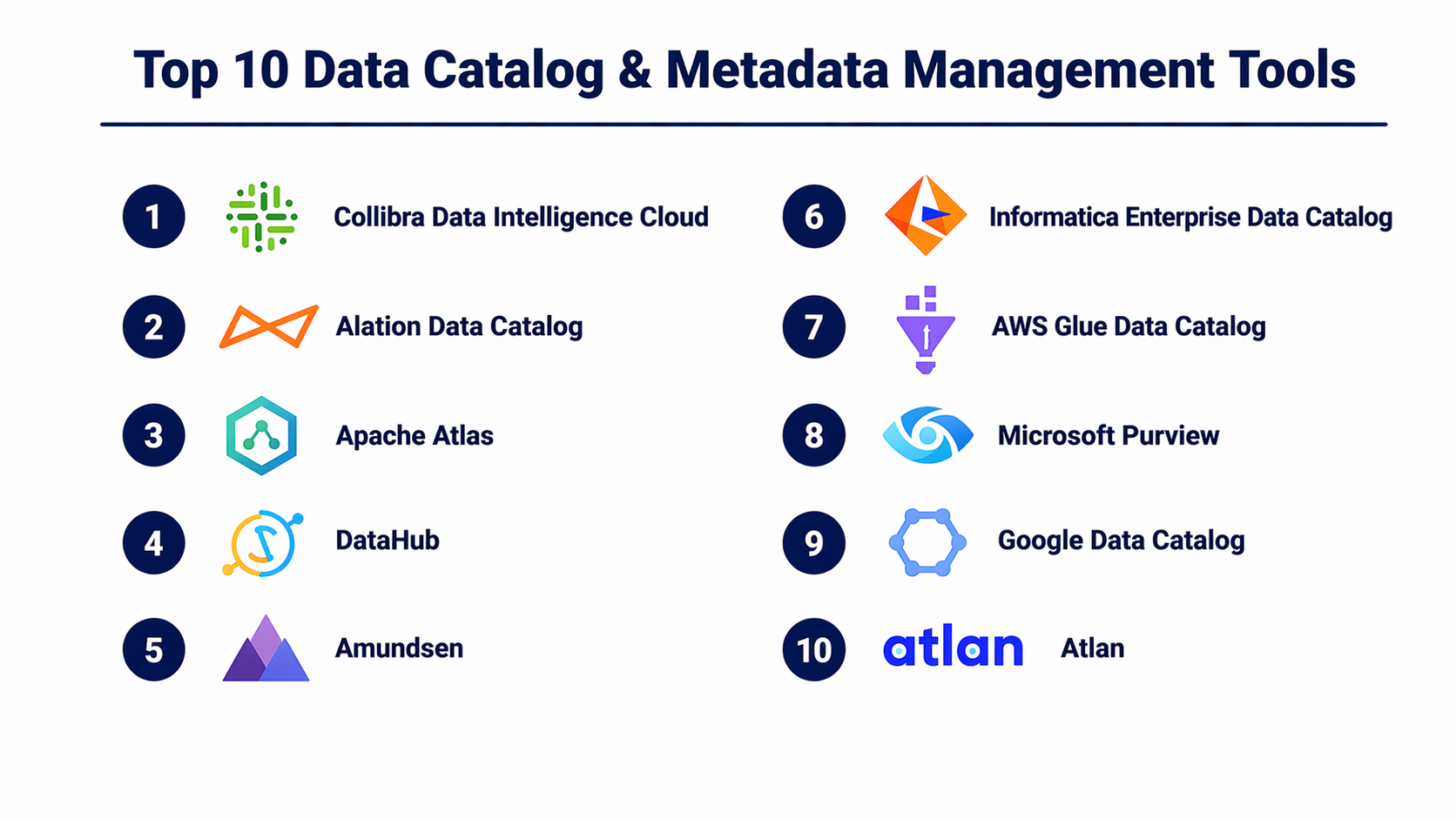
Top 10 Data Catalog & Metadata Management Tools
#1 — Collibra Data Intelligence Cloud
Short description: Enterprise-grade data catalog and governance platform designed for large organizations requiring strong compliance and metadata management.
Key Features
- Data catalog and governance integration
- Business glossary management
- Data lineage tracking
- Workflow automation
- Data stewardship tools
- Policy enforcement
- Metadata discovery
Pros
- Strong governance capabilities
- Scalable for enterprise environments
Cons
- High cost
- Complex implementation
Platforms / Deployment
Cloud
Security & Compliance
Supports RBAC, audit logs, encryption. Other certifications: Not publicly stated.
Integrations & Ecosystem
Integrates with enterprise data systems and analytics tools.
- Data warehouses
- BI tools
- ETL platforms
- APIs
Support & Community
Strong enterprise support and documentation.
#2 — Alation Data Catalog
Short description: Popular data catalog tool known for its intuitive UI and strong collaboration features.
Key Features
- Data search and discovery
- Data lineage visualization
- Behavioral analysis
- Data stewardship tools
- Collaboration features
- Query analysis
- AI-driven recommendations
Pros
- User-friendly interface
- Strong collaboration tools
Cons
- Expensive
- Limited customization
Platforms / Deployment
Cloud / Hybrid
Security & Compliance
Supports SSO, RBAC. Other details not publicly stated.
Integrations & Ecosystem
- BI tools
- Databases
- Cloud platforms
- APIs
Support & Community
Strong vendor support and active community.
#3 — Apache Atlas
Short description: Open-source metadata management and governance tool widely used in big data ecosystems.
Key Features
- Metadata management
- Data lineage tracking
- Classification and tagging
- Governance policies
- Integration with Hadoop ecosystem
- Audit tracking
Pros
- Open-source and flexible
- Strong governance capabilities
Cons
- Requires technical expertise
- Limited UI experience
Platforms / Deployment
Self-hosted
Security & Compliance
Not publicly stated.
Integrations & Ecosystem
- Hadoop ecosystem
- Big data platforms
- APIs
Support & Community
Active open-source community.
#4 — DataHub
Short description: Open-source metadata platform built for modern data stacks with real-time metadata capabilities.
Key Features
- Real-time metadata ingestion
- Data lineage tracking
- Schema versioning
- Search and discovery
- Metadata APIs
- Event-driven architecture
Pros
- Modern architecture
- Strong developer focus
Cons
- Requires setup effort
- Limited enterprise support
Platforms / Deployment
Cloud / Self-hosted
Security & Compliance
Not publicly stated.
Integrations & Ecosystem
- Kafka
- Data warehouses
- ETL tools
- APIs
Support & Community
Strong developer community.
#5 — Amundsen
Short description: Lightweight open-source data catalog designed for fast data discovery.
Key Features
- Data search
- Metadata ingestion
- Data preview
- Tagging and descriptions
- Integration with data platforms
- User-friendly UI
Pros
- Simple and fast
- Easy to deploy
Cons
- Limited advanced features
- Not enterprise-grade
Platforms / Deployment
Self-hosted
Security & Compliance
Not publicly stated.
Integrations & Ecosystem
- Databases
- Data warehouses
- APIs
Support & Community
Active open-source community.
#6 — Informatica Enterprise Data Catalog
Short description: Enterprise-level catalog tool with strong AI capabilities for metadata discovery and governance.
Key Features
- AI-powered metadata discovery
- Data lineage
- Data profiling
- Business glossary
- Integration with Informatica tools
- Automated classification
Pros
- Strong AI capabilities
- Enterprise-ready
Cons
- Expensive
- Complex setup
Platforms / Deployment
Cloud / Hybrid
Security & Compliance
Supports enterprise security features.
Integrations & Ecosystem
- Informatica ecosystem
- Cloud platforms
- BI tools
Support & Community
Enterprise-grade support.
#7 — AWS Glue Data Catalog
Short description: Managed metadata repository within AWS ecosystem.
Key Features
- Metadata cataloging
- Schema management
- Integration with AWS services
- Serverless architecture
- Data discovery
- ETL integration
Pros
- Fully managed
- Seamless AWS integration
Cons
- AWS-dependent
- Limited outside AWS
Platforms / Deployment
Cloud
Security & Compliance
Supports IAM-based access control.
Integrations & Ecosystem
- AWS services
- Data lakes
- APIs
Support & Community
Strong AWS documentation and support.
#8 — Microsoft Purview
Short description: Unified data governance and catalog tool for Microsoft ecosystems.
Key Features
- Data discovery
- Data classification
- Data lineage
- Compliance tools
- Policy management
- Integration with Azure
Pros
- Strong Microsoft integration
- Compliance-focused
Cons
- Azure dependency
- Learning curve
Platforms / Deployment
Cloud
Security & Compliance
Supports enterprise-grade compliance controls.
Integrations & Ecosystem
- Azure services
- Data sources
- APIs
Support & Community
Strong enterprise support.
#9 — Google Data Catalog
Short description: Metadata management service within Google Cloud ecosystem.
Key Features
- Metadata tagging
- Data discovery
- Integration with BigQuery
- Search capabilities
- Access control
- Schema management
Pros
- Easy to use
- Native GCP integration
Cons
- Limited outside GCP
- Fewer advanced features
Platforms / Deployment
Cloud
Security & Compliance
Supports IAM controls.
Integrations & Ecosystem
- GCP services
- BigQuery
- APIs
Support & Community
Strong Google Cloud support.
#10 — Atlan
Short description: Modern collaborative data catalog designed for data teams and business users.
Key Features
- Data discovery
- Collaboration features
- Data lineage
- Metadata automation
- AI-powered recommendations
- Workflow automation
Pros
- Modern UI
- Strong collaboration
Cons
- Newer platform
- Pricing not transparent
Platforms / Deployment
Cloud
Security & Compliance
Supports RBAC and encryption.
Integrations & Ecosystem
- Snowflake
- dbt
- BI tools
- APIs
Support & Community
Growing community and strong support.
Comparison Table (Top 10)
| Tool Name | Best For | Platform(s) Supported | Deployment | Standout Feature | Public Rating |
|---|---|---|---|---|---|
| Collibra | Enterprise governance | Web | Cloud | Governance workflows | N/A |
| Alation | Data discovery | Web | Cloud/Hybrid | Collaboration | N/A |
| Apache Atlas | Open-source governance | Linux | Self-hosted | Metadata lineage | N/A |
| DataHub | Modern data stack | Web/Linux | Cloud/Self-hosted | Real-time metadata | N/A |
| Amundsen | Lightweight catalog | Web | Self-hosted | Fast search | N/A |
| Informatica | Enterprise AI catalog | Web | Cloud/Hybrid | AI metadata discovery | N/A |
| AWS Glue | AWS users | Web | Cloud | Serverless catalog | N/A |
| Microsoft Purview | Azure users | Web | Cloud | Compliance features | N/A |
| Google Data Catalog | GCP users | Web | Cloud | Simple metadata tagging | N/A |
| Atlan | Modern teams | Web | Cloud | Collaboration-first | N/A |
Evaluation & Scoring of Data Catalog & Metadata Management Tools
| Tool Name | Core | Ease | Integrations | Security | Performance | Support | Value | Weighted Total |
|---|---|---|---|---|---|---|---|---|
| Collibra | 9 | 6 | 9 | 9 | 9 | 9 | 6 | 8.4 |
| Alation | 8 | 8 | 8 | 8 | 8 | 8 | 7 | 7.9 |
| Apache Atlas | 7 | 6 | 7 | 7 | 7 | 7 | 9 | 7.2 |
| DataHub | 8 | 7 | 9 | 7 | 8 | 8 | 8 | 8.0 |
| Amundsen | 6 | 8 | 6 | 6 | 7 | 7 | 9 | 7.0 |
| Informatica | 9 | 6 | 9 | 9 | 9 | 9 | 6 | 8.4 |
| AWS Glue | 8 | 8 | 8 | 8 | 8 | 8 | 7 | 7.9 |
| Microsoft Purview | 8 | 7 | 8 | 9 | 8 | 8 | 7 | 8.0 |
| Google Data Catalog | 7 | 8 | 7 | 8 | 7 | 7 | 8 | 7.5 |
| Atlan | 8 | 9 | 8 | 8 | 8 | 8 | 7 | 8.1 |
How to interpret scores:
- Scores are relative across tools in this category
- Enterprise tools score higher in security and governance
- Open-source tools score higher in value
- Choose based on your environment and team expertise
Which Data Catalog & Metadata Management Tools Right for You?
Solo / Freelancer
- Best: Amundsen, Apache Atlas
- Focus on simplicity and low cost
SMB
- Best: DataHub, Atlan
- Balance between usability and features
Mid-Market
- Best: Alation, Microsoft Purview
- Good mix of governance and usability
Enterprise
- Best: Collibra, Informatica
- Strong governance and compliance
Budget vs Premium
- Budget: Open-source tools
- Premium: Collibra, Informatica
Feature Depth vs Ease of Use
- Easy: Atlan, Alation
- Feature-rich: Informatica
Integrations & Scalability
- Cloud-native: AWS, GCP tools
- Enterprise: Collibra
Security & Compliance Needs
- High compliance: Purview, Collibra
- Basic: Open-source tools
Frequently Asked Questions (FAQs)
What is a Data Catalog Tool?
It is a system that organizes and indexes data assets, making them searchable and understandable.
Why is metadata important?
Metadata provides context about data, helping teams understand and trust it.
Are these tools only for large enterprises?
No, there are open-source and SMB-friendly options available.
Do they support cloud environments?
Yes, most modern tools are cloud-native or hybrid.
Can business users use these tools?
Yes, many tools are designed for self-service analytics.
How long does implementation take?
It varies from weeks to months depending on scale.
Are they secure?
Enterprise tools provide strong security features.
Can I integrate with ETL tools?
Yes, integration with ETL/ELT tools is common.
What is data lineage?
It tracks how data moves and transforms across systems.
Can I switch tools later?
Yes, but migration requires planning.
Conclusion
Data catalog and metadata management tools have become essential for organizations managing complex and large-scale data environments. They help improve data discovery, governance, and collaboration while enabling reliable analytics and AI outcomes. However, the right tool depends heavily on your organization’s size, technical maturity, and ecosystem. Enterprise platforms like Collibra and Informatica offer deep governance and scalability, while modern tools like Atlan and DataHub provide flexibility and usability. A practical next step is to shortlist two or three tools that align with your data stack, run a pilot project, and evaluate their integration, usability, and governance capabilities before making a final decision.
