Introduction
Data lineage tools help organizations understand where data comes from, how it moves, and how it changes over time. In simple terms, they provide a visual and technical map of data flows across systems, pipelines, and transformations. This visibility is essential in modern data ecosystems where multiple tools, cloud platforms, and teams interact with data continuously.
In today’s data-driven world, especially with the rise of AI, analytics, and compliance requirements, data lineage is no longer optional. It plays a key role in ensuring data trust, governance, and regulatory compliance. Organizations now rely on lineage tools to debug pipelines, ensure data quality, and meet audit requirements.
Common use cases include:
- Root cause analysis for broken dashboards or reports
- Regulatory compliance (GDPR, data audits)
- Impact analysis before schema changes
- Data quality tracking and validation
- AI/ML model data traceability
What buyers should evaluate:
- Depth of lineage (column-level vs table-level)
- Automation capabilities
- Integration coverage (ETL, BI, cloud platforms)
- Visualization clarity
- Scalability and performance
- Security and governance features
- Ease of use for technical vs non-technical users
- Deployment flexibility
- Cost vs value
Best for: Data engineers, data architects, governance teams, compliance officers, and enterprises managing complex data ecosystems.
Not ideal for: Small teams with simple datasets or organizations not dealing with regulatory or multi-system data complexity.
Key Trends in Data Lineage Tools
- AI-powered lineage discovery improving automatic mapping of pipelines
- Column-level lineage becoming standard for granular traceability
- Integration with data catalogs and governance platforms
- Cloud-native lineage tools dominating new deployments
- Real-time lineage tracking for streaming data pipelines
- Embedded lineage in ETL/ELT tools like dbt and cloud warehouses
- Increased focus on compliance automation
- Graph-based lineage visualization for complex systems
- API-first platforms enabling custom integrations
- Usage-based pricing models replacing fixed licensing
How We Selected These Tools (Methodology)
- Evaluated market adoption and enterprise usage
- Assessed feature completeness and lineage depth
- Considered performance and scalability signals
- Reviewed security and governance capabilities
- Analyzed integration ecosystem breadth
- Checked support for modern data stacks (cloud, lakehouse)
- Evaluated usability for both engineers and analysts
- Included both enterprise-grade and developer-friendly tools
- Balanced commercial and open-source solutions
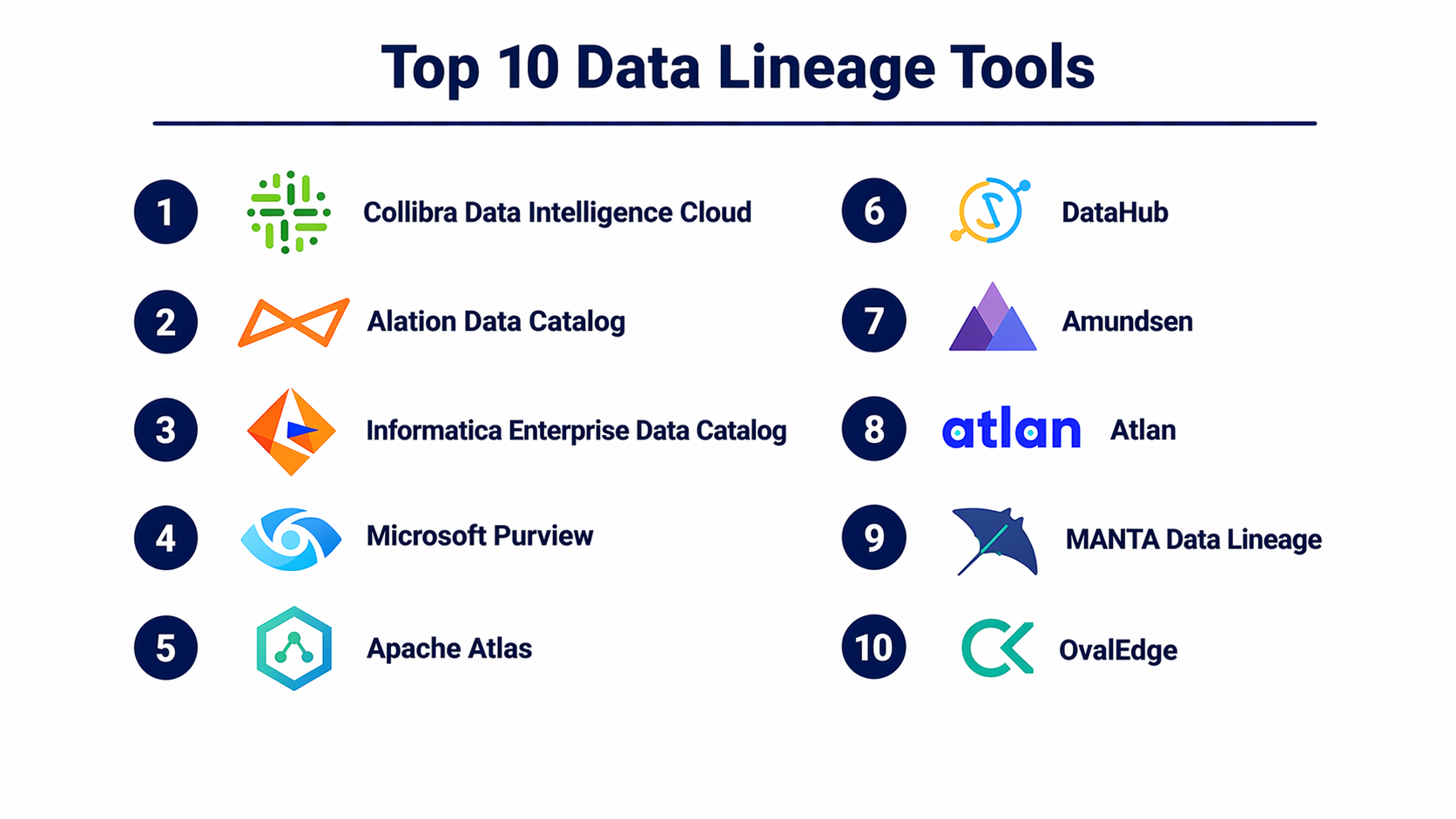
Top 10 Data Lineage Tools
#1 — Collibra Data Intelligence Cloud
Short description: A leading enterprise data governance platform with strong lineage capabilities, ideal for large organizations.
Key Features
- End-to-end data lineage visualization
- Integration with governance workflows
- Metadata management
- Impact analysis tools
- Business glossary integration
Pros
- Strong governance + lineage combination
- Enterprise-grade scalability
Cons
- Complex setup
- Higher cost
Platforms / Deployment
Cloud / Hybrid
Security & Compliance
SSO, RBAC, audit logs (others not publicly stated)
Integrations & Ecosystem
Supports major data platforms and BI tools
- Snowflake
- Tableau
- Power BI
- ETL tools
Support & Community
Enterprise-level support; documentation is strong
#2 — Alation Data Catalog
Short description: A data catalog platform with robust lineage tracking and user-friendly interface.
Key Features
- Automated lineage extraction
- Data catalog integration
- Search and discovery
- Usage analytics
- Collaboration tools
Pros
- Easy to use
- Strong adoption in enterprises
Cons
- Limited deep technical lineage in some cases
- Pricing varies
Platforms / Deployment
Cloud / Hybrid
Security & Compliance
SSO, RBAC (others not publicly stated)
Integrations & Ecosystem
Wide ecosystem
- Databases
- BI tools
- APIs
Support & Community
Good enterprise support; active community
#3 — Informatica Enterprise Data Catalog
Short description: Enterprise-grade metadata and lineage tool with deep integration into Informatica ecosystem.
Key Features
- AI-driven lineage discovery
- Column-level lineage
- Metadata scanning
- Data profiling
- Governance integration
Pros
- Very powerful lineage depth
- Mature platform
Cons
- Complex implementation
- Expensive
Platforms / Deployment
Cloud / On-premise
Security & Compliance
Not publicly stated
Integrations & Ecosystem
Strong with enterprise tools
- Databases
- ETL systems
Support & Community
Strong enterprise support
#4 — Microsoft Purview
Short description: Microsoft’s unified data governance and lineage platform integrated with Azure ecosystem.
Key Features
- Automated lineage mapping
- Data classification
- Policy enforcement
- Data catalog
- Compliance tracking
Pros
- Seamless Azure integration
- Strong compliance features
Cons
- Best suited for Microsoft ecosystem
- Limited cross-platform flexibility
Platforms / Deployment
Cloud
Security & Compliance
RBAC, encryption, compliance features (others not publicly stated)
Integrations & Ecosystem
Azure-focused integrations
- Azure Data Factory
- Power BI
Support & Community
Backed by Microsoft support
#5 — Apache Atlas
Short description: Open-source metadata and lineage tool designed for Hadoop ecosystems.
Key Features
- Metadata management
- Data classification
- Lineage tracking
- Policy enforcement
- Tag-based governance
Pros
- Open-source
- Flexible customization
Cons
- Requires engineering effort
- Limited UI experience
Platforms / Deployment
Self-hosted
Security & Compliance
Not publicly stated
Integrations & Ecosystem
Hadoop ecosystem
- Hive
- HDFS
Support & Community
Community-driven support
#6 — DataHub
Short description: Open-source data catalog with strong lineage capabilities, originally developed at LinkedIn.
Key Features
- Real-time lineage tracking
- Metadata management
- Graph-based lineage
- API-first architecture
- Schema history tracking
Pros
- Developer-friendly
- Highly extensible
Cons
- Setup complexity
- Requires maintenance
Platforms / Deployment
Cloud / Self-hosted
Security & Compliance
Not publicly stated
Integrations & Ecosystem
Strong integrations
- Kafka
- Snowflake
- dbt
Support & Community
Active open-source community
#7 — Amundsen
Short description: Lightweight data discovery and lineage tool built for fast metadata access.
Key Features
- Data discovery
- Metadata indexing
- Lineage visualization
- Search functionality
- Lightweight architecture
Pros
- Fast performance
- Simple interface
Cons
- Limited enterprise features
- Requires customization
Platforms / Deployment
Self-hosted
Security & Compliance
Not publicly stated
Integrations & Ecosystem
Supports data warehouses and BI tools
Support & Community
Community-driven
#8 — Atlan
Short description: Modern data workspace with lineage, catalog, and governance features.
Key Features
- Automated lineage
- Data collaboration
- Metadata management
- Workflow automation
- Slack integration
Pros
- User-friendly
- Strong collaboration features
Cons
- Pricing varies
- Relatively newer
Platforms / Deployment
Cloud
Security & Compliance
SSO, RBAC (others not publicly stated)
Integrations & Ecosystem
Modern stack integrations
- Snowflake
- BigQuery
Support & Community
Good support; growing ecosystem
#9 — MANTA Data Lineage
Short description: Specialized lineage platform focused on deep technical lineage for complex systems.
Key Features
- Automated lineage scanning
- Impact analysis
- Code parsing
- Visualization
- Compliance tracking
Pros
- Deep lineage capabilities
- Strong for compliance
Cons
- Technical complexity
- Enterprise-focused
Platforms / Deployment
Cloud / On-premise
Security & Compliance
Not publicly stated
Integrations & Ecosystem
Supports enterprise systems
- Databases
- ETL tools
Support & Community
Enterprise support
#10 — OvalEdge
Short description: Data governance platform with integrated lineage and catalog features.
Key Features
- End-to-end lineage
- Data catalog
- Governance workflows
- Data quality tracking
- Business glossary
Pros
- All-in-one platform
- Strong governance features
Cons
- UI complexity
- Learning curve
Platforms / Deployment
Cloud / On-premise
Security & Compliance
Not publicly stated
Integrations & Ecosystem
Supports major data tools
Support & Community
Enterprise support available
Comparison Table (Top 10)
| Tool Name | Best For | Platform(s) Supported | Deployment | Standout Feature | Public Rating |
|---|---|---|---|---|---|
| Collibra | Enterprise governance | Web | Cloud/Hybrid | Governance + lineage | N/A |
| Alation | Data catalog users | Web | Cloud/Hybrid | Ease of use | N/A |
| Informatica EDC | Large enterprises | Web | Cloud/On-prem | AI lineage | N/A |
| Microsoft Purview | Azure users | Web | Cloud | Compliance integration | N/A |
| Apache Atlas | Hadoop users | Linux | Self-hosted | Open-source lineage | N/A |
| DataHub | Developers | Web/Linux | Hybrid | Real-time lineage | N/A |
| Amundsen | Lightweight use | Web | Self-hosted | Fast metadata search | N/A |
| Atlan | Modern teams | Web | Cloud | Collaboration features | N/A |
| MANTA | Compliance-heavy orgs | Web | Hybrid | Deep lineage scanning | N/A |
| OvalEdge | Governance teams | Web | Hybrid | All-in-one platform | N/A |
Evaluation & Scoring of Data Lineage Tools
| Tool Name | Core | Ease | Integrations | Security | Performance | Support | Value | Weighted Total |
|---|---|---|---|---|---|---|---|---|
| Collibra | 9 | 7 | 9 | 8 | 8 | 9 | 7 | 8.2 |
| Alation | 8 | 8 | 8 | 7 | 8 | 8 | 7 | 7.9 |
| Informatica | 9 | 6 | 9 | 8 | 9 | 9 | 6 | 8.1 |
| Purview | 8 | 7 | 8 | 8 | 8 | 8 | 7 | 7.8 |
| Apache Atlas | 7 | 5 | 7 | 6 | 7 | 6 | 8 | 6.8 |
| DataHub | 8 | 6 | 8 | 6 | 8 | 7 | 8 | 7.5 |
| Amundsen | 6 | 7 | 6 | 6 | 7 | 6 | 7 | 6.6 |
| Atlan | 8 | 9 | 8 | 7 | 8 | 8 | 7 | 8.0 |
| MANTA | 9 | 6 | 8 | 8 | 8 | 8 | 6 | 7.9 |
| OvalEdge | 8 | 7 | 8 | 7 | 7 | 7 | 7 | 7.5 |
How to interpret scores:
- Scores are comparative across tools, not absolute
- Higher “Core” reflects stronger lineage capabilities
- “Ease” indicates onboarding and usability
- “Value” balances pricing vs capabilities
- Enterprise tools score higher in depth but lower in ease
Which Data Lineage Tools Right for You?
Solo / Freelancer
Lightweight tools like Amundsen or open-source options work best.
SMB
Atlan or DataHub provide balance between usability and features.
Mid-Market
Alation or Microsoft Purview offer strong integration and scalability.
Enterprise
Collibra, Informatica, and MANTA are ideal for complex environments.
Budget vs Premium
- Budget: Apache Atlas, DataHub
- Premium: Collibra, Informatica
Feature Depth vs Ease of Use
- Deep features: MANTA, Informatica
- Easy to use: Atlan, Alation
Integrations & Scalability
Choose tools with strong API and cloud integrations for growth.
Security & Compliance Needs
Enterprise-grade tools are better for regulated industries.
Frequently Asked Questions (FAQs)
What are data lineage tools used for?
They track data flow and transformations across systems.
Are data lineage tools expensive?
Pricing varies; enterprise tools are costly while open-source is free.
Do small teams need lineage tools?
Not always; simpler tools may suffice.
How long does implementation take?
From days (cloud tools) to months (enterprise systems).
Are these tools cloud-based?
Many are cloud-native, but some support hybrid/on-prem.
Can lineage tools improve data quality?
Yes, by identifying issues and dependencies.
Do they support real-time data?
Some modern tools support real-time lineage.
Are open-source tools reliable?
Yes, but require technical expertise.
Can they integrate with BI tools?
Most tools support major BI integrations.
What’s the biggest challenge?
Complex setup and integration.
Conclusion
Data lineage tools have become essential for organizations dealing with complex, distributed, and regulated data environments. As data ecosystems grow, the need to understand how data flows, transforms, and impacts downstream systems becomes critical for both operational efficiency and compliance. While enterprise tools like Collibra and Informatica offer deep capabilities, newer platforms like Atlan and DataHub provide a more modern and flexible approach.
