Introduction
Data Quality Tools are software platforms that help organizations ensure their data is accurate, consistent, complete, and reliable across systems. In simple terms, they detect errors, clean messy data, enforce rules, and monitor data health over time.
In today’s data-driven environment, poor data quality directly impacts business decisions, AI models, customer experience, and compliance. As organizations adopt data lakes, real-time analytics, and AI pipelines, maintaining high-quality data has become a foundational requirement rather than an optional step.
Real-world use cases include:
- Cleaning customer data in CRM systems
- Validating financial transactions and reporting data
- Ensuring accurate inputs for AI/ML models
- Monitoring data pipelines in modern data stacks
- Maintaining compliance-ready datasets (GDPR, internal audits)
What buyers should evaluate:
- Data profiling and validation capabilities
- Automation and AI-assisted data cleaning
- Integration with data pipelines and warehouses
- Scalability for large datasets
- Real-time monitoring and alerting
- Security and governance controls
- Ease of use and learning curve
- Deployment flexibility (cloud vs on-prem)
- Pricing model and ROI
- Support and documentation quality
Best for: Data engineers, data analysts, IT managers, compliance teams, and organizations managing large or complex data pipelines across industries like finance, healthcare, e-commerce, and SaaS.
Not ideal for: Small teams with minimal structured data, or organizations using simple spreadsheets where lightweight validation tools may be sufficient.
Key Trends in Data Quality Tools
- AI-driven data cleansing: Tools now use ML to detect anomalies and auto-suggest fixes
- Data observability integration: Real-time monitoring of data pipelines is becoming standard
- Shift to cloud-native platforms: Most modern tools are SaaS-first with scalable architectures
- Automation-first workflows: Reduced manual intervention through rule-based automation
- Data governance convergence: Quality tools increasingly overlap with governance platforms
- Real-time validation: Streaming data quality checks for event-driven systems
- Embedded quality in pipelines: Integration with ETL/ELT tools like dbt and Airflow
- Compliance-ready frameworks: Built-in support for regulatory data requirements
- API-first architecture: Strong integration capabilities across modern data stacks
- Usage-based pricing models: Cost tied to data volume and processing rather than licenses
How We Selected These Tools (Methodology)
- Evaluated market adoption and enterprise usage
- Assessed feature completeness and depth of data validation capabilities
- Considered performance and reliability signals in production environments
- Reviewed security posture and governance capabilities
- Checked integration ecosystem compatibility (ETL, BI, cloud platforms)
- Balanced enterprise-grade and developer-friendly tools
- Included both cloud-native and open-source options
- Considered usability and onboarding complexity
- Ensured coverage across different business sizes and industries
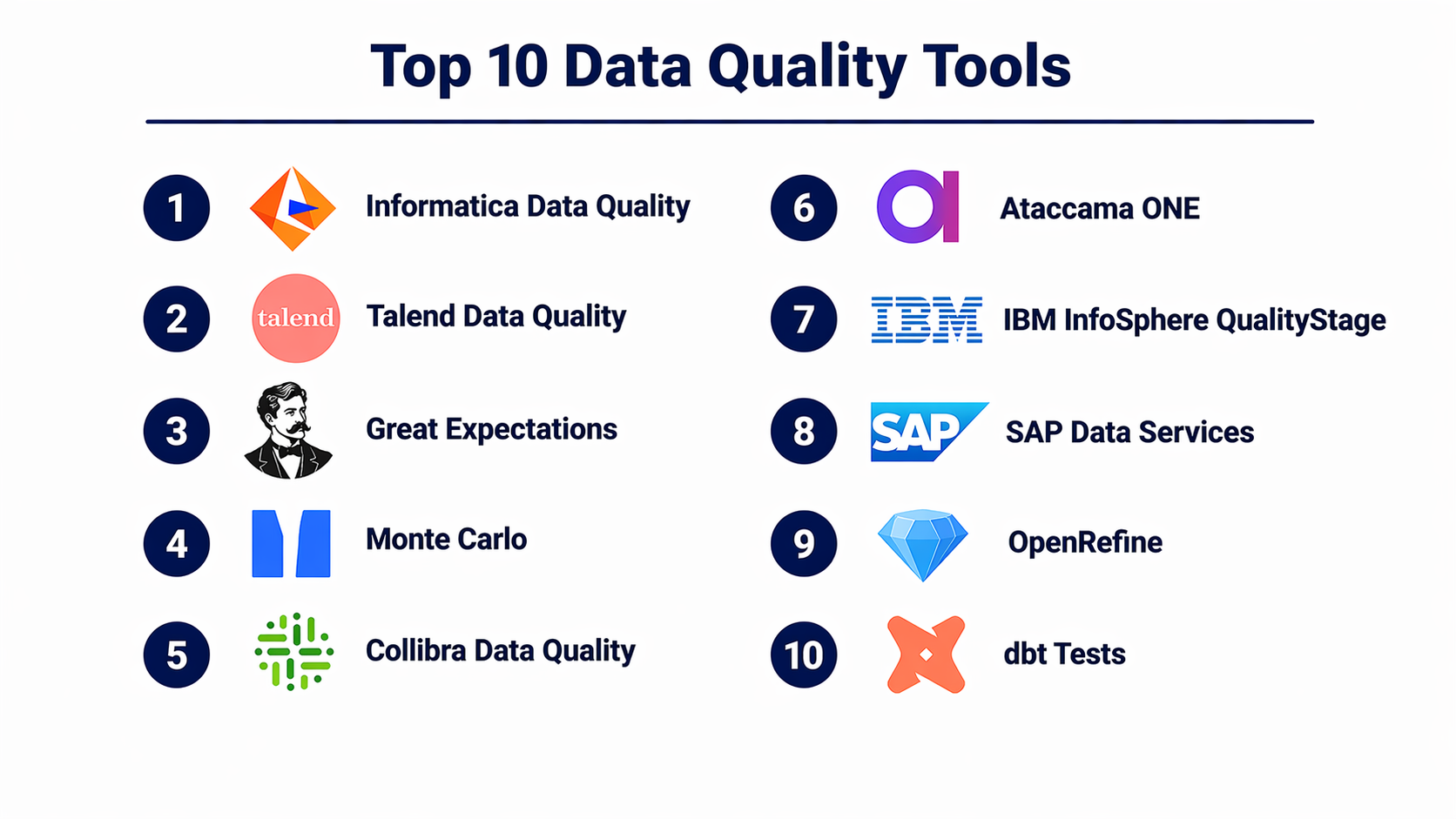
Top 10 Data Quality Tools
#1 — Informatica Data Quality
Short description: Enterprise-grade data quality platform designed for large organizations needing advanced profiling, cleansing, and governance.
Key Features
- Data profiling and discovery
- Rule-based validation and cleansing
- AI-powered data matching
- Data standardization tools
- Integration with Informatica ecosystem
- Metadata management
- Data quality dashboards
Pros
- Strong enterprise capabilities
- Highly scalable for large datasets
Cons
- Complex setup and learning curve
- Expensive for smaller teams
Platforms / Deployment
Cloud / Hybrid
Security & Compliance
Supports RBAC, encryption, audit logs. Other certifications: Not publicly stated.
Integrations & Ecosystem
Integrates deeply with enterprise systems.
- ETL platforms
- Data warehouses
- CRM systems
- APIs
Support & Community
Strong enterprise support; documentation is extensive but complex.
#2 — Talend Data Quality
Short description: Open-source-friendly tool with strong integration into data pipelines and ETL workflows.
Key Features
- Data profiling
- Data cleansing workflows
- Duplicate detection
- Integration with Talend ETL
- Data standardization
- Open-source flexibility
Pros
- Flexible and extensible
- Strong integration with pipelines
Cons
- UI can feel outdated
- Requires technical expertise
Platforms / Deployment
Cloud / Self-hosted
Security & Compliance
Basic controls; details vary.
Integrations & Ecosystem
- Talend ecosystem
- Databases
- Cloud platforms
- APIs
Support & Community
Good community support due to open-source presence.
#3 — Great Expectations
Short description: Developer-first open-source framework for data validation and testing.
Key Features
- Data testing framework
- Expectation-based validation
- Data documentation
- Integration with pipelines
- CI/CD support
- Custom rule creation
Pros
- Highly customizable
- Ideal for modern data stacks
Cons
- Requires coding knowledge
- Limited UI compared to SaaS tools
Platforms / Deployment
Self-hosted / Cloud
Security & Compliance
Not publicly stated.
Integrations & Ecosystem
- dbt
- Airflow
- Spark
- Cloud warehouses
Support & Community
Strong open-source community.
#4 — Monte Carlo
Short description: Data observability platform focusing on pipeline monitoring and anomaly detection.
Key Features
- Data anomaly detection
- Pipeline monitoring
- Root cause analysis
- Data freshness tracking
- Incident alerting
- AI-driven insights
Pros
- Strong observability features
- Easy to use
Cons
- Premium pricing
- Limited deep cleansing features
Platforms / Deployment
Cloud
Security & Compliance
Not publicly stated.
Integrations & Ecosystem
- Snowflake
- BigQuery
- Redshift
- BI tools
Support & Community
Enterprise-focused support.
#5 — Collibra Data Quality
Short description: Governance-focused data quality tool for enterprises needing compliance and data catalog integration.
Key Features
- Data governance integration
- Data lineage tracking
- Rule-based validation
- Data cataloging
- Compliance workflows
- Quality dashboards
Pros
- Strong governance capabilities
- Enterprise-grade solution
Cons
- Expensive
- Complex implementation
Platforms / Deployment
Cloud / Hybrid
Security & Compliance
Supports enterprise-grade security controls.
Integrations & Ecosystem
- Data catalogs
- BI tools
- ETL tools
Support & Community
Strong enterprise support.
#6 — Ataccama ONE
Short description: Unified platform combining data quality, governance, and master data management.
Key Features
- AI-driven data quality
- Data profiling
- Master data management
- Data governance
- Workflow automation
- Anomaly detection
Pros
- All-in-one platform
- Strong AI features
Cons
- Learning curve
- Higher cost
Platforms / Deployment
Cloud / Hybrid
Security & Compliance
Not publicly stated.
Integrations & Ecosystem
- Enterprise systems
- Data lakes
- APIs
Support & Community
Enterprise-level support.
#7 — IBM InfoSphere QualityStage
Short description: Enterprise solution focused on data cleansing and standardization for large-scale operations.
Key Features
- Data cleansing
- Standardization
- Matching and deduplication
- Data enrichment
- Integration with IBM stack
Pros
- Highly reliable
- Enterprise-ready
Cons
- Expensive
- Legacy UI
Platforms / Deployment
On-prem / Cloud
Security & Compliance
Enterprise-grade security; details not publicly stated.
Integrations & Ecosystem
- IBM ecosystem
- Databases
- ETL tools
Support & Community
Strong enterprise support.
#8 — SAP Data Services
Short description: Data integration and quality platform tightly integrated with SAP environments.
Key Features
- Data cleansing
- ETL capabilities
- Data profiling
- Integration with SAP systems
- Data transformation
- Metadata management
Pros
- Ideal for SAP users
- Strong integration
Cons
- Limited flexibility outside SAP
- Complex setup
Platforms / Deployment
On-prem / Cloud
Security & Compliance
Not publicly stated.
Integrations & Ecosystem
- SAP systems
- Databases
- Enterprise apps
Support & Community
Strong SAP support ecosystem.
#9 — OpenRefine
Short description: Lightweight open-source tool for cleaning messy datasets.
Key Features
- Data cleaning
- Transformation tools
- Clustering for duplicates
- Extension support
- Local processing
Pros
- Free and open-source
- Easy for small datasets
Cons
- Not scalable
- Limited automation
Platforms / Deployment
Windows / macOS / Linux
Security & Compliance
Not publicly stated.
Integrations & Ecosystem
- CSV/Excel data
- Extensions
Support & Community
Active open-source community.
#10 — dbt Tests (dbt Core)
Short description: Data testing capabilities within dbt for modern data transformation workflows.
Key Features
- Data testing
- SQL-based validation
- Pipeline integration
- Version control
- Documentation generation
Pros
- Developer-friendly
- Fits modern data stacks
Cons
- Requires SQL knowledge
- Limited UI
Platforms / Deployment
Cloud / Self-hosted
Security & Compliance
Not publicly stated.
Integrations & Ecosystem
- Data warehouses
- ETL tools
- CI/CD pipelines
Support & Community
Strong developer community.
Comparison Table (Top 10)
| Tool Name | Best For | Platform(s) Supported | Deployment | Standout Feature | Public Rating |
|---|---|---|---|---|---|
| Informatica Data Quality | Enterprises | Web | Cloud/Hybrid | AI data matching | N/A |
| Talend Data Quality | SMB/Developers | Web | Cloud/Self-hosted | Open-source flexibility | N/A |
| Great Expectations | Developers | Linux/Web | Self-hosted/Cloud | Data testing framework | N/A |
| Monte Carlo | Data observability | Web | Cloud | Anomaly detection | N/A |
| Collibra Data Quality | Governance teams | Web | Cloud/Hybrid | Data catalog integration | N/A |
| Ataccama ONE | Enterprises | Web | Cloud/Hybrid | AI-driven quality | N/A |
| IBM QualityStage | Large enterprises | Web | On-prem/Cloud | Data standardization | N/A |
| SAP Data Services | SAP users | Web | On-prem/Cloud | SAP integration | N/A |
| OpenRefine | Individuals | Desktop | Local | Data cleaning simplicity | N/A |
| dbt Tests | Data engineers | CLI/Web | Cloud/Self-hosted | SQL-based validation | N/A |
Evaluation & Scoring of Data Quality Tools
| Tool Name | Core (25%) | Ease (15%) | Integrations (15%) | Security (10%) | Performance (10%) | Support (10%) | Value (15%) | Weighted Total |
|---|---|---|---|---|---|---|---|---|
| Informatica | 9 | 6 | 9 | 8 | 9 | 9 | 6 | 8.1 |
| Talend | 8 | 7 | 8 | 7 | 8 | 7 | 8 | 7.8 |
| Great Expectations | 8 | 6 | 9 | 6 | 8 | 8 | 9 | 7.9 |
| Monte Carlo | 8 | 8 | 8 | 7 | 8 | 8 | 6 | 7.7 |
| Collibra | 9 | 6 | 8 | 9 | 8 | 9 | 6 | 8.0 |
| Ataccama | 9 | 7 | 8 | 8 | 8 | 8 | 7 | 8.0 |
| IBM QualityStage | 8 | 6 | 7 | 8 | 9 | 8 | 6 | 7.7 |
| SAP Data Services | 8 | 6 | 7 | 7 | 8 | 8 | 6 | 7.5 |
| OpenRefine | 6 | 9 | 5 | 5 | 6 | 6 | 10 | 6.8 |
| dbt Tests | 8 | 7 | 9 | 6 | 8 | 8 | 9 | 8.0 |
How to interpret scores:
- Scores are comparative, not absolute
- Enterprise tools score higher on features but lower on value
- Developer tools score higher on flexibility and integrations
- Choose based on use case, not just score
Which Data Quality Tools Right for You?
Solo / Freelancer
- Best: OpenRefine, dbt Tests
- Focus on simplicity and cost
SMB
- Best: Talend, Great Expectations
- Balance of flexibility and affordability
Mid-Market
- Best: Monte Carlo, Ataccama
- Focus on automation and scalability
Enterprise
- Best: Informatica, Collibra, IBM
- Strong governance and compliance
Budget vs Premium
- Budget: OpenRefine, dbt
- Premium: Informatica, Collibra
Feature Depth vs Ease of Use
- Easy: Monte Carlo
- Deep features: Informatica
Integrations & Scalability
- Modern stack: Great Expectations, dbt
- Enterprise stack: SAP, IBM
Security & Compliance Needs
- High compliance: Collibra, Informatica
- Basic needs: Open-source tools
Frequently Asked Questions (FAQs)
What are Data Quality Tools?
They are tools that clean, validate, and monitor data to ensure accuracy and reliability.
Are Data Quality Tools expensive?
Costs vary widely from free open-source tools to expensive enterprise platforms.
Can small businesses use them?
Yes, tools like OpenRefine and Talend are suitable for smaller teams.
Do they support real-time data?
Some modern tools support real-time validation and monitoring.
Are they necessary for AI projects?
Yes, poor data quality leads to poor AI model performance.
How long does implementation take?
Depends on complexity; can range from days to months.
Do they integrate with cloud platforms?
Most modern tools support major cloud platforms.
Are they secure?
Enterprise tools offer strong security; open-source tools depend on setup.
Can I switch tools later?
Yes, but migration can be complex depending on integrations.
What is the biggest mistake to avoid?
Ignoring data quality early in the pipeline.
Conclusion
Data quality is no longer just a backend concern—it directly impacts analytics accuracy, AI outcomes, compliance, and business trust. The tools listed here range from lightweight open-source options to enterprise-grade platforms, each designed for different levels of complexity and scale. There is no single “best” tool for everyone. Instead, the right choice depends on your data maturity, team skills, budget, and integration needs. A practical approach is to shortlist two or three tools that align with your environment, run a pilot project, and evaluate how well they integrate with your existing data stack. Focus on long-term scalability, automation capabilities, and governance support to ensure sustainable data quality improvements.
