Introduction
Static Code Analysis Tools are software solutions that analyze source code without executing it to identify bugs, vulnerabilities, code smells, and maintainability issues. These tools help development teams catch problems early in the development lifecycle, improving code quality and reducing the cost of fixing defects later.
With the rise of DevSecOps, secure coding practices, and compliance requirements, static analysis has become a critical part of modern software development. These tools integrate into CI/CD pipelines, IDEs, and version control systems to provide continuous feedback on code quality and security risks.
Common use cases include:
- Detecting bugs and logic errors before runtime
- Identifying security vulnerabilities
- Enforcing coding standards and best practices
- Improving code maintainability
- Supporting compliance and audit requirements
What buyers should evaluate:
- Language support and coverage
- Accuracy and false-positive rates
- Security vulnerability detection
- Integration with CI/CD pipelines
- Ease of setup and use
- Reporting and dashboards
- Scalability for large codebases
- Custom rule creation
- Performance impact
- Cost and licensing
Best for: Developers, QA engineers, DevOps teams, and security professionals focused on improving code quality and security.
Not ideal for: Small scripts or projects where manual review is sufficient and automated analysis may be unnecessary.
Key Trends in Static Code Analysis Tools
- Shift-left security (DevSecOps): Integrating security checks early in development
- AI-assisted code analysis: Smarter detection with fewer false positives
- Cloud-based scanning: Scalable and accessible analysis platforms
- Real-time feedback in IDEs: Immediate insights while coding
- Policy-as-code: Enforcing rules automatically
- Multi-language support: Handling diverse tech stacks
- Integration with CI/CD pipelines: Automated quality gates
- Developer-friendly UX: Simplified dashboards and reports
- Compliance-driven features: Supporting standards like GDPR and secure coding
- Open-source adoption: Growing use of community-driven tools
How We Selected These Tools (Methodology)
- Evaluated industry adoption and credibility
- Assessed code quality and security analysis capabilities
- Reviewed language and framework support
- Considered integration with DevOps ecosystems
- Analyzed accuracy and false-positive handling
- Checked scalability and performance
- Evaluated ease of use and onboarding
- Examined reporting and visualization features
- Included both open-source and enterprise tools
- Focused on real-world developer workflows
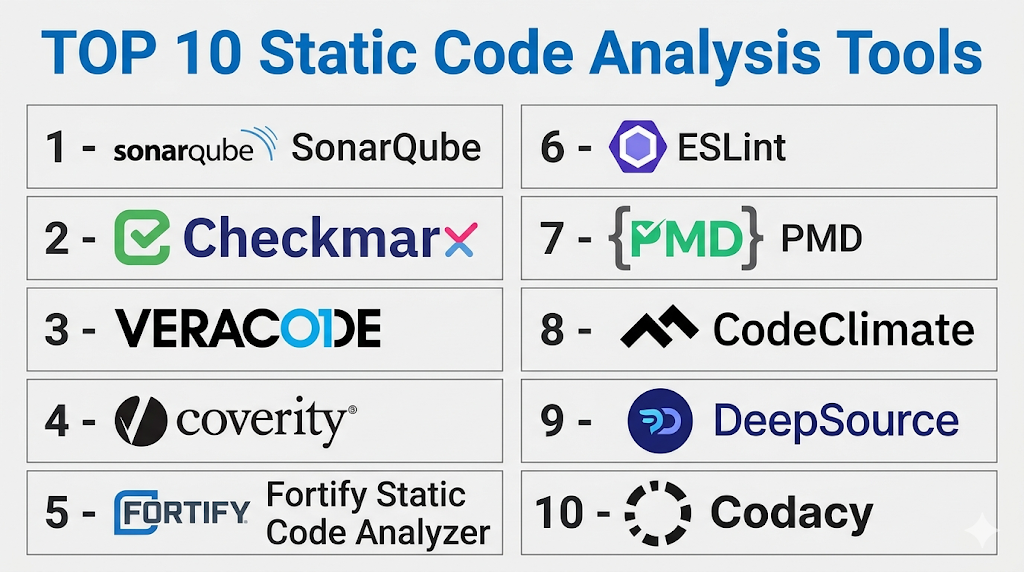
Top Static Code Analysis Tools
#1 — SonarQube
Short description: A widely used platform for continuous code quality and security analysis.
Key Features
- Multi-language support
- Code quality metrics
- Security vulnerability detection
- Quality gates
- CI/CD integration
- Detailed dashboards
Pros
- Comprehensive analysis
- Strong community
Cons
- Setup complexity
- Resource-heavy
Platforms / Deployment
Cloud / Self-hosted
Security & Compliance
RBAC, security scanning
Integrations & Ecosystem
SonarQube integrates with major DevOps tools.
- Jenkins
- GitHub
- GitLab
- APIs
Support & Community
Large global community.
#2 — Checkmarx
Short description: An enterprise-grade tool focused on application security testing.
Key Features
- Static application security testing (SAST)
- Vulnerability detection
- Compliance support
- CI/CD integration
- Reporting tools
Pros
- Strong security focus
- Enterprise-ready
Cons
- Expensive
- Complex setup
Platforms / Deployment
Cloud / On-prem / Hybrid
Security & Compliance
SAST, compliance tools
Integrations & Ecosystem
- CI/CD tools
- APIs
- DevOps platforms
Support & Community
Enterprise support.
#3 — Veracode
Short description: A cloud-based platform for application security testing.
Key Features
- Static analysis
- Security scanning
- Compliance reporting
- Developer training
- Cloud-native platform
Pros
- Strong security features
- Easy cloud access
Cons
- Costly
- Limited customization
Platforms / Deployment
Cloud
Security & Compliance
Compliance tools, encryption
Integrations & Ecosystem
- CI/CD tools
- APIs
- Dev tools
Support & Community
Enterprise support.
#4 — Coverity
Short description: A static analysis tool focused on identifying critical defects.
Key Features
- Deep code analysis
- Security vulnerability detection
- Compliance support
- CI/CD integration
- Reporting tools
Pros
- High accuracy
- Enterprise-grade
Cons
- Expensive
- Complex UI
Platforms / Deployment
Cloud / On-prem
Security & Compliance
Security scanning, compliance
Integrations & Ecosystem
- DevOps tools
- APIs
- CI/CD platforms
Support & Community
Enterprise support.
#5 — Fortify Static Code Analyzer
Short description: A security-focused static analysis tool for enterprise environments.
Key Features
- Vulnerability detection
- Compliance support
- Multi-language support
- Automation
- Reporting tools
Pros
- Strong security capabilities
- Enterprise support
Cons
- High cost
- Complex setup
Platforms / Deployment
Cloud / On-prem / Hybrid
Security & Compliance
Security scanning, compliance
Integrations & Ecosystem
- CI/CD tools
- APIs
- Dev platforms
Support & Community
Enterprise support.
#6 — ESLint
Short description: A popular open-source tool for analyzing JavaScript code.
Key Features
- Rule-based analysis
- Plugin ecosystem
- Custom rules
- Integration with editors
- Lightweight
Pros
- Free and open-source
- Highly customizable
Cons
- Limited to JavaScript
- Requires configuration
Platforms / Deployment
Cross-platform / Local
Security & Compliance
Not publicly stated
Integrations & Ecosystem
- VS Code
- APIs
- Dev tools
Support & Community
Very active community.
#7 — PMD
Short description: An open-source tool for detecting code issues in multiple languages.
Key Features
- Code rule enforcement
- Multi-language support
- Duplicate code detection
- Custom rules
- Lightweight
Pros
- Free
- Multi-language support
Cons
- Basic UI
- Limited advanced features
Platforms / Deployment
Cross-platform / Local
Security & Compliance
Not publicly stated
Integrations & Ecosystem
- CI/CD tools
- APIs
- Dev tools
Support & Community
Active community.
#8 — CodeClimate
Short description: A cloud-based platform for code quality and maintainability insights.
Key Features
- Code quality analysis
- Maintainability metrics
- Automated checks
- CI/CD integration
- Reporting dashboards
Pros
- Easy to use
- Good visualization
Cons
- Limited deep analysis
- Pricing concerns
Platforms / Deployment
Cloud
Security & Compliance
Not publicly stated
Integrations & Ecosystem
- GitHub
- GitLab
- APIs
Support & Community
Moderate support.
#9 — DeepSource
Short description: A developer-friendly static analysis platform with automation features.
Key Features
- Automated code review
- Multi-language support
- Security analysis
- Autofix suggestions
- CI/CD integration
Pros
- Easy setup
- Automated fixes
Cons
- Limited enterprise features
- Smaller ecosystem
Platforms / Deployment
Cloud
Security & Compliance
Not publicly stated
Integrations & Ecosystem
- GitHub
- GitLab
- APIs
Support & Community
Growing community.
#10 — Codacy
Short description: A code quality and security analysis tool with automated insights.
Key Features
- Automated code reviews
- Multi-language support
- Security analysis
- CI/CD integration
- Reporting dashboards
Pros
- Easy to use
- Good automation
Cons
- Limited customization
- Pricing limitations
Platforms / Deployment
Cloud
Security & Compliance
Not publicly stated
Integrations & Ecosystem
- GitHub
- Bitbucket
- APIs
Support & Community
Moderate community.
Comparison Table (Top 10)
| Tool Name | Best For | Platform(s) Supported | Deployment | Standout Feature | Public Rating |
|---|---|---|---|---|---|
| SonarQube | Code quality | Multi-platform | Hybrid | Quality gates | N/A |
| Checkmarx | Security | Multi-platform | Hybrid | SAST | N/A |
| Veracode | Cloud security | Web | Cloud | Compliance | N/A |
| Coverity | Bug detection | Multi-platform | Hybrid | Accuracy | N/A |
| Fortify | Enterprise security | Multi-platform | Hybrid | Vulnerability detection | N/A |
| ESLint | JavaScript | Multi-platform | Local | Custom rules | N/A |
| PMD | Multi-language | Multi-platform | Local | Rule engine | N/A |
| CodeClimate | Maintainability | Web | Cloud | Insights | N/A |
| DeepSource | Automation | Web | Cloud | Autofix | N/A |
| Codacy | Code quality | Web | Cloud | Automation | N/A |
Static Code Analysis Tools (Scoring)
| Tool Name | Core (25%) | Ease (15%) | Integrations (15%) | Security (10%) | Performance (10%) | Support (10%) | Value (15%) | Weighted Total |
|---|---|---|---|---|---|---|---|---|
| SonarQube | 10 | 8 | 10 | 9 | 9 | 10 | 9 | 9.4 |
| Checkmarx | 9 | 7 | 9 | 10 | 9 | 9 | 6 | 8.7 |
| Veracode | 9 | 8 | 9 | 10 | 9 | 9 | 6 | 8.8 |
| Coverity | 9 | 7 | 8 | 9 | 10 | 9 | 6 | 8.5 |
| Fortify | 9 | 7 | 8 | 10 | 9 | 9 | 6 | 8.6 |
| ESLint | 8 | 9 | 8 | 6 | 9 | 10 | 10 | 8.6 |
| PMD | 7 | 8 | 7 | 6 | 8 | 8 | 10 | 7.8 |
| CodeClimate | 8 | 9 | 8 | 6 | 8 | 8 | 7 | 7.9 |
| DeepSource | 8 | 9 | 8 | 7 | 8 | 7 | 8 | 8.0 |
| Codacy | 8 | 9 | 8 | 7 | 8 | 7 | 8 | 8.0 |
How to interpret:
- Scores are relative comparisons across tools
- Higher scores indicate balanced capabilities
- Enterprise tools excel in security and depth
- Open-source tools offer high value and flexibility
Which Service Mesh Platforms Is Right for You?
Solo / Freelancer
Use ESLint or Codacy for simplicity.
SMB
Choose DeepSource or CodeClimate.
Mid-Market
Use SonarQube or Codacy.
Enterprise
Go with Checkmarx, Veracode, or Fortify.
Budget vs Premium
- Budget: ESLint, PMD
- Premium: Veracode, Checkmarx
Feature Depth vs Ease of Use
- Easy: Codacy, DeepSource
- Advanced: SonarQube
Integrations & Scalability
- Best: SonarQube, Checkmarx
- Limited: PMD
Security & Compliance Needs
- High: Veracode, Fortify
- Basic: ESLint
Static Code Analysis Tools (FAQs)
What is static code analysis?
It analyzes code without running it.
Why is it important?
It helps detect bugs early.
Do these tools improve security?
Yes, many detect vulnerabilities.
Are they integrated with CI/CD?
Most modern tools support this.
Are open-source tools available?
Yes, like ESLint and PMD.
Can they handle large codebases?
Enterprise tools can.
Are they easy to use?
Some require setup and configuration.
Do they support multiple languages?
Many tools do.
What are common challenges?
False positives and configuration.
Can I switch tools later?
Yes, but requires migration effort.
Conclusion
Static Code Analysis Tools are essential for maintaining high-quality, secure, and maintainable code in modern development environments. Whether you need lightweight rule-based analysis or enterprise-grade security scanning, there’s a tool tailored to your needs.
