Introduction
Vendor Management Systems (VMS) are software platforms designed to help organizations manage their relationships with external vendors, suppliers, contractors, and service providers in a structured and efficient way. In simple terms, a VMS centralizes vendor data, automates procurement workflows, tracks performance, and ensures compliance—all from one place.
In the modern business environment, especially as companies rely more on distributed teams, outsourcing, and global supply chains, VMS platforms have become essential. In 2026 and beyond, organizations face increasing complexity in vendor ecosystems, stricter compliance regulations, and a growing need for automation and AI-driven decision-making. A robust VMS helps reduce risk, improve cost control, and enhance operational efficiency.
Real-world use cases include:
- Managing contingent workforce vendors in IT and engineering firms
- Tracking supplier performance and contracts in manufacturing
- Handling procurement and onboarding of service vendors in enterprises
- Ensuring compliance with data privacy and security standards
- Automating vendor payments and contract renewals
What buyers should evaluate:
- Vendor onboarding and lifecycle management capabilities
- Contract management and compliance features
- Reporting and analytics (including AI insights)
- Integration with ERP, HR, and procurement systems
- Security and access control mechanisms
- Scalability and multi-region support
- User experience and workflow automation
- Pricing structure and ROI potential
Best for: Enterprises, procurement teams, HR departments, finance leaders, and operations managers in industries like IT, manufacturing, healthcare, and logistics.
Not ideal for: Small teams with minimal vendor interactions or freelancers managing only a few vendors—simple spreadsheets or lightweight tools may be sufficient in such cases.
Key Trends in Vendor Management Systems (VMS)
- AI-powered vendor scoring: Systems now use AI to predict vendor performance, risk, and cost efficiency.
- Automation-first workflows: Automated onboarding, compliance checks, and invoice approvals reduce manual effort.
- Integrated procurement ecosystems: VMS platforms increasingly connect deeply with ERP and finance systems.
- Focus on compliance & risk management: GDPR, data security, and audit readiness are central features.
- Cloud-native adoption: Most modern VMS tools are SaaS-based with scalable architectures.
- Real-time analytics dashboards: Businesses demand instant visibility into vendor performance and spend.
- Vendor self-service portals: Vendors can update their profiles, upload documents, and manage contracts directly.
- Flexible pricing models: Subscription-based and usage-based pricing are becoming common.
- API-first platforms: Strong API ecosystems enable custom integrations and automation.
How We Selected These Tools (Methodology)
- Evaluated market adoption and enterprise usage across industries
- Assessed feature completeness, especially vendor lifecycle and contract management
- Considered performance reliability and scalability for large organizations
- Reviewed security posture indicators such as RBAC, encryption, and compliance readiness
- Analyzed integration ecosystems including ERP, HR, and procurement tools
- Included tools suitable for different business sizes (SMB to enterprise)
- Prioritized platforms with modern UI/UX and automation capabilities
- Balanced innovation (AI, analytics) with proven operational stability
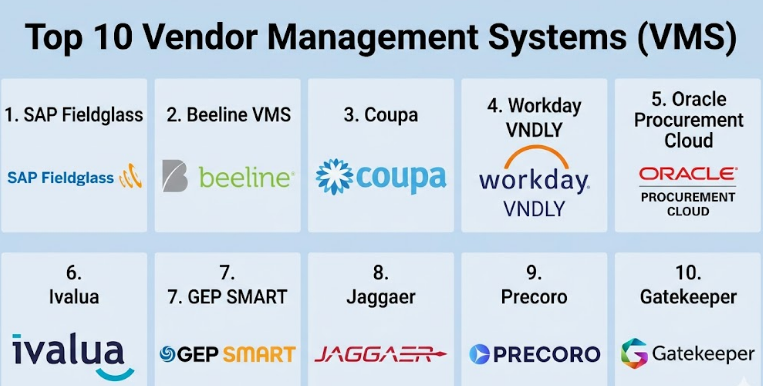
Top 10 Vendor Management Systems (VMS)
#1 — SAP Fieldglass
Short description: A leading enterprise-grade VMS focused on managing contingent workforce and services procurement. Ideal for large organizations with complex vendor ecosystems.
Key Features
- End-to-end vendor lifecycle management
- Contingent workforce tracking
- Real-time analytics and dashboards
- Compliance and risk monitoring
- Vendor onboarding workflows
- Contract and rate management
Pros
- Highly scalable for global enterprises
- Deep integration with SAP ecosystem
Cons
- Complex implementation
- Expensive for smaller businesses
Platforms / Deployment
Cloud
Security & Compliance
SSO, RBAC, encryption, audit logs; SOC 2 and GDPR support (varies by implementation)
Integrations & Ecosystem
SAP Fieldglass integrates deeply with SAP ERP and procurement systems, offering strong enterprise-level connectivity.
- SAP S/4HANA
- Ariba
- Workday
- Oracle systems
Support & Community
Enterprise-grade support with dedicated account teams; strong documentation but requires onboarding assistance.
#2 — Beeline VMS
Short description: A widely adopted VMS platform for managing external workforce and vendor relationships, especially in HR-driven environments.
Key Features
- Workforce and vendor management
- Advanced analytics
- Compliance tracking
- Vendor performance scoring
- Automated workflows
Pros
- Strong reporting capabilities
- Flexible configuration
Cons
- UI can feel outdated
- Learning curve for new users
Platforms / Deployment
Cloud
Security & Compliance
SSO, encryption, RBAC; compliance capabilities available
Integrations & Ecosystem
- HR systems
- ERP tools
- Payroll platforms
- APIs for custom integrations
Support & Community
Enterprise-level support; onboarding assistance recommended.
#3 — Coupa
Short description: A comprehensive spend management platform with strong vendor management capabilities, suitable for finance and procurement teams.
Key Features
- Supplier management
- Spend analytics
- Procurement automation
- Contract lifecycle management
- Invoice and payment tracking
Pros
- Strong financial insights
- Unified spend visibility
Cons
- Not purely VMS-focused
- Implementation complexity
Platforms / Deployment
Cloud
Security & Compliance
SSO, MFA, encryption, audit logs; compliance features included
Integrations & Ecosystem
- ERP systems
- Financial platforms
- Procurement tools
- API-based integrations
Support & Community
Strong enterprise support and documentation.
#4 — Workday VNDLY
Short description: A modern VMS integrated with Workday, focusing on workforce and vendor management.
Key Features
- Vendor lifecycle management
- Workforce planning
- Spend tracking
- Analytics dashboards
- Compliance workflows
Pros
- Seamless Workday integration
- Modern interface
Cons
- Limited outside Workday ecosystem
- Requires Workday adoption
Platforms / Deployment
Cloud
Security & Compliance
SSO, RBAC, encryption; compliance features available
Integrations & Ecosystem
- Workday ecosystem
- HR tools
- Financial systems
Support & Community
Backed by Workday support; good enterprise onboarding.
#5 — Oracle Procurement Cloud
Short description: A robust procurement and vendor management platform for large enterprises.
Key Features
- Supplier onboarding
- Contract management
- Procurement workflows
- Spend analytics
- Risk management
Pros
- Strong enterprise capabilities
- Deep Oracle integration
Cons
- Complex setup
- Requires Oracle ecosystem familiarity
Platforms / Deployment
Cloud
Security & Compliance
SSO, encryption, audit logs; compliance support varies
Integrations & Ecosystem
- Oracle ERP
- Financial systems
- Supply chain tools
Support & Community
Enterprise support with extensive documentation.
#6 — Ivalua
Short description: A flexible procurement and vendor management platform known for customization.
Key Features
- Supplier lifecycle management
- Risk and compliance tracking
- Spend management
- Contract management
- Workflow automation
Pros
- Highly customizable
- Strong procurement features
Cons
- Requires configuration effort
- Not beginner-friendly
Platforms / Deployment
Cloud / Hybrid
Security & Compliance
RBAC, encryption, audit logs; compliance features available
Integrations & Ecosystem
- ERP systems
- Financial tools
- APIs for extensibility
Support & Community
Strong enterprise support; customization assistance required.
#7 — GEP SMART
Short description: An AI-driven procurement and vendor management platform with advanced analytics.
Key Features
- AI-powered insights
- Supplier management
- Spend analysis
- Contract management
- Risk assessment
Pros
- Strong AI capabilities
- Modern UI
Cons
- Premium pricing
- Learning curve
Platforms / Deployment
Cloud
Security & Compliance
SSO, encryption, audit logs; compliance varies
Integrations & Ecosystem
- ERP systems
- Procurement tools
- APIs
Support & Community
Good support and onboarding services.
#8 — Jaggaer
Short description: A procurement-focused VMS with strong supplier management capabilities.
Key Features
- Supplier onboarding
- Spend analysis
- Procurement workflows
- Contract management
- Risk monitoring
Pros
- Strong sourcing features
- Good analytics
Cons
- UI improvements needed
- Setup complexity
Platforms / Deployment
Cloud
Security & Compliance
Encryption, RBAC; compliance varies
Integrations & Ecosystem
- ERP tools
- Procurement systems
- APIs
Support & Community
Enterprise support available.
#9 — Precoro
Short description: A user-friendly procurement and vendor management tool for SMBs.
Key Features
- Vendor database management
- Purchase order tracking
- Budget control
- Invoice management
- Reporting dashboards
Pros
- Easy to use
- Affordable
Cons
- Limited enterprise features
- Basic analytics
Platforms / Deployment
Cloud
Security & Compliance
Not publicly stated
Integrations & Ecosystem
- Accounting tools
- Financial systems
- APIs
Support & Community
Responsive support; SMB-friendly onboarding.
#10 — Gatekeeper
Short description: A contract and vendor management platform focused on visibility and compliance.
Key Features
- Vendor database
- Contract lifecycle management
- Compliance tracking
- Workflow automation
- Reporting tools
Pros
- Strong contract visibility
- Easy implementation
Cons
- Limited advanced analytics
- Less enterprise depth
Platforms / Deployment
Cloud
Security & Compliance
SSO, encryption; compliance varies
Integrations & Ecosystem
- CRM systems
- Procurement tools
- APIs
Support & Community
Good documentation and customer support.
Comparison Table (Top 10)
| Tool Name | Best For | Platform(s) Supported | Deployment | Standout Feature | Public Rating |
|---|---|---|---|---|---|
| SAP Fieldglass | Enterprise workforce management | Web | Cloud | Contingent workforce tracking | N/A |
| Beeline | Workforce & vendor tracking | Web | Cloud | Advanced reporting | N/A |
| Coupa | Spend management | Web | Cloud | Unified spend visibility | N/A |
| Workday VNDLY | Workday users | Web | Cloud | Native integration | N/A |
| Oracle Procurement Cloud | Enterprise procurement | Web | Cloud | Oracle ecosystem | N/A |
| Ivalua | Custom workflows | Web | Cloud/Hybrid | Flexibility | N/A |
| GEP SMART | AI-driven procurement | Web | Cloud | AI insights | N/A |
| Jaggaer | Supplier sourcing | Web | Cloud | Procurement depth | N/A |
| Precoro | SMB procurement | Web | Cloud | Ease of use | N/A |
| Gatekeeper | Contract management | Web | Cloud | Vendor visibility | N/A |
Evaluation & Scoring of Vendor Management Systems (VMS)
| Tool Name | Core (25%) | Ease (15%) | Integrations (15%) | Security (10%) | Performance (10%) | Support (10%) | Value (15%) | Weighted Total |
|---|---|---|---|---|---|---|---|---|
| SAP Fieldglass | 9 | 6 | 9 | 9 | 9 | 8 | 6 | 8.0 |
| Beeline | 8 | 6 | 8 | 8 | 8 | 7 | 7 | 7.5 |
| Coupa | 9 | 7 | 9 | 9 | 9 | 8 | 7 | 8.3 |
| Workday VNDLY | 8 | 8 | 8 | 8 | 8 | 8 | 7 | 7.9 |
| Oracle Procurement Cloud | 9 | 6 | 9 | 9 | 9 | 8 | 6 | 8.0 |
| Ivalua | 8 | 6 | 8 | 8 | 8 | 7 | 7 | 7.5 |
| GEP SMART | 9 | 7 | 8 | 8 | 9 | 8 | 7 | 8.1 |
| Jaggaer | 8 | 6 | 8 | 8 | 8 | 7 | 7 | 7.5 |
| Precoro | 6 | 9 | 6 | 6 | 7 | 8 | 9 | 7.3 |
| Gatekeeper | 7 | 8 | 7 | 7 | 7 | 8 | 8 | 7.6 |
How to interpret:
- Scores are relative comparisons across tools in this category
- Higher “Core” reflects feature depth and completeness
- “Ease” reflects usability and onboarding effort
- “Value” considers pricing vs capabilities
- No tool is universally best—fit depends on your use case
Which Vendor Management Systems (VMS)
Solo / Freelancer
Lightweight tools like Precoro or Gatekeeper are sufficient for basic vendor tracking.
SMB
Choose user-friendly platforms like Precoro for quick deployment and cost efficiency.
Mid-Market
Ivalua or Jaggaer provide a balance between features and flexibility.
Enterprise
SAP Fieldglass, Coupa, or Oracle Procurement Cloud are ideal for large-scale operations.
Budget vs Premium
- Budget: Precoro
- Premium: SAP Fieldglass, Coupa
Feature Depth vs Ease of Use
- Deep features: SAP, Oracle
- Easy to use: Precoro, Gatekeeper
Integrations & Scalability
- Best integrations: SAP, Oracle, Coupa
- Scalable: Fieldglass, GEP SMART
Security & Compliance Needs
- Strong compliance: SAP, Oracle
- Moderate: SMB tools
Frequently Asked Questions (FAQs)
1. What is a Vendor Management System (VMS)?
A VMS is software that helps organizations manage vendor relationships, contracts, performance, and payments in a centralized platform.
2. How much does a VMS cost?
Pricing varies widely depending on features and scale. It can range from affordable SMB subscriptions to enterprise-level pricing.
3. How long does implementation take?
Implementation can take from a few days (SMB tools) to several months (enterprise platforms).
4. Can VMS integrate with ERP systems?
Yes, most modern VMS platforms offer integrations with ERP, HR, and finance systems.
5. What industries benefit most from VMS?
IT, manufacturing, healthcare, logistics, and finance benefit significantly.
6. Is VMS secure?
Most platforms offer encryption, access controls, and compliance features, but specifics vary by vendor.
7. Can small businesses use VMS?
Yes, SMB-focused tools like Precoro are designed for smaller teams.
8. What are common mistakes when choosing a VMS?
Ignoring integration needs, underestimating implementation complexity, and not evaluating scalability.
9. Can I switch VMS later?
Yes, but migration requires planning, especially for data and integrations.
10. Are there alternatives to VMS?
Yes, basic tools like spreadsheets or procurement software can be alternatives for smaller use cases.
Conclusion
Vendor Management Systems are no longer optional for organizations that rely on multiple vendors, suppliers, or external workforce partners. As vendor ecosystems grow more complex, businesses need structured, scalable, and secure platforms to manage relationships, ensure compliance, and control costs. While enterprise tools like SAP Fieldglass, Coupa, and Oracle Procurement Cloud offer deep functionality and scalability, they also require significant investment and implementation effort. On the other hand, tools like Precoro and Gatekeeper provide simpler, more accessible solutions for smaller teams or growing businesses.