Introduction
Security Information & Event Management (SIEM) is a cybersecurity solution that collects, analyzes, and correlates security data from across an organization’s IT environment. It centralizes logs and events from endpoints, servers, applications, and network devices to provide real-time threat detection, monitoring, and incident response.
SIEM plays a critical role in modern security operations by helping teams identify threats, investigate incidents, and meet compliance requirements. With increasing cyber threats and complex IT environments, organizations rely on SIEM platforms to gain visibility, control, and actionable insights into their security posture.
Common Use Cases
- Centralized log management and monitoring
- Threat detection and alerting
- Incident investigation and response
- Compliance reporting (e.g., audit trails)
- Security analytics and threat hunting
What Buyers Should Evaluate
- Log ingestion and data processing capabilities
- Real-time analytics and correlation rules
- Integration with security tools (EDR, NDR, SOAR)
- Ease of deployment and usability
- Scalability and performance
- Alerting accuracy and noise reduction
- Compliance and reporting features
- Customization and rule creation
- Pricing model (data volume-based, subscription)
- Visualization and dashboards
Best for: Security teams, SOC analysts, enterprises, and organizations with complex IT infrastructures requiring centralized security visibility.
Not ideal for: Small teams without dedicated security resources or environments with minimal security monitoring needs.
Key Trends in Security Information & Event Management (SIEM)
- Cloud-native SIEM platforms: Improved scalability and reduced infrastructure overhead
- AI-driven analytics: Enhanced threat detection and anomaly identification
- Integration with XDR and SOAR: Unified security operations
- Automated incident response: Faster containment and remediation
- Data lake architecture: Handling large-scale data ingestion
- Improved user behavior analytics (UEBA): Detecting insider threats
- Noise reduction techniques: Reducing false positives
- API-first design: Easier integration with modern tools
- Managed SIEM services: Outsourced monitoring and management
- Real-time threat intelligence integration: Better context for alerts
How We Selected These Tools (Methodology)
- Evaluated market adoption and leadership
- Assessed core SIEM capabilities and analytics depth
- Reviewed threat detection accuracy and innovation
- Considered ease of use and operational efficiency
- Analyzed integration ecosystems and extensibility
- Examined scalability and performance
- Included tools for enterprise and mid-market users
- Factored in support quality and community presence
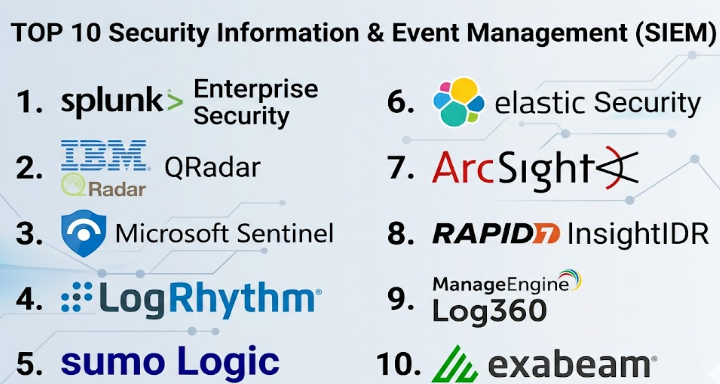
Top Security Information & Event Management (SIEM)
#1 — Splunk Enterprise Security
Short description: A leading SIEM platform known for powerful analytics, scalability, and extensive customization.
Key Features
- Real-time log analysis
- Advanced correlation and analytics
- Threat detection and alerting
- Custom dashboards and reporting
- Integration with Splunk ecosystem
- Threat intelligence integration
Pros
- Highly scalable and flexible
- Strong analytics capabilities
Cons
- Expensive
- Complex setup and management
Platforms / Deployment
Cloud / On-prem
Security & Compliance
RBAC, audit logs, encryption
Compliance varies
Integrations & Ecosystem
Extensive ecosystem and APIs
- Security tools
- Cloud platforms
- Custom integrations
Support & Community
Large community and strong documentation
#2 — IBM QRadar
Short description: Enterprise SIEM platform focused on threat detection, compliance, and incident response.
Key Features
- Log management
- Threat detection
- Behavioral analytics
- Compliance reporting
- Incident investigation tools
Pros
- Strong compliance capabilities
- Good threat detection
Cons
- Complex interface
- Requires expertise
Platforms / Deployment
On-prem / Cloud
Security & Compliance
RBAC, encryption
Compliance varies
Integrations & Ecosystem
Integrates with enterprise security tools
Support & Community
Enterprise support
#3 — Microsoft Sentinel
Short description: Cloud-native SIEM integrated with Microsoft security ecosystem.
Key Features
- Cloud-based log analytics
- AI-driven threat detection
- Automated response workflows
- Integration with Microsoft tools
- Threat intelligence
Pros
- Scalable cloud architecture
- Seamless Microsoft integration
Cons
- Requires Azure expertise
- Pricing can vary based on usage
Platforms / Deployment
Cloud
Security & Compliance
RBAC, audit logs
Compliance varies
Integrations & Ecosystem
Deep Microsoft integrations
- Azure
- Microsoft 365
- APIs
Support & Community
Strong enterprise support
#4 — LogRhythm
Short description: SIEM platform designed for unified security operations and compliance.
Key Features
- Log collection and analysis
- Threat detection
- Incident response
- Compliance reporting
- User behavior analytics
Pros
- Integrated platform
- Good compliance support
Cons
- Interface complexity
- Performance tuning required
Platforms / Deployment
Cloud / On-prem
Security & Compliance
RBAC, encryption
Compliance varies
Integrations & Ecosystem
Integrates with security tools
Support & Community
Strong support
#5 — Sumo Logic
Short description: Cloud-native SIEM solution focused on real-time analytics and monitoring.
Key Features
- Log analytics
- Threat detection
- Cloud-native architecture
- Real-time dashboards
- Compliance tools
Pros
- Easy to deploy
- Scalable
Cons
- Limited advanced customization
- Pricing varies with data usage
Platforms / Deployment
Cloud
Security & Compliance
Encryption, audit logs
Compliance varies
Integrations & Ecosystem
Integrates with cloud and DevOps tools
Support & Community
Good documentation
#6 — Elastic Security (SIEM)
Short description: Open and flexible SIEM platform built on the Elastic Stack.
Key Features
- Log ingestion and analytics
- Threat detection
- SIEM dashboards
- Threat hunting tools
- Open-source flexibility
Pros
- Highly customizable
- Cost-effective
Cons
- Requires expertise
- Setup complexity
Platforms / Deployment
Cloud / Self-hosted
Security & Compliance
Encryption
Compliance varies
Integrations & Ecosystem
Strong Elastic ecosystem
Support & Community
Strong community
#7 — ArcSight (OpenText)
Short description: Enterprise SIEM platform with strong analytics and compliance capabilities.
Key Features
- Log management
- Threat detection
- Correlation rules
- Compliance reporting
- Incident investigation
Pros
- Mature platform
- Strong compliance
Cons
- Complex setup
- Legacy interface
Platforms / Deployment
On-prem / Cloud
Security & Compliance
RBAC, encryption
Compliance varies
Integrations & Ecosystem
Enterprise integrations
Support & Community
Enterprise support
#8 — Rapid7 InsightIDR
Short description: SIEM solution focused on detection and response with integrated analytics.
Key Features
- Log management
- Threat detection
- User behavior analytics
- Incident response
- Endpoint visibility
Pros
- Easy to use
- Strong detection capabilities
Cons
- Limited customization
- Pricing varies
Platforms / Deployment
Cloud
Security & Compliance
Encryption, RBAC
Compliance varies
Integrations & Ecosystem
Integrates with Rapid7 ecosystem
Support & Community
Good support
#9 — ManageEngine Log360
Short description: SIEM solution designed for SMBs with strong compliance features.
Key Features
- Log management
- Threat detection
- Compliance reporting
- User activity monitoring
- Alerting
Pros
- Affordable
- Easy to deploy
Cons
- Limited advanced analytics
- Smaller ecosystem
Platforms / Deployment
On-prem / Cloud
Security & Compliance
Audit logs, encryption
Compliance varies
Integrations & Ecosystem
Basic integrations
Support & Community
Good support
#10 — Exabeam
Short description: SIEM platform focused on user behavior analytics and automation.
Key Features
- Behavioral analytics
- Threat detection
- Incident response automation
- Log management
- Threat intelligence
Pros
- Strong UEBA capabilities
- Automation features
Cons
- Complex setup
- Premium pricing
Platforms / Deployment
Cloud
Security & Compliance
RBAC, encryption
Compliance varies
Integrations & Ecosystem
Integrates with security tools and APIs
Support & Community
Enterprise support
Comparison Table (Top 10)
| Tool Name | Best For | Platform(s) Supported | Deployment | Standout Feature | Public Rating |
|---|---|---|---|---|---|
| Splunk | Enterprises | Web | Cloud/On-prem | Advanced analytics | N/A |
| IBM QRadar | Compliance | Web | Hybrid | Threat correlation | N/A |
| Microsoft Sentinel | Cloud SIEM | Web | Cloud | AI analytics | N/A |
| LogRhythm | Unified security | Web | Hybrid | Integrated platform | N/A |
| Sumo Logic | Cloud-native | Web | Cloud | Real-time analytics | N/A |
| Elastic Security | Open-source | Web | Hybrid | Customization | N/A |
| ArcSight | Enterprises | Web | Hybrid | Compliance tools | N/A |
| Rapid7 InsightIDR | Detection | Web | Cloud | UEBA | N/A |
| ManageEngine | SMB | Web | Hybrid | Affordability | N/A |
| Exabeam | UEBA focus | Web | Cloud | Behavioral analytics | N/A |
Security Information & Event Management (SIEM)
Scoring Table
| Tool Name | Core (25%) | Ease (15%) | Integrations (15%) | Security (10%) | Performance (10%) | Support (10%) | Value (15%) | Weighted Total |
|---|---|---|---|---|---|---|---|---|
| Splunk | 10 | 6 | 10 | 10 | 9 | 9 | 6 | 8.9 |
| IBM QRadar | 9 | 6 | 9 | 9 | 8 | 8 | 6 | 8.2 |
| Microsoft Sentinel | 9 | 7 | 10 | 9 | 9 | 9 | 7 | 8.7 |
| LogRhythm | 8 | 6 | 8 | 8 | 8 | 8 | 7 | 7.9 |
| Sumo Logic | 8 | 8 | 8 | 8 | 8 | 8 | 7 | 8.0 |
| Elastic | 8 | 5 | 9 | 8 | 8 | 7 | 9 | 7.9 |
| ArcSight | 8 | 5 | 8 | 9 | 8 | 7 | 6 | 7.6 |
| Rapid7 | 8 | 8 | 8 | 8 | 8 | 8 | 8 | 8.0 |
| ManageEngine | 7 | 8 | 6 | 7 | 7 | 7 | 9 | 7.5 |
| Exabeam | 9 | 6 | 8 | 9 | 8 | 7 | 6 | 8.0 |
How to interpret scores:
- Scores are comparative across tools
- Enterprise tools excel in core features and integrations
- SMB tools perform better in ease and value
- Choose based on data scale and team expertise
Which Security Information & Event Management (SIEM) Is Right for You?
Solo / Freelancer
- SIEM is generally not required
- Consider lightweight monitoring tools
SMB
- ManageEngine Log360 or Sumo Logic
- Affordable and easy to deploy
Mid-Market
- Rapid7 InsightIDR or LogRhythm
- Balanced features and usability
Enterprise
- Splunk, Microsoft Sentinel, IBM QRadar
- Advanced analytics and scalability
Budget vs Premium
- Budget: ManageEngine, Elastic
- Premium: Splunk, Exabeam
Feature Depth vs Ease of Use
- Feature-rich: Splunk, QRadar
- Easy-to-use: Sumo Logic, Rapid7
Integrations & Scalability
- Microsoft ecosystem: Sentinel
- Open ecosystem: Elastic
Security & Compliance Needs
- High compliance: Splunk, QRadar
- Moderate: Sumo Logic, Rapid7
Security Information & Event Management (SIEM)
What is SIEM?
SIEM collects and analyzes security data to detect threats and manage incidents.
How is SIEM different from EDR?
SIEM aggregates logs, while EDR focuses on endpoint activity.
Is SIEM necessary for small businesses?
Not always, unless compliance or security needs are high.
How is SIEM priced?
Typically based on data ingestion volume.
What is log management?
Collecting and storing logs from systems for analysis.
Can SIEM detect insider threats?
Yes, especially with behavioral analytics.
How complex is deployment?
Ranges from moderate to complex.
Can SIEM integrate with EDR and NDR?
Yes, integration is a core feature.
What are common mistakes?
Overloading with data, poor rule tuning, ignoring alerts.
Is cloud SIEM better?
Cloud SIEM offers scalability and easier management.
Conclusion
Security Information & Event Management (SIEM) platforms are a cornerstone of modern security operations, providing centralized visibility, advanced analytics, and the ability to detect and respond to threats across complex environments. While enterprise solutions like Splunk, Microsoft Sentinel, and IBM QRadar offer powerful capabilities for large-scale deployments, tools such as Sumo Logic, Rapid7, and ManageEngine provide a more accessible path for mid-sized organizations and growing teams. The right choice depends on factors like data volume, team expertise, compliance requirements, and existing infrastructure. Instead of focusing on a single “best” option, organizations should evaluate how well a SIEM integrates with their broader security ecosystem, supports efficient workflows, and scales with their needs, then validate those assumptions through pilot testing before committing long term.
