Introduction
SaaS Security Posture Management (SSPM) refers to tools that help organizations monitor, manage, and secure their SaaS applications such as Google Workspace, Microsoft 365, Salesforce, Slack, and others. These tools continuously assess configurations, permissions, integrations, and user behavior to identify risks and enforce security best practices.
As businesses rely heavily on SaaS platforms for daily operations, the attack surface has expanded significantly. Misconfigurations, over-permissioned users, shadow apps, and risky third-party integrations can expose sensitive data. SSPM tools provide visibility and control across these applications, ensuring that security policies are enforced and compliance requirements are met.
Common use cases include:
- Detecting misconfigurations in SaaS applications
- Monitoring user access and permission risks
- Managing third-party app integrations
- Enforcing compliance policies
- Identifying shadow IT and unsanctioned SaaS usage
Key evaluation criteria for buyers:
- Coverage of SaaS applications (Google Workspace, Microsoft 365, etc.)
- Continuous configuration monitoring
- Identity and access risk analysis
- Integration management and third-party app control
- Automation and remediation capabilities
- Compliance reporting and policy enforcement
- Ease of deployment and usability
- Scalability for large organizations
- API integrations and extensibility
Best for: Security teams, IT administrators, compliance officers, and organizations managing multiple SaaS platforms.
Not ideal for: Businesses with minimal SaaS usage or those relying primarily on on-premise software.
Key Trends in SaaS Security Posture Management (SSPM)
- Increased focus on identity-centric security models
- Integration with identity providers and zero-trust architectures
- AI-driven risk detection and anomaly analysis
- Automated remediation for misconfigurations and access issues
- Expansion of SaaS coverage across niche and vertical apps
- Policy-as-code for SaaS configuration management
- Deeper visibility into third-party integrations and shadow IT
- API-first architectures enabling seamless integrations
- Consolidation into broader SaaS security platforms
- Flexible pricing based on users or applications
How We Selected These Tools (Methodology)
- Evaluated market adoption and vendor reputation
- Assessed breadth of SaaS application coverage
- Reviewed feature depth in configuration monitoring and access control
- Considered automation and remediation capabilities
- Analyzed integration with identity providers and security tools
- Included solutions suitable for SMBs and enterprises
- Evaluated ease of deployment and usability
- Considered scalability and performance
- Reviewed support and documentation quality
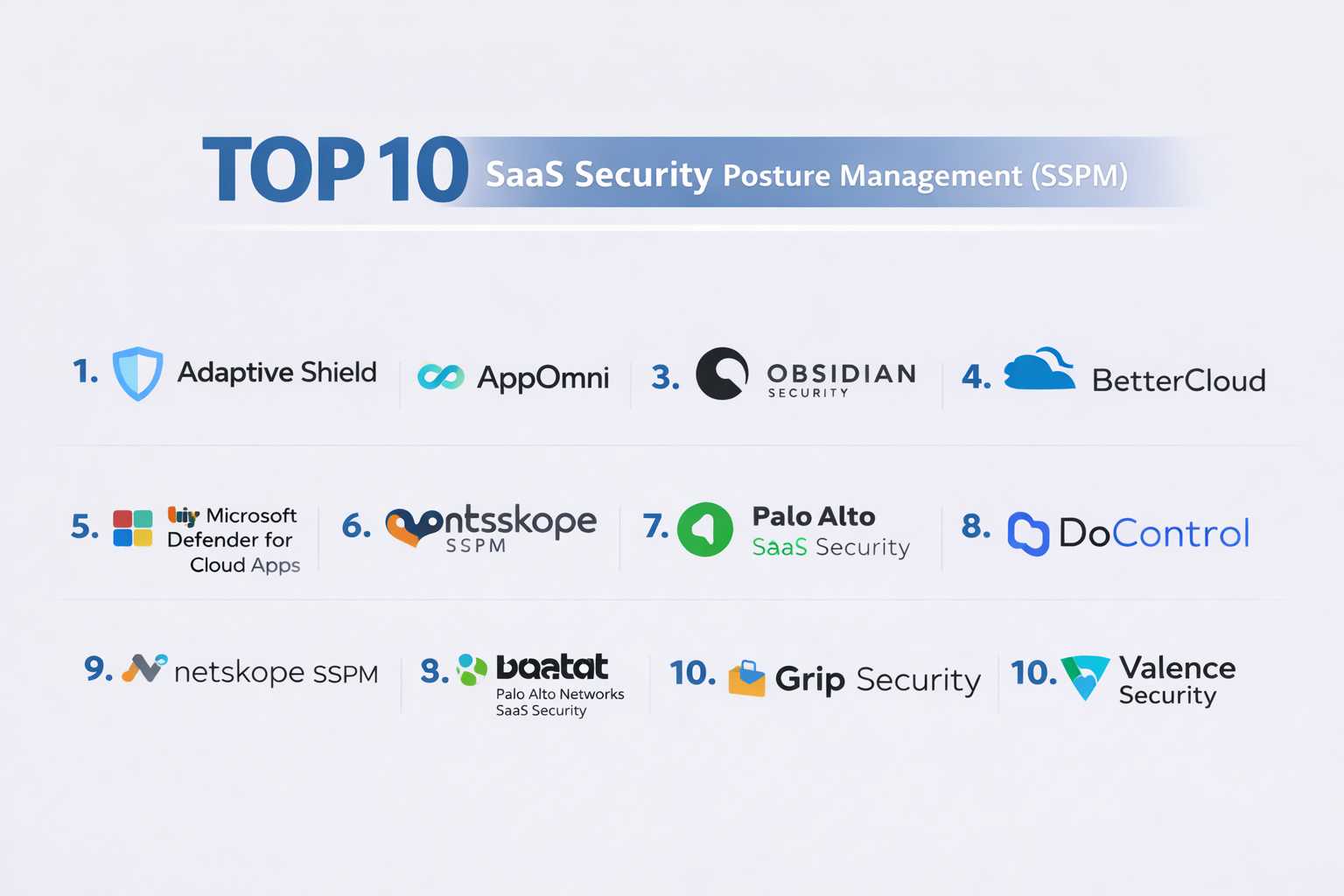
Top SaaS Security Posture Management (SSPM)
#1 — Adaptive Shield
Short description: A leading SSPM platform providing deep visibility and security across multiple SaaS applications.
Key Features
- SaaS configuration monitoring
- Identity and access analysis
- Third-party app management
- Compliance enforcement
- Automated remediation
- Risk scoring
Pros
- Strong SaaS coverage
- Deep visibility into integrations
Cons
- Premium pricing
- Complexity for beginners
Platforms / Deployment
Cloud
Security & Compliance
SSO, MFA, RBAC, encryption, audit logs.
Integrations & Ecosystem
Supports major SaaS platforms and security tools.
- Google Workspace
- Microsoft 365
- Salesforce
- APIs
Support & Community
Enterprise-grade support and documentation.
#2 — AppOmni
Short description: Enterprise-focused SSPM platform specializing in SaaS application security and compliance.
Key Features
- SaaS security posture monitoring
- Compliance automation
- Threat detection
- Configuration auditing
- Access control monitoring
Pros
- Strong enterprise focus
- Comprehensive compliance features
Cons
- High cost
- Complex setup
Platforms / Deployment
Cloud
Security & Compliance
SSO, MFA, encryption.
Integrations & Ecosystem
- SaaS platforms
- Security tools
- APIs
Support & Community
Strong enterprise support.
#3 — Obsidian Security
Short description: Modern SSPM solution focused on identity-driven SaaS security.
Key Features
- Identity threat detection
- SaaS monitoring
- Risk analytics
- Access control visibility
- Automation
Pros
- Strong identity security
- Modern architecture
Cons
- Limited integrations compared to competitors
- Pricing
Platforms / Deployment
Cloud
Security & Compliance
SSO, MFA, RBAC.
Integrations & Ecosystem
- Identity providers
- SaaS apps
- APIs
Support & Community
Growing community and support.
#4 — BetterCloud
Short description: SaaS operations and security platform focused on automation and governance.
Key Features
- Workflow automation
- User lifecycle management
- SaaS monitoring
- Policy enforcement
- Data protection
Pros
- Easy automation
- Strong governance features
Cons
- Limited deep security analytics
- Focus on operations
Platforms / Deployment
Cloud
Security & Compliance
SSO, MFA.
Integrations & Ecosystem
- SaaS apps
- APIs
- IT tools
Support & Community
Strong documentation and support.
#5 — Microsoft Defender for Cloud Apps
Short description: Microsoft’s SSPM solution providing SaaS visibility and threat protection.
Key Features
- Shadow IT discovery
- Access control monitoring
- Threat detection
- Compliance support
- Integration with Microsoft ecosystem
Pros
- Strong Microsoft integration
- Easy for existing users
Cons
- Limited outside Microsoft ecosystem
- Complexity
Platforms / Deployment
Cloud
Security & Compliance
SSO, MFA, RBAC.
Integrations & Ecosystem
- Microsoft 365
- Azure
- APIs
Support & Community
Extensive support and documentation.
#6 — Netskope SSPM
Short description: Part of Netskope’s security platform focusing on SaaS posture management.
Key Features
- SaaS configuration monitoring
- Risk assessment
- Data protection
- Compliance enforcement
- Access control
Pros
- Strong data security
- Integrated platform
Cons
- Complex deployment
- Cost
Platforms / Deployment
Cloud
Security & Compliance
SSO, MFA, encryption.
Integrations & Ecosystem
- SaaS apps
- Security tools
- APIs
Support & Community
Enterprise-level support.
#7 — Palo Alto Networks SaaS Security (SSPM)
Short description: SSPM capabilities within Palo Alto’s cloud security ecosystem.
Key Features
- SaaS risk monitoring
- Threat detection
- Configuration management
- Compliance checks
- Automation
Pros
- Strong security features
- Enterprise-ready
Cons
- Pricing
- Complexity
Platforms / Deployment
Cloud
Security & Compliance
SSO, MFA, RBAC.
Integrations & Ecosystem
- SaaS apps
- Security tools
- APIs
Support & Community
Strong enterprise support.
#8 — DoControl
Short description: SaaS security platform focusing on data access and insider risk management.
Key Features
- Data access monitoring
- Insider threat detection
- SaaS security posture
- Automation
- Risk alerts
Pros
- Strong data protection
- Easy deployment
Cons
- Limited coverage
- Fewer advanced features
Platforms / Deployment
Cloud
Security & Compliance
SSO, MFA.
Integrations & Ecosystem
- SaaS apps
- APIs
Support & Community
Good support.
#9 — Grip Security
Short description: SSPM platform focused on SaaS discovery and identity risk management.
Key Features
- SaaS discovery
- Identity risk analysis
- Shadow IT detection
- Automation
- Integration monitoring
Pros
- Strong visibility
- Identity focus
Cons
- Limited enterprise features
- Growing platform
Platforms / Deployment
Cloud
Security & Compliance
SSO, MFA.
Integrations & Ecosystem
- SaaS apps
- APIs
Support & Community
Growing support ecosystem.
#10 — Valence Security
Short description: SSPM platform focused on collaboration apps and SaaS risk management.
Key Features
- SaaS configuration monitoring
- Risk detection
- Compliance checks
- Automation
- Integration control
Pros
- Focused SaaS security
- Easy deployment
Cons
- Limited coverage
- Smaller ecosystem
Platforms / Deployment
Cloud
Security & Compliance
SSO, MFA.
Integrations & Ecosystem
- SaaS apps
- APIs
Support & Community
Emerging support and documentation.
Comparison Table (Top 10)
| Tool Name | Best For | Platform(s) Supported | Deployment | Standout Feature | Public Rating |
|---|---|---|---|---|---|
| Adaptive Shield | Enterprise SSPM | Web | Cloud | Deep SaaS visibility | N/A |
| AppOmni | Compliance-heavy orgs | Web | Cloud | Compliance automation | N/A |
| Obsidian Security | Identity security | Web | Cloud | Identity analytics | N/A |
| BetterCloud | SaaS operations | Web | Cloud | Workflow automation | N/A |
| Microsoft Defender for Cloud Apps | Microsoft users | Web | Cloud | Shadow IT detection | N/A |
| Netskope SSPM | Data security | Web | Cloud | Data protection | N/A |
| Palo Alto SaaS Security | Enterprise | Web | Cloud | Threat detection | N/A |
| DoControl | Data access security | Web | Cloud | Insider threat detection | N/A |
| Grip Security | SaaS discovery | Web | Cloud | Identity risk insights | N/A |
| Valence Security | Collaboration apps | Web | Cloud | SaaS risk control | N/A |
SaaS Security Posture Management (SSPM)
| Tool Name | Core | Ease | Integrations | Security | Performance | Support | Value | Weighted Total |
|---|---|---|---|---|---|---|---|---|
| Adaptive Shield | 9 | 7 | 9 | 9 | 9 | 8 | 7 | 8.5 |
| AppOmni | 9 | 7 | 8 | 9 | 8 | 8 | 7 | 8.3 |
| Obsidian Security | 8 | 8 | 7 | 8 | 8 | 8 | 7 | 8.0 |
| BetterCloud | 8 | 9 | 8 | 7 | 8 | 8 | 8 | 8.2 |
| Microsoft Defender for Cloud Apps | 8 | 8 | 8 | 9 | 8 | 9 | 8 | 8.3 |
| Netskope SSPM | 8 | 7 | 8 | 9 | 8 | 8 | 7 | 8.1 |
| Palo Alto SaaS Security | 9 | 7 | 9 | 9 | 9 | 8 | 7 | 8.5 |
| DoControl | 8 | 8 | 7 | 8 | 8 | 8 | 7 | 7.9 |
| Grip Security | 7 | 8 | 7 | 7 | 8 | 7 | 8 | 7.6 |
| Valence Security | 7 | 8 | 7 | 7 | 8 | 7 | 8 | 7.6 |
How to interpret scores:
These scores are comparative and reflect how each tool performs across key criteria. Higher scores indicate better overall balance, while lower scores may highlight trade-offs such as limited integrations or fewer advanced features. The best choice depends on your SaaS ecosystem and security priorities.
Which Service Mesh Platforms Is Right for You?
Solo / Freelancer
Basic SaaS usage can rely on native security settings and simple tools.
SMB
BetterCloud and DoControl offer ease of use and automation.
Mid-Market
Obsidian Security and Netskope provide strong balance of features.
Enterprise
Adaptive Shield, AppOmni, and Palo Alto are ideal for large SaaS environments.
Budget vs Premium
Lower-cost tools offer basic monitoring, while premium tools provide deep analytics.
Feature Depth vs Ease of Use
BetterCloud is easier, while Adaptive Shield offers deeper capabilities.
Integrations & Scalability
Enterprise tools support broader integrations and scalability.
Security & Compliance Needs
Highly regulated industries should prioritize compliance-heavy platforms.
SaaS Security Posture Management (SSPM)
What is SSPM?
It is a tool that monitors and secures SaaS applications.
Why is SSPM important?
It helps prevent misconfigurations and data exposure.
Which SaaS apps are supported?
Common apps include Google Workspace, Microsoft 365, and Salesforce.
Is SSPM only for enterprises?
No, SMBs can also benefit.
Does SSPM detect insider threats?
Yes, many tools include insider risk detection.
How long does deployment take?
Usually quick since most tools are cloud-based.
Can SSPM automate fixes?
Yes, many tools offer automated remediation.
Is SSPM expensive?
Pricing varies depending on features and users.
What are common mistakes?
Ignoring alerts and not enforcing policies.
Are there alternatives?
CASB and identity security tools are related alternatives.
Conclusion
SaaS Security Posture Management tools have become essential for organizations relying on multiple SaaS applications, helping maintain visibility, control, and compliance across platforms. These tools address critical risks such as misconfigurations, excessive permissions, and shadow IT, which are common in SaaS-heavy environments. While enterprise platforms like Adaptive Shield and AppOmni offer deep visibility and advanced capabilities, tools like BetterCloud provide simplicity and strong automation for everyday operations. The right solution depends on your SaaS ecosystem, security maturity, and compliance requirements. Start by identifying key risks, shortlist a few tools, and run pilot implementations to validate integrations, usability, and effectiveness before making a final decision.
