Introduction
Port Community Systems (PCS) are digital platforms that connect all stakeholders in a port ecosystem—including shipping lines, terminal operators, customs authorities, freight forwarders, and logistics providers—into a single, integrated system. Instead of fragmented communication via emails, calls, or manual paperwork, PCS enables real-time data exchange, automation, and coordination across port operations.
In the modern logistics landscape, especially with growing global trade and supply chain complexity, PCS has become essential. As ports handle higher cargo volumes and stricter compliance requirements, these systems help reduce delays, improve visibility, and enhance operational efficiency. With increasing focus on digital transformation, sustainability, and AI-driven logistics, PCS platforms are evolving rapidly.
Real-world use cases:
- Vessel arrival and departure coordination
- Cargo tracking and documentation automation
- Customs clearance and regulatory compliance
- Gate and yard management optimization
- Real-time communication among port stakeholders
What buyers should evaluate:
- Integration with legacy port systems
- Real-time data visibility and analytics
- Automation capabilities (AI/ML features)
- Security and compliance standards
- Scalability across multiple ports
- Ease of onboarding stakeholders
- Interoperability with global trade systems
- Deployment flexibility (cloud vs on-prem)
- Cost structure and ROI
- Vendor support and ecosystem maturity
Best for: Port authorities, terminal operators, logistics providers, shipping companies, and government agencies managing complex port ecosystems.
Not ideal for: Small logistics operators or standalone warehouses that do not require multi-stakeholder coordination; simpler logistics software may be sufficient.
Key Trends in Port Community Systems
- AI-driven predictive analytics for vessel scheduling and congestion forecasting
- Automation of documentation using digital workflows and e-signatures
- Blockchain adoption for secure and transparent trade documentation
- Cloud-native PCS platforms replacing legacy on-premise systems
- Integration with IoT devices for real-time cargo and asset tracking
- Regulatory compliance automation for customs and trade authorities
- API-first architectures enabling seamless integration with third-party systems
- Sustainability tracking (carbon emissions, green logistics initiatives)
- Cybersecurity enhancements due to increased digitalization risks
- Digital twin technology for simulating port operations
How We Selected These Tools (Methodology)
- Evaluated global adoption and deployment across major ports
- Assessed feature completeness including vessel, cargo, and documentation management
- Reviewed performance and scalability indicators in high-traffic environments
- Considered security posture and compliance readiness
- Examined integration capabilities with ERP, customs, and logistics systems
- Analyzed vendor ecosystem and partner network
- Looked at customer fit across enterprise and government use cases
- Prioritized future-readiness (AI, automation, cloud capabilities)
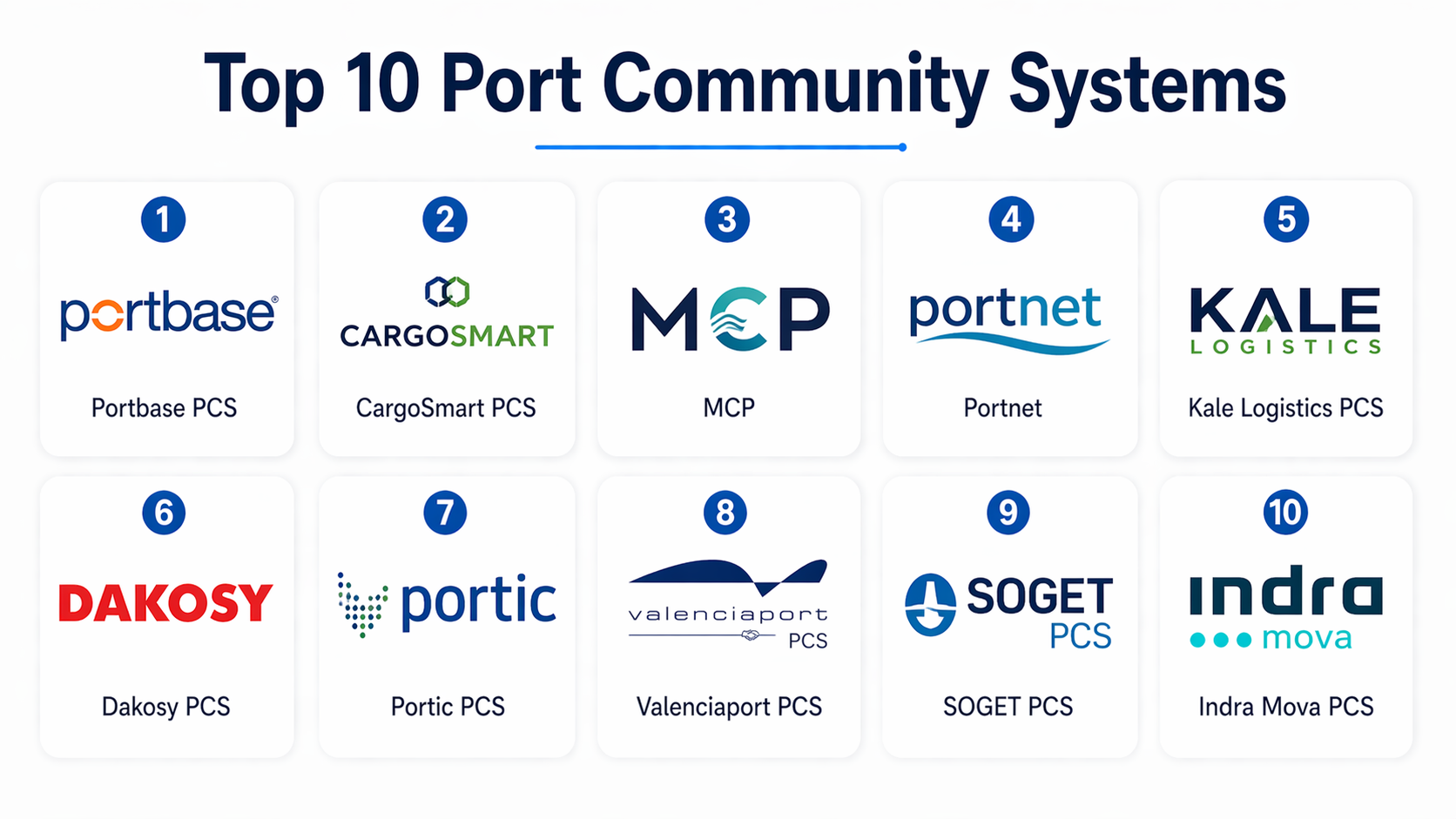
Top 10 Port Community Systems
#1 — Portbase PCS
Short description:
Portbase is a widely used PCS platform connecting stakeholders in major European ports. It focuses on improving logistics efficiency through digital collaboration and real-time data exchange.
Key Features
- Vessel and cargo information exchange
- Digital documentation workflows
- Real-time shipment visibility
- Customs integration
- API-based connectivity
- Automated notifications
Pros
- Strong adoption in major ports
- Reliable real-time data sharing
Cons
- Limited flexibility outside supported regions
- Customization can be complex
Platforms / Deployment
Web / Cloud
Security & Compliance
GDPR, encryption, RBAC
Integrations & Ecosystem
Supports integration with logistics platforms and customs systems.
- APIs for third-party tools
- ERP integrations
- Shipping line systems
Support & Community
Strong enterprise support; documentation is structured.
#2 — CargoSmart PCS
Short description:
CargoSmart offers a digital platform for port and logistics collaboration, focusing on data visibility and predictive analytics.
Key Features
- AI-powered scheduling
- Shipment visibility dashboards
- Port congestion insights
- Collaboration tools
- Data analytics
Pros
- Advanced analytics capabilities
- Strong integration support
Cons
- Premium pricing
- Complex onboarding
Platforms / Deployment
Web / Cloud
Security & Compliance
Not publicly stated
Integrations & Ecosystem
Integrates with global shipping and logistics systems.
- API support
- Data exchange platforms
Support & Community
Enterprise-level support; onboarding assistance available.
#3 — MCP (Maritime Community Platform)
Short description:
MCP enables standardized communication between maritime stakeholders, focusing on interoperability and data exchange.
Key Features
- Standardized data protocols
- Vessel traffic coordination
- Secure communication
- Interoperability support
Pros
- Strong interoperability
- Standardized communication
Cons
- Limited UI capabilities
- Adoption varies by region
Platforms / Deployment
Web / Hybrid
Security & Compliance
Encryption, secure messaging
Integrations & Ecosystem
Supports maritime systems and traffic platforms.
- Data exchange protocols
- API integrations
Support & Community
Moderate support; evolving ecosystem.
#4 — Portnet (Singapore PCS)
Short description:
Portnet is a mature PCS used in Singapore, enabling seamless coordination between port stakeholders.
Key Features
- Cargo clearance automation
- Vessel scheduling
- Trade documentation
- Stakeholder communication
Pros
- Highly reliable system
- Proven large-scale deployment
Cons
- Limited availability outside region
- Customization constraints
Platforms / Deployment
Web / Cloud
Security & Compliance
Not publicly stated
Integrations & Ecosystem
Integrates with national trade systems.
- Customs systems
- Shipping platforms
Support & Community
Strong institutional support.
#5 — Kale Logistics PCS
Short description:
Kale Logistics provides PCS solutions for airports and seaports, focusing on digital transformation and automation.
Key Features
- Cargo management
- Digital workflows
- Compliance automation
- Data analytics
Pros
- Flexible deployment
- Strong in emerging markets
Cons
- UI may require improvement
- Limited global adoption compared to leaders
Platforms / Deployment
Web / Cloud / Hybrid
Security & Compliance
Not publicly stated
Integrations & Ecosystem
Supports logistics and cargo systems.
- API integrations
- ERP connectivity
Support & Community
Good support; growing ecosystem.
#6 — Dakosy PCS
Short description:
Dakosy is a German PCS platform supporting logistics coordination and digital documentation.
Key Features
- Shipment tracking
- Documentation automation
- Data exchange
- Logistics coordination
Pros
- Strong regional presence
- Reliable system
Cons
- Limited scalability outside region
- UI is traditional
Platforms / Deployment
Web / Cloud
Security & Compliance
GDPR compliant
Integrations & Ecosystem
Integrates with European logistics systems.
- APIs
- Customs integration
Support & Community
Strong support in Europe.
#7 — Portic PCS
Short description:
Portic is a French PCS platform focused on optimizing port logistics and communication.
Key Features
- Real-time data sharing
- Cargo tracking
- Workflow automation
- Analytics
Pros
- Good visibility features
- Strong government backing
Cons
- Limited global reach
- Customization challenges
Platforms / Deployment
Web / Cloud
Security & Compliance
Not publicly stated
Integrations & Ecosystem
Supports logistics integrations.
- APIs
- Data exchange systems
Support & Community
Moderate support.
#8 — Valenciaport PCS
Short description:
Valenciaport PCS is used in Spain to streamline port operations and improve logistics efficiency.
Key Features
- Cargo and vessel tracking
- Digital documentation
- Stakeholder collaboration
- Real-time updates
Pros
- Efficient coordination
- Proven deployment
Cons
- Regional limitation
- Limited advanced analytics
Platforms / Deployment
Web / Cloud
Security & Compliance
Not publicly stated
Integrations & Ecosystem
Integrates with port and logistics systems.
- API connectivity
- Customs systems
Support & Community
Stable support.
#9 — SOGET PCS (S)ONE
Short description:
SOGET provides PCS solutions with a focus on digital logistics platforms and trade facilitation.
Key Features
- Trade documentation
- Cargo visibility
- Workflow automation
- Data analytics
Pros
- Strong digital transformation features
- Scalable platform
Cons
- Requires training
- Implementation complexity
Platforms / Deployment
Web / Cloud
Security & Compliance
Not publicly stated
Integrations & Ecosystem
Supports logistics and customs systems.
- APIs
- Integration tools
Support & Community
Good enterprise support.
#10 — Indra Mova PCS
Short description:
Indra Mova provides PCS solutions focusing on smart mobility and logistics digitalization.
Key Features
- Smart logistics coordination
- AI-driven insights
- Digital workflows
- Real-time monitoring
Pros
- Advanced technology stack
- AI capabilities
Cons
- High cost
- Complex deployment
Platforms / Deployment
Web / Cloud / Hybrid
Security & Compliance
Not publicly stated
Integrations & Ecosystem
Integrates with smart transport systems.
- APIs
- IoT integrations
Support & Community
Enterprise-grade support.
Comparison Table (Top 10)
| Tool Name | Best For | Platform(s) Supported | Deployment | Standout Feature | Public Rating |
|---|---|---|---|---|---|
| Portbase PCS | European ports | Web | Cloud | Real-time collaboration | N/A |
| CargoSmart PCS | Global enterprises | Web | Cloud | AI analytics | N/A |
| MCP | Interoperability | Web | Hybrid | Standardized protocols | N/A |
| Portnet | Large-scale ports | Web | Cloud | Proven reliability | N/A |
| Kale Logistics PCS | Emerging markets | Web | Cloud/Hybrid | Flexible deployment | N/A |
| Dakosy PCS | European logistics | Web | Cloud | Documentation automation | N/A |
| Portic PCS | Government-backed ports | Web | Cloud | Workflow automation | N/A |
| Valenciaport PCS | Spanish ports | Web | Cloud | Cargo tracking | N/A |
| SOGET PCS | Trade facilitation | Web | Cloud | Digital logistics | N/A |
| Indra Mova PCS | Smart ports | Web | Cloud/Hybrid | AI insights | N/A |
Evaluation & Scoring of Port Community Systems
| Tool Name | Core (25%) | Ease (15%) | Integrations (15%) | Security (10%) | Performance (10%) | Support (10%) | Value (15%) | Weighted Total |
|---|---|---|---|---|---|---|---|---|
| Portbase PCS | 9 | 7 | 8 | 8 | 9 | 8 | 7 | 8.2 |
| CargoSmart PCS | 9 | 6 | 9 | 7 | 9 | 8 | 6 | 8.0 |
| MCP | 7 | 6 | 9 | 7 | 7 | 6 | 8 | 7.2 |
| Portnet | 9 | 7 | 8 | 7 | 9 | 8 | 7 | 8.1 |
| Kale Logistics PCS | 8 | 7 | 8 | 7 | 8 | 7 | 8 | 7.9 |
| Dakosy PCS | 8 | 6 | 7 | 8 | 8 | 7 | 7 | 7.6 |
| Portic PCS | 7 | 6 | 7 | 7 | 7 | 6 | 7 | 6.9 |
| Valenciaport PCS | 7 | 6 | 7 | 7 | 7 | 6 | 7 | 6.9 |
| SOGET PCS | 8 | 6 | 8 | 7 | 8 | 7 | 7 | 7.6 |
| Indra Mova PCS | 9 | 6 | 9 | 7 | 9 | 8 | 6 | 8.1 |
How to interpret scores:
- Scores are comparative, not absolute benchmarks.
- Higher scores indicate stronger overall capability across criteria.
- Core features and integrations carry the most weight.
- Choose tools based on your specific needs rather than highest score alone.
Which Port Community Systems
Solo / Freelancer
PCS is generally not needed. Use simple logistics or shipment tracking tools.
SMB
Choose solutions like Kale Logistics PCS for flexibility and cost-effectiveness.
Mid-Market
Consider SOGET PCS or Dakosy PCS for balanced features and scalability.
Enterprise
Go with CargoSmart PCS, Portbase PCS, or Indra Mova PCS for advanced capabilities.
Budget vs Premium
- Budget: Kale Logistics PCS
- Premium: CargoSmart PCS, Indra Mova PCS
Feature Depth vs Ease of Use
- Feature-rich: CargoSmart, Indra Mova
- Easier adoption: Portbase, Kale Logistics
Integrations & Scalability
- Strong integrations: CargoSmart, MCP
- Moderate: Kale Logistics, SOGET
Security & Compliance Needs
- Strong compliance focus: Portbase, Dakosy
- Moderate: Others
Frequently Asked Questions (FAQs)
1. What is a Port Community System?
A PCS is a digital platform that connects port stakeholders to streamline communication, operations, and data exchange.
2. How much does a PCS cost?
Pricing varies widely based on scale and deployment. It is typically enterprise-level and custom-priced.
3. How long does implementation take?
Implementation can take several months depending on complexity and integrations.
4. Can PCS integrate with existing systems?
Yes, most PCS platforms provide APIs for integration with ERP and logistics systems.
5. Is PCS secure?
Most systems include encryption and access controls, but compliance varies by vendor.
6. What are common mistakes when adopting PCS?
Poor stakeholder onboarding and lack of integration planning are common issues.
7. Can PCS scale across multiple ports?
Yes, enterprise PCS platforms are designed for multi-port scalability.
8. What industries benefit from PCS?
Shipping, logistics, port authorities, and government agencies benefit most.
9. Are there alternatives to PCS?
Yes, standalone logistics or supply chain platforms can be alternatives for smaller use cases.
10. How to choose the right PCS?
Evaluate based on integration, scalability, security, and operational needs.
Conclusion
Port Community Systems have become a critical backbone for modern port operations, enabling seamless coordination, improved visibility, and faster decision-making across complex logistics ecosystems. As ports continue to evolve into smart, data-driven environments, the role of PCS will only grow stronger, especially with the integration of AI, automation, and IoT technologies. However, there is no one-size-fits-all solution. The best system depends on your port size, operational complexity, regulatory requirements, and integration needs. A practical approach is to shortlist two or three solutions, run pilot implementations, and validate their performance in real-world scenarios before committing to a full deployment.