Introduction
OTA (Over-the-Air) Firmware Update Platforms help organizations remotely deploy, manage, monitor, and secure firmware and software updates across connected devices, IoT systems, embedded hardware, vehicles, industrial equipment, edge devices, and smart infrastructure. In simple terms, these platforms allow businesses to update device firmware remotely without requiring physical access to hardware.
In OTA firmware management has become a mission-critical operational capability due to the rapid expansion of IoT ecosystems, connected vehicles, industrial automation, smart medical devices, edge computing, and distributed infrastructure environments. Organizations increasingly require secure, scalable, and automated firmware delivery systems to reduce operational downtime, improve cybersecurity, and maintain compliance across millions of distributed devices.
Modern OTA Firmware Update Platforms combine secure update delivery, rollback management, device identity controls, phased rollouts, telemetry monitoring, compliance governance, edge orchestration, and AI-assisted diagnostics into centralized operational ecosystems.
Common real-world use cases include:
- IoT firmware update automation
- Connected vehicle software deployment
- Industrial equipment lifecycle management
- Edge device patching and security updates
- Smart appliance and embedded system management
When evaluating OTA Firmware Update Platforms, buyers should consider:
- Scalability across large device fleets
- Security and firmware signing controls
- Rollback and recovery mechanisms
- Differential and delta update support
- Device compatibility and protocol support
- Deployment automation and scheduling
- Telemetry and update monitoring
- Edge and offline operation support
- Compliance and governance controls
- API and developer ecosystem maturity
Best for: IoT manufacturers, automotive companies, industrial enterprises, telecom providers, healthcare device manufacturers, consumer electronics companies, smart city operators, and businesses managing distributed connected devices.
Not ideal for: Organizations operating only traditional desktop infrastructure without embedded devices or distributed connected hardware.
Key Trends in OTA Firmware Update Platforms
- Secure firmware signing and supply chain protection are becoming critical priorities.
- Differential and delta update technologies are improving bandwidth efficiency.
- AI-assisted anomaly detection during firmware rollouts is expanding.
- Edge-native OTA orchestration is becoming more common.
- Zero Trust device identity frameworks are increasingly important.
- Automotive and industrial OTA adoption is accelerating rapidly.
- Cloud-native OTA infrastructure is replacing legacy update systems.
- Real-time telemetry analytics for firmware health are improving.
- Compliance governance and auditability are becoming stronger requirements.
- Containerized edge firmware deployment models are growing.
How We Selected These Tools (Methodology)
The platforms in this list were selected based on scalability, firmware security capabilities, enterprise adoption, and operational reliability.
Our evaluation process included:
- Market adoption and vendor credibility
- OTA deployment scalability
- Firmware security and signing functionality
- Rollback and recovery mechanisms
- Device provisioning and lifecycle management
- Telemetry and analytics visibility
- Edge and hybrid deployment support
- Integration ecosystem maturity
- Protocol and hardware compatibility
- Vendor support and developer ecosystem strength
The final selection includes hyperscale cloud platforms, automotive OTA vendors, industrial device management ecosystems, and open-source firmware update frameworks.
OTA Firmware Update Platforms
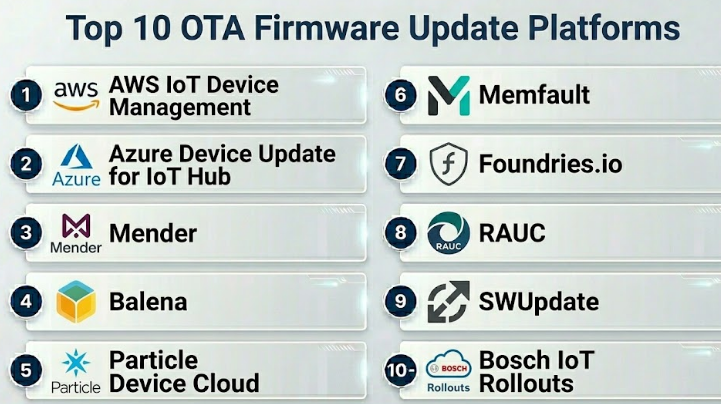
#1 — AWS IoT Device Management
Short description :
AWS IoT Device Management provides large-scale OTA firmware deployment, device lifecycle management, remote diagnostics, and secure update orchestration for connected IoT and edge devices. It is widely used in industrial IoT, manufacturing, logistics, and smart infrastructure environments.
Key Features
- OTA firmware deployment
- Secure device provisioning
- Device shadow synchronization
- Fleet indexing and organization
- Rollback management
- Device telemetry visibility
- Remote diagnostics
Pros
- Excellent scalability for large IoT fleets
- Strong AWS ecosystem integration
- Good automation and orchestration capabilities
Cons
- Complex enterprise deployment models
- Pricing can increase significantly at scale
- Requires AWS operational expertise
Platforms / Deployment
- Cloud / Hybrid / Edge
Security & Compliance
- Encryption
- IAM integration
- RBAC
- Audit logs
- MFA integration
- Secure device identity management
Integrations & Ecosystem
AWS IoT Device Management integrates deeply with AWS cloud ecosystems.
- AWS IoT Core
- Lambda
- Greengrass
- APIs
- Security services
- Analytics platforms
Support & Community
Massive enterprise cloud ecosystem with extensive developer and operational documentation.
#2 — Azure Device Update for IoT Hub
Short description :
Azure Device Update for IoT Hub is Microsoft’s OTA firmware and software update platform designed for connected devices, industrial systems, and edge infrastructure managed through Azure IoT ecosystems.
Key Features
- Secure OTA firmware deployment
- Progressive rollout management
- Device grouping and targeting
- Update compliance tracking
- Rollback support
- Edge device management
- Update monitoring dashboards
Pros
- Strong Microsoft ecosystem integration
- Good enterprise update governance
- Useful staged deployment capabilities
Cons
- Requires Azure operational expertise
- Some advanced device workflows need customization
- Enterprise-scale architecture can become complex
Platforms / Deployment
- Cloud / Hybrid / Edge
Security & Compliance
- Encryption
- RBAC
- MFA integration
- Audit logs
- Device identity controls
- GDPR support
Integrations & Ecosystem
Azure Device Update integrates broadly across Microsoft ecosystems.
- Azure IoT Hub
- Azure Defender
- APIs
- Azure Digital Twins
- Analytics tools
Support & Community
Strong enterprise cloud ecosystem with extensive operational documentation.
#3 — Mender
Short description :
Mender is an open-source OTA update platform focused on secure firmware and software deployment for embedded Linux devices, IoT systems, and edge infrastructure. It is widely used for Linux-based connected device management.
Key Features
- OTA firmware updates
- Dual-rootfs rollback support
- Device grouping
- Phased deployment management
- Remote troubleshooting
- Update monitoring
- Open-source deployment flexibility
Pros
- Strong rollback and recovery capabilities
- Flexible open-source architecture
- Good Linux device support
Cons
- Primarily Linux-focused
- Enterprise governance varies by edition
- Advanced integrations may require customization
Platforms / Deployment
- Linux / Embedded systems
- Cloud / Self-hosted / Hybrid
Security & Compliance
- Encryption
- RBAC
- Audit logs
- Secure update delivery
- MFA integration
Integrations & Ecosystem
Mender integrates with embedded Linux and DevOps ecosystems.
- Yocto Project
- Docker
- CI/CD platforms
- APIs
- Edge infrastructure tools
Support & Community
Strong embedded Linux and IoT developer community.
#4 — Balena
Short description :
Balena is a container-focused edge device management and OTA deployment platform designed for distributed Linux edge systems, IoT infrastructure, and connected product operations.
Key Features
- Containerized OTA deployment
- Remote fleet management
- Device health monitoring
- GitOps deployment workflows
- Secure update orchestration
- Edge application lifecycle management
- Remote diagnostics
Pros
- Excellent containerized deployment support
- Strong developer-friendly workflows
- Good remote edge visibility
Cons
- Primarily Linux-focused
- Specialized operational focus
- Enterprise governance depth varies
Platforms / Deployment
- Linux / Embedded devices
- Cloud / Hybrid / Edge
Security & Compliance
- Encryption
- RBAC
- Audit logs
- MFA integration
- Secure communication channels
Integrations & Ecosystem
Balena integrates with edge and DevOps ecosystems.
- Docker
- APIs
- CI/CD pipelines
- Cloud services
- Edge gateways
Support & Community
Strong edge computing community with growing enterprise adoption.
#5 — Particle Device Cloud
Short description :
Particle Device Cloud is a connected product platform providing OTA firmware updates, fleet monitoring, device lifecycle management, and remote diagnostics for cellular and IoT devices.
Key Features
- OTA firmware management
- Cellular device connectivity
- Device fleet monitoring
- Remote diagnostics
- Product lifecycle management
- Cloud APIs
- Device provisioning workflows
Pros
- Developer-friendly ecosystem
- Good rapid deployment workflows
- Strong connected product focus
Cons
- Large industrial deployments may require customization
- Enterprise governance depth varies
- Specialized connected product focus
Platforms / Deployment
- Cloud / Edge
Security & Compliance
- Encryption
- Device authentication
- RBAC
- Secure firmware delivery
- Audit logging
Integrations & Ecosystem
Particle integrates with cloud development ecosystems.
- AWS
- Azure
- APIs
- Webhooks
- Analytics systems
Support & Community
Strong startup and product engineering community with extensive documentation.
#6 — Memfault
Short description :
Memfault is a connected device reliability and OTA management platform focused on embedded systems observability, firmware deployment, crash diagnostics, and device health monitoring.
Key Features
- OTA firmware deployment
- Embedded crash diagnostics
- Device telemetry analytics
- Firmware rollback support
- Device health monitoring
- Remote debugging tools
- Reliability analytics
Pros
- Excellent observability capabilities
- Strong embedded diagnostics support
- Good firmware reliability monitoring
Cons
- Specialized embedded systems focus
- Smaller ecosystem compared to hyperscalers
- Some advanced workflows require integrations
Platforms / Deployment
- Embedded systems / IoT devices
- Cloud / Hybrid
Security & Compliance
- Encryption
- RBAC
- Audit logs
- Secure firmware delivery
- Device authentication
Integrations & Ecosystem
Memfault integrates with embedded development ecosystems.
- CI/CD platforms
- APIs
- Embedded Linux tools
- Cloud infrastructure
- Developer workflows
Support & Community
Growing embedded systems and firmware engineering ecosystem.
#7 — Foundries.io
Short description :
Foundries.io is a Linux edge and IoT device management platform focused on secure OTA firmware delivery, DevSecOps workflows, and connected device lifecycle management.
Key Features
- Secure OTA updates
- DevSecOps automation
- Device lifecycle management
- CI/CD integration
- Remote diagnostics
- Fleet provisioning
- Secure boot support
Pros
- Strong security-focused architecture
- Good Linux and edge support
- Useful DevSecOps workflows
Cons
- Primarily Linux-focused
- Smaller ecosystem maturity
- Enterprise integrations vary
Platforms / Deployment
- Linux / Embedded devices
- Cloud / Hybrid / Edge
Security & Compliance
- Secure boot
- Encryption
- RBAC
- Audit logs
- MFA integration
Integrations & Ecosystem
Foundries.io integrates with Linux and DevOps ecosystems.
- Docker
- CI/CD platforms
- APIs
- Edge hardware vendors
- Cloud services
Support & Community
Growing edge Linux ecosystem with developer-focused support.
#8 — RAUC
Short description :
RAUC is an open-source OTA update framework designed for embedded Linux systems requiring secure, reliable, and fail-safe firmware update mechanisms.
Key Features
- Secure firmware updates
- Fail-safe rollback support
- Embedded Linux compatibility
- Signed update bundles
- A/B partition support
- Lightweight architecture
- Open-source deployment flexibility
Pros
- Strong update reliability mechanisms
- Lightweight embedded deployment model
- Good security-focused architecture
Cons
- Primarily framework-focused
- Requires engineering expertise
- Limited enterprise management tooling
Platforms / Deployment
- Linux / Embedded systems
- Self-hosted / Edge
Security & Compliance
- Signed firmware bundles
- Encryption
- Secure rollback support
- Auditability controls
Integrations & Ecosystem
RAUC integrates with embedded Linux ecosystems.
- Yocto Project
- Buildroot
- Embedded Linux distributions
- CI/CD systems
Support & Community
Strong embedded Linux open-source community support.
#9 — SWUpdate
Short description :
SWUpdate is an open-source software and firmware update framework designed for embedded Linux and industrial device environments requiring reliable OTA deployment mechanisms.
Key Features
- OTA firmware deployment
- Embedded Linux update support
- Secure update validation
- Rollback mechanisms
- Lightweight architecture
- Flexible deployment workflows
- Signed update support
Pros
- Flexible open-source framework
- Good embedded Linux compatibility
- Strong customization capabilities
Cons
- Requires engineering expertise
- Limited centralized management tooling
- Enterprise support varies
Platforms / Deployment
- Linux / Embedded systems
- Self-hosted / Edge
Security & Compliance
- Signed update validation
- Encryption
- Secure update workflows
- Auditability controls
Integrations & Ecosystem
SWUpdate integrates with embedded Linux ecosystems.
- Yocto Project
- Build systems
- CI/CD platforms
- Embedded hardware vendors
Support & Community
Active embedded Linux developer community with industrial adoption.
#10 — Bosch IoT Rollouts
Short description :
Bosch IoT Rollouts is an enterprise OTA management platform focused on secure software deployment, phased update rollouts, and industrial IoT firmware lifecycle management.
Key Features
- Secure OTA deployment
- Phased rollout management
- Device targeting and grouping
- Rollback support
- Fleet monitoring dashboards
- Industrial IoT support
- Compliance reporting
Pros
- Strong industrial IoT focus
- Good rollout governance capabilities
- Enterprise operational scalability
Cons
- Enterprise deployment complexity
- Smaller ecosystem than hyperscale vendors
- Premium industrial platform pricing
Platforms / Deployment
- Cloud / Hybrid / Edge
Security & Compliance
- Encryption
- RBAC
- Audit logs
- MFA integration
- Secure firmware delivery
Integrations & Ecosystem
Bosch IoT Rollouts integrates with industrial IoT ecosystems.
- Bosch IoT Suite
- APIs
- Industrial gateways
- Analytics systems
- Device management platforms
Support & Community
Established industrial IoT ecosystem with enterprise operational support.
Comparison Table (Top 10)
| Tool Name | Best For | Platform(s) Supported | Deployment | Standout Feature | Public Rating |
|---|---|---|---|---|---|
| AWS IoT Device Management | Large-scale IoT firmware updates | Cloud, Edge | Hybrid | Massive fleet scalability | N/A |
| Azure Device Update | Microsoft-centric IoT operations | Cloud, Edge | Hybrid | Staged update rollouts | N/A |
| Mender | Linux embedded OTA updates | Linux | Self-hosted, Hybrid | Dual-rootfs rollback | N/A |
| Balena | Containerized edge deployments | Linux | Hybrid, Edge | GitOps OTA workflows | N/A |
| Particle Device Cloud | Connected product management | IoT devices | Cloud | Cellular IoT workflows | N/A |
| Memfault | Embedded observability and updates | Embedded systems | Hybrid | Crash diagnostics | N/A |
| Foundries.io | Secure Linux OTA management | Linux | Hybrid, Edge | DevSecOps integration | N/A |
| RAUC | Fail-safe embedded firmware updates | Linux embedded systems | Self-hosted | A/B rollback support | N/A |
| SWUpdate | Embedded Linux firmware delivery | Linux embedded systems | Self-hosted | Flexible update workflows | N/A |
| Bosch IoT Rollouts | Industrial IoT OTA governance | Industrial devices | Hybrid | Phased industrial rollouts | N/A |
Evaluation & OTA Firmware Update Platforms
| Tool Name | Core (25%) | Ease (15%) | Integrations (15%) | Security (10%) | Performance (10%) | Support (10%) | Value (15%) | Weighted Total (0–10) |
|---|---|---|---|---|---|---|---|---|
| AWS IoT Device Management | 10 | 7 | 10 | 9 | 10 | 9 | 7 | 8.85 |
| Azure Device Update | 9 | 8 | 10 | 9 | 9 | 9 | 8 | 8.85 |
| Mender | 9 | 8 | 8 | 9 | 8 | 8 | 9 | 8.50 |
| Balena | 8 | 9 | 7 | 8 | 8 | 8 | 8 | 8.00 |
| Particle Device Cloud | 8 | 9 | 7 | 8 | 8 | 8 | 8 | 8.00 |
| Memfault | 8 | 8 | 7 | 9 | 8 | 8 | 8 | 7.95 |
| Foundries.io | 8 | 7 | 7 | 9 | 8 | 7 | 8 | 7.75 |
| RAUC | 7 | 6 | 6 | 9 | 8 | 7 | 9 | 7.30 |
| SWUpdate | 7 | 6 | 6 | 8 | 8 | 7 | 9 | 7.15 |
| Bosch IoT Rollouts | 8 | 7 | 8 | 9 | 8 | 8 | 7 | 7.85 |
These scores are comparative evaluations designed to help organizations understand the relative strengths of OTA firmware update platforms. Hyperscale cloud vendors generally score highly in scalability and ecosystem integrations, while embedded Linux frameworks provide stronger customization flexibility and firmware-level control. Buyers should prioritize categories aligned with deployment scale, device architecture, security requirements, and operational maturity.
Which OTA Firmware Update Platforms
Solo / Freelancer
Developers and makers often benefit most from lightweight open-source frameworks such as RAUC or SWUpdate for embedded experimentation and small deployments.
SMB
Mender, Particle Device Cloud, and Balena provide good operational simplicity, manageable complexity, and scalable OTA functionality for SMB environments.
Mid-Market
Azure Device Update, Memfault, and Foundries.io work well for organizations balancing firmware governance, observability, and operational scalability.
Enterprise
AWS IoT Device Management, Bosch IoT Rollouts, and Azure Device Update are ideal for enterprises requiring large-scale OTA governance, compliance, and distributed fleet orchestration.
Budget vs Premium
Budget-conscious organizations may prefer open-source platforms such as Mender, RAUC, or SWUpdate, while premium enterprise buyers often invest in AWS, Azure, or Bosch ecosystems.
Feature Depth vs Ease of Use
Enterprise platforms provide advanced governance and scalability but may require experienced DevOps or IoT engineering teams. Mender and Particle generally provide easier onboarding and operational simplicity.
Integrations & Scalability
Organizations heavily invested in AWS, Azure, industrial IoT systems, or embedded Linux ecosystems should prioritize tools with strong native integrations and automation workflows.
Security & Compliance Needs
Highly regulated industries should prioritize OTA platforms offering secure firmware signing, rollback protection, encryption, audit logging, and device identity management.
Frequently Asked Questions (FAQs)
1. What are OTA Firmware Update Platforms?
OTA Firmware Update Platforms help organizations remotely deploy and manage firmware and software updates across connected devices and edge infrastructure.
2. Why are OTA update platforms important?
Modern connected device fleets require centralized update management to improve security, reduce downtime, and maintain operational consistency.
3. What does OTA mean?
OTA stands for Over-the-Air, meaning updates are delivered remotely through network connectivity without physical device access.
4. What industries commonly use OTA firmware platforms?
Automotive, healthcare, manufacturing, consumer electronics, telecom, logistics, and smart city operations are major adopters.
5. Can OTA platforms improve cybersecurity?
Yes. They help organizations rapidly deploy security patches, revoke vulnerable firmware, and maintain secure device lifecycle management.
6. What features matter most in OTA platforms?
Important features include rollback protection, secure firmware signing, staged deployments, telemetry visibility, scalability, and update automation.
7. What is rollback protection?
Rollback protection allows devices to safely revert to previous firmware versions if updates fail or introduce operational issues.
8. Are open-source OTA frameworks viable for production environments?
Yes. Platforms such as Mender, RAUC, and SWUpdate are widely used in embedded Linux and industrial device deployments.
9. What are common OTA implementation mistakes?
Common mistakes include insufficient testing, weak firmware signing practices, poor rollback planning, and limited telemetry visibility.
10. Can SMBs benefit from OTA firmware update platforms?
Yes. SMBs managing connected products or IoT devices can improve operational efficiency and security using OTA management platforms.
11. How do OTA platforms support edge computing?
They allow organizations to remotely update and manage edge devices, AI inference systems, and distributed infrastructure workloads.
12. What is the difference between OTA firmware updates and software patching?
OTA firmware updates often modify low-level device operating systems or embedded logic, while traditional software patching typically targets higher-level applications and operating systems.
Conclusion
OTA Firmware Update Platforms have become essential operational technologies for organizations managing distributed connected devices, embedded systems, industrial infrastructure, and edge computing environments. In businesses require secure remote firmware deployment, scalable lifecycle management, telemetry-driven observability, and reliable rollback protection to maintain operational resilience and cybersecurity across rapidly expanding device ecosystems.The ideal OTA platform depends heavily on device architecture, cloud strategy, Linux adoption, operational scale, and security requirements.
