Introduction
Observability Platforms are tools that help teams monitor, analyze, and understand the internal state of systems using telemetry data such as logs, metrics, and traces. Unlike traditional monitoring, observability provides deep insights into system behavior, enabling faster troubleshooting, performance optimization, and proactive incident management.
As organizations adopt microservices, cloud-native architectures, and distributed systems, observability has become a critical requirement. Modern platforms go beyond basic monitoring by offering real-time analytics, AI-driven insights, and end-to-end visibility across complex infrastructures.
Common use cases include:
- Monitoring application performance and uptime
- Troubleshooting production issues
- Analyzing logs, metrics, and traces
- Detecting anomalies and incidents
- Optimizing system performance
What buyers should evaluate:
- Support for logs, metrics, and traces (full-stack observability)
- Real-time monitoring and alerting capabilities
- Ease of setup and instrumentation
- Integration with cloud and DevOps tools
- Scalability for distributed systems
- AI/ML-based anomaly detection
- Visualization and dashboards
- Data retention and storage options
- Security and compliance features
- Pricing and cost predictability
Best for: DevOps teams, SREs, platform engineers, and enterprises managing complex distributed systems.
Not ideal for: Small applications with minimal monitoring needs or teams relying on basic logging tools.
Key Trends in Observability Platforms
- Unified observability stacks: Combining logs, metrics, and traces in one platform
- AI-driven insights: Automated anomaly detection and root cause analysis
- OpenTelemetry adoption: Standardized data collection across systems
- Cloud-native observability: Built for Kubernetes and microservices
- Real-time streaming analytics: Instant insights into system behavior
- Cost optimization features: Managing observability data expenses
- Shift-left observability: Integrating observability earlier in development
- Security observability convergence: Combining security and monitoring
- Serverless monitoring support: Observing ephemeral workloads
- API-first and extensibility: Flexible integration across ecosystems
How We Selected These Tools (Methodology)
- Evaluated market adoption and industry credibility
- Assessed support for logs, metrics, and distributed tracing
- Reviewed performance and scalability
- Considered ease of implementation and onboarding
- Analyzed AI/ML capabilities for anomaly detection
- Checked integration with cloud and DevOps ecosystems
- Evaluated visualization and reporting features
- Examined security and compliance capabilities
- Included both open-source and enterprise platforms
- Focused on real-world DevOps and SRE workflows
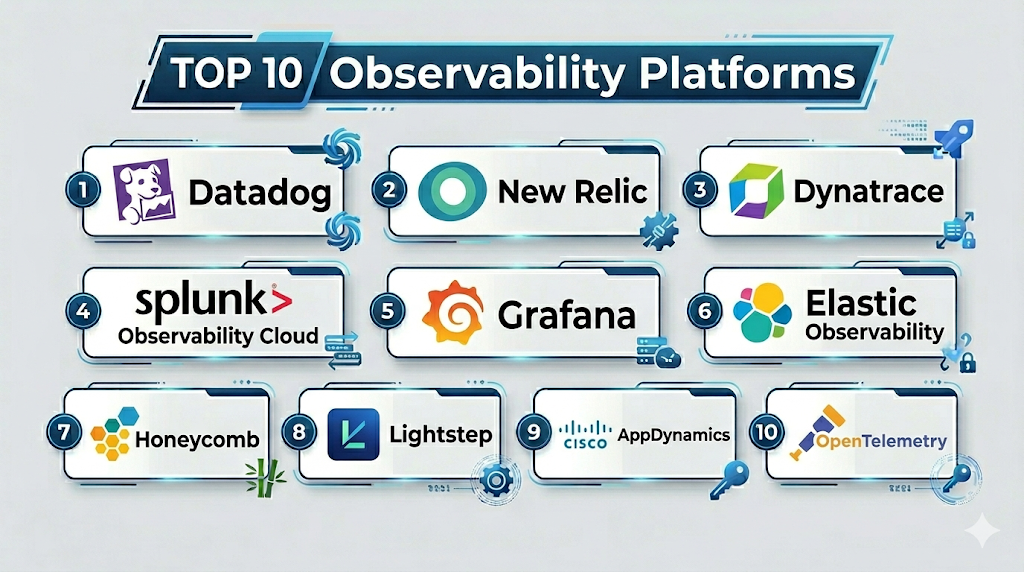
Top Observability Platforms
#1 — Datadog
Short description: A leading cloud-based observability platform offering full-stack monitoring and analytics.
Key Features
- Metrics, logs, and traces in one platform
- Real-time dashboards
- AI-based anomaly detection
- Infrastructure and application monitoring
- Integration with cloud services
- Alerting and incident management
Pros
- Comprehensive observability
- Strong integrations
Cons
- Expensive at scale
- Complex pricing
Platforms / Deployment
Cloud
Security & Compliance
RBAC, encryption, audit logs
Integrations & Ecosystem
Datadog integrates with a wide range of services.
- AWS
- Azure
- Kubernetes
- APIs
Support & Community
Strong enterprise support and community.
#2 — New Relic
Short description: A full-stack observability platform with powerful analytics and monitoring capabilities.
Key Features
- Unified telemetry data
- Distributed tracing
- Real-time analytics
- Custom dashboards
- Alerting system
- AI insights
Pros
- Developer-friendly
- Flexible pricing
Cons
- UI complexity
- Learning curve
Platforms / Deployment
Cloud
Security & Compliance
RBAC, encryption
Integrations & Ecosystem
- Cloud platforms
- APIs
- DevOps tools
Support & Community
Strong support.
#3 — Dynatrace
Short description: An AI-powered observability platform focused on automation and performance monitoring.
Key Features
- AI-driven root cause analysis
- Full-stack monitoring
- Automatic instrumentation
- Real-time insights
- Cloud-native support
- Digital experience monitoring
Pros
- Advanced AI capabilities
- Deep insights
Cons
- Expensive
- Complex setup
Platforms / Deployment
Cloud / Hybrid
Security & Compliance
RBAC, encryption, compliance tools
Integrations & Ecosystem
- Cloud providers
- APIs
- DevOps tools
Support & Community
Enterprise support.
#4 — Splunk Observability Cloud
Short description: A powerful platform for monitoring and analyzing machine data.
Key Features
- Metrics, logs, and traces
- Real-time analytics
- AI-driven insights
- Custom dashboards
- Alerting system
- Data ingestion capabilities
Pros
- Highly scalable
- Strong analytics
Cons
- Expensive
- Steep learning curve
Platforms / Deployment
Cloud
Security & Compliance
RBAC, encryption, audit logs
Integrations & Ecosystem
- APIs
- Cloud tools
- DevOps platforms
Support & Community
Strong enterprise support.
#5 — Grafana (with Prometheus/Loki/Tempo)
Short description: An open-source observability stack for metrics, logs, and traces visualization.
Key Features
- Custom dashboards
- Metrics via Prometheus
- Logs via Loki
- Traces via Tempo
- Plugin ecosystem
- Open-source flexibility
Pros
- Free and flexible
- Highly customizable
Cons
- Requires setup
- Fragmented stack
Platforms / Deployment
Cloud / Self-hosted
Security & Compliance
RBAC, plugin-based security
Integrations & Ecosystem
- Kubernetes
- APIs
- DevOps tools
Support & Community
Very strong open-source community.
#6 — Elastic Observability
Short description: A unified observability solution built on the Elastic Stack.
Key Features
- Log and metrics analysis
- APM (Application Performance Monitoring)
- Distributed tracing
- Search and analytics
- Visualization tools
Pros
- Powerful search capabilities
- Open-source option
Cons
- Resource-intensive
- Complex setup
Platforms / Deployment
Cloud / Self-hosted
Security & Compliance
RBAC, encryption
Integrations & Ecosystem
- APIs
- Cloud tools
- DevOps platforms
Support & Community
Strong community.
#7 — Honeycomb
Short description: A modern observability platform focused on debugging distributed systems.
Key Features
- Event-based observability
- High-cardinality data analysis
- Real-time debugging
- Distributed tracing
- Query tools
Pros
- Great for debugging
- Fast insights
Cons
- Niche use cases
- Pricing concerns
Platforms / Deployment
Cloud
Security & Compliance
Not publicly stated
Integrations & Ecosystem
- APIs
- Dev tools
- CI/CD tools
Support & Community
Growing community.
#8 — Lightstep
Short description: A cloud-native observability platform focused on distributed tracing.
Key Features
- Distributed tracing
- Real-time monitoring
- Root cause analysis
- OpenTelemetry support
- Cloud-native architecture
Pros
- Strong tracing capabilities
- Developer-friendly
Cons
- Limited full-stack features
- Smaller ecosystem
Platforms / Deployment
Cloud
Security & Compliance
Not publicly stated
Integrations & Ecosystem
- OpenTelemetry
- APIs
- DevOps tools
Support & Community
Moderate support.
#9 — AppDynamics
Short description: An enterprise-grade application performance monitoring and observability platform.
Key Features
- Application performance monitoring
- Business transaction tracking
- Real-time analytics
- Alerting and reporting
- AI insights
Pros
- Strong enterprise features
- Business insights
Cons
- Expensive
- Complex UI
Platforms / Deployment
Cloud / On-prem
Security & Compliance
RBAC, encryption
Integrations & Ecosystem
- APIs
- Cloud tools
- DevOps platforms
Support & Community
Enterprise support.
#10 — OpenTelemetry (Ecosystem)
Short description: An open-source framework for collecting and exporting observability data.
Key Features
- Standardized telemetry collection
- Multi-language support
- Vendor-neutral
- Integration with multiple backends
- Extensible architecture
Pros
- Open standard
- Flexible
Cons
- Requires setup
- Not a standalone UI
Platforms / Deployment
Cross-platform / Open-source
Security & Compliance
Varies / N/A
Integrations & Ecosystem
- Observability platforms
- APIs
- Dev tools
Support & Community
Very strong community.
Comparison Table (Top 10)
| Tool Name | Best For | Platform(s) Supported | Deployment | Standout Feature | Public Rating |
|---|---|---|---|---|---|
| Datadog | Full-stack | Web | Cloud | Unified monitoring | N/A |
| New Relic | Developers | Web | Cloud | Flexibility | N/A |
| Dynatrace | AI insights | Web | Hybrid | AI automation | N/A |
| Splunk | Data analytics | Web | Cloud | Scalability | N/A |
| Grafana | Open-source | Multi | Hybrid | Custom dashboards | N/A |
| Elastic | Search-based | Multi | Hybrid | Analytics | N/A |
| Honeycomb | Debugging | Web | Cloud | Event-based | N/A |
| Lightstep | Tracing | Web | Cloud | Distributed tracing | N/A |
| AppDynamics | Enterprise | Multi | Hybrid | Business insights | N/A |
| OpenTelemetry | Framework | Multi | Open-source | Standardization | N/A |
Observability Platforms (Scoring)
| Tool Name | Core (25%) | Ease (15%) | Integrations (15%) | Security (10%) | Performance (10%) | Support (10%) | Value (15%) | Weighted Total |
|---|---|---|---|---|---|---|---|---|
| Datadog | 10 | 9 | 10 | 9 | 9 | 10 | 7 | 9.2 |
| New Relic | 9 | 8 | 9 | 8 | 9 | 9 | 8 | 8.8 |
| Dynatrace | 10 | 7 | 9 | 10 | 9 | 9 | 7 | 8.9 |
| Splunk | 9 | 7 | 9 | 9 | 10 | 9 | 6 | 8.6 |
| Grafana | 9 | 7 | 10 | 8 | 9 | 9 | 10 | 9.0 |
| Elastic | 9 | 7 | 9 | 8 | 9 | 8 | 9 | 8.6 |
| Honeycomb | 8 | 8 | 8 | 7 | 9 | 7 | 7 | 8.0 |
| Lightstep | 8 | 8 | 8 | 7 | 9 | 7 | 7 | 8.0 |
| AppDynamics | 9 | 7 | 9 | 9 | 9 | 9 | 6 | 8.5 |
| OpenTelemetry | 9 | 6 | 10 | 7 | 9 | 9 | 10 | 8.8 |
How to interpret:
- Scores are relative comparisons across tools
- Enterprise tools excel in depth and AI capabilities
- Open-source tools provide flexibility and value
- Choose based on scale, budget, and complexity
Which Service Mesh Platforms Is Right for You?
Solo / Freelancer
Use Grafana stack or OpenTelemetry.
SMB
Choose New Relic or Datadog.
Mid-Market
Use Datadog or Elastic Observability.
Enterprise
Go with Dynatrace, Splunk, or AppDynamics.
Budget vs Premium
- Budget: Grafana, OpenTelemetry
- Premium: Datadog, Dynatrace
Feature Depth vs Ease of Use
- Easy: New Relic
- Advanced: Dynatrace
Integrations & Scalability
- Best: Datadog, Splunk
- Flexible: OpenTelemetry
Security & Compliance Needs
- High: Dynatrace, Splunk
- Basic: Open-source tools
Observability Platforms (FAQs)
What is observability?
It’s the ability to understand system behavior using data.
How is it different from monitoring?
Observability provides deeper insights.
Do these tools support real-time data?
Yes, most platforms do.
Are they cloud-based?
Many are cloud-native.
Do they support Kubernetes?
Yes, most modern tools do.
Are open-source options available?
Yes, like Grafana and OpenTelemetry.
Can they scale?
Enterprise tools handle large systems.
Do they integrate with DevOps tools?
Yes, via APIs and integrations.
Are they expensive?
Some enterprise tools can be costly.
Can I switch platforms?
Yes, but migration can be complex.
Conclusion
Observability Platforms are essential for managing modern, distributed, and cloud-native systems. From enterprise solutions like Datadog and Dynatrace to open-source stacks like Grafana and OpenTelemetry, organizations have a wide range of options.
