Introduction
Model Risk Management (MRM) software helps organizations identify, assess, monitor, and mitigate risks associated with predictive, financial, or operational models. These tools centralize model inventories, track validation results, manage model approvals, and ensure compliance with regulatory requirements. In simple terms, MRM platforms provide structured oversight of models to reduce errors, misestimations, or misuse that could lead to financial losses or strategic missteps.
MRM tools are increasingly important as organizations rely on complex statistical, machine learning, and AI models for decision-making, credit assessment, risk modeling, capital allocation, and operational forecasting. Without proper governance, models can generate inaccurate predictions, regulatory breaches, or financial exposure.
Common use cases include model inventory management, validation tracking, risk assessment of model assumptions, scenario analysis, compliance documentation, version control, and regulatory reporting.
Buyers should evaluate features such as model lifecycle management, validation workflows, audit trails, compliance support, scenario testing, integration with data and analytics tools, reporting and dashboards, collaboration features, security, and scalability.
Best for: Financial institutions, insurance companies, large enterprises using predictive models, risk management teams, quant teams, data science groups, and organizations needing regulatory compliance for models.
Not ideal for: Small organizations with simple models or those using ad hoc spreadsheets where formal validation and governance are not required.
Key Trends in Model Risk Management Software
- Regulatory compliance focus: Tools now align with guidelines like SR 11-7, Basel, and OCC Model Risk Management principles.
- Integration with AI/ML pipelines: Modern platforms monitor machine learning models for drift, bias, and performance over time.
- Centralized model inventory: Companies consolidate models across departments for better governance and oversight.
- Automated validation workflows: Tools offer automated checks, reporting, and validation templates.
- Version control and audit trails: Platforms provide full history for approvals, modifications, and validation results.
- Scenario testing and stress testing: Models can be evaluated under extreme or hypothetical scenarios to assess robustness.
- Collaboration and workflow management: Facilitates coordinated work between quants, risk managers, auditors, and executives.
- Cloud-based deployment: SaaS solutions simplify access, scaling, and integration with data platforms.
- Advanced analytics and dashboards: Visualization of model risk, performance, and validation results.
- API connectivity: Integration with data sources, model development platforms, and enterprise reporting systems.
How We Selected These Tools Methodology
- Evaluated market recognition and adoption among financial, insurance, and risk-focused organizations.
- Assessed feature completeness including inventory management, validation workflows, compliance tracking, and reporting.
- Reviewed scalability and usability for enterprise and mid-market organizations.
- Considered integration capability with model development tools, data warehouses, and analytics pipelines.
- Focused on tools supporting AI, ML, and traditional statistical model governance.
- Included platforms that facilitate regulatory compliance and audit readiness.
- Avoided guessing ratings, certifications, or pricing details.
- Balanced dedicated MRM platforms with broader risk or GRC solutions that support model risk functions.
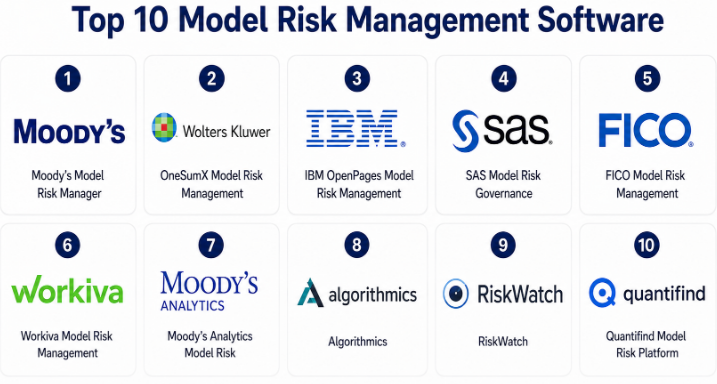
#1 — Moody’s Model Risk Manager
Short description: Moody’s Model Risk Manager is an enterprise platform designed to manage financial, credit, and operational model risks. It provides a centralized model inventory, validation tracking, audit trails, and regulatory compliance documentation. Organizations use it to govern complex quantitative models, streamline validation workflows, and ensure compliance with industry regulations. It is particularly suited for banks, insurance companies, and large enterprises with extensive model portfolios.
Key Features
- Centralized model inventory and catalog.
- Automated validation workflows.
- Audit trail and regulatory documentation support.
- Model performance monitoring and reporting.
- Scenario testing and stress testing.
- Workflow and approval management.
- Integration with quantitative and analytics platforms.
Pros
- Strong focus on financial and regulatory compliance.
- Centralized governance improves oversight.
- Automates validation and approval processes.
Cons
- Complex setup may require expert implementation.
- Higher learning curve for smaller teams.
- Designed primarily for financial models.
Platforms / Deployment
- Web
- Cloud / Hybrid
Security & Compliance
Not publicly stated.
Integrations & Ecosystem
Supports integration with model development environments, data platforms, and analytics pipelines. Enables enterprise risk teams to consolidate and manage models centrally.
Support & Community
Enterprise support and training provided; documentation is detailed. Community primarily consists of enterprise customers.
#2 — Wolters Kluwer OneSumX Model Risk Management
Short description: OneSumX MRM provides financial institutions with governance, validation, and monitoring capabilities for their model portfolios. The platform tracks model lifecycle, validation results, and compliance activities. It is widely used by banks and insurance firms for credit, market, operational, and capital models to ensure proper oversight and regulatory alignment.
Key Features
- Model inventory and lifecycle management.
- Validation documentation and tracking.
- Regulatory compliance support.
- Scenario analysis and stress testing.
- Performance monitoring dashboards.
- Approval workflows for model sign-offs.
- Integration with enterprise risk systems.
Pros
- Strong compliance and regulatory alignment.
- Centralized model oversight improves governance.
- Supports large portfolios of financial models.
Cons
- Primarily suited for financial institutions.
- Implementation complexity can be high.
- May be more than needed for smaller organizations.
Platforms / Deployment
- Web
- Cloud
Security & Compliance
Not publicly stated.
Integrations & Ecosystem
Integrates with risk systems, data warehouses, analytics platforms, and enterprise reporting tools to provide a consolidated model governance framework.
Support & Community
Enterprise support and implementation assistance; community mainly institutional clients.
#3 — IBM OpenPages Model Risk Management
Short description: IBM OpenPages MRM is part of the OpenPages governance, risk, and compliance suite. It allows enterprises to manage model risk, validation, and approvals within a unified GRC environment. It is designed for organizations with complex model portfolios that require compliance documentation, risk scoring, and centralized governance.
Key Features
- Model inventory and cataloging.
- Validation and approval workflows.
- Compliance documentation support.
- Risk scoring and monitoring dashboards.
- Scenario and stress testing capabilities.
- Integration with OpenPages GRC modules.
- Automated alerts and notifications.
Pros
- Integrates with broader enterprise GRC.
- Strong compliance and documentation support.
- Centralized model governance improves oversight.
Cons
- Best suited for large organizations with OpenPages ecosystem.
- Complexity can be high for smaller teams.
- Primarily targets financial and operational models.
Platforms / Deployment
- Web
- Cloud / Hybrid
Security & Compliance
Not publicly stated.
Integrations & Ecosystem
Integrates with other OpenPages modules, ERP, and analytics systems, providing consolidated model governance.
Support & Community
Enterprise support and training available; community is mainly OpenPages users.
#4 — SAS Model Risk Governance
Short description: SAS Model Risk Governance helps organizations manage, validate, and monitor risk across statistical, machine learning, and AI models. It provides a centralized platform to document validation, track performance, and comply with regulatory standards. Widely used in banking and insurance, it supports both traditional and advanced analytical models, including machine learning algorithms.
Key Features
- Model inventory and lifecycle management.
- Validation and back-testing workflows.
- Regulatory compliance tracking.
- Model performance monitoring.
- AI and machine learning model support.
- Dashboards and reporting.
- Scenario analysis and stress testing.
Pros
- Strong support for advanced analytical models.
- Centralized governance improves oversight.
- Regulatory alignment with financial institutions.
Cons
- Can be complex to implement.
- Requires expertise to validate machine learning models.
- May be too advanced for small organizations.
Platforms / Deployment
- Web
- Cloud / Hybrid
Security & Compliance
Not publicly stated.
Integrations & Ecosystem
Integrates with analytics pipelines, data platforms, and enterprise risk systems. Supports machine learning and statistical model governance.
Support & Community
Enterprise support and training programs are available.
#5 — FICO Model Risk Management
Short description: FICO MRM provides financial institutions with model inventory management, validation, monitoring, and governance. It supports risk scoring, compliance documentation, and automated workflow approvals. The platform is suitable for organizations managing credit, market, operational, and capital models, ensuring proper oversight and regulatory compliance.
Key Features
- Model inventory and lifecycle tracking.
- Validation documentation workflows.
- Performance monitoring dashboards.
- Regulatory compliance alignment.
- Scenario and stress testing.
- Automated workflow approvals.
- Integration with risk management and analytics platforms.
Pros
- Strong alignment with regulatory requirements.
- Centralized oversight for multiple model types.
- Supports workflow automation.
Cons
- Primarily targets financial institutions.
- Implementation can be complex.
- Smaller organizations may not need all features.
Platforms / Deployment
- Web
- Cloud
Security & Compliance
Not publicly stated.
Integrations & Ecosystem
Integrates with enterprise analytics, risk, and financial systems. APIs allow automation and reporting.
Support & Community
Enterprise-focused support; documentation and onboarding resources provided.
#6 — Workiva Model Risk Management
Short description: Workiva MRM provides model inventory, validation, and reporting within a cloud-based platform focused on regulatory and operational risk. It allows enterprises to track model performance, document validation, and generate compliance reports. Workiva is particularly useful for companies that need strong reporting and collaboration across risk, audit, and finance teams.
Key Features
- Model inventory and cataloging.
- Validation and compliance documentation.
- Risk scoring and monitoring.
- Dashboards and reporting.
- Workflow and collaboration tools.
- Scenario and stress testing.
- Integration with financial and analytics systems.
Pros
- Strong collaborative and reporting capabilities.
- Cloud-based for easy access.
- Simplifies compliance documentation.
Cons
- Focused on reporting and validation, not full GRC integration.
- May require additional tools for scenario analysis.
- Best for enterprises with structured model governance teams.
Platforms / Deployment
- Web
- Cloud
Security & Compliance
Not publicly stated.
Integrations & Ecosystem
Integrates with analytics pipelines, financial systems, and reporting platforms to support centralized model governance.
Support & Community
Documentation, onboarding, and enterprise support available.
#7 — Moody’s Analytics Model Risk
Short description: Moody’s Analytics MRM solution helps financial institutions manage the lifecycle, validation, and compliance of their financial models. It provides centralized inventory, validation tracking, reporting, and regulatory compliance tools. It is particularly suited for credit, market, and operational models in banking and insurance.
Key Features
- Model inventory and cataloging.
- Validation and approval tracking.
- Performance monitoring dashboards.
- Regulatory compliance support.
- Scenario and stress testing.
- Workflow automation.
- Integration with risk analytics platforms.
Pros
- Strong financial model governance.
- Centralized model validation improves oversight.
- Supports regulatory reporting needs.
Cons
- Primarily for financial models.
- Implementation may require specialized staff.
- Less suitable for small enterprises.
Platforms / Deployment
- Web
- Cloud
Security & Compliance
Not publicly stated.
Integrations & Ecosystem
Integrates with risk and analytics platforms, data sources, and enterprise systems for model management.
Support & Community
Enterprise support, training, and documentation provided.
#8 — Algorithmics (SAS)
Short description: Algorithmics MRM is designed for financial institutions and insurers to manage model risk across credit, market, operational, and capital models. It provides model inventory, validation, governance workflows, and reporting. It is particularly strong for large organizations requiring regulatory compliance and scenario analysis.
Key Features
- Model inventory and lifecycle management.
- Validation tracking workflows.
- Compliance and audit documentation.
- Scenario and stress testing.
- Risk scoring and dashboards.
- Workflow automation for approvals.
- Integration with analytics and risk systems.
Pros
- Strong regulatory alignment.
- Comprehensive model risk governance.
- Centralized oversight for large portfolios.
Cons
- Implementation can be resource-intensive.
- Complex for small organizations.
- Primarily designed for financial institutions.
Platforms / Deployment
- Web
- Cloud / Hybrid
Security & Compliance
Not publicly stated.
Integrations & Ecosystem
Integrates with analytics pipelines, ERP, risk systems, and reporting platforms.
Support & Community
Enterprise-focused support and documentation provided.
#9 — RiskWatch
Short description: RiskWatch MRM is a flexible tool for managing model inventories, validation, risk scoring, and compliance documentation. It supports financial, operational, and predictive models, providing dashboards, alerts, and workflow management. It is suitable for mid-market and enterprise teams needing centralized model risk tracking and regulatory documentation.
Key Features
- Model inventory and catalog.
- Validation tracking.
- Compliance documentation.
- Risk scoring and monitoring.
- Workflow automation.
- Reporting dashboards.
- Scenario analysis support.
Pros
- Flexible and user-friendly.
- Suitable for mid-market organizations.
- Supports compliance documentation and monitoring.
Cons
- May not have advanced financial or AI model support.
- Limited scenario modeling for large portfolios.
- Smaller ecosystem compared to enterprise vendors.
Platforms / Deployment
- Web
- Cloud
Security & Compliance
Not publicly stated.
Integrations & Ecosystem
Integrates with data platforms, analytics pipelines, and workflow tools for model risk management.
#10 — Quantifind Model Risk Platform
Short description: Quantifind provides model risk governance, validation, and monitoring, particularly for statistical, financial, and AI models. It centralizes model inventory, tracks validation results, provides dashboards, and supports compliance documentation. It is designed for enterprises with complex model portfolios requiring oversight and regulatory alignment.
Key Features
- Centralized model inventory.
- Validation tracking and workflow management.
- Compliance documentation support.
- Model performance monitoring.
- Scenario and stress testing.
- Risk scoring dashboards.
- Integration with analytics and enterprise systems.
Pros
- Strong oversight for complex model portfolios.
- Supports regulatory compliance.
- Centralized dashboards and workflow automation.
Cons
- Focused on enterprise financial and operational models.
- Implementation may require specialized staff.
- Smaller organizations may find it too complex.
Platforms / Deployment
- Web
- Cloud
Security & Compliance
Not publicly stated.
Comparison Table Top 10
| Tool Name | Best For | Platform(s) Supported | Deployment | Standout Feature | Public Rating |
|---|---|---|---|---|---|
| Moody’s Model Risk Manager | Financial institutions | Web | Cloud / Hybrid | Centralized model inventory | N/A |
| Wolters Kluwer OneSumX | Banks, insurers | Web | Cloud | Lifecycle and validation tracking | N/A |
| IBM OpenPages MRM | Enterprises | Web | Cloud / Hybrid | GRC-integrated model risk | N/A |
| SAS Model Risk Governance | AI/ML & financial models | Web | Cloud / Hybrid | Advanced model validation | N/A |
| FICO Model Risk Management | Financial models | Web | Cloud | Automated validation workflows | N/A |
| Workiva MRM | Operational & regulatory compliance | Web | Cloud | Collaborative reporting & validation | N/A |
| Moody’s Analytics MRM | Credit, market, operational models | Web | Cloud | Regulatory-focused oversight | N/A |
| Algorithmics (SAS) | Banks & insurers | Web | Cloud / Hybrid | Comprehensive governance & scenario testing | N/A |
| RiskWatch | Mid-market & enterprise models | Web | Cloud | Flexible validation & dashboards | N/A |
| Quantifind | AI, statistical, financial models | Web | Cloud | Centralized performance monitoring | N/A |
Evaluation & Model Risk Management Tools
| Tool Name | Core 25% | Ease 15% | Integrations 15% | Security 10% | Performance 10% | Support 10% | Value 15% | Weighted Total 0–10 |
|---|---|---|---|---|---|---|---|---|
| Moody’s Model Risk Manager | 9 | 7 | 8 | 7 | 8 | 8 | 7 | 7.85 |
| OneSumX | 9 | 7 | 7 | 7 | 8 | 8 | 7 | 7.70 |
| IBM OpenPages MRM | 8 | 6 | 8 | 7 | 8 | 8 | 7 | 7.55 |
| SAS Model Risk Governance | 9 | 6 | 8 | 7 | 8 | 8 | 7 | 7.70 |
| FICO MRM | 8 | 7 | 7 | 7 | 8 | 7 | 7 | 7.45 |
| Workiva MRM | 8 | 8 | 7 | 7 | 7 | 7 | 7 | 7.50 |
| Moody’s Analytics MRM | 9 | 6 | 7 | 7 | 8 | 8 | 7 | 7.60 |
| Algorithmics | 9 | 6 | 8 | 7 | 8 | 8 | 7 | 7.70 |
| RiskWatch | 8 | 7 | 7 | 7 | 7 | 7 | 7 | 7.35 |
| Quantifind | 8 | 7 | 7 | 7 | 7 | 7 | 7 | 7.35 |
Which Model Risk Management Tools
Solo / Freelancer
Small teams managing limited models may choose RiskWatch or Workiva MRM for flexibility and ease of reporting.
SMB
Organizations with moderate model portfolios may benefit from SAS Model Risk Governance, FICO MRM, or Workiva MRM.
Mid-Market
Needs centralized dashboards, validation workflows, and scenario testing. Moody’s MRM, OneSumX, and IBM OpenPages are suitable.
Enterprise
Complex portfolios with regulatory oversight require Moody’s Model Risk Manager, Algorithmics, SAS Model Risk Governance, or Quantifind for full governance.
Budget vs Premium
Budget: Workiva, RiskWatch, Quantifind.
Premium: Moody’s MRM, OneSumX, IBM OpenPages, SAS Model Risk Governance.
Feature Depth vs Ease of Use
Deep features: Moody’s MRM, SAS Model Risk Governance, OneSumX.
Ease of use: Workiva, RiskWatch, Quantifind.
Integrations & Scalability
Enterprise-grade MRM platforms support ERP, analytics, data pipelines, and GRC integrations; smaller tools may need custom APIs.
Security & Compliance Needs
Evaluate SSO, MFA, encryption, audit logs, RBAC, and regulatory compliance capabilities before deployment. Enterprise tools generally include extensive security features.
Frequently Asked Questions (FAQs)
1. What is MRM software?
MRM software helps manage the lifecycle, validation, monitoring, and risk of predictive, financial, or operational models. It supports regulatory compliance, risk oversight, and performance tracking.
2. Who uses MRM platforms?
Risk managers, quants, data scientists, compliance teams, internal audit, finance teams, and operational managers use MRM platforms for model governance.
3. How is MRM different from ERM?
ERM manages enterprise-level strategic and operational risk broadly. MRM specifically governs predictive, statistical, AI, or financial models to ensure reliability and regulatory compliance.
4. Can MRM reduce model errors?
Yes, MRM software tracks validation, monitors performance, enforces approvals, and creates structured oversight to reduce errors and misestimations.
5. Are MRM platforms cloud-based?
Many modern MRM platforms are cloud-based, providing scalability, remote access, and integration with analytics and data pipelines. Some offer hybrid deployment options.
6. How long does implementation take?
Implementation depends on model inventory size, workflow complexity, integration needs, and reporting requirements. Small portfolios may deploy in weeks; enterprise-grade systems may take months.
7. Do MRM tools support AI and ML models?
Yes, leading platforms like SAS, Quantifind, and Workiva support machine learning and AI models for validation, performance monitoring, and drift detection.
8. Are MRM platforms useful for compliance?
Yes, MRM platforms maintain audit trails, validation documentation, regulatory reporting, and workflow approvals, aligning with guidelines such as SR 11-7 or Basel principles.
9. Can MRM integrate with analytics pipelines?
Yes, most platforms integrate with Python, R, SQL, ERP, and data warehouse systems for automated monitoring, reporting, and validation.
10. What alternatives exist to MRM software?
Alternatives include spreadsheets, homegrown tracking systems, manual validation, GRC tools, and enterprise risk platforms, but these often lack automation, traceability, and audit-ready documentation.
Conclusion
Model Risk Management software centralizes model governance, ensures compliance, and reduces operational and financial exposure from inaccurate or misused models. Moody’s Model Risk Manager, OneSumX, and SAS Model Risk Governance provide enterprise-grade capabilities for financial institutions. Workiva, RiskWatch, and Quantifind are easier-to-use options for mid-market or small teams. The right choice depends on model complexity, organizational size, regulatory requirements, and integration needs.
