Introduction
Hospital Bed Management Systems help hospitals, clinics, and healthcare networks manage bed availability, patient admissions, transfers, discharges, ward capacity, and real-time occupancy. In simple words, these tools help hospital teams know which beds are available, which patients are waiting, which wards are full, and where patients can be placed safely and quickly.
These systems matter because hospitals face pressure from emergency admissions, planned surgeries, ICU demand, staffing limits, infection control needs, and discharge delays. Poor bed visibility can increase patient wait times, slow down emergency care, create staff confusion, and reduce operational efficiency.
Common use cases include emergency department bed allocation, ICU bed visibility, patient transfer management, discharge planning, ward occupancy tracking, housekeeping coordination, infection isolation planning, and hospital capacity dashboards.
Buyers should evaluate real-time bed visibility, patient flow tracking, EHR integration, admission-discharge-transfer workflows, role-based access, mobile access, analytics, alerting, housekeeping coordination, reporting, scalability, and ease of use.
Best for: Hospitals, health systems, emergency departments, ICU teams, nursing supervisors, patient flow managers, bed coordinators, hospital operations leaders, and healthcare administrators.
Not ideal for: Very small clinics with few beds, outpatient-only centers, or organizations that only need basic room scheduling without real-time patient flow and capacity management.
Key Trends in Hospital Bed Management Systems
- Real-time bed visibility is becoming essential for emergency departments, ICU units, surgical wards, and hospital command centers.
- AI-assisted patient flow prediction is growing, helping hospitals forecast demand, discharge delays, and likely bed shortages.
- Integration with EHR and ADT systems is now a major requirement, because bed status must connect with patient admission, transfer, and discharge events.
- Command center dashboards are becoming popular, especially in large hospitals and multi-site health systems.
- Mobile access is increasingly important, allowing nursing teams, bed coordinators, housekeeping, and transport teams to update status from anywhere.
- Discharge planning workflows are being connected with bed management, helping teams reduce delays and improve turnover.
- Infection control and isolation bed tracking are more important, especially for hospitals managing communicable diseases or special-care requirements.
- Housekeeping and transport coordination are becoming part of bed operations, because a bed is not truly available until cleaning and readiness steps are complete.
- Analytics and capacity reporting are improving, helping hospital leaders understand bottlenecks, occupancy trends, length of stay, and operational pressure.
- Cloud-based deployment is increasing, but many hospitals still require hybrid or enterprise-controlled deployments due to security, integration, and governance needs.
How We Selected These Tools
- We selected tools widely recognized for hospital capacity management, patient flow, bed management, command centers, or healthcare operational visibility.
- We considered practical fit for hospitals, emergency departments, health systems, nursing teams, and patient flow operations.
- We prioritized tools that support real-time bed tracking, ADT workflows, patient movement, discharge coordination, dashboards, and operational alerts.
- We included both enterprise hospital platforms and specialized patient flow solutions.
- We considered integration potential with EHR, ADT, clinical systems, housekeeping systems, transport systems, and analytics tools.
- We looked at usability for frontline users such as nursing supervisors, bed managers, ward clerks, and operations teams.
- We avoided guessing public ratings, pricing, certifications, or unsupported security claims.
- We used N/A, Varies / N/A, and Not publicly stated wherever information is uncertain.
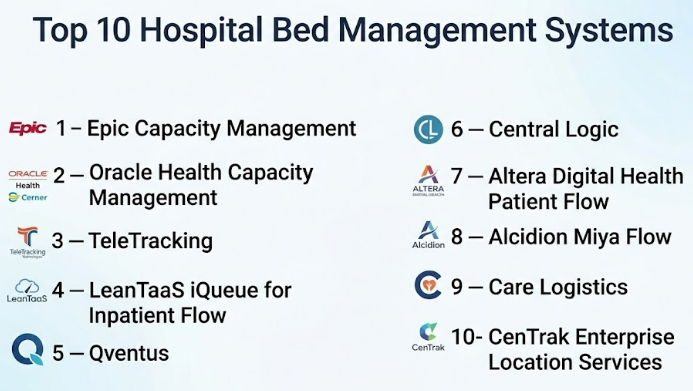
#1 — Epic Capacity Management
Short description: Epic Capacity Management is part of the broader Epic ecosystem and helps hospitals manage bed availability, patient placement, transfers, and capacity visibility. It is best suited for hospitals and health systems already using Epic as their core EHR. The system can help operational teams connect patient flow with clinical records, admissions, discharges, and transfers. It is a strong fit for large hospitals that need bed management tightly integrated with patient data and hospital workflows.
Key Features
- Bed availability tracking.
- Admission, discharge, and transfer workflow support.
- Patient placement visibility.
- Capacity dashboards.
- EHR-connected patient flow.
- Discharge coordination support.
- Multi-unit operational visibility.
Pros
- Strong fit for Epic-based hospitals.
- Connects bed management with clinical and patient data.
- Useful for large hospital networks with complex workflows.
Cons
- Best suited for organizations already using Epic.
- Implementation can require strong internal change management.
- May be less practical for non-Epic hospitals.
Platforms / Deployment
Web / Mobile / Varies / N/A
Cloud / Self-hosted / Hybrid / Varies / N/A
Security & Compliance
Epic environments commonly support role-based access, audit controls, identity management, and enterprise healthcare security workflows. Specific certifications: Not publicly stated.
Integrations & Ecosystem
Epic Capacity Management works strongest inside the Epic ecosystem and can connect with hospital clinical and operational workflows.
- EHR workflows.
- ADT events.
- Patient transfer processes.
- Discharge planning workflows.
- Hospital reporting tools.
- Clinical operations dashboards.
Support & Community
Epic provides enterprise support, implementation guidance, training resources, and a strong customer network. Support experience depends on the hospital’s Epic contract, internal IT resources, and implementation maturity.
#2 — Oracle Health Capacity Management
Short description: Oracle Health Capacity Management supports hospital capacity planning, patient flow, and bed visibility within Oracle Health environments. It is useful for hospitals that need operational control over admissions, transfers, discharges, and bed status across departments. The platform can help teams improve coordination between emergency departments, inpatient units, nursing, and operations. It is a practical option for organizations already using Oracle Health systems and seeking connected capacity workflows.
Key Features
- Bed status visibility.
- Patient flow tracking.
- Admission and transfer coordination.
- Discharge workflow support.
- Capacity dashboards.
- Operational reporting.
- EHR-connected workflows.
Pros
- Good fit for Oracle Health users.
- Supports hospital-wide capacity visibility.
- Useful for patient movement and operational coordination.
Cons
- Best value comes in Oracle Health environments.
- May require implementation and workflow configuration.
- Non-Oracle hospitals may need more integration effort.
Platforms / Deployment
Web / Mobile / Varies / N/A
Cloud / Self-hosted / Hybrid / Varies / N/A
Security & Compliance
Security details vary by deployment and customer environment. Capabilities may include access control, audit logging, identity management, and healthcare data protection workflows. Specific certifications: Not publicly stated.
Integrations & Ecosystem
Oracle Health Capacity Management is strongest when connected with Oracle Health clinical, administrative, and operational systems.
- EHR integration.
- ADT workflows.
- Patient placement data.
- Discharge workflows.
- Reporting dashboards.
- Hospital operations systems.
Support & Community
Oracle Health provides enterprise support, documentation, implementation services, and partner resources. Support quality depends on customer agreement, deployment model, and internal system readiness.
#3 — TeleTracking
Short description: TeleTracking is a patient flow and hospital operations platform focused on bed management, capacity visibility, transfer management, and command center workflows. It helps hospitals improve bed turnover, reduce bottlenecks, and coordinate patient movement across departments. The platform is useful for large hospitals, emergency departments, command centers, and health systems that need real-time operational visibility. It is a strong option for organizations focused on improving patient flow and reducing delays.
Key Features
- Real-time bed management.
- Patient flow coordination.
- Transfer center workflows.
- Command center dashboards.
- Capacity and occupancy visibility.
- Discharge and throughput tracking.
- Operational alerts and reporting.
Pros
- Strong focus on patient flow and bed operations.
- Useful for command center and transfer workflows.
- Good fit for hospitals facing capacity pressure.
Cons
- May require workflow redesign to get full value.
- Integration with existing hospital systems should be validated.
- Smaller hospitals may not need the full platform depth.
Platforms / Deployment
Web / Mobile / Varies / N/A
Cloud / Hybrid / Varies / N/A
Security & Compliance
Security details vary by deployment and customer agreement. Specific certifications: Not publicly stated.
Integrations & Ecosystem
TeleTracking can connect with hospital systems to support real-time capacity and patient movement workflows.
- EHR integrations.
- ADT feeds.
- Transfer center workflows.
- Housekeeping coordination.
- Transport systems.
- Analytics and reporting dashboards.
Support & Community
TeleTracking provides vendor-led implementation, onboarding, customer support, and operational guidance. Public community strength is limited, but hospital operations expertise is strong.
#4 — LeanTaaS iQueue for Inpatient Flow
Short description: LeanTaaS iQueue for Inpatient Flow helps hospitals improve inpatient capacity, discharge planning, patient flow, and operational decision-making through analytics and predictive workflows. It is useful for hospitals that want to reduce bottlenecks, improve bed utilization, and better manage patient placement. The platform is especially valuable for teams looking for data-driven recommendations rather than only a static bed board. It is a strong fit for hospitals focused on operational improvement and patient throughput.
Key Features
- Inpatient flow optimization.
- Predictive capacity analytics.
- Discharge planning support.
- Bed utilization insights.
- Bottleneck detection.
- Operational dashboards.
- Decision support for patient flow teams.
Pros
- Strong analytics-driven patient flow support.
- Useful for improving bed utilization.
- Helps hospitals identify operational bottlenecks.
Cons
- May need strong data integration for best results.
- Not simply a basic bed board tool.
- Adoption depends on operational team engagement.
Platforms / Deployment
Web / Varies / N/A
Cloud
Security & Compliance
Security and compliance details vary by contract and implementation. Specific certifications: Not publicly stated.
Integrations & Ecosystem
LeanTaaS iQueue can connect with hospital data systems to support predictive patient flow decisions.
- EHR data integration.
- ADT workflow data.
- Capacity dashboards.
- Discharge planning data.
- Operational analytics.
- Reporting tools.
Support & Community
LeanTaaS provides vendor-led onboarding, analytics support, implementation guidance, and customer success resources. Community is strongest among healthcare operations and capacity management leaders.
#5 — Qventus
Short description: Qventus is a healthcare operations platform that uses automation and AI-assisted workflows to improve patient flow, capacity management, discharge planning, and hospital operations. It helps teams identify delays, coordinate actions, and improve operational execution across departments. The platform is suitable for hospitals that want more than visibility and need proactive recommendations for better throughput. It is a strong option for hospitals focused on reducing discharge delays and improving inpatient flow.
Key Features
- AI-assisted patient flow workflows.
- Capacity management support.
- Discharge planning automation.
- Operational alerts.
- Bottleneck identification.
- Workflow coordination.
- Hospital operations dashboards.
Pros
- Strong for operational automation and proactive recommendations.
- Useful for discharge and throughput improvement.
- Helps coordinate teams across departments.
Cons
- Requires strong change management for adoption.
- Best value depends on data quality and integration.
- May not be ideal for hospitals needing only a simple bed board.
Platforms / Deployment
Web / Varies / N/A
Cloud
Security & Compliance
Security details vary by deployment and agreement. Specific certifications: Not publicly stated.
Integrations & Ecosystem
Qventus can connect with hospital systems and operational data to support automated workflows.
- EHR integrations.
- ADT data feeds.
- Discharge workflow data.
- Capacity analytics.
- Operational alerts.
- Reporting and dashboards.
Support & Community
Qventus provides implementation support, customer success services, operational guidance, and workflow support. Public community strength is limited, but healthcare operations focus is strong.
#6 — Central Logic
Short description: Central Logic is a transfer center and patient access platform that helps hospitals manage patient transfers, referrals, capacity, and placement decisions. It is useful for health systems that receive transfer requests from outside facilities and need clear visibility into bed availability, service lines, and acceptance workflows. The platform supports patient access coordination and helps improve communication between transfer centers, hospitals, and clinical teams. It is a strong fit for regional health systems and hospitals with active transfer operations.
Key Features
- Transfer center management.
- Patient access workflows.
- Bed availability visibility.
- Referral coordination.
- Capacity matching.
- Communication tracking.
- Reporting and analytics.
Pros
- Strong fit for transfer center operations.
- Useful for regional health systems.
- Helps coordinate patient placement decisions.
Cons
- More transfer-focused than general bed management.
- Integration with hospital systems should be reviewed.
- Smaller hospitals may not need full transfer center features.
Platforms / Deployment
Web / Varies / N/A
Cloud / Varies / N/A
Security & Compliance
Security and compliance details vary by agreement. Specific certifications: Not publicly stated.
Integrations & Ecosystem
Central Logic supports patient transfer workflows and can connect with hospital capacity and clinical systems.
- EHR integration options.
- ADT data workflows.
- Transfer center workflows.
- Referral management.
- Capacity visibility.
- Reporting dashboards.
Support & Community
Support is vendor-led with onboarding, implementation assistance, customer support, and operational guidance for transfer and patient access teams.
#7 — Altera Digital Health Patient Flow
Short description: Altera Digital Health Patient Flow supports hospital operations by helping teams manage patient movement, bed availability, transfers, and discharge workflows. It is useful for hospitals that need visibility into patient status and operational bottlenecks across departments. The platform can help care teams coordinate better between emergency departments, wards, nursing teams, and discharge planners. It is a practical option for organizations using or evaluating Altera’s broader healthcare technology ecosystem.
Key Features
- Patient flow tracking.
- Bed visibility.
- Transfer support.
- Discharge workflow support.
- Operational dashboards.
- Department-level visibility.
- Clinical workflow alignment.
Pros
- Useful for hospital patient flow coordination.
- Can align with broader clinical systems.
- Supports visibility across care areas.
Cons
- Product scope may vary by package.
- Best fit depends on existing hospital technology environment.
- Integration details should be validated.
Platforms / Deployment
Web / Mobile / Varies / N/A
Cloud / Self-hosted / Hybrid / Varies / N/A
Security & Compliance
Security details vary by deployment and customer setup. Specific certifications: Not publicly stated.
Integrations & Ecosystem
Altera Digital Health Patient Flow can support connected hospital operations and patient movement workflows.
- EHR integration options.
- ADT data workflows.
- Patient placement processes.
- Discharge planning.
- Operational dashboards.
- Reporting tools.
Support & Community
Altera provides vendor-led customer support, documentation, implementation services, and healthcare IT guidance. Support depends on customer agreement and deployment model.
#8 — Alcidion Miya Flow
Short description: Alcidion Miya Flow is a patient flow and hospital operations solution designed to improve visibility across admissions, discharges, transfers, ward status, and operational bottlenecks. It helps clinical and operational teams coordinate patient movement and understand capacity pressure. The platform is useful for hospitals that need better real-time visibility into patient flow and ward operations. It is a strong option for organizations looking for a modern patient flow system with operational dashboards.
Key Features
- Patient flow management.
- Bed and ward visibility.
- Admission and discharge tracking.
- Transfer management.
- Operational dashboards.
- Alerts and task coordination.
- Capacity pressure visibility.
Pros
- Strong patient flow visibility.
- Useful for ward-level operational coordination.
- Helps teams manage capacity pressure.
Cons
- Regional availability and implementation scope should be confirmed.
- Integration needs should be reviewed early.
- May require workflow changes for full benefit.
Platforms / Deployment
Web / Mobile / Varies / N/A
Cloud / Hybrid / Varies / N/A
Security & Compliance
Security details vary by deployment and customer agreement. Specific certifications: Not publicly stated.
Integrations & Ecosystem
Miya Flow can connect with hospital clinical and operational systems to support real-time patient flow workflows.
- EHR data connections.
- ADT workflows.
- Ward management data.
- Task coordination.
- Operational dashboards.
- Reporting and analytics.
Support & Community
Alcidion provides vendor-led implementation, support, onboarding, and product guidance. Public community strength is limited, but healthcare workflow focus is clear.
#9 — Care Logistics
Short description: Care Logistics provides patient flow and hospital operations solutions focused on improving throughput, reducing delays, and coordinating care progression. It helps hospitals manage capacity, discharge readiness, bottlenecks, and operational accountability. The platform is useful for hospitals that want structured patient flow improvement with both technology and operational process support. It is a strong fit for organizations that need more disciplined coordination around bed management and patient progression.
Key Features
- Patient flow management.
- Capacity visibility.
- Discharge coordination.
- Operational accountability workflows.
- Bottleneck tracking.
- Care progression support.
- Reporting and analytics.
Pros
- Strong focus on patient throughput improvement.
- Useful for hospitals needing operational discipline.
- Supports capacity and discharge coordination.
Cons
- May require process redesign.
- Not just a simple software deployment.
- Fit depends on hospital leadership and operational adoption.
Platforms / Deployment
Web / Varies / N/A
Cloud / Hybrid / Varies / N/A
Security & Compliance
Security details vary by implementation and customer agreement. Specific certifications: Not publicly stated.
Integrations & Ecosystem
Care Logistics can support hospital operations workflows and connect with existing systems depending on implementation.
- EHR integration options.
- ADT data workflows.
- Capacity dashboards.
- Discharge workflow data.
- Operational reporting.
- Care progression workflows.
Support & Community
Care Logistics support is typically vendor-led and often includes implementation, operational guidance, training, and process improvement assistance.
#10 — CenTrak Enterprise Location Services
Short description: CenTrak Enterprise Location Services is a real-time location system used by hospitals to track assets, patients, staff, and room-level activity. While it is not only a bed management system, it can support bed and room workflow visibility when combined with hospital operations processes. It is useful for hospitals that need real-time location data to improve patient flow, asset availability, room turnover, and operational awareness. It is best for organizations that want location-driven visibility alongside bed management workflows.
Key Features
- Real-time location tracking.
- Asset and patient location visibility.
- Room-level workflow data.
- Staff workflow support.
- Operational analytics.
- Integration with hospital systems.
- Location-driven automation.
Pros
- Useful for real-time hospital visibility.
- Helps improve asset and room workflow tracking.
- Can support bed turnover and operational awareness.
Cons
- Not a standalone bed management platform.
- Requires hardware and infrastructure planning.
- Best used with broader hospital operations systems.
Platforms / Deployment
Web / Mobile / Varies / N/A
Cloud / Self-hosted / Hybrid / Varies / N/A
Security & Compliance
Security details vary by deployment and hospital environment. Specific certifications: Not publicly stated.
Integrations & Ecosystem
CenTrak can support location-based workflows and connect with hospital operational systems.
- EHR integration options.
- RTLS infrastructure.
- Asset management systems.
- Nurse call or workflow systems.
- Operational dashboards.
- Analytics and reporting tools.
Support & Community
CenTrak provides vendor-led implementation, hardware planning, support, training, and customer assistance. Public community strength is limited, but healthcare RTLS ecosystem experience is strong.
Comparison Table
| Tool Name | Best For | Platform(s) Supported | Deployment | Standout Feature | Public Rating |
|---|---|---|---|---|---|
| Epic Capacity Management | Epic-based hospitals and health systems | Web / Mobile / Varies | Cloud / Self-hosted / Hybrid / Varies | EHR-connected patient flow and bed visibility | N/A |
| Oracle Health Capacity Management | Oracle Health environments | Web / Mobile / Varies | Cloud / Self-hosted / Hybrid / Varies | Capacity workflows tied to hospital operations | N/A |
| TeleTracking | Patient flow and command centers | Web / Mobile / Varies | Cloud / Hybrid / Varies | Real-time capacity and transfer visibility | N/A |
| LeanTaaS iQueue for Inpatient Flow | Predictive inpatient flow optimization | Web / Varies | Cloud | Data-driven capacity and discharge insights | N/A |
| Qventus | AI-assisted hospital operations | Web / Varies | Cloud | Proactive patient flow automation | N/A |
| Central Logic | Transfer center and patient access teams | Web / Varies | Cloud / Varies | Transfer and referral coordination | N/A |
| Altera Digital Health Patient Flow | Hospital patient movement visibility | Web / Mobile / Varies | Cloud / Self-hosted / Hybrid / Varies | Patient flow across departments | N/A |
| Alcidion Miya Flow | Ward-level patient flow coordination | Web / Mobile / Varies | Cloud / Hybrid / Varies | Real-time flow and ward dashboards | N/A |
| Care Logistics | Throughput and care progression improvement | Web / Varies | Cloud / Hybrid / Varies | Operational accountability for patient flow | N/A |
| CenTrak Enterprise Location Services | Location-driven hospital workflow visibility | Web / Mobile / Varies | Cloud / Self-hosted / Hybrid / Varies | RTLS-based room, asset, and workflow visibility | N/A |
Evaluation & Hospital Bed Management Systems
| Tool Name | Core (25%) | Ease (15%) | Integrations (15%) | Security (10%) | Performance (10%) | Support (10%) | Value (15%) | Weighted Total |
|---|---|---|---|---|---|---|---|---|
| Epic Capacity Management | 9 | 7 | 9 | 8 | 8 | 8 | 7 | 8.15 |
| Oracle Health Capacity Management | 8 | 7 | 8 | 8 | 8 | 8 | 7 | 7.80 |
| TeleTracking | 9 | 7 | 8 | 7 | 8 | 8 | 7 | 7.85 |
| LeanTaaS iQueue for Inpatient Flow | 8 | 8 | 8 | 7 | 8 | 8 | 8 | 7.95 |
| Qventus | 8 | 8 | 8 | 7 | 8 | 8 | 8 | 7.95 |
| Central Logic | 8 | 8 | 7 | 7 | 8 | 8 | 7 | 7.60 |
| Altera Digital Health Patient Flow | 8 | 7 | 8 | 7 | 8 | 7 | 7 | 7.50 |
| Alcidion Miya Flow | 8 | 8 | 7 | 7 | 8 | 7 | 7 | 7.60 |
| Care Logistics | 8 | 7 | 7 | 7 | 8 | 8 | 7 | 7.45 |
| CenTrak Enterprise Location Services | 7 | 7 | 8 | 7 | 8 | 8 | 7 | 7.35 |
These scores are comparative and should be treated as a starting point, not a final ranking. A tool that scores lower overall may still be the best choice if it solves your exact bottleneck, such as transfer coordination, discharge delays, or room-level tracking. EHR-native platforms often score well for integration, while specialist patient flow tools may offer stronger operational visibility and analytics. Buyers should validate workflows, integration effort, support model, security, and user adoption before making a final decision.
Which Hospital Bed Management System Should You Choose?
Solo / Freelancer
Independent healthcare consultants or small advisory teams do not usually need a full hospital bed management system. They may use reporting tools, process maps, or analytics platforms to help hospitals assess bed utilization and patient flow issues. If they are advising hospitals, they should evaluate tools based on integration readiness, workflow fit, and operational improvement potential.
SMB
Small hospitals and specialty facilities should focus on usability, cost, and practical workflows. They may not need a large command center system. Alcidion Miya Flow, Care Logistics, Central Logic, or a module from the existing EHR vendor may be suitable depending on whether the need is bed tracking, transfer coordination, or discharge management.
Mid-Market
Mid-sized hospitals need stronger integration with EHR, ADT, housekeeping, transport, and discharge workflows. TeleTracking, LeanTaaS iQueue for Inpatient Flow, Qventus, Altera Digital Health Patient Flow, and Central Logic can be strong options depending on the main operational challenge. Hospitals should involve nursing, emergency, operations, IT, and discharge planning teams during selection.
Enterprise
Large hospitals and health systems need scalable capacity visibility, multi-site support, command center dashboards, patient transfer workflows, analytics, and enterprise-grade integration. Epic Capacity Management, Oracle Health Capacity Management, TeleTracking, LeanTaaS, Qventus, and Interoperable patient flow platforms are stronger enterprise options depending on the existing EHR and operational model.
Budget vs Premium
Budget-focused hospitals should first understand whether the problem is visibility, discharge delay, housekeeping coordination, transfer management, or staffing-related capacity pressure. Premium buyers should focus on predictive analytics, command center workflows, EHR integration, enterprise dashboards, automation, and long-term scalability.
Feature Depth vs Ease of Use
A simple bed board may be easier to adopt, but it may not solve deeper patient flow issues. Advanced systems can support predictive analytics, discharge planning, transfer coordination, and operational alerts, but they require stronger implementation and user training. The right balance depends on hospital size and process maturity.
Integrations & Scalability
Bed management depends heavily on integration with EHR, ADT, housekeeping, transport, nurse call, staffing, emergency department, ICU, and analytics systems. Buyers should validate data flows before purchase because real-time bed visibility is only useful if the system receives accurate and timely updates.
Security & Compliance Needs
Hospitals should review access control, audit logs, encryption, authentication, role permissions, user activity tracking, data retention, and integration security. Since bed management systems may include patient identifiers and care location data, security and privacy review should be completed before implementation.
Frequently Asked Questions
1. What is a Hospital Bed Management System?
A Hospital Bed Management System helps hospitals track bed availability, patient admissions, transfers, discharges, and occupancy in real time. It improves patient placement and helps staff understand capacity across wards, ICUs, emergency departments, and specialty units.
2. Why do hospitals need bed management software?
Hospitals need bed management software to reduce delays, improve patient flow, support emergency admissions, manage discharge planning, and make better use of available capacity. Without real-time visibility, teams may waste time calling units manually or working from outdated information.
3. What is the difference between bed management and patient flow?
Bed management focuses on bed availability and readiness. Patient flow is broader and includes admissions, transfers, discharges, transport, housekeeping, care progression, and operational bottlenecks across the hospital.
4. Can these systems integrate with EHR platforms?
Yes, many hospital bed management systems can integrate with EHR and ADT systems. Buyers should validate integration depth, update frequency, data accuracy, interface requirements, and support for patient movement workflows.
5. How much does hospital bed management software cost?
Pricing varies based on hospital size, number of beds, users, modules, integrations, deployment model, and support needs. Many vendors use custom pricing, so buyers should request quotes based on actual workflow and scale.
6. How long does implementation usually take?
Implementation depends on hospital size, integration complexity, data quality, workflow readiness, and training needs. A basic deployment may be faster, while enterprise command center or multi-site rollout requires more planning.
7. What common mistakes should hospitals avoid?
Common mistakes include choosing software without fixing workflow issues, ignoring frontline staff needs, underestimating integrations, failing to define bed status rules, and not training housekeeping, nursing, transport, and discharge teams properly.
8. Can bed management systems help reduce emergency department wait times?
Yes, they can help by improving visibility into available beds, reducing placement delays, and coordinating transfers more quickly. However, results also depend on staffing, discharge processes, emergency department workflow, and hospital capacity strategy.
9. Do these tools support ICU bed management?
Many systems can support ICU bed visibility, but buyers should confirm whether the tool handles ICU-specific needs such as isolation requirements, equipment readiness, staffing constraints, and patient acuity considerations.
10. Can bed management software support housekeeping workflows?
Yes, some systems include housekeeping status, cleaning requests, room readiness, and turnover tracking. This is important because a bed is not truly available until the room is cleaned, prepared, and marked ready.
Conclusion
Hospital Bed Management Systems help hospitals improve capacity visibility, patient placement, admissions, transfers, discharges, and overall patient flow. The best system depends on hospital size, EHR environment, operational bottlenecks, integration readiness, and budget. Epic and Oracle Health are strong choices for hospitals already using those ecosystems. TeleTracking, LeanTaaS, and Qventus are strong for patient flow, command center visibility, analytics, and operational improvement. Central Logic is useful for transfer centers, while Alcidion, Altera, and Care Logistics support patient flow and care progression workflows. CenTrak can add real-time location visibility where hospitals need room, asset, and workflow tracking.
