Introduction
Clinical Terminology Management Tools help healthcare organizations manage, map, standardize, and maintain medical terms used across electronic health records, lab systems, claims systems, analytics platforms, public health reporting, and clinical applications. In simple words, these tools help make sure that different systems understand the same medical meaning even when doctors, coders, labs, and software platforms use different words.
These tools are important because healthcare data often comes from many systems and many formats. A diagnosis, procedure, medication, lab result, or clinical finding may be written differently across hospitals, clinics, payers, and health technology platforms. Clinical terminology tools help reduce confusion, improve interoperability, support coding accuracy, improve analytics, and make patient records easier to share and understand.
Common use cases include terminology mapping, value set management, SNOMED CT management, ICD mapping, LOINC mapping, clinical coding support, data normalization, FHIR terminology services, quality reporting, and healthcare analytics.
Buyers should evaluate terminology coverage, mapping accuracy, standards support, API quality, EHR integration, value set management, governance workflows, audit trails, scalability, security, and ease of maintenance.
Best for: Hospitals, health systems, EHR vendors, health information exchanges, public health agencies, payers, clinical data platforms, digital health companies, research organizations, and healthcare analytics teams.
Not ideal for: Very small clinics that only use a standard EHR without custom terminology needs, teams that do not exchange clinical data, or organizations that only need basic coding lookup without terminology governance.
Key Trends in Clinical Terminology Management Tools
- Interoperability is becoming the main driver, especially as healthcare systems need cleaner data exchange across EHRs, labs, payers, and public health platforms.
- FHIR terminology services are gaining importance, because modern healthcare applications need APIs for code systems, value sets, concept maps, and validation.
- Clinical data normalization is becoming essential, especially for analytics, AI models, quality measurement, and population health programs.
- AI-assisted terminology mapping is emerging, helping teams suggest mappings, detect inconsistencies, and speed up terminology maintenance.
- Value set governance is becoming more mature, with stronger approval workflows, version control, and audit trails.
- Terminology tools are moving toward cloud delivery, making it easier for distributed healthcare teams to manage clinical vocabularies.
- Support for multiple standards is now expected, including SNOMED CT, ICD, LOINC, RxNorm, CPT, HCPCS, and local code systems.
- Healthcare analytics teams are demanding cleaner coded data, because inconsistent terms can weaken reporting, risk adjustment, and clinical decision support.
- Terminology APIs are becoming more important, especially for developers building EHR extensions, clinical apps, data platforms, and interoperability solutions.
- Governance and compliance controls are growing in importance, including role-based access, audit logs, version history, and controlled publishing.
How We Selected These Tools
- We selected tools that are widely recognized for clinical terminology management, healthcare data normalization, value set management, terminology services, or clinical vocabulary mapping.
- We considered practical relevance for hospitals, EHR vendors, health systems, public health organizations, payers, and healthcare data platforms.
- We prioritized tools that support real-world terminology workflows such as mapping, value set management, code validation, concept lookup, and interoperability.
- We included both enterprise platforms and specialized terminology servers.
- We considered support for healthcare standards such as SNOMED CT, LOINC, ICD, RxNorm, CPT, HCPCS, and FHIR terminology services.
- We reviewed fit across different use cases, including clinical documentation, analytics, research, public health, payer operations, and application development.
- We avoided guessing ratings, certifications, or security claims.
- We used N/A, Varies / N/A, and Not publicly stated where details are uncertain.
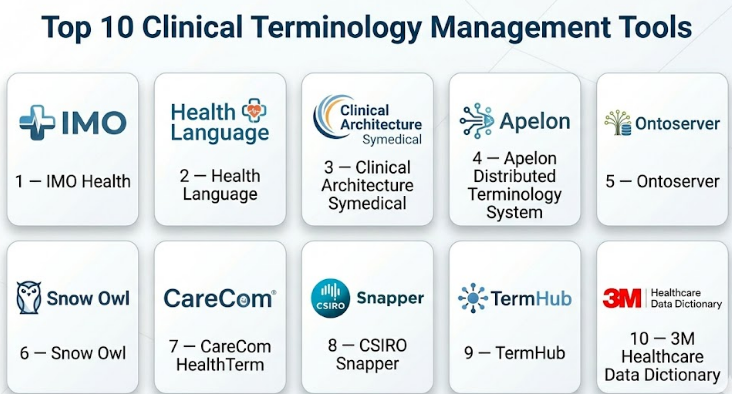
#1 — IMO Health
Short description: IMO Health is a clinical terminology and data normalization platform used by healthcare organizations to improve clinical documentation, coding, interoperability, and analytics. It helps map clinician-friendly terms to standardized codes and supports cleaner clinical data across EHRs and healthcare applications. The platform is useful for hospitals, health systems, EHR vendors, analytics teams, and clinical application developers that need reliable terminology mapping and normalization.
Key Features
- Clinical terminology management.
- Data normalization support.
- Mapping to standard code systems.
- Clinician-friendly terminology.
- EHR and application integration support.
- Search and concept identification.
- Analytics-ready data support.
Pros
- Strong fit for clinical documentation and terminology normalization.
- Useful for healthcare organizations dealing with messy clinical data.
- Supports better coding, reporting, and interoperability workflows.
Cons
- May be more than small clinics need.
- Pricing and packaging should be confirmed directly.
- Best value depends on integration quality with existing systems.
Platforms / Deployment
Web / Varies / N/A
Cloud / Hybrid / Varies / N/A
Security & Compliance
Security and compliance details vary by product and contract. Specific certifications: Not publicly stated.
Integrations & Ecosystem
IMO Health can support EHR, analytics, and clinical application workflows where terminology normalization is needed.
- EHR integration options.
- Clinical documentation workflows.
- Analytics platform support.
- API-based terminology access.
- Mapping to standard code sets.
- Data normalization workflows.
Support & Community
IMO Health generally provides vendor-led support, documentation, onboarding assistance, and customer success resources. Public community strength is limited, but industry presence in clinical terminology is strong.
#2 — Health Language
Short description: Health Language is a healthcare terminology management and data interoperability solution used to manage, normalize, and map clinical and administrative code sets. It helps healthcare organizations improve data quality, coding consistency, analytics, and interoperability across systems. The tool is useful for payers, providers, health systems, and healthcare technology companies that need strong terminology governance and code set management.
Key Features
- Clinical terminology management.
- Code set mapping.
- Data normalization.
- Value set management.
- Healthcare standards support.
- Terminology governance workflows.
- Interoperability support.
Pros
- Strong fit for healthcare data standardization.
- Useful for both provider and payer environments.
- Supports terminology governance and code set management.
Cons
- May require implementation planning.
- Advanced configuration can need domain expertise.
- Public details on some capabilities may vary.
Platforms / Deployment
Web / Varies / N/A
Cloud / Hybrid / Varies / N/A
Security & Compliance
Security details vary by deployment and customer agreement. Specific certifications: Not publicly stated.
Integrations & Ecosystem
Health Language can support terminology workflows across provider, payer, analytics, and interoperability systems.
- EHR and claims system integration.
- Code set management workflows.
- Value set management.
- API-based terminology access.
- Healthcare analytics support.
- Data normalization processes.
Support & Community
Support is typically vendor-led with implementation assistance, documentation, and customer service. Public community strength is limited, but enterprise healthcare terminology support is available.
#3 — Clinical Architecture Symedical
Short description: Clinical Architecture Symedical is a terminology management and clinical data quality platform designed to help healthcare organizations manage code systems, value sets, mappings, and clinical data normalization. It supports interoperability, analytics, population health, and clinical data governance. The platform is useful for hospitals, health systems, public health agencies, and healthcare data companies that need controlled terminology management across multiple systems.
Key Features
- Terminology management.
- Clinical data normalization.
- Value set management.
- Concept mapping.
- Code system management.
- Data quality workflows.
- Interoperability support.
Pros
- Strong terminology governance capabilities.
- Useful for healthcare analytics and interoperability.
- Good fit for organizations managing multiple code systems.
Cons
- May require terminology expertise.
- Implementation can be complex for large environments.
- Smaller teams may find it more advanced than needed.
Platforms / Deployment
Web / Varies / N/A
Cloud / Hybrid / Varies / N/A
Security & Compliance
Security details vary by deployment and contract. Specific certifications: Not publicly stated.
Integrations & Ecosystem
Symedical can connect terminology governance with clinical data quality, analytics, and interoperability workflows.
- EHR integration options.
- Data warehouse integration.
- API-based terminology access.
- Value set workflows.
- Mapping management.
- Clinical analytics support.
Support & Community
Clinical Architecture provides vendor-led onboarding, technical support, implementation guidance, and documentation. Public community strength is limited, but domain expertise in terminology management is strong.
#4 — Apelon Distributed Terminology System
Short description: Apelon Distributed Terminology System is a terminology management solution used to create, manage, map, and maintain clinical terminologies and controlled vocabularies. It is useful for organizations that need strong control over terminology assets, custom vocabularies, mappings, and code system versions. The tool fits healthcare organizations, research groups, public health bodies, and technology teams that need deeper terminology lifecycle management.
Key Features
- Terminology lifecycle management.
- Code system management.
- Concept mapping.
- Custom vocabulary support.
- Version management.
- Terminology publishing.
- Standards-based terminology support.
Pros
- Strong for controlled vocabulary management.
- Useful for organizations needing custom terminology governance.
- Supports complex terminology lifecycle workflows.
Cons
- May require technical and terminology expertise.
- User experience may not be ideal for casual users.
- Implementation needs should be reviewed carefully.
Platforms / Deployment
Web / Windows / Varies / N/A
Self-hosted / Hybrid / Varies / N/A
Security & Compliance
Security details vary by deployment and environment. Specific certifications: Not publicly stated.
Integrations & Ecosystem
Apelon Distributed Terminology System can support terminology governance and integration with healthcare data platforms.
- Custom terminology repositories.
- Mapping workflows.
- Code system management.
- Terminology publishing.
- Data platform integration.
- API or configured connectivity may vary.
Support & Community
Support is generally vendor-led with documentation and implementation assistance. Community strength is more specialized and terminology-focused than broad healthcare IT.
#5 — Ontoserver
Short description: Ontoserver is a FHIR terminology server that supports terminology operations for modern healthcare interoperability. It helps organizations manage and serve code systems, value sets, concept maps, validation, expansion, and terminology APIs. It is especially useful for healthcare technology teams, interoperability programs, public health agencies, and organizations building FHIR-based applications or data exchange systems.
Key Features
- FHIR terminology services.
- Code system support.
- Value set expansion.
- Concept map management.
- Terminology validation.
- API-based terminology operations.
- Interoperability-focused architecture.
Pros
- Strong fit for FHIR-based healthcare systems.
- Good for modern interoperability projects.
- Useful for developers and terminology teams.
Cons
- May require FHIR and terminology expertise.
- Not a full enterprise clinical documentation platform.
- Best value comes in API-driven environments.
Platforms / Deployment
Web / Linux / Varies / N/A
Cloud / Self-hosted / Hybrid / Varies / N/A
Security & Compliance
Security details depend on deployment and environment. Specific certifications: Not publicly stated.
Integrations & Ecosystem
Ontoserver is designed for FHIR terminology workflows and can support healthcare interoperability applications.
- FHIR API integration.
- Value set services.
- Code validation services.
- Concept map workflows.
- Health data platform integration.
- Developer-first terminology access.
Support & Community
Support depends on implementation and vendor agreement. Community strength is stronger among FHIR, interoperability, and health informatics professionals than general healthcare users.
#6 — Snow Owl
Short description: Snow Owl is a terminology server and authoring platform used for managing clinical terminologies, ontologies, code systems, and healthcare vocabularies. It can support SNOMED CT and other terminology assets, making it useful for health informatics teams, terminology managers, and interoperability projects. The platform is a good fit for organizations that need terminology authoring, versioning, validation, and server-based terminology access.
Key Features
- Terminology authoring.
- Code system management.
- Version control.
- Terminology server capabilities.
- SNOMED CT support.
- Value set and concept management.
- API-based access.
Pros
- Useful for terminology authoring and governance.
- Good for informatics and interoperability teams.
- Supports controlled terminology workflows.
Cons
- May require technical setup and domain expertise.
- Not ideal for teams needing only simple code lookup.
- Enterprise deployment details should be validated.
Platforms / Deployment
Web / Linux / Varies / N/A
Cloud / Self-hosted / Hybrid / Varies / N/A
Security & Compliance
Security details vary by deployment and package. Specific certifications: Not publicly stated.
Integrations & Ecosystem
Snow Owl can support terminology repositories, authoring workflows, and API-driven terminology access.
- Terminology server integration.
- SNOMED CT workflows.
- Custom terminology management.
- API-based access.
- Versioned terminology publishing.
- Healthcare data platform integration.
Support & Community
Support depends on vendor package and implementation model. Public community exists around terminology and open health informatics topics, but enterprise support should be confirmed directly.
#7 — CareCom HealthTerm
Short description: CareCom HealthTerm is a terminology management platform used for healthcare data mapping, semantic interoperability, and terminology governance. It helps organizations manage clinical terms, code systems, mappings, and healthcare concepts across systems. The platform is useful for hospitals, health systems, national health programs, and health IT teams that need consistent terminology management and semantic data alignment.
Key Features
- Clinical terminology management.
- Semantic interoperability support.
- Code mapping.
- Concept management.
- Healthcare vocabulary governance.
- Data standardization workflows.
- Terminology services.
Pros
- Strong fit for semantic interoperability.
- Useful for healthcare data standardization.
- Supports terminology governance across systems.
Cons
- May require terminology and informatics expertise.
- Details may vary by deployment and package.
- Smaller organizations may need simpler tools.
Platforms / Deployment
Web / Varies / N/A
Cloud / Hybrid / Varies / N/A
Security & Compliance
Security details vary by product package and deployment. Specific certifications: Not publicly stated.
Integrations & Ecosystem
CareCom HealthTerm can support semantic interoperability and terminology workflows across healthcare systems.
- EHR integration options.
- Healthcare data platform support.
- Mapping workflows.
- Terminology services.
- Standards-based code system support.
- API or configured integrations may vary.
Support & Community
Support is vendor-led with onboarding, documentation, and implementation guidance. Public community strength is limited, but terminology and interoperability expertise is available through the vendor ecosystem.
#8 — CSIRO Snapper
Short description: CSIRO Snapper is a terminology authoring and value set management tool often associated with healthcare terminology workflows and FHIR-based implementation needs. It can help teams create, edit, review, and manage value sets and terminology artifacts. It is useful for informatics teams, standards groups, implementation guide authors, and healthcare organizations working on terminology governance and interoperability projects.
Key Features
- Value set authoring.
- Terminology artifact management.
- FHIR terminology workflow support.
- Review and editing workflows.
- Code system and concept handling.
- Implementation guide support.
- Collaboration support for terminology teams.
Pros
- Useful for value set and terminology artifact work.
- Good fit for FHIR and interoperability projects.
- Practical for standards-focused teams.
Cons
- Not a full enterprise terminology management suite.
- May require informatics knowledge.
- Deployment and support details should be confirmed.
Platforms / Deployment
Web / Varies / N/A
Cloud / Varies / N/A
Security & Compliance
Security details are Not publicly stated.
Integrations & Ecosystem
Snapper can support terminology and value set workflows in standards-based healthcare projects.
- FHIR implementation workflows.
- Value set authoring.
- Terminology review processes.
- Standards development support.
- Code system handling.
- Export and publication workflows may vary.
Support & Community
Support and community strength are strongest among health informatics, FHIR, and standards-focused users. Enterprise support details should be confirmed before production use.
#9 — TermHub
Short description: TermHub is a terminology and value set management platform focused on helping teams search, manage, compare, and maintain clinical terminology assets. It is useful for organizations working with value sets, quality measures, analytics definitions, and clinical vocabularies. The platform can help reduce manual terminology work and improve governance for healthcare data teams, research teams, and informatics groups.
Key Features
- Value set management.
- Terminology search.
- Code system comparison.
- Clinical vocabulary workflows.
- Governance support.
- Analytics terminology support.
- Collaboration features.
Pros
- Useful for value set governance and analytics teams.
- Helps manage terminology assets more clearly.
- Practical for research and quality measurement use cases.
Cons
- May not replace a full enterprise terminology server.
- Integration details should be validated.
- Best fit depends on terminology governance maturity.
Platforms / Deployment
Web
Cloud / Varies / N/A
Security & Compliance
Security details are Not publicly stated.
Integrations & Ecosystem
TermHub can support terminology workflows for analytics, research, value sets, and clinical data teams.
- Value set management.
- Terminology search and review.
- Healthcare analytics workflows.
- Code system comparison.
- Collaboration workflows.
- Export and integration options may vary.
Support & Community
Support details vary. Public community strength is more specialized among terminology, informatics, and healthcare analytics users.
#10 — 3M Healthcare Data Dictionary
Short description: 3M Healthcare Data Dictionary is a healthcare terminology and data normalization solution used to support consistent clinical data across systems. It helps organizations map local terms to standard vocabularies and improve data quality for analytics, reporting, clinical decision support, and interoperability. It is useful for hospitals, health systems, and healthcare data teams that need stronger consistency across clinical systems and reporting environments.
Key Features
- Clinical terminology mapping.
- Data normalization.
- Standard vocabulary alignment.
- Healthcare data dictionary support.
- Interoperability support.
- Analytics-ready data preparation.
- Clinical concept management.
Pros
- Useful for healthcare data normalization.
- Supports consistent terminology across systems.
- Good fit for analytics and reporting workflows.
Cons
- May require healthcare data expertise.
- Product packaging and availability may vary.
- Security and deployment details should be confirmed.
Platforms / Deployment
Web / Varies / N/A
Cloud / Hybrid / Varies / N/A
Security & Compliance
Security and compliance details vary by deployment and agreement. Specific certifications: Not publicly stated.
Integrations & Ecosystem
3M Healthcare Data Dictionary can support clinical data mapping, reporting, and interoperability workflows.
- EHR data integration.
- Data warehouse support.
- Clinical analytics workflows.
- Standard vocabulary mapping.
- Reporting system support.
- Healthcare data normalization.
Support & Community
Support is typically vendor-led with customer service, documentation, and implementation guidance. Community strength is more enterprise healthcare-focused than public developer-focused.
Comparison Table
| Tool Name | Best For | Platform(s) Supported | Deployment | Standout Feature | Public Rating |
|---|---|---|---|---|---|
| IMO Health | Clinical terminology normalization | Web / Varies | Cloud / Hybrid / Varies | Clinician-friendly terminology mapping | N/A |
| Health Language | Code set and terminology governance | Web / Varies | Cloud / Hybrid / Varies | Healthcare code set management | N/A |
| Clinical Architecture Symedical | Clinical data quality and terminology governance | Web / Varies | Cloud / Hybrid / Varies | Data normalization and value set management | N/A |
| Apelon Distributed Terminology System | Custom terminology lifecycle management | Web / Windows / Varies | Self-hosted / Hybrid / Varies | Controlled vocabulary management | N/A |
| Ontoserver | FHIR terminology services | Web / Linux / Varies | Cloud / Self-hosted / Hybrid / Varies | FHIR-based terminology APIs | N/A |
| Snow Owl | Terminology authoring and server workflows | Web / Linux / Varies | Cloud / Self-hosted / Hybrid / Varies | Terminology authoring and versioning | N/A |
| CareCom HealthTerm | Semantic interoperability | Web / Varies | Cloud / Hybrid / Varies | Healthcare semantic terminology governance | N/A |
| CSIRO Snapper | Value set authoring | Web / Varies | Cloud / Varies | FHIR-friendly value set workflows | N/A |
| TermHub | Value set and terminology asset management | Web | Cloud / Varies | Terminology search and governance | N/A |
| 3M Healthcare Data Dictionary | Healthcare data normalization | Web / Varies | Cloud / Hybrid / Varies | Clinical data dictionary and mapping | N/A |
Evaluation & Clinical Terminology Management Tools
| Tool Name | Core (25%) | Ease (15%) | Integrations (15%) | Security (10%) | Performance (10%) | Support (10%) | Value (15%) | Weighted Total |
|---|---|---|---|---|---|---|---|---|
| IMO Health | 9 | 8 | 8 | 7 | 8 | 8 | 7 | 7.95 |
| Health Language | 8 | 7 | 8 | 7 | 8 | 8 | 7 | 7.65 |
| Clinical Architecture Symedical | 9 | 7 | 8 | 7 | 8 | 8 | 7 | 7.90 |
| Apelon Distributed Terminology System | 8 | 6 | 7 | 7 | 8 | 7 | 7 | 7.20 |
| Ontoserver | 8 | 7 | 9 | 7 | 8 | 7 | 8 | 7.80 |
| Snow Owl | 8 | 7 | 8 | 7 | 8 | 7 | 8 | 7.65 |
| CareCom HealthTerm | 8 | 7 | 8 | 7 | 8 | 7 | 7 | 7.50 |
| CSIRO Snapper | 7 | 8 | 7 | 6 | 7 | 7 | 8 | 7.15 |
| TermHub | 7 | 8 | 7 | 6 | 7 | 7 | 8 | 7.15 |
| 3M Healthcare Data Dictionary | 8 | 7 | 8 | 7 | 8 | 8 | 7 | 7.65 |
These scores are comparative and should be used as a starting point, not as a final buying decision. A tool with a lower score may still be the best fit if it matches your terminology governance model, technical environment, and standards needs. Enterprise terminology platforms usually score higher on depth and support, while FHIR-first tools may score higher for modern API-based interoperability. Always validate terminology coverage, integration quality, security controls, and workflow fit before selection.
Which Clinical Terminology Management Tool Should You Choose?
Solo / Freelancer
Solo consultants, terminology advisors, or independent healthcare data specialists may not need a large enterprise terminology platform. They should focus on tools that help with value set review, terminology lookup, mapping support, and standards-based workflows. TermHub, CSIRO Snapper, or similar focused tools may be practical for smaller terminology and informatics projects.
SMB
Small and mid-sized digital health companies, clinics, and healthcare technology teams should prioritize ease of use, API access, terminology coverage, and integration with existing systems. Ontoserver, Snow Owl, TermHub, and Health Language may be suitable depending on whether the need is FHIR terminology service, value set governance, or data normalization.
Mid-Market
Mid-market healthcare organizations usually need stronger governance, better mapping workflows, support for multiple code systems, and integration with analytics or EHR environments. IMO Health, Health Language, Clinical Architecture Symedical, CareCom HealthTerm, and 3M Healthcare Data Dictionary can be strong options depending on the specific use case.
Enterprise
Large health systems, payer organizations, EHR vendors, public health agencies, and national programs should focus on scalability, terminology governance, APIs, security, auditability, standards support, and data normalization depth. IMO Health, Health Language, Clinical Architecture Symedical, Ontoserver, Snow Owl, Apelon Distributed Terminology System, and 3M Healthcare Data Dictionary are stronger enterprise options.
Budget vs Premium
Budget-focused teams should avoid buying a broad enterprise platform if they only need value set review or basic terminology support. Focused tools may be more cost-effective. Premium buyers should prioritize governance depth, integration maturity, standards coverage, support, and long-term scalability.
Feature Depth vs Ease of Use
Enterprise platforms often provide stronger mapping, governance, and normalization capabilities, but they may require more planning and terminology expertise. Lightweight value set and terminology tools may be easier to start with but may not support complex enterprise governance needs.
Integrations & Scalability
Clinical terminology tools should connect with EHRs, data warehouses, interoperability platforms, FHIR servers, analytics tools, claims systems, and quality reporting systems. Scalability matters because terminology assets grow over time, especially when organizations manage multiple code systems, mappings, value sets, and local vocabularies.
Security & Compliance Needs
Healthcare organizations should review role-based access, audit logs, data encryption, authentication, backup, user activity tracking, and access governance. Even when terminology data itself is not always patient-identifiable, these systems often connect to sensitive healthcare workflows, so security review is still important.
Frequently Asked Questions
1. What are Clinical Terminology Management Tools?
Clinical Terminology Management Tools help healthcare organizations manage medical vocabularies, code systems, mappings, value sets, and terminology services. They make healthcare data more consistent, searchable, and interoperable across systems.
2. Why are clinical terminology tools important?
They help reduce confusion caused by different systems using different words for the same clinical concept. This improves interoperability, reporting, analytics, clinical decision support, and data quality.
3. What standards do these tools usually support?
Many tools support standards such as SNOMED CT, ICD, LOINC, RxNorm, CPT, HCPCS, and FHIR terminology resources. Exact support varies by vendor and package, so buyers should confirm coverage before purchase.
4. What is terminology mapping?
Terminology mapping connects one code or term to another equivalent or related concept. For example, a local lab code may be mapped to a standard LOINC code to support reporting and interoperability.
5. What is value set management?
Value set management is the process of creating, maintaining, reviewing, and publishing groups of codes used for reporting, quality measures, clinical decision support, and interoperability. Good value set management improves consistency and governance.
6. How much do these tools cost?
Pricing varies widely based on users, terminology packages, deployment model, API volume, support level, and enterprise requirements. Many vendors provide custom pricing rather than public pricing.
7. Can these tools integrate with EHR systems?
Yes, many clinical terminology tools can integrate with EHR systems, data warehouses, FHIR servers, and analytics platforms. Buyers should validate API support, standards compatibility, and workflow fit before selection.
8. Are these tools only for hospitals?
No. They are used by hospitals, payers, public health agencies, research groups, EHR vendors, analytics companies, digital health platforms, and interoperability teams.
9. What common mistakes should buyers avoid?
Common mistakes include ignoring governance workflows, underestimating mapping complexity, buying a tool without checking standards coverage, and failing to involve clinical informatics, IT, analytics, and compliance teams early.
10. Do these tools support FHIR?
Some tools strongly support FHIR terminology services, while others focus more on mapping, data normalization, or terminology governance. Buyers should confirm support for code systems, value sets, concept maps, expansion, validation, and APIs.
Conclusion
Clinical Terminology Management Tools are essential for healthcare organizations that need clean, consistent, and interoperable clinical data. The best tool depends on your environment, standards needs, data quality goals, integration requirements, and governance maturity. IMO Health, Health Language, Clinical Architecture Symedical, and 3M Healthcare Data Dictionary are strong options for terminology normalization and enterprise healthcare data quality. Ontoserver and Snow Owl are strong choices for FHIR terminology services, terminology authoring, and API-driven interoperability. Apelon Distributed Terminology System, CareCom HealthTerm, CSIRO Snapper, and TermHub can support more specialized terminology governance, value set, and standards-focused workflows.
